I think the the scientific approach is to use the best data you have at a given time and update your understanding as you get new data. You make a lot of big claims that contradict multiple specific studies with published results. It's clear you hope that the epidemic is over (as we all do). But hope isn't enough.
To quote Derek Lowe [1], a scientist working in drug discovery:
"Everyone will have seen the various population surveys with antibody testing that have suggested, in most cases, that a rather small percentage of people have been exposed. Think of the various ways you could get such a result:
(1) it’s just what it looks like, and most people are unprotected because they have so far been unexposed.
(2) the antibody results are what they look like – low exposure – but people’s T-cell responses mean that there are actually more people protected than we realize.
(3) the antibody results are deceiving, because the antibody response fades over time, meaning that more people have been exposed than it looks like.
(3a) the antibody response fades, but the T-cell response is still protective
(3b) the antibody response fades and so does the T-cell response. That last one is not a happy possibility."
So we essentially have 4 plausible scenarios that explain our best study results. We all hope it's (2) or (3a). But I wouldn't say that we have a lot of actual evidence to prove that yet.
[1] https://blogs.sciencemag.org/pipeline/archives/2020/06/22/th...
My objection was that many early predictions disregarded this null hypothesis and only looked at preliminary data thereby discarding everything we've learned about RTIs in the past 200 years. That's how you end up with predictions that are off by 1000x or more. That is a huge blunder, and really inexcusable.
You say we don't have a lot of actual evidence yet, but I think we do. For instance we see that Sweden that didn't lock down has practically indistinguishable All Cause Deaths outcomes as the neighboring Nordics[1]. Many predicted that Sweden would have catastrophically worse outcomes but it hasn't. How is that possible when clearly the virus is spreading freely in Sweden but the outcome isn't any worse? Locking down a country 5 months into the Flu season is completely pointless because by that point too large a percentage of the population is infected already, so you wouldn't expect that to make any kind of meaningful difference. And that's consistent with the data. In the VS abnormal deaths were at a 6-year high in November[2]! The notion that Covid19 was contained for --months-- in China is an absurdity, given how much we travel by air. Antibodies were also found in sewage from December all over Europe, which proves beyond a doubt that virus spread without us even realizing it for months! If I had more time I could give you countless more sources, but the evidence clearly points in one direction: New coronavirus just like other known coronaviruses.
[1] https://pbs.twimg.com/media/EZlnYQCU0AA0jkv?format=png&name=...
[2] https://pbs.twimg.com/media/EZNQ9arUEAAS9W9?format=png&name=...
> For instance we see that Sweden that didn't lock down has practically indistinguishable All Cause Deaths outcomes as the neighboring Nordics[1].
Sweden had very high excess mortality compared to its neighbors and is still showing abnormally high. For Norway and Finland the numbers remained flat. Your plot sums up the entire winter and stops at week 18! It's decidedly not fine-grained enough to judge lock-down effects.
> New coronavirus just like other known coronaviruses.
Even for younger people we haven't seen a peak in deaths like that in a while. Looking at Euromomo the age bracket 15-44 years saw a 15% increase in deaths during a whole month. An unprecedented increase in the last five years. We don't know how much worse the numbers would be without lock-down. And it's not over yet.
Please don't say that the virus is "just like other coronaviruses". Most of them are benign and not even tracked that much. So we know little about them. SARS-Cov2 can well be compared to SARS-Cov which is extinct. Luckily.
Euromomo data is preprocessed data and not suitable for analysis. Get the raw all cause mortality statistics (by age group if possible) directly from each country health agency, and use that instead.
I'm not aware of a flaw in the Euromomo collection. Why discount it? I think they're more competent at collecting death-tolls than I am. What would be the benefit of me collecting the numbers myself?
Do you disagree with my estimate of 15% excess mortality in the 15-44 age-bracket? Or do you know of a Coronavirus epidemic in the past that had a comparable effect?
The most recent phylogenetic analysis on 7000+ viral sequences from isolates points at the end of October as a possible date.
Can you source this claim?
That's one.
And CDC data shows that Covid was already widespread in October 2019:
https://pbs.twimg.com/media/EZNQ9arUEAAS9W9?format=png&name=...
With a spike in abnormal deaths 24 days later in November. For covid deaths to be clearly visible in November it must have been widespread a month before that, and starting its spread around September.
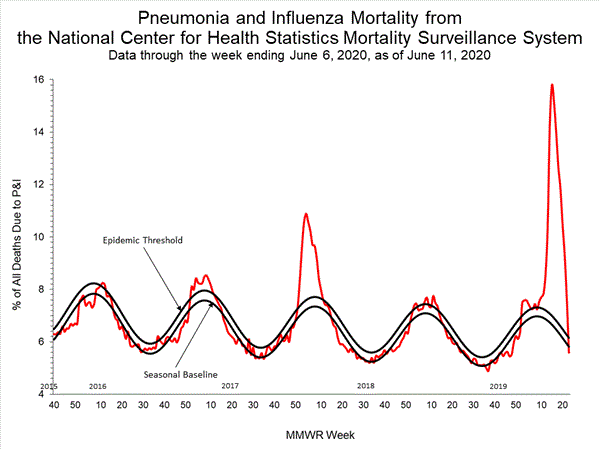
COVID emphatically was not circulating in numbers in november. We would have noticed, same as the chinese did, from the massive increase in pnuemonia clusters. Genetic analysis backs this up. You don't know what you're talking about, again.
Absolutely not. The scientific approach is to look at the new disease and see how it compares to other similar RTIs. For instance, covid19 was discovered around October at the start of the seasonal flu season in the northern hemisphere and it was a coronavirus, which makes it 95% likely to be strongly seasonal, highly infectious, and mild. It also should lead us to assume that exposure to prior viruses gives (some) protection, and that the elderly and immunocompromised are the most at risk. In addition, we know that diseases like this spread highly unevenly (powerlaw distribution) with a small number of big hotspots and many places that are left largely unaffected.
This is the BASELINE SCENARIO, based on the knowledge we have of hundreds of similar respiratory infections. Covid19 could be a different animal, but for that we'd have to carefully look at the data.
But what did we do? We took seriously the doom-saying of scientists that extrapolated from comically unrepresentative cruise ship data and other hot spots. This is junk science, because data from a hot spot doesn't say --anything-- about how infectious a hotspot disease is or how deadly, except that it's possible for people to die from it, but that's also entirely unsurprising for a RTI.
> At the peak of this epidemic in hard-hit places like the UK, something like only 1 in 400 people are known to have been infected at a time.
Impossible. Covid reached Europe by December, and has spread like wildfire since.
> Many younger people (as much as 70%) show absolutely no symptoms when they are infected.
Oh no, way more than 70%. How many kids got visible symptoms? Close to zero. And many got infected because the virus is absolutely everywhere. At least 70% of people in the 50-65 age group have no visible symptoms, so for young people the number must be drastically higher.
> The disease is astronomically worse for elderly people.
All cause mortality isn't high worldwide. We had two mild flu seasons in a row and that left us with many elderly with a negative life expectancy.