I'm a bit hesitant to compare to either of them because I can't read the local news. That being said, didn't Sweden go with a lockdown-lite policy?
The Sweedes do have the freedom to die from COVID-19 because public health orders are affronts to their liberty.
EDIT And the lockdowns are threatening something like 265 million people experiencing famine [0]. "flag-wrapped know-betters demand Golden Corral reopen for buffet service" is trivialising a serious thing here; the economy isn't a nice-to-have. It is the major generator of all the prosperity that exists in the world. It is too complicated for me to understand causes and effects, but if it doesn't start back up again ASAP the hurt will get worse.
[0] https://www.theguardian.com/global-development/2020/apr/21/c...
Locally, I see city and county governments taking a tack of making slightly differing decisions regarding what to open and keep closed. For example, my city is keeping parks and playgrounds closed; the county is doing the opposite? Why? each other's data shows the historical use trends and such data plays a large part in making reasonable, responsible descisions.
BTW, I'm in Georgia (US state); while the national media makes it out like we're backwoods country idiots, our local governments are very effective in making reasonable choices. Plus the vast marjority of folks are wearing masks and self-distancing. Most people aren't stupid. They only want the freedom to start their lives back up, plus not depend on the state and national governments for their very survival.
I don't think demand will immediately return to 100%, but I think quite a few people are itching to get out and spend money and enjoy life. Maybe not in some areas, but most of the country is probably ready to go.
Keeping things shut down isn't going to help these people get back to work.
When you need those jobs created by reopening to get people back to work and closer to the point of having disposable income again.
This isn't pure chicken & egg, since consumer debt is tightening up while business debt is getting cheaper. Plus the only way we're going to alleviate fear is by opening and seeing what happens.
Even testing vaccines will require that leap of faith at some point. After all, what good would a clinical trial be if the patient quarantined during it?
Not to mention that they've been heavily criticized for mishandling the lockdown.
Sweden never closed down, and Germany is in the midst of reopening. As to the safety net—there is no evidence that safety net has made a difference. (I’m part, I suspect, because the Us already has a comprehensive safety net for the elderly population that is mainly affected by COVID-19). The death rate in the US, per 100,000 people, is well below that of Sweden. It’s also far lower than the death rate in countries with well developed safety nets like France and Italy.
I strongly suspect that people in Germany/Sweden, etc., have more trust in their government because the people themselves are simply less far apart. To pick a controversial but illustrative example: in Germany the outside limit on abortions is 12 weeks—shorter than in any US state. (Excepting a few “heartbeat law” states where the laws have not yet taken effect.) But within that period, abortions are generally available. No such compromise is possible in America. The right is currently focused on ending abortion entirely, while the left is trying to extend abortions into the third trimester (which are pretty much unprecedented in Europe). Or take taxes. Many in the right want to dismantle the existing tax system. But on the left, they treat lowering corporate taxes to the same level as Sweden or Germany (and France and Canada, etc.) not merely as bad policy, but as an affront to morality and decency.
The same is true for COVID-19. In every European country, there is a grown up debate about balancing health and safety with the need to reopen the economy. The American left, meanwhile, has condemned even the idea of such balancing as racist, classist, colonialism, what have you. The left greeted travel bans—which countries from Germany to New Zealand to Denmark have imposed to great effect—as manifest racism and xenophobia. They’re not talking about reopening, as Europe is already doing, but sheltering in place through the rest of 2020. The right, meanwhile, is shouting “give me liberty or give me death.” There is no trust because everybody is crazy, and everybody hates each other, and we should give up being one country and disband the union already.
You seem to forget that in France & Germany, people go to the Netherlands or Spain for abortions after 12 weeks. It’s not a « compromise », it’s just a 1970s law that hasn’t been changed because conservative groups are annoying.
For the European audience: the shortest abortion period that is currently in effect in the US is Mississippi’s at 20 weeks: https://www.guttmacher.org/sites/default/files/922-3.jpg. Shorter ones have been proposed but have been stayed pending litigation. Most of the deep south is close to the Netherlands line at 22 weeks. Most of the blue states limit up to viability, which can be up to 28 weeks. 7 states have no limit whatsoever. (Note that I’m not taking a position in what’s right; I’m just describing how various countries have addressed a divisive issue.)
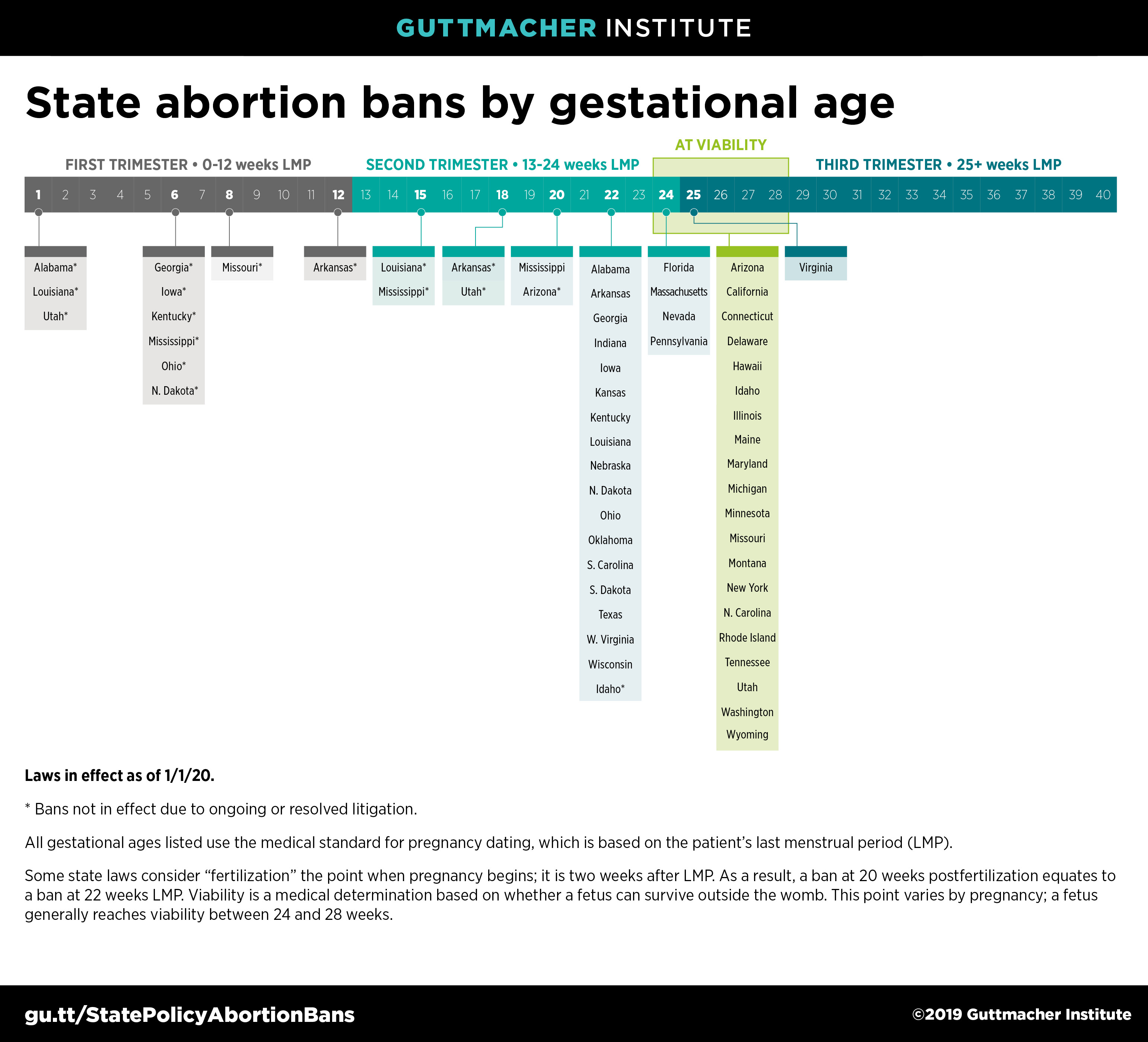
As to “conservative groups” being annoying—that makes it sound like something the majority agrees with but they just haven’t gotten around to updating the law. In fact, the dominant party in both France and Germany has opposed lengthening the current periods. The woman Angela Merkel hand-picked to be her successor as leader of the CDU is against abortion entirely, like many in the CDU. Merkel has maintained the status quo precisely as a compromise between her party and the more liberal parties in Germany.
Despite what you've listed, there are other laws on the books that make operating one nearly impossible - they can't be located within a mile of a school, they need to have admission powers at a hospital, etc, etc.
Apart from that, those restrictions are part of my point. Germans have achieved a compromise, involving fairly high paper requirements for getting an abortion—including limiting most abortions to the first trimester and requiring counseling and a waiting period. German state-sponsored health insurance also generally does not cover abortions absent medical necessity. But the other side of the compromise is that, once those requirements are met, the procedure is relatively accessible.
In the US, the German compromise would be unthinkable to both sides. Here, the battleground for the right is laws limiting abortions to six weeks and abusing zoning laws to shut down clinics. The battleground for the left is things like public funding (not universal in Europe), making third trimester abortions a matter of discretionary medical judgment (highly unusual in Europe), and eliminating medical providers’ rights to refuse to perform abortions for conscience or religious reasons (a right that is nearly universal in Europe).
That seems like a mighty big next step and one that many of "not-so-friendly" countries would want the US to take.
So... in the UK we have the Daily Briefings about covid. Each time I listen to it I hear politicians (they take it in turns) to come out and give us a fucking performance, projecting their voice, projecting (they think) 'calm' and 'competent' and 'in charge of it all' while they spew words for 15 or 20 minutes which could have been given in 5 at the most.
Then it's time for questions from journalists. Which get answered if convenient or if inconvenient they'll answer a question that wasn't asked, all the fucking while spinning to make themselves look like they've not made a series of serious mistakes.
And each time I hear it my confidence in their competence drops further.
And they've no idea why. They don't seem to understand respect is earned.
The only reason politicians are deferring to experts is they've realised experts are actually useful whereas before they didn't like them (something about the time for experts is over, something like that, can anyone recall?)
Conversely you haven't touched on the fact that the buggers are constantly spinning, deferring blame for not getting enough PPE, plain deceit about the number of tests done etc.
The UK has not done well. That was avoidable. If you defend that, you let the responsible ones off the hook and they will do it again.
Michael Gove said, during the Brexit referendum, that "people in this country have had enough of experts".[1]
-- [1] https://www.ft.com/content/3be49734-29cb-11e6-83e4-abc22d5d1...
In a later interview [1] he said this:
"When I was being interviewed on Sky by Faisal Islam, he put it to me that there were a number of economists and organizations of economic prestige that questioned the arguments for leaving the European Union and said that it would be a mistake if we did. I countered it by saying people have had enough of experts from organizations with acronyms that have got things so wrong in the past. And Faisal Islam, as a skilled interrogator, cut me off half way, so while I completed my sentence he took the first half and said ‘people have had enough experts?’ and used that as a fencing posture in the interview itself."
[1] https://www.chathamhouse.org/expert/comment/michael-gove-tro...
The politicians aren't deferring to experts with evidence. They are setting up the experts to be the fallguys for their political missteps.
"We were just following the science" is their excuse when held to account for poorly executed political actions.
> "Protect the NHS" ffs.. how about protect the population?
protecting the NHS IS protecting the population. If you have a better idea of how to protect the population - note that we have had nearly 2 months of government-mandated lockdown based on scientific advice (though taken too late) - then suggest it.
> The politicians aren't deferring to experts with evidence
Yes they are, finally.
> They are setting up the experts to be the fallguys
No they're not and they know it wouldn't work anyway.
I tried to make a justified criticism but yours is just plain destructive cynicism.
I recommend talking to some people instead of parroting the pictures you see in the news.
Is the quantity of risk identical to all populations?
The answer is no. But people like you never mention this.
I'm curious:
What is, in your opinion, the trigger for reopening? What metric? Is that metric at a city, county, or state level?
I'd like to hear specifics, because I have yet to hear them from the cowardly ass covering politicians who say there is no cost that can be put on a human life. The same people who choose not to put a guardrail on a dangerous rural road because the cost isn't worth the number of lives lost per year on said road.
Well ask me something about it and I'll answer it (or tell you if I don't know). There are a million things I haven't mentioned. Just like you. We're not writing dissertations on COVID-19 here. I can only address so many things that I find relevant to the discussion.
What are you even expecting me to say about this? Of course the elderly and the vulnerable are worse off. How is that against anything I was saying? I was suggesting we make more economic impact payments rather than pack together into a crowd and protest. Does it look like there was some obvious connection between that and people's age that I somehow deliberately omitted and that would've hurt my argument? If so please enlighten me and I'll address it.
Meanwhile the one thing I don't hear from "people like you" (since you like painting people with one broad stroke like that) is a single acknowledgment that the experts might know more than you (and me), and this isn't about your opinion vs. mine. Which is funny, though not in a humorous way. To you nobody knows what they're doing. To us, there are people who know what they're doing somewhat better than us laypeople, so we're trying to at least give them and their opinions that much credit and weight.
> What is, in your opinion, the trigger for reopening? What metric? Is that metric at a city, county, or state level? I'd like to hear specifics, because I have yet to hear them from the cowardly ass covering politicians who say there is no cost that can be put on a human life
Well that might be because you haven't been listening to them. I know Cuomo has answered your question quite precisely... same guy whom you're mocking for saying every life is priceless. He said (and this is not his opinion or mine, this is the opinion of the experts advising him) that when the infection rates become constant (i.e. when the derivative reaches 0), you can start to reopen. That is the trigger. https://www.youtube.com/watch?v=jyOnfK_UMV4&t=4m38s
Also, FYI, experts have put costs on human life and they have come to the conclusion (sorry if this isn't what you're hoping to hear) that it's very much worth it to shut down the economy. If you're interested, listen here. I imagine you'll disagree anyway (the experts are blind etc.) but at least you can't accuse them of not having tried to do the analyses that you appear to believe you have done. https://www.npr.org/transcripts/835571843
You are correct. I don't know all of your opinions on this virus response, and shouldn't have characterized it so.
In that note, I certainly don't HOPE to hear anything from experts. I just want to make sure the experts are being consulted on all sides, to better weigh the costs vs. the benefits.
Regarding the NPR article you sent, a rather grim detail that I didn't see addressed in that conversation (but maybe I missed it!!) is how that valuation changes for people when they are near the end of their life.
Is a person's life more "valuable" (putting it in the harsh aspects of policy decision making, that frankly cause me great discomfort) if they are younger, and in prime earning years, than a person in a nursing home who has a rich social life with their grandkids and other patients in their assisted care facility?
It's a horrible thing to try to quantify things that, to me, are objectively valuable, and even sacred. However, our decisions are doing just that, but on the side of people at highest risk vs. others.
I've just come back from my barber after her shop reopened. She's not the owner, just an employee. The visit was very interesting.
I had to wait outside, and a woman (87 years old, but looked MUCH younger) came out of the shop. My son and I both were wearing masks and keeping distant, but we spoke to her and asked how she was. It was her first time leaving her facility since the lockdown, and she told us a good friend of hers had died of the virus. She was a wonderful person to talk to, and had visited my same stylist for years.
My stylist/barber (she is licensed for both in my state) then told me she is leaving the state and moving back to the east coast. Her husband is a mechanic, and they have been financially ruined by this. She applied for benefits right away, but only received them 3 days before the shop was allowed to reopen. She has 3 children, 1 of them special needs. They are good working class people, but they didn't have the savings to weather this shut down, and now have to move in with family on the east coast. Today was my last time seeing her. She'll be gone in 2 weeks.
She expressed frustration at not being able to have the shop opened weeks ago in a controlled manner, with her and the owners radically changing how they operate the business to protect the high-risk populations. She stated that the high cost of housing here also exacerbated the issue, so it's not 100% covid, but the shutdown, she said, was the tipping point. She and her family are all alive, and I'm hoping they do ok on the east coast, but I thought this little visit to the barber shop captured an interesting moment. BTW, when she applied for her unemployment benefits in Colorado, an apalling thing with the legislation: Her tip income, which is 40% of her total, was legally not included with her unemployment payout. So she got a reduced amount of what she normally earns, AND she got it late. Other states probably did a far superior job, but I don't have any ideas if that's the case.
This whole thing is a tragedy, one way or another.
Yeah you did miss it. The question is asked directly ("Did we factor in the age...?") answered quite directly ("Valuing people differently was kind of tried once in 2003..."). I would suggest listening to the whole thing. It's quite eye-opening.
> She expressed frustration at not being able to have the shop opened weeks ago in a control+the owners radically changing how they operate the business to protect the high-risk populations.
It must be incredibly frustrating. I do imagine if she'd gotten checks in the mail to keep life her going, she'd have appreciated that at least as much as having to come to work in the middle of the pandemic, if not more.
> BTW, when she applied for her unemployment benefits in Colorado, an apalling thing with the legislation: Her tip income, which is 40% of her total, was legally not included with her unemployment payout. So she got a reduced amount of what she normally earns, AND she got it late. Other states probably did a far superior job, but I don't have any ideas if that's the case.
This is yet another reason why we need to get rid of tipping and just pay people better instead. And why we need to just mail everyone a check for the pandemic instead of having them rely on unemployment benefits.
> This whole thing is a tragedy, one way or another.
It is definitely a tragedy. However it doesn't need to be this much of a tragedy. If they sent people payments and changed laws accordingly then at least the only thing ruining lives would be the virus, not the economy. It's very tough to say the alternatives people are fighting about are all equally awful with equal certainty here.
Earning a living vs being provided one isn't even really the issue.
> I don't think you're accurately representing what the protesters are angry about. Earning a living vs being provided one isn't even really the issue.
I'm sorry, I was just replying to what you wrote, and you were telling me that the issue is earning a living. Now you changed your argument entirely. So you're saying this isn't even about making a living then, given that paying people would clearly solve that problem? That means you're concluding it's really a political protest then? Isn't that a pretty strong, rational reason for everyone else to actively ignore the protesters in that case? Rather than "show a little more compassion" for something they're not protesting about?
And it's not only about the paycheck/stimulus check. Its also about going out to eat, going to the movies, enjoying life. A stimulus check doesn't compensate for this.
I can't recall meeting many people who get substantially more conservative with age, but I do know many who shift more liberal. I believe there is a correlation with open-mindedness.
You haven't been to a Trump rally and visited with people waiting in line, have you? Lots of people at them have crossed the party lines.
In addition, for the most part, folks in the US want to return to work. The vast majority find pride and comfort in work, even if they bitch about. They know eventually the payouts will come back out of their pocket.
The mixed signals from the CDC and governmental agencies add to the confusion (everything is fine/stay inside until a vaccine is available, don't wear masks/cover up you face once you step outside, etc.) only add to the feeling the government really dosn't have a clue.
I'm confused. I was saying people could demand more money instead of going back to work... precisely because the $1200 they got clearly wasn't enough (like you also said) and because clearly going back to work is otherwise riskier. You just jumped from "$1200 isn't enough" to "the only solution is to go back to work"?
I would not be opposed to constituents showing up at the personal homes of Congressional representatives to protest, but that requires resources as well.
OWS protests resulted in zero legislation. Zero.
I can go to a superstore which is deemed essential because it sells groceries and buy all sorts of items that specialty stores aren't able to sell me because they're closed. any member of the public can enter these superstores with no screening whatsoever. The small business owners would screen customers much more effectively than a large store would.
It's almost like we've taken steps that are arbitrary in nature and aren't actually scientifically valid because we don't have enough data on this virus and how it actually spreads. these arbitrary measures are then doubled down upon by the local governments in the name of preserving their authority and looking good to the press.
what really bugs me is the level of certainty that people seem to have about this. I'm coming from a position of uncertainty. Anyone being honest right now is doing the same.
Look at your comment: you are absolutely certain that a dubious at best chance of economic survival for small businesses is being traded against a certain chance of a public health crisis. I don't think you're being honest with yourself with a level of certainty like that. You're just like the rest of us flying blind, but you are just positive that you are right and that businesses should be closed to support your preconceived notions.
It's real easy to do that when you have a job that allows you to work remotely. It's not costing you anything just let those Walmart shopping losers go out and deal with the unemployment system. In the meantime a percentage of all of our tax dollars goes to paying off interest on the national debt and that percentage is going to have to increase as a result of this.
I'm not a moron or a science denier. I'm fine with taking on debt to the degree necessary to maximize public health. But there are multiple dimensions to public health not just this virus. My brother's business is in jeopardy and it was growing fast before this pandemic hit. Now I'm deeply concerned that he's going to fall back to an addiction that he beat 10 years ago. That's a tiny story that represents something that's going to happen in this country when young people who would otherwise be unaffected by the virus or going to suffer economic calamity.
By the way my brother always voted Democratic. Due to the false partisan positioning of opening versus reopening pushed by the media, he is now never going to vote Democrat again and plans to vote for Trump in November. He voted for Clinton last time think about that.
In the meantime people on keyboards who were going to vote for Biden anyway are now pushing policies that are going to hand this election to Trump. Maybe the elderly will carry Biden since many appear to be switching their votes. But when they're dead in a few years the young people who have lost their businesses will still be voting. It's not going to go well.
At a high level though: surely you understand not everything is equally uncertain here, and that not everything is being flown blindly? We have like 200 other countries in the world to observe and draw conclusions from, both socioeconomically and medically. We have ourselves to draw conclusions from, given the preceding shutdown and its effects. And we have experts who know and analyze quite a bit more than either you or me being quite united in their opinions. You can't seriously be so confident that their opinions are just coin tosses in a vacuum, come on. Especially not when you're the one preaching uncertainty!
"At a high level though: surely you understand not everything is equally uncertain here, and that not everything is being flown blindly? We have like 200 other countries in the world to observe and draw conclusions from, both socioeconomically and medically. "
Yes, you are 100% correct, and I appreciate you taking a charitable view of my comment.
The issue I see here is that the 200 countries we can observe provide a massive stream of data that then gets applied through a tribal filter.
Those who advocate for continued, strict shutdowns look at Sweden and compare it to Finland/Norway negatively. Those who advocate for moderated, easing shutdowns for economy look at Sweden and compare it to other countries with internationally connected economies in Europe in a positive framing.
I see this constantly playing out, with endless justifications/explanations for why "I'm still right."
"They had more testing, and they are better people and can be trusted to wear masks, so no, we're not like South Korea"
"The Swedes are culturally less individualist, and can be trusted more"
"Georgia and Texas are going to be disasters. It hasn't been a full 2 weeks, but just wait, the incubation period..."
I'm on pretty solid ground here. The costs of poverty and economic collapse are arguably better researched than pandemics.
And it is hard not to be disgusted by the attitude of many people on HN, who are least affected by this.
Having some relatives in that part of the country, I would compare this to the dust bowl. A complete economic collapse that will over the next year require millions of people to flee to cities, as they have absolutely nothing left. What are people supposed to do when every single business has gone from their town?
But people here like to sneer at these "stupid rednecks" that are clearly not as smart as us, right?
> But people here like to sneer at these "stupid rednecks" that are clearly not as smart as us, right?
Wow. You're putting a lot of words in people's mouths.
That's also quite a bit coming from someone who just claimed such confidence in his own prediction of the future. I assume this means you're more of an expert in this than the ones in the government we're all familiar with and who are predicting the opposite?
But in case you're actually interested in what actual experts (not me) think about the whole "minimizing harm" thing, you might enjoy reading/listening to this, which evaluates at what point it's worth shutting down the economy. It might shake your solid ground: https://www.npr.org/transcripts/835571843
I realize, of course, I am shouting into the wind. I understand that it isn't actually about the economically underprivileged, because we'd write the checks. And it isn't actually about the Small Business Owner--service industry small business owner checking in, doing fine, thanks--being threatened, because we'd write the checks. It's about something much darker and much more mendacious and the rhetoric that is so readily adopted by useful idiots who want their haircuts or whatever.
We will have to come to grips with the understanding that in many parts of modern America it is more acceptable to have Grandma drown in her own goddamned lungs than it is to just write the checks.
And that is the downfall of civic society before all else.
This is a generality and of course it's more nuanced than just this, but "spend in bad times, tax in good times" is a reasonable place to start. Where we have problems is that the "tax in good times" side of this keeps getting dropped for one reason or another. Cynically, I notice that this "for one reason or another" coincides strongly with a particular political party being elected once good times are back so that they can proceed to drive it off the nearest hillside yet again and somehow blame "government" for it.
I mean, I'm not arguing about how to avoid inflation. My question is about the debt being fictional. When you say "debt is fictional" that means that you can rack it up endlessly without consequences, but this clearly means there are consequences that you have to mitigate in another way. To argue that it's fictional you'd need to argue those problems don't come up at all. Otherwise you might as well say heart attacks are fictional because we can treat them, snake bites are fictional because we can treat them, etc...
Nobody in this thread said anything about that.
"Debt is denominated in our own currency and it's the reserve currency of the world, that debt is fucking fictional."
I studied economics. I can assure you, that's a radical oversimplification of how international debt works.
Are you aware of how US government debt is taken on? I don't think you are. You are acting as if the risk profile remains unchanged as policies are pursued.
I'm not debating Keynesian economics here. If the economy is in a deflationary spiral, then creating money isn't going to be destructive in pure terms, provided it's done correctly.
"We will have to come to grips with the understanding that in many parts of modern America it is more acceptable to have Grandma drown in her own goddamned lungs than it is to just write the checks."
Again, I'm not against writing the checks. I'm against writing the checks if it's not necessary and there isn't a benefit to doing so. The same callousness you highlight in that line could also be said about allowing small businesses to fail (ruining young people's lives) to protect grandma, who had elderly people in previous generations just accept deadly diseases as a part of reality rather than shutting down whole economies to protect themselves.
Glad you, as a small service business owner, are doing fine. But every day, the percentage of business owners who aren't doing fine goes up.
What's the stop criteria for this in your opinion? What is the signal that SHOULD be used for opening back up?
Waiting for a vaccine relies on hope, and that as we all know, is not a strategy.
The economy was going to collapse no matter what - that's not because of government giving an order to stay home, it's because the reality is that the virus infects everyone and leads to horrific health deterioration. Furthermore, our government has provided our economy nearly zero safety net to account for something like this.
Pandemics are scary. Suffering severe health deterioration or maybe even dying are existentially scary. No amount of shutting our ears and screaming "HOAX!" is going to change how most people view the risk - it only increases the chaos and lengthens the crisis. You want the economy to come back? Then figure out how to make people feel safe, which means getting rid of the virus, because no amount of weird charts or saying "it's just the flu" is going to work now that people realize how bad it really is. Ignoring the problem isn't a solution.
Open the stores and nobody comes?
- Slowed the spread of the virus, so it won't overwhelm the capacity of a nation's healthcare system
- Build up testing and tracing capacity to track future spread.
In the US, the SIP orders are an overwhelming success on the first point, and cases are slowly starting to drop off.
On the second point, the US is still far, far behind on testing. For a nation the size of the US, there needs to be something on the order of 2 million tests per day, compared to the the current capacity of roughly 300,000. I cannot overstate how important this testing failure is; without it, businesses will be closed for longer, more jobs will be lost permanently, and the citizens get frustrated that they're stuck at home without any income.
If there was adequate testing capacity, businesses could reopen with precautions, and the government could sustainably offer benefits to those testing positive so they can afford to stay home and not spread the virus any further. If there isn't adequate testing capacity, even with precautions, future waves are more likely, and any of those waves can overwhelm the healthcare system.
The entire rust belt became a cesspool of opiate and heroin addicts and no one cared when companies moved manufacturing offshore. No one cared that healthcare is tied to jobs.
I've talked to a lot of people who said yea I need to work, but I don't WANT to work, I have to. And that is not a failure of the lockdown. it is a failure of this very nation to take care of its own so that the rich can get richer.
Is this really necessary? It's a very inaccurate, and hurtful thing to say.
https://www.washingtonpost.com/news/to-your-health/wp/2016/1...
https://en.wikipedia.org/wiki/Rust_Belt
This is not a comment about the quality of the people in the region, but of the challenging circumstances caused by factors largely outside their control.
https://www.drugabuse.gov/drugs-abuse/opioids/opioid-summari...
https://www.city-journal.org/opiods-homelessness-west-coast
https://calmatters.org/explainers/californias-homelessness-c...
https://www.usnews.com/news/best-states/articles/2019-12-26/...
Maybe California is a cesspool too?
https://www.seattletimes.com/seattle-news/crime/as-opioid-ep...
Or maybe Seattle?
And who knows. Maybe now with more companies going remote or encouraging more remote work, fewer people will feel compelled to move to the Bay Area or whatever.
Anyway. My point isn't to get into "x is better than y" because, frankly, it's not that interesting. But combating stereotypes about locations and geographies or peoples is of interest. Calling the Rust Belt area a cesspool, is pretty pathetic, especially when despite all the nice weather California has its own "cesspool" problems to deal with. If you just spend a lot of time reading coast newspapers it's easy to magnify problems in other areas. In fact, why is it that leading population centers like New York, D.C., and S.F. were able to spend so much energy destroying and outsourcing manufacturing at the expense of their fellow Americans? Why did regulators and politicians in D.C., along with our medical establishment and pharmaceutical companies allow so many opioids to be prescribed?
If you're going to destroy the coal industry because of regulation (which I support) why aren't you also advocating for finding meaningful employment for those who are regulated out of a job? Maybe they should move to SF and learn to code? Well, now they might get their chance, and Twitter et al. may be paying them $60,000 year to do tech jobs that were $200,000/year in NYC or SF or Seattle.
The U.S. really needs to get its shit together and start caring about one another. I've never in my life thought that one part of the country was a cesspool or worthy of ridicule, even if I disagreed with politics there.
I'm not from the valley - born and raised, and live currently, in Pittsburgh. My father was a steel worker, my grandfather on one side an ironworker, the other a steelworker as well. I've seen the downfall, and some of the comeback, and it's a great place - but there are so many areas that are really bad and haven't recovered, and you say "people still live there" - well, look at their population 50 years ago, and try living there now. Because if you did, your tune would damn well change in 5 minutes.
You don't have to be the size of Chicago to be successful.
The cognitive dissonance comes about because it's not very American to expect or ask for help. Even though we're mainly in this position because the government itself mismanaged economic policy for decades, resulting in us being collectively overleveraged.
There seems to be a myth going around that Europe is handling this better than the US and the statistics don't really support that claim. If you have to bash Golden Corral to make your claim, you're probably a bit biased against Americans.
That being said, none of these countries are handling this well, it's just annoying to see the double standard.
Or not, depending on country.
https://ourworldindata.org/grapher/total-daily-covid-deaths-...
https://ourworldindata.org/grapher/total-daily-covid-deaths-...
https://ourworldindata.org/grapher/total-daily-covid-deaths-...
Norway and Sweden are in other measures very similar countries. We lie right next to each other, we have quite similar political environment etc. Our societies are in general quite similar. We had a very different response to the corona virus though.
I'm completely aware that there are different countries in Europe that have different strategies for containing this thing. But so do the states in the US.
[1] https://91-divoc.com/pages/covid-visualization/?chart=states...
I don't claim to know better than local governments what the best decision is -- we're all just making this up as we go along, and I'm glad I don't personally have to make the decision between massive death or economic damage for millions of people.
Infections are inherently locally clustered. There seem to be all sorts of factors affecting spread, and there's no clear picture of what they are. Eastern Europe isn't very heavily affected and nobody seems to know why. Belgium is a disaster; why?
The UK made a number of big mistakes; the first cases were appearing at the end of February, but the Cheltenham Festival still went ahead in mid-March putting 250,000 people close to each other. We're now relaxing the lockdown and putting people back on packed public transport despite still having thousands of new cases per day.
In a month's time, the best handling countries will be almost entirely out of lockdown with weekly COVID deaths below 10. The worst handling countries will still have lockdown and weekly deaths in the hundreds. It looks like that will include the UK and New York state.
1) Stop infected people from entering the country. If you have enough testing capacity, you can allow in those who are clear. Otherwise they have to be quarantined.
2) Track every infection within the country.
3) Test all their contacts.
Of course, those are very hard to do in an airtight fashion. But the smaller the absolute numbers the easier they are to do. Countries not working towards building this capability are just going to keep struggling.
Even NZ has not fully lifted the restrictions yet. They've not even sent kids back to school. https://news.sky.com/story/coronavirus-new-zealand-eases-loc...
Sweden is handling it, not great but not terrible and so is the US and many other countries.
On top of that there is a lot that we don't understand, for example why do many Mediterranean countries has low death rate even though the sick count is not low ?
Wisconsin (pop 5.8 mil, 10.6k cases, 418 deaths). Sweden (pop 10.2 mil, 27.9k cases, 3460 deaths).
It's not a game, and we don't fully understand how this works so maybe we should stop comparing.
Also let’s look at the fundamentals. This virus is spread through contact with viral laden particles, either in an aerosol or on a surface. It is obvious that to get the disease you need to come into contact with the virus. Limit contacts and you limit exposure, this is so basic I hesitate to call it science.
You have a tough row to hoe if you’re going to try and prove no correlation between lockdowns and cases.
[1] https://github.com/ronigold/Covid19-Analysis [2] https://rotter.net/User_files/forum/5ebd03177682d9061.jpg [3] https://rotter.net/User_files/forum/5ebd019c5e89dca42.jpg


The way to do an analysis of this sort is to find very tightly constrained natural experiments. Sweden and Norway (or Sweden and Finland) is an interesting example. Germany and Austria (picking them randomly, I don't know how well-coordinated their lockdown policies are). Or you can pick city twins, like NYC and Mexico City and compare the results each got from their approach.
IOW, in order to say something meaningful about effect of lockdowns, you have to go narrow, not broad.
Do you mind showing your work? What do the statistics say about Europe vs. US? I see you mentioned Sweden and Germany but Europe has many more countries than those two.
I can just as easily pick 3 of the least and tell you a completely different story.
And even you ajust for population you then should also take into account how densely populated, etc. It's hard to make fair comparisons.
Sort by deaths/1M. You’ll see the US doing better than UK, France, Belgium, Spain, Italy, etc.
And in absolute terms, there’s still more cases and deaths in Europe as a whole (I find it funny that when it comes to GDP, we like to think of Europe as “United States of Europe”, but when talking about corona deaths, not so much).
WRT. "United States of Europe", thanks to the EU, you can often consider the Union as a unit in terms of trade; Europe is also more homogenous culturarly than the states. However, when talking about COVID-19, EU has almost zero influence on how the pandemic is handled (somewhat by design, definitely by vote); it's only meaningful to talk about individual nations, with their own healthcare systems, their own emergency policies, and their own sovereign, locked down borders.
Now take into account that these countries have supposedly superior healthcare systems, a healthier population, and leaders not named Trump. I’d say that negates those factors.
If you include all European countries you get a different story.
And Europe has roughly double the population of the US, it's not surprising that it has more cases in absolute numbers.
And yet we’re constantly compared against these countries and told they’re doing things “right” and the US is a disaster.
> If you include all European countries you get a different story.
You mean a bunch of Eastern European countries that basically aren’t doing any testing?
> And Europe has roughly double the population of the US, it's not surprising that it has more cases in absolute numbers.
EU 446M versus US 330M...
Why is it so difficult to stick with the same terms and definitions? Just in this thread Europe has been defined in like five different ways, all of which are various subsets, presumably picked to suit each argument as needed.
An article that really shows that difference is: https://www.forbes.com/sites/lbsbusinessstrategyreview/2020/...
New York City recently reclassified 3K+ deaths as “likely” due to Covid, despite none of those people having been tested. And our CDC’s guidelines state that anyone who died WITH Covid is assumed to have died FROM Covid. I would say we’re definitely not being conservative with the reporting here...
But my point was that picking a handful of countries and calling them Europe isn't very accurate at all.
But the same lies about "the US is doing worse" are told here in Europe as well. Just need to look to the stats, do the sum, and suddenly the US and EU are about the same.
Oh well, modern journalism is about clicks, not facts, unfortunately.
I've been a Social Democrat for over 30 years, that's why I left the social democratic party here.
I don't see how you can call that ultra leftist. For me that would be introducing a planned economy.
https://www.startribune.com/even-during-the-pandemic-in-swed...
It is a shame that we (Americans) stand for this - the right for a parent to under-educate or mis-educate their children. If one allows for homeschool, there should be robust oversight, which in most states, there isn't.
I bumped into a few of them at a community college after I got out of the military. The USMC indoc'd me hard with the groupthink, and that took a while to get past, but I could at least do high school Trig and had basic history. I remember one girl who didn't believe the Holy Roman Empire existed and despite her extensively Christian background, didn't know a damn thing about the Crusades.
But I know folks like the ones you met exist as well, and it irritates me to no end that we, as a society, allow this to happen. It is easy to see that such a thing might have lifelong consequences.
Some of the failures can honestly be dealt with if there were proper coordination and oversight: Use an accredited program (for example). Require regular meetings with other students: Say, perhaps, PE at the school a couple times a week at an elementary level. Require parents to pass the tests for the coursework they are planning on teaching the next year or two. Include more variety on standardized tests: If you want to teach sex education or how to follow a recipe, include these sorts of questions on tests.
Until some sort of system is in place to catch the ones that don't really get taught anything other than propaganda, yes, I condemn the entire thing.
This is precisely why “homeschooling” is so dangerous.
It is also precisely WHY the majority of Americans who “homeschool” chose to do it. It is usually religious families, and they explicitly do it to isolate and “protect” their children from outside influences.
as always, the relevant question is "compared to what?". lots of american public school systems are still deeply segregated and produce astonishingly poor outcomes for their students. the part about being exposed to concepts parents disagree with is a good point, but certain homogeneous christian communities have had some success getting divine creation presented at least side-by-side with evolution (see "teach the controversy"). many public schools still give very watered down versions of slavery and dealings with native americans as well. the high school I went to (in an east coast city and not too long ago) only covered abstinence in sex ed. we were never taught about condoms or other contraceptives. the potential for propaganda in public schools is the same, just at scale. in a democratic system, it's hard to teach things that parents don't want. I guess the most extreme views probably cancel out a bit as you scale up the system, but this has the tradeoff of baking in the status quo even more thoroughly.
implemented correctly, I don't think oversight and coordination would be a bad idea (although if it worked, we might consider applying it to our public/private/charter schools as well). I don't agree that all homeschooling should be banned until such measures are in place.
At the risk of potentially misunderstanding what you meant, there's a yawning chasm between "freedom to die from COVID-19 because public health orders are affronts to liberty" and "extra-judicially kidnapped by one's own government."
I'd much rather live in Sweden or Germany, where people have sufficient trust in their government and a massive social safety net to catch employees who have to be out of work for health reasons--ANY health reasons, but COVID specifically in this instance--and we're able to trust that our fellow residents will act reasonably without forcing others back to work, than in America where the least-powerful and least-well-off of us have the cover of unemployment payments ripped away because some flag-wrapped know-betters demand Golden Corral reopen for buffet service after getting a haircut.