Just get some nice fast DDR4-3600 CL16 RAM to go with it.
I recently built a gaming/developer PC, here is my part list (prices are NZD if you don’t want to have a heart attack):
https://pcpartpicker.com/list/2x4kb8
Handles any game I throw at it, and I can do 4K gaming for quite a few, though with 60Hz monitors you can see I’m not a hardcore gamer.
There is some confusion in their naming. Zen is the architecture name, and so far we've had Zen, Zen+, and Zen 2. The consumer processor line is branded Ryzen (and Ryzen Mobile for laptop parts). The HEDT processor line is branded Threadripper, and the server line is branded Epyc.
Ryzen and Threadripper 1000-series are Zen.
Ryzen Mobile 2000-series is Zen.
Epyc 7001-series is Zen.
Ryzen and Threadripper 2000-series are Zen+
Ryzen Mobile 3000-series is Zen+.
Ryzen and Threadripper 3000-series are Zen 2.
Ryzen Mobile 4000-series is Zen 2.
Epyc 7002-series is Zen 2 (Epyc skipped Zen+).
Zen 3 is expected in 2020, based on AMD guidance. Asssuming they follow their part numbering scheme, we should expect this to appear in Ryzen and Threadripper 4000-series, Ryzen Mobile 5000-series, and Epyc 7003-series.
You can spend time gazing at the benchmarks for each CPU, but I would not pinpoint it as the bottleneck for a responsive and pleasant programming environment. The new AMD chips are good all around. The new Intels are still OK, but the top end probably too hot and loud to reccommend.
For gaming, high clocks/high single-threaded IPC remain the primary factors. Games are mostly designed towards a certain number of cores and speed of I/O. Fast disk and memory will reduce sources of stutter but this is dependent on how often the game tries to load something.
Others have mentioned Phoronix (linux benchmarking) but I would also recommend Level1Techs. They are the only reviewers I've found that actually (occasionally) dig into what kind of performance actually matters to developers.
Recently, they did a video on using the Threadripper 3990X for Unreal Engine game development[0]. Some useful insights came out of that, such as:
- Compilers favor large cache sizes (which favors AMD)
- Usually the biggest performance bottleneck isn't compiling the code, but running automated tests (especially when it involves running a bunch of VMs).
I guess there are more gaming benchmarks because there are much more gamers than software engineers.
> I guess there are more gaming benchmarks because there are much more gamers than software engineers.
That may be true, but I don't think that's a sufficient explanation. There are plenty of benchmarks for other professional workloads, such as CAD, 3D rendering, video editing, and mathematical modeling for financial or scientific applications.
Anandtech has a section of benchmarks with many workloads. I used that for years to assess CPU relative performance. https://www.anandtech.com/bench/CPU-2019/2224
You can also look at https://hwbot.org/benchmarks , but it's harder to use.
Another good resource would be: https://www.notebookcheck.net/Benchmarks-Tech.123.0.html
It depends on what you're shoving into docker, or how much you're building in golang...
As far as gaming, all the Ryzen 3000 series perform within a couple percent of any Intel CPU close to the price point... The 10900X might do another 3-5% better for gaming, but your electricty use will nearly double for that very minor increase, not worth it imo.
Edit: Corsair also offers 3200 kits I'm pretty sure, too lazy to look up their exact specs
One of the main value propositions (for a programmer) of going from a Ryzen 5 or Ryzen 7 to a Ryzen 9 is that you get double the amount of cache (and four times the amount of an Intel Core i9-9900K).
Both the 3900X and the 3950X have that extra cache. Aside from that, the extra 4 cores are going to have diminishing returns for most programmers, and the bump in boost clocks is minimal (though the ability to achieve those clocks with the same TDP as the 3900X is impressive).
That CPU is a bit outdated now, but just a nice benchmark to show the 3*x is definitely enough.
I built a high-end gaming machine about a year ago (Intel 8700k, Nvidia 2080TI). While its an extremely good machine, I find that I absolutely detest Windows, even for gaming. Its unusable for me for doing development work.
The hardware I picked, with the exception of the 2080TI, were oriented towards being Hackintosh compatible. That mainly includes the motherboard and cpu. I'm now contemplating purchasing a top of the line AMD gpu and moving ahead with the Hackintosh project. Another benefit to doing that switch is that the AMD products are a hell of a lot cheaper than Nvidia's while offering very competitive performance.
Now programming is difficult. You might want to check phoronix, they have some programming-related workloads, like compiling Linux kernel.
Also you might want to check geekbench. It consists of a several real-world usage tests like AES, etc.
But the others are right, you should be looking for a Ryzen 3000, depending on budget 3600, 3700X, 3900X or even 3950X.
Just one of many threads from the last few weeks:
https://www.reddit.com/r/Amd/comments/fyhl1g/tim_from_hardwa...
The idea was this was supposed to be what games care about, but it isn't. Modern games have issues with even 6c/6t CPUs, such as the horrible 1% lows on the 9600K in Far Cry 5: https://www.gamersnexus.net/hwreviews/3407-intel-i5-9600k-cp...
It looks like Userbench has since adjusted to weight up to 8 threads of performance? Which is maaaaybe less trash if all you care about is gaming. But the Core i5 series still tops charts on userbench despite reviewers no longer recommending the i5's due to performance inconsistency.
They even make ludicrous claims like that the 9100F is perfectly fine for gaming, and is even 10% better than a 2700X. They seem to be basing this decision entirely on older games or games specifically built for as broad a userbase as possible (eg, CSGO, Fortnite & Overwatch). Meanwhile actual reviews say things like "The quad-core Core i3-9100F was hopeless in Battlefield V, pretty bad in Assassin’s Creed: Odyssey, fairly useless in The Division 2, and weak in Shadow of the Tomb Raider." https://www.techspot.com/review/1983-intel-vs-amd-budget-cpu...
So even if you're an Intel fan, userbench is still a terrible way to pick a CPU.
"fairly useless" here is over 60 fps average in the heavy titles and 90-110 fps in the multiplayer titles, with a similar ratio of minimums as the 1600 AF (so no more or less prone to stutter). And that's with them loading the dice by picking the absolute most thread-heavy games they could find, most games the 9100F does comparatively much better than that.
And the reality is that Zen1 and Zen+ actually are pretty weak in gaming. Zen2 made a ~30% improvement over Zen1 in gaming performance (much better than the "average" gains for other workloads), and it's still 10-15% behind the fastest Intel processors. Zen1 especially was hot garbage in gaming, those thread-heavy titles aren't representative of its average performance. About all you can say is that it aged better than the 4Cs that Intel had on the consumer platform at the time (or the 8100/9100F/etc that followed), an OC'd 8700K lays a smackdown on it and an OC'd 5820K remains extremely viable even today.
I'm not going to defend userbenchmark's composite scores, but gaming performance does heavily depend on per-core performance even today. Having 8 faster cores is still more desirable for gaming than 16 slower cores. And single-core performance is a good analogue of "per-core performance" so this number remains very relevant.
You missed the point. The point was UB claimed the 9100F was 10% faster than a 2700X. In reality the 2700X absolutely massacres the 9100F in gaming performance. Higher average FPS, higher min FPS, etc...
Even the 1600AF trivially beats the 9100F.
> with a similar ratio of minimums as the 1600 AF (so no more or less prone to stutter).
1600 AF in Battlefield V: 126 average, 91 1% lows
9100F in Battlefield V: 116 average, 49 1% lows
That's not a similar ratio at all.
> Zen2 made a ~30% improvement over Zen1 in gaming performance
No it didn't. You're massively misrepresenting (or mis-remembering) Zen1's gaming performance.
https://tpucdn.com/review/amd-ryzen-7-3700x/images/relative-...

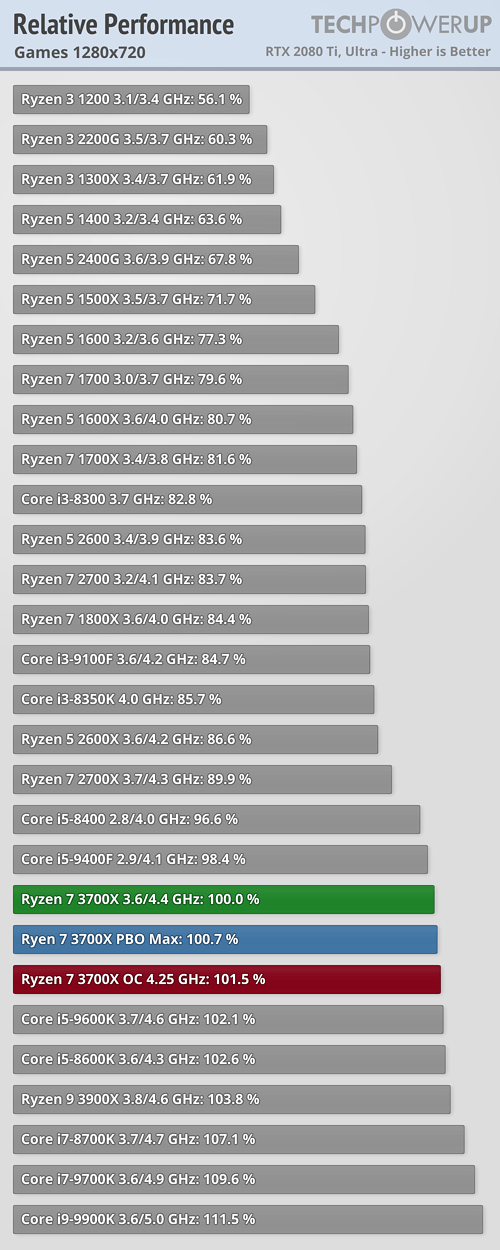
3.6ghz/4.4ghz boost 3700X is ~11% faster than the 3.6ghz/4ghz boost 1800X in 1080p gaming.
Even at 720p it's a 15% gap between those two, not 30% https://tpucdn.com/review/amd-ryzen-7-3700x/images/relative-...
> Zen1 especially was hot garbage in gaming, those thread-heavy titles aren't representative of its average performance.
No it wasn't. It lost to the equivalent Intel CPU, but it was far from bad. You could easily pair a Zen1 CPU with just about any GPU and never see a significant bottleneck. The exception being the absolute top-end. And, critically, if you had an older Intel quad core, like a 7600K, the Zen1/Zen+ CPUs were still an upgrade in gaming performance.
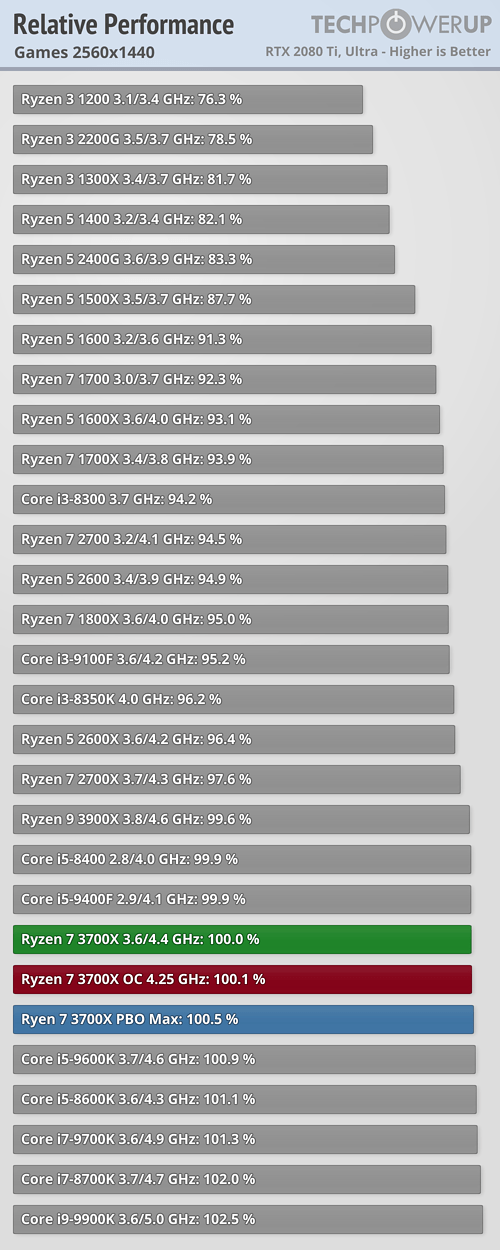
See for example at 1440p the gap between Zen1 & Zen2 & Intel being almost nonexistent even with a 2080 Ti: https://tpucdn.com/review/amd-ryzen-7-3700x/images/relative-...
> Having 8 faster cores is still more desirable for gaming than 16 slower cores.
Of course, but you still need enough cores to avoid stuttering. Which means...
> And single-core performance is a good analogue of "per-core performance" so this number remains very relevant.
Is not correct at all. Single-core performance isn't an analogue of anything these days. You need a minimum number of cores and good single-core performance.
And it's not just HWUB with these conclusions that an i5 is no longer sufficient. Gamersnexus has the same recommendations: "In more games each year, we’re noticing the cut-down Core i5 exhibiting high frametime variability that counteracts its fleeting performance superiority with unreliable, stuttery behavior. The AMD R5 3600 is more reliable and consistent in its performance across all games we’ve tested, making it the better gaming option." ( https://www.gamersnexus.net/guides/3533-best-cpus-of-2019-ro... )
And for reference, they used to have it at 30% single core, 60% quad core, 10% multi core. But that didn't advantage Intel enough, or something.
Any idea why?
0.1% lows really tank on FC5 on processors without SMT, for example a 5.2 GHz 9600K has less than half the 0.1% FPS as a stock Pentium G5600 2C4T processor. In other words it's stuttering on the 9600K but running ok on the G5600.
https://www.gamersnexus.net/images/media/2018/cpus/2600k/int...

4C4T processors (R3 1200) do OK, but that one is AMD, so it isn't clear whether it's specifically something the engine is doing wrong around Intel processors, or if there's some hardcoded assumption that if there are 6+ cores then SMT must be available, or what.
But I mean, this specific game is not evidence that "6C6T is no longer sufficient for gaming", it's just a badly programmed game that has something going wrong under the hood on 6C6T processors.
It's still a very useful site for comparing niche hardware that will never get a true review - how does a J5005 compare to a i5 750? How does a Xeon E5-1650 compare to a Ryzen 1600? Probably not going to ever be directly tested. The only alternatives are things like Passmark that are much less accurate. UserBenchmark lets you compare against all kinds of niche or rare hardware at will, that's an incredibly valuable resource. Some people are just so butthurt about the "effective speed" composite scores that they can't bring themselves to scroll past a single line, which is a little ridiculous.
Generally r/AMD constantly gets their panties in a bunch about something or other, it's constant conspiracies about how this or that is a NVIDIA or Intel backed conspiracy. Don't take them too seriously.
At times they have sent death threats because they didn't like the conclusion of a review. After the initial Ryzen launch they decided that Steve from GamersNexus (among others) was an Intel shill and started threatening his family. iirc there have been other "incidents" as well.
https://www.reddit.com/r/Amd/comments/5xkw1b/gamersnexus_rec...
(most of those "removed" posts are people justifying it because Steve is an Intel shill who put out a "biased review")
They really take the whole fanboy thing to a whole new level. It is practically a uniquely toxic subreddit, even among other "brand" subreddits, more like a sports team sub or something.
As it happens I am awaiting delivery of a Ryzen 5 3600, good to know it's likely to be even better than userbenchmark suggested!
UB stores passwords in plaintext, and emails them around.
https://plaintextoffenders.com/post/183587319928/userbenchma...
https://github.com/plaintextoffenders/plaintextoffenders/blo...
- programming, docker, golang
- gaming
can anyone recommend a resource for determining the relative performance of processors? With all the new of how well AMD is doing, I’m still not sure how to look at a given task, and determine which processor would perform better.
Does anyone know of such a source?