With reports of people being infected in nursing homes, there's a possibility that even the elderly are being silently infected and symptoms aren't severe enough for them to seek treatment. It seems like there's some unknown factor that makes some people extremely sensitive to it, while others feel nothing at all.
The percentage of people 70+ who have "other major health issues" is higher than you seem to think. People who are themselves in their 40s or 50s are likely to know several. Maybe that's not as true for people in their 20s, especially those who live within a closed social circle of mostly their FAANG/startup coworkers, but it's a bit insensitive (at best) to act as though that's true for everyone.
News articles regarding this have been very explicit about saying the victims have notable health problems and not simply age. e.g., A long history of lung problems, cancer, etc. Plenty of old people are recovering fine, and I'm sure the reason health issues are mentioned is because those people have exceptionally bad health in some way.
I don't think anyone really doesn't know that old people are less healthy overall. It's bizarre that some people think they need to explain that fact in a condescending manner.
"My son displays a general garment and you claim it's cut to your fit. What a fascinating revelation."
It wasn't a personal attack. It's not my problem if you chose to apply it to yourself. But enough of your meta-discussion. You displayed an all too common misunderstanding about how (un)healthy older people are, so I challenged it. Here are some figures on co-morbidity factors for Covid-19.
* Cardiovascular disease 13.2%
* Diabetes 9.2%
* Chronic respiratory disease 8.0%
* Hypertension 8.4%
* Cancer 7.6%
(all from https://www.worldometers.info/coronavirus/coronavirus-age-se...)
So, how common are these issues in the 70+ crowd?
* 25-35% of US adults 65 or over have cardiovascular disease (range due to gender difference)
* 19-23% have diabetes
* 8-9% have asthma, 21-26% have bronchitis or emphysema (oddly the numbers don't cover COPD which I believe is around 15%)
* 55-57% have hypertension
* 21-26% have cancer at some point
(all from https://agingstats.gov/docs/LatestReport/Older-Americans-201...)
Given those numbers, what percentage of older people do you suppose have escaped all of those ills? Clearly less than half. So of course most of the elderly who have died from Covid-19 already had some other condition, because most of the elderly period have some other condition. Assuming the existence of vast numbers of elderly without such conditions for the sake of your argument is just not helpful.
Your turn. Bring some facts to the table instead of wild supposition and complaints.
There are people who are 40 years old who are dying, and those people also have major health issues.
I'm not trying to say old people and 5 year olds are equally healthy and running around. I don't know why you're so frustrated and thinking I am and continuing to be needlessly condescending and thinking being called out makes those claims accurate (it doesn't).
What I'll repeat is plenty of people seem to be getting out of the disease just fine and many with no symptoms. Some people--regardless of age--seem to be hit especially hard. Many of those people seem to have major health issues. Since older people tend to have more health issues, it's obvious that they're generally hit harder, but many are still getting infected without it turning severe.
Again, I have zero clue what your point is or why you attacked me as some clueless FAANG employee or what relevance that even has. I'm not sure if it's some odd projection or what.
I have 4 living grandparents - which means that odds of my attending a funeral in the next year or so is at least 35%.
That's horrifying.
The major problem is systemic risk from many people requiring intensive care all at once.
The author of the linked blog post didn't mention an important and unsettling feature of the Spanish flu. It came in three waves. The first looked very similar to a bad seasonal flu or the current SARS outbreak. The second was the one that killed, by inducing a cytokine storm and immune overreaction in otherwise healthy, younger people. Deaths sometimes occurred in a matter of hours after the first appearance symptoms. Having an incredibly infectious virus cause a pandemic is one thing. Let's hope that we can monitor it's evolution to ensure that strains that it develops aren't significantly more dangerous. Its infectivity means that it will have a massive environment in which to evolve. Evolution rate is largely determined by population size.
http://www.cidrap.umn.edu/news-perspective/2020/02/study-720...
While the specific r0 and cfr are still under debate, there's no doubt this has rapidly absorbed hospital resources in hotspots in ways other coronaviruses haven't.
I don't think panic is the right answer, but people should prepare for the possibility this impacts their lives, judging from regions with cases and the continued spread to new regions. Quarantines, social distancing, fewer public activities, and extended hospitalizations of some older family members are all realistic scenarios.
If enough people get it badly enough to require significant medical care, that will quickly overwhelm hospitals, and the fatality rate among those turned away will be much higher. We're more likely to follow the Iran pattern (CFR = 5.5%) than that from Japan or South Korea or even China.
> Aside from this likely being inaccurate, is this language even remotely helpful?
If it is accurate I appreciate someone informing me in brief and plain terms.
https://raw.githubusercontent.com/jbloom/CoV_vs_flu_CFR/mast...
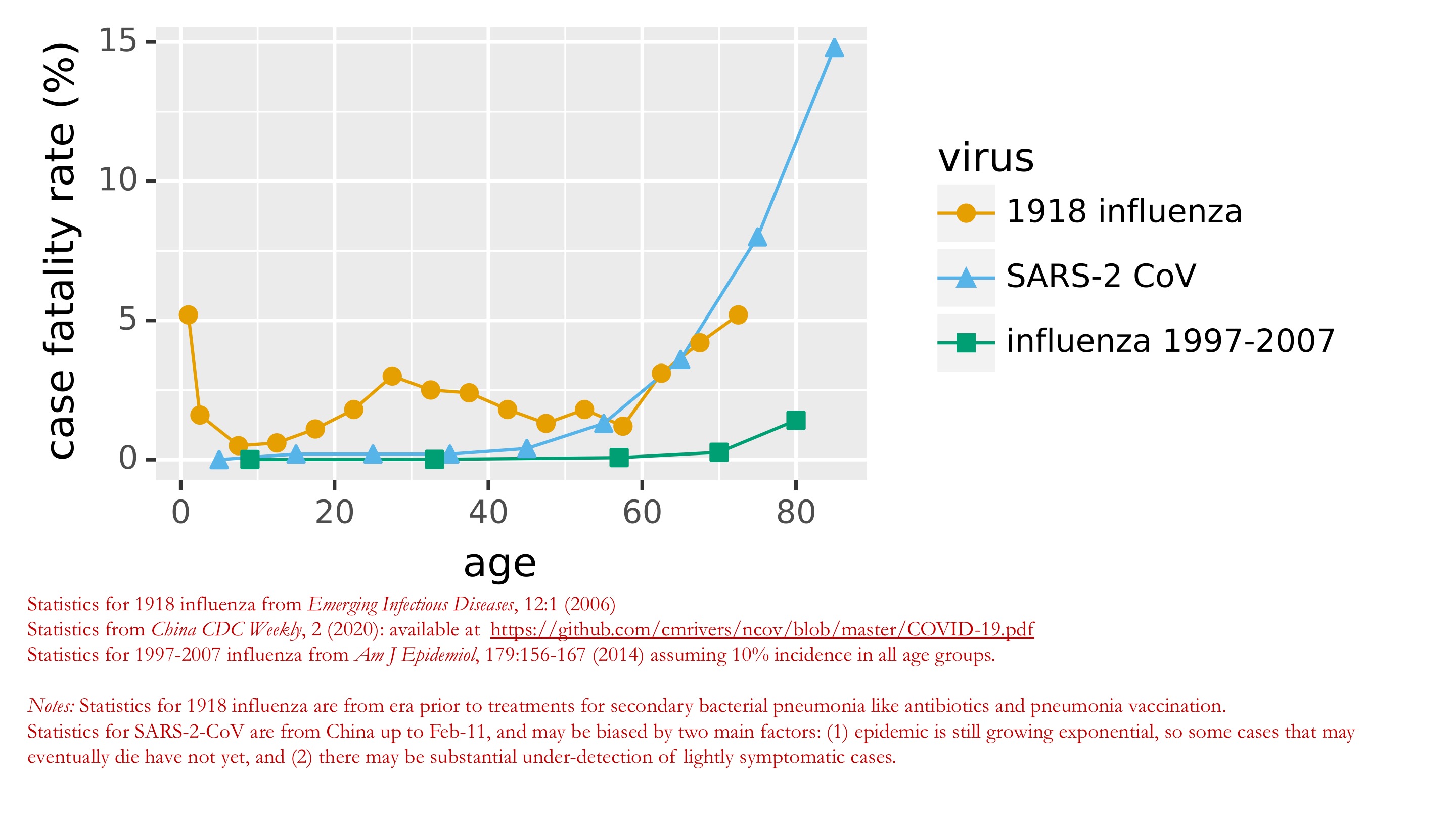
Some context:
https://twitter.com/petrakle/status/1234587264904318978
This is based on data published so far.
A̶n̶t̶i̶b̶i̶o̶t̶i̶c̶s̶ ̶w̶o̶n̶'̶t̶ ̶h̶e̶l̶p̶ ̶w̶i̶t̶h̶ ̶C̶O̶V̶I̶D̶-̶1̶9̶,̶ ̶b̶u̶t̶ ̶w̶e̶ ̶h̶a̶v̶e̶ ̶a̶ ̶l̶o̶t̶ ̶o̶f̶ ̶a̶n̶t̶i̶v̶i̶r̶a̶l̶s̶ ̶n̶o̶w̶ ̶t̶h̶a̶t̶ ̶m̶a̶y̶ ̶h̶e̶l̶p̶,̶ ̶a̶n̶d̶ ̶m̶u̶c̶h̶ ̶h̶i̶g̶h̶e̶r̶ ̶s̶t̶a̶n̶d̶a̶r̶d̶s̶ ̶o̶f̶ ̶c̶a̶r̶e̶.̶
Edit: Thanks for the correction below, I misunderstood why antibiotics could be of help.
As I have said before, if you are going to make a bet, you need to know the odds. We don't know the odds yet.
This also means that we can't be sure of any of these numbers.
Maybe the correct way to think of this isn't "people you know will die" but rather "people you know may die, so we need to be paranoid and prepare."
> Whatever the number is, it's gonna take a toll. If it really does spread as widely as that projection says, and that's what I think is likely to happen, then there are gonna be millions of people dying. And I don't think there's any way to get around that. And so I think there's real reason for people to be concerned. I also think that we can turn that concern into actions that will make the situation better.
I think pieces like this and the linked interview with Marc Lipsitch, which are clear-eyed reads on the situation from experts, should break through to the general public so they can take some action.
[1] https://www.cbsnews.com/news/coronavirus-infection-outbreak-...
You seem to have a very unconventional estimate of the world population. 1% of 8 billion is not hundreds of millions.
Anyway, overall current (non-COVID) mortality rate is around 1% annually as well, mostly elderly people as well, so even if in an extremely unlikely and tragic case this will kill 1% of the world population, expect twice as many people you know to die compared to a regular year.
Having twice the normal population die in a given year is an extreme event. The way you’re describing it sounds like it’s no biggie.
Globally speaking, that's not the case. The number of new cases was highest in early to mid-February and has been lower in the past two weeks.
What? That doesn't matter at all.
The number of new cases globally is growing at an increasing rate- the number will eclipse that from early-mid february shortly.
That's just not true. The daily increase in total cases globally has been going down since mid February.
https://www.arcgis.com/apps/opsdashboard/index.html#/bda7594... (Link fixed, thanks)
So, it would stand to reason that you would see a decrease in the number of confirmed cases if there's an artificial limit in the number of cases reported.
> There will be significant economic disruption
> Daily life will be impacted in important ways
> The acute pandemic will probably last at least for several months and quite possibly for a year or two.
Agreed, this seems very sensationalist.
Any or all of the above could be true, but at best, she is guessing right now.
It's citing two references (ref. 4 and ref. 5) that estimate CFR at respectively 2% and 1.4%, however both use the naïve CFR formula (deaths/cases) that's known to underestimate the CFR due to deaths lagging cases in a rapidly growing outbreak. I wrote about this bias and provided 5 peer-reviewed epidemiological papers that also document it, see: https://blog.zorinaq.com/case-fatality-ratio-ncov/
Then it remarks that many mild cases are probably not detected (ie. high underascertainment) but strangely makes no effort at quantifying it, or referencing other papers that do quantify it.
The 4 best published studies that correct for these two aspects (naïve CFR bias + underascertainment) are:
https://www.mdpi.com/2077-0383/9/2/523
https://www.imperial.ac.uk/media/imperial-college/medicine/s...
https://institutefordiseasemodeling.github.io/nCoV-public/an...
https://github.com/calthaus/ncov-cfr/blob/d30f02e1c20e06103a...
(3 of the 4 above studies are even referenced by the WHO in their Coronavirus disease situation report 30 (references 10, 11 and 12) and in situation report 31: https://www.who.int/docs/default-source/coronaviruse/situati... and https://www.who.int/docs/default-source/coronaviruse/situati... )
And they all estimate the CFR to be between 0.5% and 1.6%, or about 5x to 16x deadlier than the flu (0.1%)
> COVID-19 seems to be most severe in older adults.
The median age of deaths is 75. I guess that’s technically “older adults” but I think “elderly” would be a better description.
https://www.nytimes.com/2020/01/23/world/asia/coronavirus-vi...
> there are a number of indications that it will be very much like the 1918 Flu Pandemic
The New England Journal of Medicine has a different take:
https://www.nejm.org/doi/full/10.1056/NEJMe2002387
It sounds increasingly likely that the fatality rate is less than 1%, potentially a lot less, as were now hearing that 80% of people don’t even get sick enough to seek medical attention, and many have no signs of illness at all — which means the denominator in the death rate is likely much higher than is accounted for in the common 2% metric from the first data.
> Expect people you know to die.
Aside from this likely being inaccurate, is this language even remotely helpful?