It's interesting but sad watching that creativity vanish as the rents rise. There's more money here now, but less creativity.
I think this apparent contradiction is resolved by asking "who had the time to be creative?". When rents were low, artists could make ends meet and still have time to create. As rents are rising, the artists are pushed out, or forced to spend more time making money. The new tenants are people earning decent money, who again are either working too hard to create, or are not "artistic" in that sense (me included).
The old squats and communal housing are being redeveloped, the graffiti-covered walls are being repainted so the houses they cover keep their value. The focus moves from "poor but sexy" to "let's make lots of money". Everyone is richer, except the culture.
It's a concern that spans decades.
https://www.cbc.ca/archives/the-last-days-of-toronto-s-low-r... — This article dates to the 80's and its tone is the very same.
(Canada's lost sweetheart PM hopeful is interviewed in one of the videos when he was a Toronto city councilor. Such a loss. He really had his finger on the pulse)
The difference, in my uneducated opinion: commercial and retail space in those cities goes up. It is not strictly at street level, as in Toronto. Look up and you will see signs for bunny cafes, stationery, restaurants, all kinds of small/odd fashion stores...
All the condo districts in Toronto look the same: a small sliver of retail on the ground floor, invariably Rexall, Rabba's, or Aromas. And that's pretty much it.
Would love to hear from someone more familiar with urban planning on this topic.
Most cities have problems with staying creative in the face of high rents because most artist jobs pay very poorly (unless you're one of the few who makes it big). It's pretty terrible that musicians, writers, painters and sculptors tend to be in salary brackets where they can never retire and never own a home unless they become huge.
The art and culture of a city will suffer greatly if the next generation of artists is entirely forced into corporate jobs with part time on art. This is even more true if those jobs require creativity reducing the creative energy available for art.
Parkdale still has its moments but even it is being hit now and Little Tibet is feeling that sting.
There's constant [sad/angry] joking about every block consisting of Shopper's Drug Mart, Rexall, Starbucks, and bubble tea. It's not at all that bad yet, but it's also not as much of a satire as it sounds, sadly.
These days my partner and I have been strongly considering a move to Hamilton if we can sort it out with our work.
Where are the artists going to?
Where are the places that used to be rich, but are becoming "poor but sexy"?
The savvy ones scrounged up enough to buy property and either hold out their with less of a community, or they sell and move and just do their own thing.
In Ontario, there isn't a cheaper place for quite an expanse. Hamilton or other smaller cities are a bit of the last holdouts. But because of some of the exodus from Toronto (and like cities) they are being bought up and redeveloped as well.
Some escape to small towns, but those usually stay small and grow sleepy even though they're interesting places.
I've always worked a day job, even at my most active, so I've kind of had one foot in both worlds.
Cities were attractive because people were close together—there was variety, word could get around. They were vivacious. It would be terrible to see that completely snuffed out.
oh, you said poor AND sexy...
funny enough though, as oil and gas declines in importance (and loud, oxygen-sucking volume) some new and preexisting voices are getting an opportunity to emerge. We're young, educated and ambitious so despite poor economic fundamentals I'm bullish ...
Seems like we are regressing from artists back to "mathematicks". Hopefully we don't regress further into "Politicks and War".
― Virginia Woolf, A Room of One's Own
>Shafts were driven down into the ground and galleries opened where slaves, chained, naked, and branded, worked the seams illuminated only by guttering oil lamps. An unrecorded number were children. It was a miserable, dangerous, and brief life. [0]
It is always the most comfortable that consume the most vivid persecution porn. Feminists seem to have been doing this for a century longer than the The Handmaid's Tale, which was my introduction to that brand of mental illness.
[0] The Rise of Athens: The Story of the World’s Greatest Civilisation
Pretty much the only people who are persecuted in the west are whistle blowers, zoophiles and pedophiles.
Maybe one day you'll come around to the idea that feminist ideas are valid without feminists being put into jail.
Not only do you worry about your own small income; but grants, scholarships, registration fees and a myriad of other things have in recent times become volatile and can be taken away from year to year.
Most of the issues is due to 1) our government being corrupt and 2) promises the government made about free education.
I am not against free education, but I am against impoverished professors.
This is why I decided to side-step academia. It is delaying my PhD by probably 3–7 years (I am at year 2's start now) but it's better than having in theory 100% time spent on a PhD but actually worrying about the University and your peers, your own future, etc. in reality.
Welcome to the sad reality of academia almost everywhere in the world. (sigh)
Basically in order to be productive under those circumstances you have to ignore reality, which can be problematic for the people around you.
But at the same time everything is relative on your perception of reality. We spend today 50-100 times more energy per person that people 100 years ago, and most of those people were happy.
We upgraded our expectations, specially because of mass media and advertisements and feel always dissatisfied because they will compare us with people that have more than we have.
Obviously, the more materially rich your society is, the better the latter deal is, but happiness comes from feelings of safety, not being overworked, and solid social ties.
https://www.eia.gov/totalenergy/data/annual/showtext.php?t=p...
https://en.wikipedia.org/wiki/1920_United_States_Census
In 2018 the United States consumed 101.2 quadrillion BTU of primary energy, with a population of 327 million.
https://flowcharts.llnl.gov/content/assets/images/charts/Ene...

https://www.worldometers.info/world-population/us-population...
Primary energy consumption per capita in the United States increased about 54% in the last 100 years, not 5000%.
Global energy consumption per capita has grown by nearly 300% since 1920:
http://theoildrum.com/files/per-capita-world-energy-by-sourc...
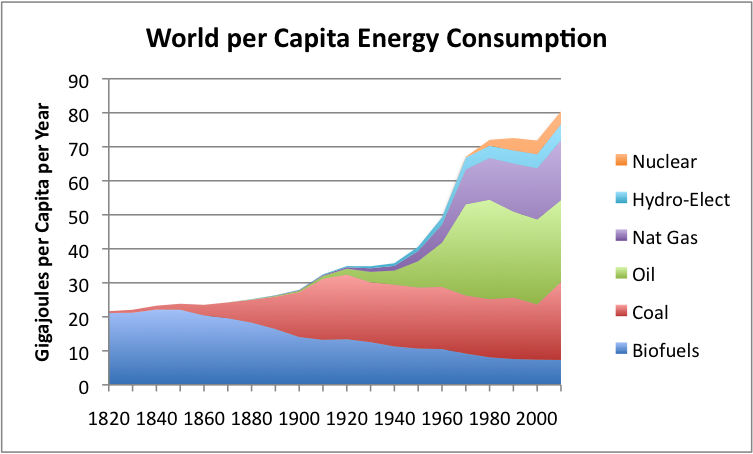
This is still much less than 5000%.
I’m asking out of general curiosity and not snark, but is there a reliable source to this?
A cursory search on my end didn’t return anything. I often wonder if the obsession with “happiness” is a relatively recent phenomenon borne of our own privilege.
The data seems to show that improving those indicators seems to increase happiness up to a certain level, after which they have much more marginal effects. One theory is that once basic needs are met, happiness becomes "relative" to the people around you, so rich countries/societies getting richer doesn't further improve happiness.
I can't speak to what was going on 100 years ago but based on the above I'd imagine they were a lot less happy than we are now - as a lot of people were not having their basic needs met.
my mum has not been financially stable for over a decade. in this time she has been starting to "reset" what she finds acceptable. just recently she had to downsize her house and she has already focused on only what I can describe are ways to spend money to avoid reality. she recently listed a train of things she wants to do to her new house that sounds like she wants to stay there for the rest of her life. when asked about the conflict between staying and her next year goals is met with internal strife. she couldn't accept the fact that she needed to use what little money she had to lift herself out of her situation. instead she put priority on installing a dishwasher in her 600sqft apt to help the next person.
your brain is the greatest troll ever to exist
100 years ago was 1920. That is two years after WWI. That is destroyed countries moving from crisis to crisis, veterans struggling to become part of society ...
So I guess it depends which part of world you talk about, tho none of it sounds perfect.
citation?
I am scared of losing my job though, because of a lapse in mental health or whatever. Not because my expectations are high, but because I'm afraid of having to sell my house in a hurry and move into a small apartment with my wife and my 3 children, as well as the feelings of failure and shame.
Is that known?
Expectations are also imposed. We have to commute to our jobs and pay for our apartments that conform to building codes.
Lacking money occupies your mind, you just tend to forget if money isn't a problem anymore.
To me that's the main benefit of earning more. Sure, it's nice to be able to buy more expensive things overall, and e.g. be able to travel more, but I find more value in the many tiny day to day improvements that individually sound trivial, such as not having to budget when at the grocery store. It's a few minutes here and a few minutes there extra where my mind is free to relax or focus on more interesting things, and it really adds up.
There was a year in my youth when I had a big economic setback, and suddenly had to budget my day to day expenses again, and frankly, the time I lost that I had to spend thinking about money, from the small things like how much I could afford to spend for lunch to how to cover rent, was exhausting, and a very stark reminder of how easy my life had become prior to that. And I've never experienced true poverty - I always had multiple safety nets; I'd never have starved, for example.
I think the mental exhaustion from dealing with a strained economy is one of those things people who haven't experienced it tend to don't get when trying to imagine what life is like for people who have little money.
Not disagreeing, just trying to add some complexion.
Poverty may even trigger creativity at times. But stress is the major impediment, and therefore living in long-term poverty does not favor sustained creativity.
I grew up in Norway; incidentally, one of the most famous Norwegian novels is the semi-autobiographical "Sult" (literally "Hunger") by Knut Hamsun, describing a young writers descent into madness as the hunger grips him as he wanders around in what is now Oslo.
But I've also seen the flip side, where you spend so much time worrying about money or acquiring a semblance of security that everything else gets pushed aside.
"I must study politics and war, that our sons may have liberty to study mathematics and philosophy. Our sons ought to study mathematics and philosophy, geography, natural history and naval architecture, navigation, commerce and agriculture in order to give their children a right to study painting, poetry, music, architecture, statuary, tapestry and porcelain.”
Like Maslow's hierarchy of needs... generally people have to expend their creative thought on how to provide for themselves before they have the opportunity to use that thought in more expansive ways.
Do a Dan Price and you jump start people's ability to settle the lower levels of needs and be able to make more choices.
But then again, we will never know about extremely creative yet poor people who are struggling to make ends meet and wasting their precious mental energy on things others take for granted.
But that does not discredit the original point (to which I was agreeing), that being poor is not an impediment to creativity.
water / food / electricity doesn't total high for my needs, rent on the other hand
I guess that's why artists lives in old buildings sometimes..
ps: also, call me crazy, but I think in a hunter settings you'd have more time to wander and create than todays city life. As long as there's enough rabbits around to grab ..
https://en.wikipedia.org/wiki/Henry_Cavendish
This guy managed to get a measurement of G (the one from high school physics) in his basement IIRC.
It's a shame that so often that thing seems to be how to pay rent on time, or being able to provide for your familiy financially.
Who was paying you and could you not go do something else for money?
Would be hard pressed to do that as I don't come from a place of privilege. Check your assumptions.
On top of that being broke and exhausted makes it difficult for people to change what they are doing. If you can't go two weeks without a paycheck, how are you going to switch jobs, etc..
0:
I also "lost" a lot of money this week, but I'm not leveraged and I have positive monthly cashflow, so it's no big deal. I just bought a little more of my favorite broad market etf than usual and went back to my life.
Although we are the exception not the rule. My last job had me running around exhausted and I thought being super productive would increase my bonus (narrator: it didn't)
and no i don't recommend anyone doing what i did, but basic technical analysis said to sell [or buy puts] last week and with enough time watching markets you will know when an oversold relief rally is due [including mini rallies within overall downtrends]
I spent the first several years of my career working in academia for a poverty level wage.
I can confirm from my own experience that when you worry about not being able to pay rent and all the bills, it's very difficult to be productive, much less in a job that requires any kind of focus or creative thinking.