Obviously, the more materially rich your society is, the better the latter deal is, but happiness comes from feelings of safety, not being overworked, and solid social ties.
https://www.eia.gov/totalenergy/data/annual/showtext.php?t=p...
https://en.wikipedia.org/wiki/1920_United_States_Census
In 2018 the United States consumed 101.2 quadrillion BTU of primary energy, with a population of 327 million.
https://flowcharts.llnl.gov/content/assets/images/charts/Ene...

https://www.worldometers.info/world-population/us-population...
Primary energy consumption per capita in the United States increased about 54% in the last 100 years, not 5000%.
Global energy consumption per capita has grown by nearly 300% since 1920:
http://theoildrum.com/files/per-capita-world-energy-by-sourc...
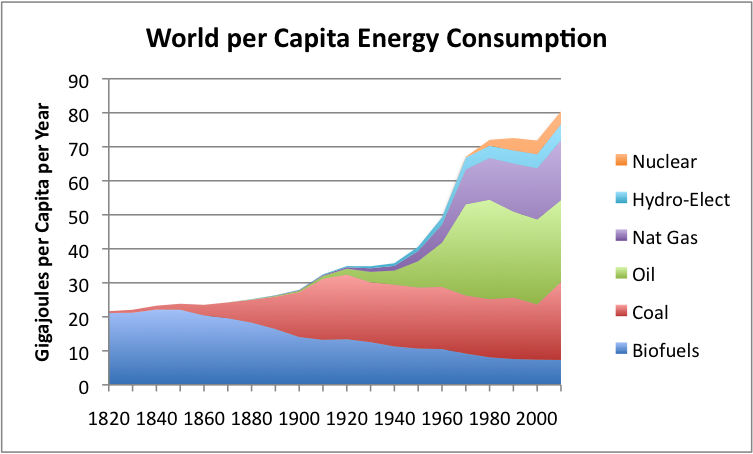
This is still much less than 5000%.
I’m asking out of general curiosity and not snark, but is there a reliable source to this?
A cursory search on my end didn’t return anything. I often wonder if the obsession with “happiness” is a relatively recent phenomenon borne of our own privilege.
The data seems to show that improving those indicators seems to increase happiness up to a certain level, after which they have much more marginal effects. One theory is that once basic needs are met, happiness becomes "relative" to the people around you, so rich countries/societies getting richer doesn't further improve happiness.
I can't speak to what was going on 100 years ago but based on the above I'd imagine they were a lot less happy than we are now - as a lot of people were not having their basic needs met.
my mum has not been financially stable for over a decade. in this time she has been starting to "reset" what she finds acceptable. just recently she had to downsize her house and she has already focused on only what I can describe are ways to spend money to avoid reality. she recently listed a train of things she wants to do to her new house that sounds like she wants to stay there for the rest of her life. when asked about the conflict between staying and her next year goals is met with internal strife. she couldn't accept the fact that she needed to use what little money she had to lift herself out of her situation. instead she put priority on installing a dishwasher in her 600sqft apt to help the next person.
your brain is the greatest troll ever to exist
100 years ago was 1920. That is two years after WWI. That is destroyed countries moving from crisis to crisis, veterans struggling to become part of society ...
So I guess it depends which part of world you talk about, tho none of it sounds perfect.
citation?
I am scared of losing my job though, because of a lapse in mental health or whatever. Not because my expectations are high, but because I'm afraid of having to sell my house in a hurry and move into a small apartment with my wife and my 3 children, as well as the feelings of failure and shame.
Is that known?
Expectations are also imposed. We have to commute to our jobs and pay for our apartments that conform to building codes.
Basically in order to be productive under those circumstances you have to ignore reality, which can be problematic for the people around you.
But at the same time everything is relative on your perception of reality. We spend today 50-100 times more energy per person that people 100 years ago, and most of those people were happy.
We upgraded our expectations, specially because of mass media and advertisements and feel always dissatisfied because they will compare us with people that have more than we have.