I have a beautiful case (Corsair 570x mirror black tempered glass on 'all' sides). 8700K, 64GB memory, 4TB of SSDs, Vega 64. Runs just as silently as you could hope (H150 closed loop water cooling).
Like you said, Apple gives you the finger for a lot of things. I've lost track of the number of iPhones, iPads, MBPs between my girlfriend and I (but probably at least five each of the letters, and most of the iPhones). But I cannot stomach, in good faith, the world's richest company charging me $1,000 for 56GB of RAM (8->64) when I could buy high end or even faster memory for $250 for 64GB.
And, following some guides? It "just works". Continuity, Handoff, Apple Watch unlocking, iMessage, Sidecar. Clover Configurator is awesome, and if you want to be/feel even more native, OpenCore is even better (though requires manual work, whereas Clover can have your system booting into macOS in 40 minutes from building your USB).
So could I spec out a new Mac Pro that outpaces this? Sure. As could I grow this machine (it's just been my Windows workhorse for about 18 months).
I still love Apple products, but I don't feel any particular remorse for doing this, versus plonking down what most likely would have been $9,000 for a similar Mac setup.
Then inevitably something doesn’t quite work properly anymore.
IIRC my first build was with El Capitan, and I tried to follow with all updates, but it was painful every time.
When I was building my Hackintosh, the common advice was to use nvidia GPU, so I got myself a then fresh out GTX 1070. But then soon, Apple decided not to sign the nvidia web driver, so we all are SOL with the support on newer macOS versions.
I was even considering trying to sell my current GPU to replace it with an AMD one, but instead decided to make it work with iGPU and do the GPU-heavy work on Windows.
I would never use or recommend a Hackintosh for any work where you'd expect a reliable machine, let alone using it for work.
But I would also not drop the cash on the insanely priced mac dekstop lineup. I've got a macbook and I will probably buy another one (not convinced because the keyboard fiasco which also affected my machine).
I was not expecting it, but windows 10 is much improved over the windows I knew. I now use it for gaming and some personal projects where GPU matters (game dev, computer vision, machine learning). I still need to get used to it and I sometimes miss some tools (Alfred, Preview.app, iTerm, modifier keys -> cmd > windows). But while macOS seems to have been dropping the ball recently, windows is scoring goals.
I will seriously consider switching back for my next machine, especially if apple keeps doing this stupid stuff. I was also thinking about linux, but I'm not sure if I want to spend time configuring all the little things.
It gives people the time to fix the potential issues.
Also a fun fact, I have a 2012 macbook pro and when High Sierra got released the update would fail on it because I had changed the hdd. They were trying to counter Clover but it took less than a week for the Clover team to find a workaround and I coulnd't update my real macbook pro for months before Apple corrected the issue for me.
I've always wanted a tower mac but the new Mac Pro is not the machine for me. I just want the specs of an iMac on a tower.
A couple of years ago I ended up buying an iMac 5K since I needed to upgrade my old MBP and the Apple laptop landscape was so desolate. I'm very happy with it for dev and design work but I tried to use it for music production and it's not the machine for that. Cooling is bad for anything other than short bursts. Even at 30% of sustained CPU work for audio the fans turn on and are quite annoying. I ended up building a Ryzen Windows PC which cost me as much as an i7 Mini but is even more powerful than the base Mac Pro.
Checking out these graphs about Apple's revenues, apparently Mac revenues are pretty flat, while iPhone revenues continue to skyrocket (currently 5X Mac revenues!): https://sixcolors.com/post/2020/01/fun-with-charts-a-decade-...
So sure, a hobbyist-approved Mac desktop would please you and me and plenty of other geeks, but they'd also cannibalize their Mac Pro sales somewhat, and when it's all said and done, their Mac revenues would still probably be in the same ballpark. So, why do that when they can pour effort into new phones or TV services or AirPods or whatever?
The thing that worries me is that the hobbyist/geek is often the one who turns lots of others onto a technology. I'm probably where I am right now because my geek uncle passed down his used Mac to me and showed me Hypercard. And I'm pretty sure there are people who own Macs today that wouldn't if it not for me. I think appeasing the geeks is worth more than the direct profit or revenue that such a model would bring in, but in ways that aren't as immediately evident on the quarterly report.
Remember that Apple aims to sell a vertically integrated stack, all the way from their own cases, motherboards, and PSUs up through the OS and core apps. The point of this is to deliver a specific user experience that they control, and also to keep competitors out of their pool (they allowed licensed Mac clones circa 1994-96 and it didn't end well). While they still buy in CPUs from Intel and other components (RAM, video chipsets, SSDs, hard drives) from other suppliers, these are generally low-level components -- as low level as Apple can get -- and even then they're trying to build self-owned stacks so they're not dependent on anyone else (e.g. the A-series processors in the iPhone and iPad) -- a lesson they learned the hard way thanks to Motorola with the 68K and subsequently PowerPC architecture. (I'm guessing Tim Cook personally has bad memories of the failure to deliver a mobile G5 back in the day.)
Anyway ...
Developing a new machine from the ground up has got to cost in the tens of millions, at least. (Look at the sunk costs that went into the new Mac Pro, for example.)
Are there enough "enthusiast" customers with system-building interests out there to make such a beast net-profitable, after taking into account the brand dilution implication of stacking up too many SKUs (as they did in the Bad Old Days of the first half of the 1990s, before the Return of Jobs)?
I'm guessing they've done the calculation and concluded the answer is "no", at least for the time being.
The only people excited about the new Mac Pro are people already locked into the Apple ecosystem. It is a fundamentally backwards looking product that attempts to squeeze more money out of already captured customers. It is not likely to attract new customers to the Apple ecosystem.
It's possible but I doubt it. Does Apple know how many of its iMac customers would prefer a tower? Or how many sales they've lost to hackintoshes?
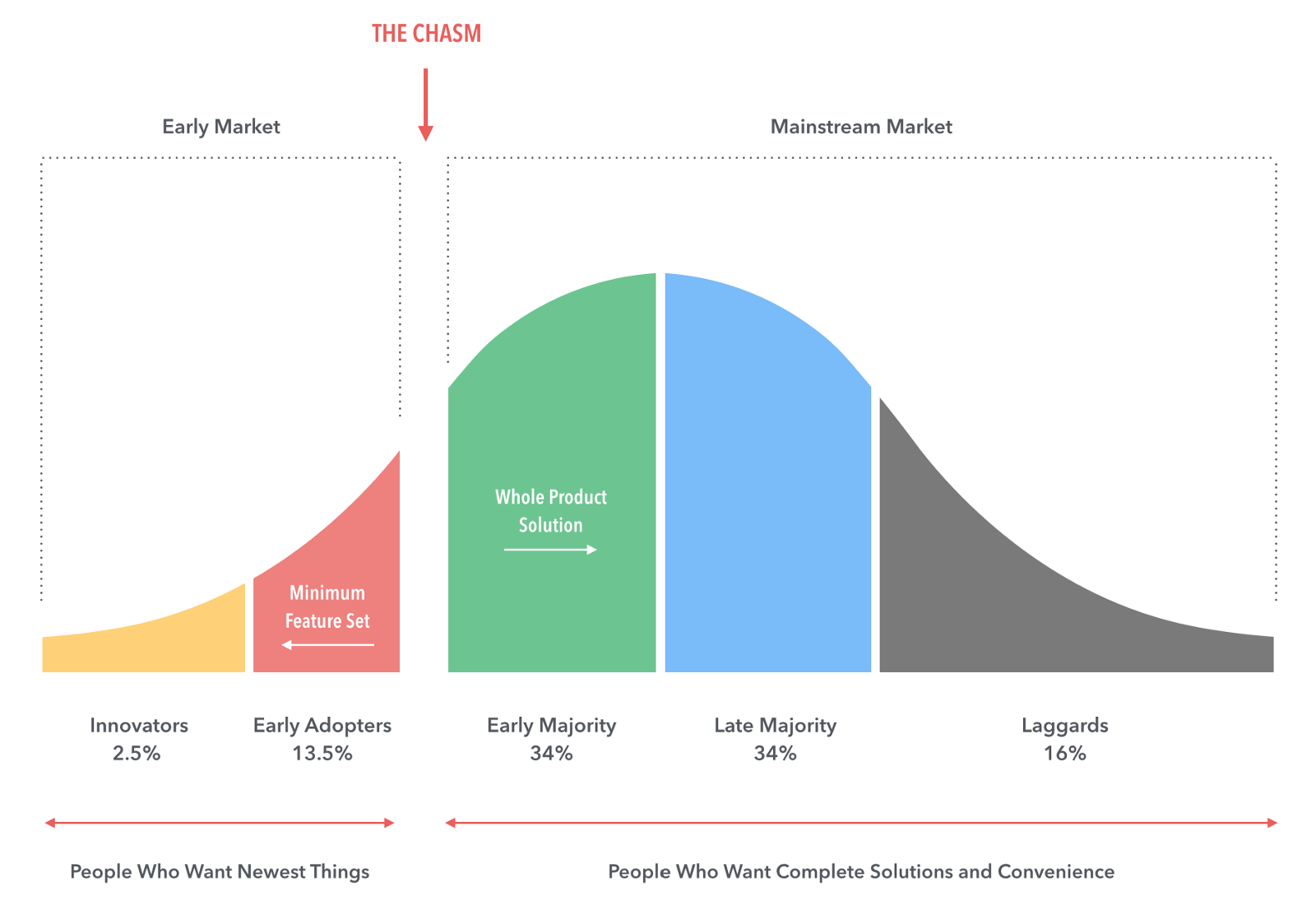
Per the curve shown in Geoffrey Moore’s “Crossing the Chasm”, HN exists largely on the left of the chasm, Apple is a trillion dollar company because it understood how to shift to the right of the chasm.
Visual explanation (.png):
https://smithhousedesign.com/wp-content/uploads/2018/02/smit...
20+ years ago?
> continue to engage deeply on the enthusiast asks right now contra-posed against their broader market understanding
Is this speculation or you have concrete evidence of this claim?
> HN exists largely on the left of the chasm, Apple is a trillion dollar company because it understood how to shift to the right of the chasm.
It think it would be the opposite. Having a tower with macOS and consumer specs (no Xeon or ECC) would be pretty boring and conservative. I think that is one of the reasons Apple won't do it.
Yeah. Back then lots of folks moonlit or ran local PC builder companies as small business PC builders and gaming PC builders. Before gateway and e-machines, and the like.
> speculation or evidence?
first hand knowledge
> think it would be the opposite
The curve is within a market. There are boring computers and exciting computers, workaday computers and toy computers, etc. Each has its curve.
Compare to automobiles, what gets shown at shows or on the track, what is limited edition, and finally what is high end then mainstream then outdated.
The high end buyers want them some of that enthusiast kit — without the high maintenance and visits to the mechanic.
That’s even true within a brand line, buyers want stuff they see getting played with over on the left of the chasm by competing enthusiasts, and they want their brand to adopt it too.
Please do go on :)
Maybe the Mac Pro will change the support issue and they will eventually be able to enter this market. But I believe their biggest fear is being compared to Windows or Linux which both have tremendous hardware support.
https://github.com/machyve/xhyve
Meaning, it’s not a heavy Virtualbox or Vmware type VM, no ‘vagrant up’ needed.
Instead:
https://minikube.sigs.k8s.io/docs/reference/drivers/hyperkit...
Apple: NEVER!
What? There is a lot wrong with AIOs.
1) Cooling is atrocious
2) Dust problems
3) Very difficult repairs and almost impossible upgrades (with some exceptions such as RAM)
4) No internal expansion. You save a cable with the monitor but you add cables for everything you want to add.
5) Once some component dies you have a very expensive monitor that can't be used for anything.
6) Much like laptops, tablets, and smartphones it's an environmental disaster.
Apple builds appliances made from hardware and software.
I’d like apple to make the xMac (cheap expandable tower) but I wouldn’t buy it myself. I suspect not many people would.
> This is the thing that absolutely friggin kills me with the Mac lineup.
You can still use your iMac as a monitor -- just plug your computer into the Mini DisplayPort connector.
> But if the Mac mini doesn't meet your needs (fast CPUS, storage bays, whatever)
The new minis have thunderbolt -- basically just a PCIe connection -- for storage bays etc. I understand it's not as esthetic as an integrated bay but who moves a desktop machine around anyway?
I'm not saying "take these options or shut up" -- I'm merely saying Apple is providing some options that will satisfy some chunk of the market that shares needs with you, and out at the long tail there are always people who aren't happy. I also buy Apple hardware and know I'm buying features that don't matter to me and miss a few features I wish they'd included.
This isn't to defend apple (why should I? Plus the list of things that annoy me about their offerings is long...like your point about their disappointing choices in Intel CPUs) I'm simply addressing two points you made.
I believe that this only works on iMacs made before 2014. New ones don't support Target Display mode (https://support.apple.com/guide/mac-help/use-an-imac-as-a-di...)
However in either case if your iMac is kaput you don't have access to the display -- the iMac has to be able to at least start their boot roms, though not boot macos, to make this work. Then again, modern external displays also have to be able to boot their firmware so perhaps I should't consider this a limitation.
That said, I do agree that I wish it could be used as a monitor.. even to power a laptop would be great. There used to be a way to do it but it died once we hit 5k.
- Connect one to either left port, and one to either right port, of the iMac Pro.
https://support.apple.com/guide/imac-pro/connect-a-display-a...
Now, personally, I want my computers either portable, or loosely coupled to the monitors. But the iMac Pro is quite a capable machine.
The best Apple solution at the moment is to use MBPs in this way, unless you want the ultra expensive Mac Pro.
Is it surprisingly hard to do this for some reason I'm missing? Or just slightly expensive and a minor feature so no one bothers?
“Use your iMac as a display
You can view the desktop of your Mac on the display of some iMac models using Target Display Mode. In some cases, you can also use Target Display Mode to play the sound from your Mac (called the primary Mac) on the speakers of the external iMac. For example, if you have a MacBook Pro you could use an iMac as the display and for playing audio.
Note: Target Display Mode isn’t supported on iMac models with Retina display. Only iMac (27-inch, Late 2009), iMac (27-inch, Mid 2010), and iMac (Mid 2011 to Mid 2014) support Target Display Mode.”¹
――――――
Furthermore, even though it is all-in-one in nature, a laptop's form factor is small enough that "putting it out to pasture" to live its life as a server with the screen always closed in your media center, or in a closet next to your cable modem is totally feasible.
Regarding monitors, I used to use self-assembled PCs all the time, and while there was a time where I would use the same monitor across different PCs, I just didn’t do that anymore by the time I bought my first iMac. Because monitor sizes and resolutions get better over the years, I’d typically give my entire computer to someone else and just buy a new monitor to go with my new PC. Maybe others don’t mind looking at an old monitor. To each their own, I guess.
This is the thing that absolutely friggin kills me with the Mac lineup.
As a developer I see monitors and computers as the perfect example of loose coupling. And I've absolutely had different lifecycles for monitors and computers in the past. My Mac mini that was once my primary desktop machine is now a media center hooked up to a TV.
But if the Mac mini doesn't meet your needs (fast CPUS, storage bays, whatever), and the Mac Pro doesn't fit your budget, Apple gives you a big ol' middle finger.
I mean, I COULD buy an iMac, but then 8 years down the road when I want a new desktop, I've got this unwieldy all-in-one where that big screen feels like more of a hindrance than an asset.
I haven't built a Hackintosh myself, but every time I look at the desktop Mac lineup I think about it.