News for hackers. Stuff that matters.
Re:Amsterdam’s canal houses have endured for 300 years by Luc on Thursday January 16, 2020 @07:39AM (#22063922)
To me that's a very surprising view. Ample space does not seem to be one of those luxurious features, that's for sure.
Re:Amsterdam’s canal houses have endured for 300 years by nizmow on Thursday January 16, 2020 @07:50AM (#22063982)
My wife and I were hunting for a new apartment a few years ago, and after looking a few houses in a village around 30km from Amsterdam we stopped at the local pub for a drink. Got to talking with an old local and explained that we were torn whether to live closer to the city, or get a place here that has a lot more space. He said to us, "More space? What's the point of that? All you'll do is put useless things in it. Move to the city."

He was right of course.

Re:Amsterdam’s canal houses have endured for 300 years by eecc on Thursday January 16, 2020 @09:37AM (#22064883)
Well, as far as I have seen space in the Dutch sense is not about functionally rather for show. Living room. A lot of living room, something you could play soccer in (or have many friends for dinner.)

Bedrooms, studies, bathrooms as small and cramped as feasible

Re:Amsterdam’s canal houses have endured for 300 years by jbverschoor on Thursday January 16, 2020 @12:29PM (#22066716)
It's not for show. It's design 101. You spend the most time in the livingroom, diningroom or kitchen, so it makes sense to use the most space for that. There's only so much space you can divide up.
Re:Amsterdam’s canal houses have endured for 300 years by patall on Thursday January 16, 2020 @07:55AM (#22064017)
A lot of people have come to the conclusion that lots of space in the house is not really luxurious but just space that you have to keep clean and pay the bills for. I know a few middle aged couples who begun to regard 800ft² of living space as maximum (not including basement etc.), some even with 2 kids, and plenty of older people who like to have less. And that's certainly not the tiny house guys. It's similar to the stuff Marie Kondo talks about. Plenty of space in the garden is different, obviously.
Re:Amsterdam’s canal houses have endured for 300 years by CalRobert on Thursday January 16, 2020 @08:27AM (#22064265)
If you're living in a small house it can be a little hard not to be envious. Our house is 517 square feet (48 square meters) interior space and it's challenging when the baby's crying wakes the toddler.

Without kids, though, it would be plenty (tbf I have a big shed outside for projects and bikes which helps a lot)

Re:Amsterdam’s canal houses have endured for 300 years by Aeolun on Thursday January 16, 2020 @08:00AM (#22064055)
Most (contemporary) Dutch houses are somewhere in the 100-160sqm range. How is that not generous?
Re:Amsterdam’s canal houses have endured for 300 years by gbear605 on Thursday January 16, 2020 @08:04AM (#22064077)
The house I grew up in in the US was considered on the small side at 2600 sqft (240 sqm). Partly the size of your family matters, but mostly I think it’s just cultural expectations.
Re:Amsterdam’s canal houses have endured for 300 years by crispyambulance on Thursday January 16, 2020 @09:58AM (#22065059)
> ...on the small side at 2600 sqft...

That's actually large by many standards across the world but also for older urban dwellings in US cities. I suspect those 2600+ ft^2 numbers are average sizes for new construction?

For whatever reason, new construction of single family homes consists almost entirely of structural wood framing and plywood, then tyvek and non-structural brick facade. That kind of construction makes building larger volumes feasible. I don't know when the change-over in the USA from structural brick to wood occured, but I suspect it was in the 50-60's. In old urban neighborhoods in the North East, 2500+ ft^2 is definitely considered "big".

Unfortunately, I doubt that modern wood frame homes will last 100+ years without serious interventions. Brick also deteriorates, but more slowly and it's possible to work on it piecemeal.

Re:Amsterdam’s canal houses have endured for 300 years by frank2 on Thursday January 16, 2020 @10:04AM (#22065121)
there never was a change-over from structural brick in the US: at least 90% of houses have been wood since the Europeans colonized it.
Re:Amsterdam’s canal houses have endured for 300 years by selectodude on Thursday January 16, 2020 @10:38AM (#22065481)
I'd say there was more a change-over to structural brick in urban areas after several massive urban conflagrations in the late 1800s.
Re:Amsterdam’s canal houses have endured for 300 years by raverbashing on Thursday January 16, 2020 @08:18AM (#22064190)
(Speaking from experience) Those American house sizes look good on paper until you have to do maintenance/cleaning etc.

Unless you have a specific need for more space (maybe a workshop, etc) I would avoid the bigger sized houses.

Re:Amsterdam’s canal houses have endured for 300 years by rayiner on Thursday January 16, 2020 @09:42AM (#22064920)
Big houses get less dirty. If you’re not religious about cleaning up a small place it gets hard to manage. (It’s like swapping to HD. You have to move stuff so you can move other stuff to get stuff into place.)
Re:Amsterdam’s canal houses have endured for 300 years by nitrogen on Friday January 17, 2020 @07:12PM (#22081097)
This is true. Once you have the minimal set of things you need for your lifestyle, having more space for those things makes it easier to keep everything clean. This breaks down if you acquire new things to fill unused space though.
Re:Amsterdam’s canal houses have endured for 300 years by tallanvor on Thursday January 16, 2020 @09:21AM (#22064727)
That's the average house size in the US now, not on the small side. 45 years ago the average house was around 1600 sqft.

For apartments, the average size is 941 sqft, which is down about 5% over the last 10 years.

Re:Amsterdam’s canal houses have endured for 300 years by CalRobert on Thursday January 16, 2020 @08:29AM (#22064283)
Energy for heating and cooling is really cheap in the US too. Garages are far more common too (not sure if you're including that)
Re:Amsterdam’s canal houses have endured for 300 years by Ma8ee on Thursday January 16, 2020 @09:48AM (#22064967)
Yes. Land is cheap (in most places) and you are used to long commutes by car.
Re:Amsterdam’s canal houses have endured for 300 years by jbverschoor on Thursday January 16, 2020 @12:30PM (#22066722)
What about NYC or any other densly populated area?
Re:Amsterdam’s canal houses have endured for 300 years by warp on Thursday January 16, 2020 @07:55AM (#22064012)
The Netherlands is densely populated. There isn't as much space available compared to most other countries.
Re:Amsterdam’s canal houses have endured for 300 years by mrarjen on Thursday January 16, 2020 @08:24AM (#22064249)
This is mainly the case in the cities, other area's offer more space that is similar to other countries.

Also Amsterdam is the peak of tiny spaces here. Single bedroom 25 m2, with shared toilet/kitchen for sale can cost you €100.000,- easily.
Re:Amsterdam’s canal houses have endured for 300 years by thijsvandien on Thursday January 16, 2020 @07:09PM (#22070513)
I just checked funda.nl, one of the most popular property websites, and that amount currently doesn't even buy you half that space anymore.
Re:Amsterdam’s canal houses have endured for 300 years by Luc on Thursday January 16, 2020 @07:57AM (#22064036)
There is though. It's just (mainly) used for agriculture.
Re:Amsterdam’s canal houses have endured for 300 years by AllegedAlec on Thursday January 16, 2020 @08:48AM (#22064425)
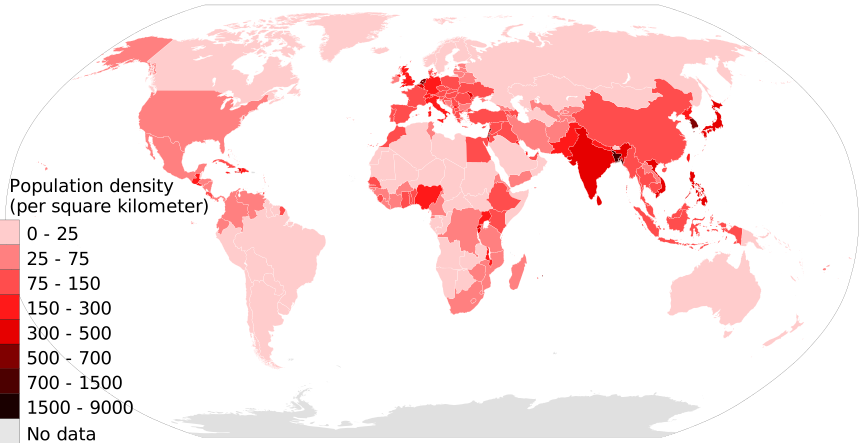
What? https://upload.wikimedia.org/wikipedia/commons/3/31/Populati...

That blackish blob in Europe is the Netherlands.

Re:Amsterdam’s canal houses have endured for 300 years by arethuza on Thursday January 16, 2020 @09:04AM (#22064575)
That's showing the average across the entire country - sounds a bit like the UK where average population density figures for the entire country are a bit misleading as there are substantial chunks of the country that are pretty empty:

https://www.sheffield.ac.uk/news/nr/land-cover-atlas-uk-1.74...

Re:Amsterdam’s canal houses have endured for 300 years by Luc on Thursday January 16, 2020 @09:19AM (#22064698)
Have a look on Google Maps instead. What's north of Amsterdam-North? Fields.

It's a political choice, a matter of spatial planning, to live this densly.

Re:Amsterdam’s canal houses have endured for 300 years by eecc on Thursday January 16, 2020 @09:45AM (#22064946)
There’s also a big toxic waste dump that makes that area verboten for the foreseeable future https://www.volgermeer.nl/Geschiedenis/Stortplaats/
Re:Amsterdam’s canal houses have endured for 300 years by brnt on Thursday January 16, 2020 @09:01AM (#22064546)
When I am abroad, I tend to describe it as Bangladesh on the Rhine. Your map proves my point ;)
Re:Amsterdam’s canal houses have endured for 300 years by tnolet on Thursday January 16, 2020 @09:24AM (#22064758)
Averages are misleading when applied countrywide. Just drive through Groningen, Friesland, Drenthe etc. (all provinces) and you will get a totally different picture.

I actually just landed at Schiphol on a clear day and you can see the country just has so much sparsely populated areas peaking out the window on approach

Re:Amsterdam’s canal houses have endured for 300 years by himlion on Thursday January 16, 2020 @09:43AM (#22064922)
That's on purpose. You are not allowed to build outside of the core areas. We do this because we don't want it to end up looking like Belgium.
Re:Amsterdam’s canal houses have endured for 300 years by AllegedAlec on Thursday January 16, 2020 @09:43AM (#22064930)
Even Groningen (the Province) has a population density of 252, about 7 times as high as the US's average of 33.6/km2.