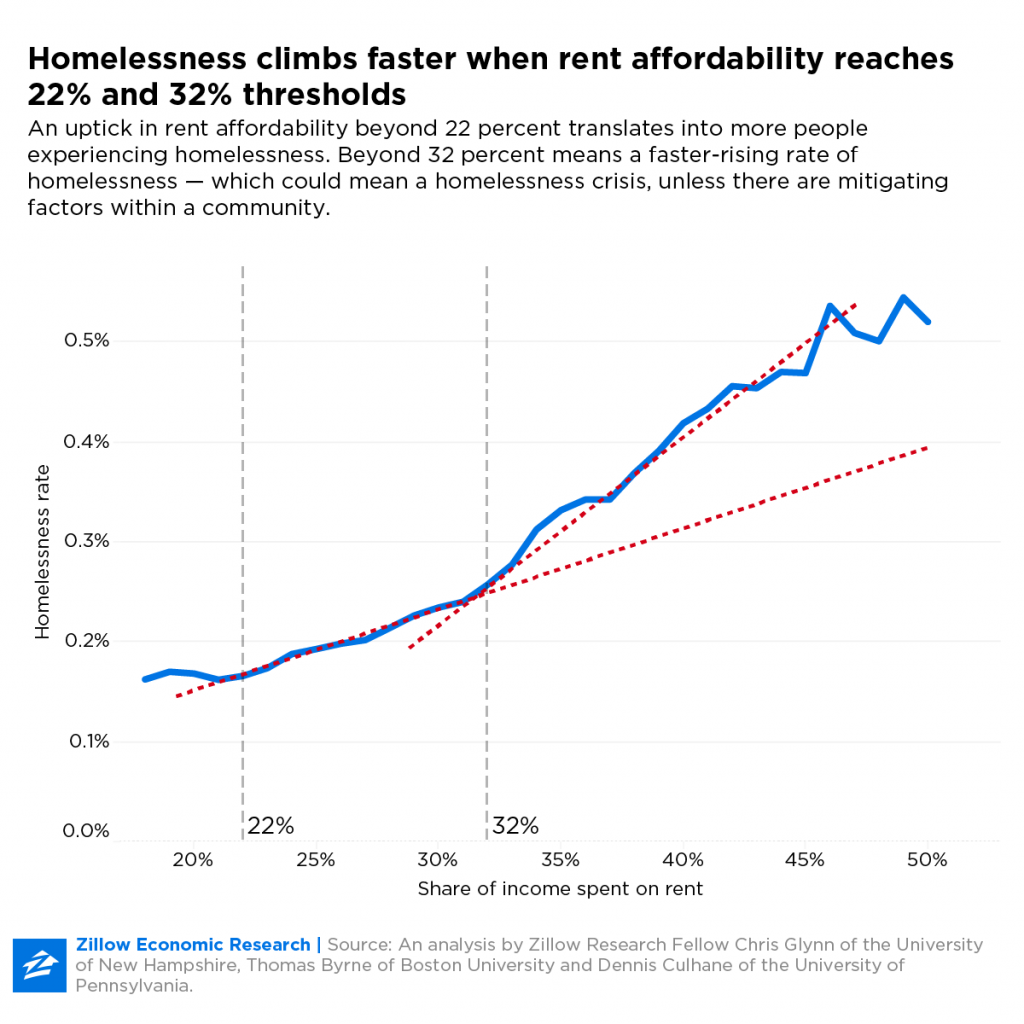
Zillow's research group looked at the correlation between rent (as a % of income) and homelessness rate. "Homelessness Rises Faster Where Rent Exceeds a Third of Income": https://www.zillow.com/research/homelessness-rent-affordabil...
That's not causality, but it's not nothing. In particular, they found two inflection points: "The first threshold is 22 percent: Any uptick in a community’s rent affordability beyond 22 percent translates into more people experiencing homelessness. The second threshold is 32 percent: Any increase in rent affordability beyond 32 percent leads to a faster-rising rate of homelessness."
Obviously both rent and income affect % spent on rent, but reducing or eliminating municipalities' bans on certain housing styles is far simpler than changing the supply of jobs.
(Full paper is "Inflection points in community-level homeless rates": https://wp.zillowstatic.com/3/Inflection_Points_20181213-ee1...)
Here's a graph: https://wp.zillowstatic.com/3/inflection-72aee4-1024x1024.pn...
But, homelessness is also a trap. Once one becomes homelessness, life changes very quickly, and it's hard to get out of it - it's almost impossible to wash off the literal and figurative stink of it and find a way out, even when one of those ways might be moving to a cheaper state.
How is allowing current owners to assert control (via regulation) over land they don't own, to serve their own private interests, better than allowing that land to be developed for higher-density use, in the interest of a larger number people?
Society isn't obligated to protect people's investments at the expense of its least fortunate members.
1) Why is using supply / demand the best way to set a price for a house?
2) Why should Americans be able to live and protect a town and prevent it form becoming a big city?
As for 1, because that is human nature. Any other method that goes against human nature doesn't work in large scale. In places that set a price, typically products are given to people with connection (see Soviet butcher getting their kid into a good school by giving the best cut of the meat to the teacher).
With regard to 2, this point comes down to what rights you think someone should have. I believe that a community should be able to form and develop themselves without too much government interference. Let's say that a community builds themselves under a tight bond, like the Amish. Imagine if the government wanted to create a huge homeless shelter in their community and house many previously homeless people there. That would completely disrupt their peaceful way of life. It seams logical to say that in that case it is bad what the government did. Similarly, some people building a town don't want the crime / dirtiness / corruption of big city. If a politician were to campaign that they will turn every town into a big city, I doubt that they would win.
With regard to topic 2, no community has the legal right to exclude anyone from moving there. If it makes economic sense for newcomers to arrive, they will arrive. If supply and demand were allowed to operate, homes would be built for them as they arrived. Instead the wealthiest members of the community interfere with supply, for their own benefit, and the least fortunate members of the community are evicted.
(I'm disregarding the homeless shelter in the Amish community because it's a contrived example. It's too far removed from any actual set of conflicting interests to have much bearing.)
There are currently two Americas: the one inhabited by the ~10% of people who work in tech and make $150k+, and the one inhabited by everyone else. If you’re part of “everyone else,” your participation in the economy is likely in domestic service to them (Uber drivers, house cleaners, etc). If you’re complaining about immigrants taking jobs, you’re probably part of “everyone else” — immigrants are seen as a positive to folks in my social class because they’re cheap domestic labor. It’s why the GOP has supported lax immigration policy for decades.
We need to have a serious conversation as to whether food, shelter and health care should be considered human rights. Free market economics cannot solve this problem — it actually only serves to make workers more desperate so they accept shittier and shittier working conditions serving the elite in order to eat.
No, but if he has five times as many people competing for the same position, he won't have to pay as much to fill it.
Responsible people don't subject their kids to life on the streets. Addicts do. I've worked in homeless shelters in DC, Denver, and even Arkansas. My mother died a homeless drug addict. She and her husband were very adept at moving from city to city, usually at the urging of social workers who would tell them what city they could move to after they had exhausted the temporary benefits of the current city. They never were willing to hold a job.
When rents get too high, normal functional humans move to another place, or take a roommate. My father had 5 kids to raise by himself when my mother bailed on us, and we had to do this.
Addicts like my mom fooled dozens of social workers into thinking they were just normal people who couldn't get work. She could keep the act up for 8 hours or even longer. But a 2 day period was all it took to see through the bullshit. I think you got fooled as well. Talk to any drug treatment specialist and they can explain to you the reality.
Temporary homeless vs chronically homeless are two different problems with 2 different causes. California is filled with chronically homeless people. If you think they want to work, you don't understand drug addicts and their generally high intelligence and ability to manipulate.
That's ridiculous. Roommates are something for students, not for people working a full-time job.
If an adult working full time for minimum wage cannot find any housing options, the housing market is broken and needs repair.
Sounds like you agree that high rents are at least somewhat to blame for homelessness.
I would take all this a step farther, in fact: the recent surge in illegal immigration is, itself, a proximal cause; that phenomenon is being now driven by climate change. But again, you don't usually hear that mentioned when people and news outlets discuss illegal immigration.
I’m curious what you mean by that. According to the DHS [1], Mexico is far and away the most represented country of origin for people who have immigrated to the US illegally. Are you saying this is caused by climate change acutely affecting Mexico’s economy?
[1] https://en.m.wikipedia.org/wiki/Illegal_immigration_to_the_U...
I'm not sure that's relevant. Based on your anecdote, the people in question in tent camps wouldn't be taking the jobs regardless of the immigration situation.
> The [Los Angeles] Times, however, found that about 67% had either a mental illness or a substance abuse disorder. Individually, substance abuse affects 46% of those living on the streets — more than three times the rate previously reported — and mental illness, including post-traumatic stress disorder, affects 51% of those living on the streets, according to the analysis.
https://www.latimes.com/california/story/2019-10-07/homeless...
As a formerly homeless person, eventually we give up looking for work. We wouldn’t be counted in the top line unemployment number.
That being said, I would recommend universal healthcare, vouchers for free daycare for lower-income Americans, and a new omnibus of worker protections to allow more humane workplaces (sorry, Amazon and Tyson Chicken). Also, much more vigorous prosecution and sentencing of those who employ illegal immigrants.
There's tons of affordable housing in the country.
> Universal healthcare.
If you show up at ER, they cannot legally refuse you healthcare. They'll bill you a lot, but since you're homeless, fortunately you'll never get it in mail.
> Basic income.
And when the basic income check gets immediately exchanged for drugs, what then? How does it help?
> Perhaps universal higher education.
That would destroy most of the value of higher education. If everyone has a degree, it makes a degree worthless: outside of some small percentage of students, higher education don't really teach anything useful, it's value is mostly in certifying that you're a kind of person who is smart enough to get admitted, and conscientious enough to jump through required hoops.
> Actually collect taxes from the very very large companies (Apple Amazon, etc).
How much do you think you'd be able to collect from them? We already pull trillions in taxes. Is everything else so much higher priority that we couldn't already shift our spending to fix this problem? Really, this is not a problem of lack of resources, though your eagerness to tax the big bad business shows where your priorities are.
https://www.usich.gov/resources/uploads/asset_library/Homele...
That took me less than a minute to find, though it’s not the first source I’ve read on the subject
The recurring theme between several studies is that of the homeless, 80% are able to recover in less than a year; while 20% are chronically homeless due to mental disabilities or drug addiction
I just find it ironic that you complain about a practice that you do yourself
They didn’t say that. They said “unauthorized immigrants”. Most people aren’t anti-immigration, but rather against unauthorized immigration.
I've done several of these in my youth - they were luxurious compared to the offerings now. Forty hours a week, no gamification, human bosses, daytime shifts, few injuries. Making the workplace like that would be an actual effort at making America great again.
I’m joking of course, but I know someone’s seriously thought of this.
Well, that part is redundant because if they were, they wouldn't be allowed in homeless shelters in the first place! An obvious source of selection bias.
I can tell you from my experience working in homeless encampments in Oakland that most of the people living there are neither mentally ill, nor abusing drugs. Most of them are people who would ordinarily work on the very bottom rung of the employment ladder, in jobs that 20 years ago would be a good fit for someone undermotivated, or quirky, or otherwise unfit for a more “responsible” job.
But there’s no place for them anymore; automation has replaced some of those jobs, and a combination of plunging wages and a more ruthless Amazon-style workplace has made many of the jobs that are left intolerable. People are choosing a tent in the park in Oakland over working three part-time jobs and being micromanaged by an AI just to barely afford 1/7th of an apartment. And, we have imported tens of millions of unskilled, mostly unauthorized immigrants who are happy to take those jobs - another thing you won’t hear discussed in these articles.