Re:Homelessness rises in U.S., driven by California housing ...
by jetrink on Sunday December 22, 2019 @11:28AM
(#21858034)
So 'rent affordability' here means percentage of income spent on rent? Higher affordability means higher rent/income, which means rent is less affordable. This is very confusing terminology.
Re:Homelessness rises in U.S., driven by California housing ...
by troydavis on Sunday December 22, 2019 @11:40AM
(#21858115)
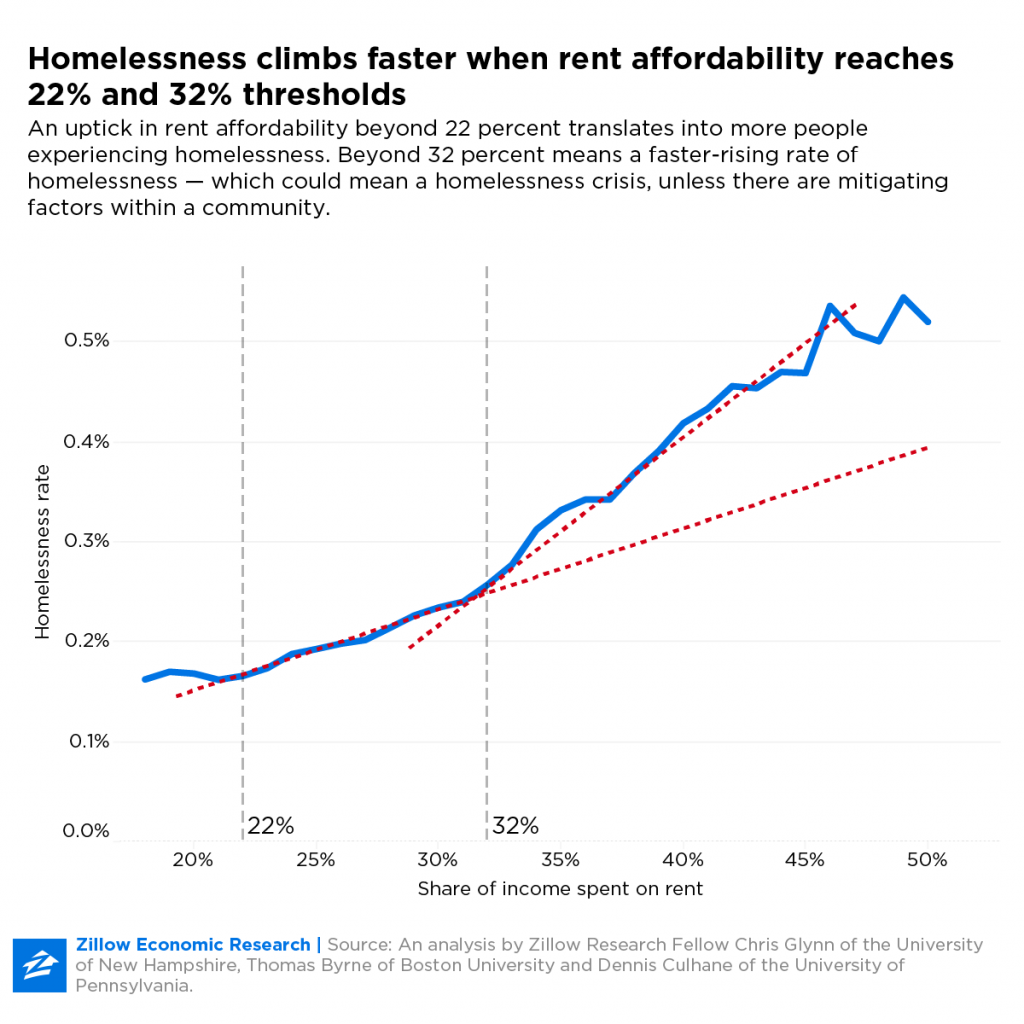
It's simpler than it sounds. "Rent affordability" is rent as a % of income. Going above 22% is associated with an increase in homelessness. Going above 32% is associated with a change in the rate of increase in homelessness (ie, not only does it rise, it goes up faster than it does from 22%-31%).
Here's a graph: https://wp.zillowstatic.com/3/inflection-72aee4-1024x1024.pn...
Re:Homelessness rises in U.S., driven by California housing ...
by friedman23 on Sunday December 22, 2019 @11:33AM
(#21858069)
It is not confusing at all you've just put it backwards. High affordability means a low rent/income ratio.
Zillow's research group looked at the correlation between rent (as a % of income) and homelessness rate. "Homelessness Rises Faster Where Rent Exceeds a Third of Income": https://www.zillow.com/research/homelessness-rent-affordabil...
That's not causality, but it's not nothing. In particular, they found two inflection points: "The first threshold is 22 percent: Any uptick in a community’s rent affordability beyond 22 percent translates into more people experiencing homelessness. The second threshold is 32 percent: Any increase in rent affordability beyond 32 percent leads to a faster-rising rate of homelessness."
Obviously both rent and income affect % spent on rent, but reducing or eliminating municipalities' bans on certain housing styles is far simpler than changing the supply of jobs.
(Full paper is "Inflection points in community-level homeless rates": https://wp.zillowstatic.com/3/Inflection_Points_20181213-ee1...)