There's a lot of confusion, I think, about how you "win" a trade war; as far as I can tell, autarchy is pretty bad for all involved; trade wars seem like a thing where everyone loses and the 'win' comes from winding down the trade war and trading again.
This is a current goal of the government of China. It's called "Made in China 2025", and was announced in 2015.. "The goals of Made in China 2025 include increasing the Chinese-domestic content of core materials to 40 percent by 2020 and 70 percent by 2025.[5] The plan focuses on high-tech fields including the pharmaceutical industry, automotive industry, aerospace industry, semiconductors, IT and robotics etc, which are presently the purview of foreign companies." There's been some backing off on this from the government of China for PR purposes, but the big goals seem to be on track. Key items include a leading position in semiconductors and in aircraft. Semiconductors seem to be coming along well. In aircraft, the COMAC 929 is a medium-sized airliner with five prototypes flying. The engine is still imported, but an engine to replace it has been developed to the prototype level.
China already has the world's largest auto industry, so that's covered. Also the largest robot industry. Don't know about pharma.
You think the US is less industrially capable than in 1980? that... seems unlikely. Sure, we import and export a lot more of our stuff now than we did then, but that's because we live a lot better when we trade (and because the technology of trade has improved vastly.)
I mean, certainly, both the US and China could survive without trade. hell, there are a bunch of people who could pull it off just by themselves. But... in all cases, all involved would be a lot poorer; they'd work a lot harder for a lot less.
Once you lose a capability it’s gone forever. That is why countries cling desperately to domestic steel, shipbuilding, arms and other industries. Once the institutional knowledge is gone and the infrastructure is gone it’s never coming back. And other countries whose interests may not align with your own have you over a barrel.
This is... not my impression, from working around Engineers all my life. My impression is that cutting edge manufacturing techniques from the '80s are now available, cheaply, to hobbyists. Stuff these guys put in the basement and work on then they are sick of javascript. (FDM aside, I could walk to several CnC lathes and... three large laser cutters from where I am right now, all dedicated to hobby usage, all of which see pretty regular use)
My impression is that if you paid your professional engineers as much to design automated widget factories as you pay them to design advertising systems, they'd make something serviceable. And sure, rev 1 isn't going to be as good as rev 2, it never is, The institutional knowledge effect is big... I'm just saying it's not insurmountable, and the US is a rich country. If we cared, we'd spend money and solve the problem.
I personally think the big capability we are putting in danger right now is the capability the US has always had to hoover the best minds from all over the world, to persuade them to come and set down roots and work in the US. That's the long term problem I see with the way we're going.
I think the second big capability we are putting in danger is that culturally, my impression is that the US is valuing education less than it used to. As a side effect, we're not paying to educate our people (and, I would argue, my compatriots are becoming harder to educate as a result.)
The long term advantage China has over the US is not really institutional knowledge; the long term advantage is that they are putting a lot more effort into education than we are, (and we are not scooping up those educated minds the way we used to.)
Re-training an Engineer from one field to another is a lot easier than bringing someone up to speed who isn't educated; I've watched both happen, and... one is definitely less effort than the other.
Not exactly: that's only true if you let neoliberal economists set your economic policy.
Countries like China recently gained those industrial capabilities, and the reason for that is not just because they have access to cheaper labor. More importantly, they have industrial policy that prioritizes the development of domestic industry.
Nothing fundamental prevents Western democracies (perhaps collectively) from implementing industrial policies that prioritize industrial development rather than stuff like finance in its ever more byzantine forms [1].
[1] I read somewhere that financial development is only really beneficial up to a point. Past that point, it actually does more harm than good.
Don’t forget the psychological side. If an industry is booming then ambitious, motivated people flock to it, colleges teach courses in it, people look to build long-term careers in it. The West had that from the Industrial Revolution up until the 80s maybe. China has it now. There are still a few steelworkers and shipwrights and even miners in the UK but those industries are winding down. If we ever need a lot of warships in a hurry - which has happened not that long ago - we would struggle. The expertise is lost.
The remaining industries are also integrated or partially integrated.
A decade or two passes and rebooting your widget industry will be an order of magnitude harder than it was to start in the first place.
Eh, you don't want any of the old equipment anyhow, you want new computer controlled stuff. I mean, sure, the people making that equipment need to have some experienced machinists, but... not so many of them; you mostly want Engineers for this job.
I think the problem America has is not with losing existing factories, but in how little value we place, culturally, on education.
In fact, many industries reinvent themselves periodically just to stay current. Restarting a factory can't be much different.
People forget that a factory itself is a sophisticated machine and operating it is an advanced skill that relies heavily on experience. A car factory is considerably more complex than any of the cars it produces, for example. Or, we never had a fab in Wales, but it’s a similar analogy. And then there’s the logistics, the supply chain, again a massively complex thing that is often overlooked. Maybe the factory had hundreds of suppliers and subcontractors, they would all need to be rebooted too. It’s a fractal problem.
If we threw the sort of effort (and by effort, I mean money) into reindustrialization that we throw into, say, selling ads, the problem would fall pretty quickly. Heck, the net effect would be that the same people would work on it, if the money shifted.
(I actually think the bit about using most of the same people is... pretty true? half the programmers I support are actually trained as some other sort of engineer; but writing code is massively more remunerative, say, than actually working as a chemical engineer or mechanical engineer, and programming is something that can be done by nearly everyone who can handle the education, as far as I can tell, required to become a real engineer)
Perhaps the widespread belief that economic growth equals wellbeing is the real problem here. Plenty of places on Earth with 7% gdp growth that you need to pay me to live in.
Combine that with the fact that after working all those hours, senior poverty rates are also much higher than in the US, and it doesn't exactly seem like a laborer's paradise.
Health and safety are great, but like GDP and money, they're not the only things that matter.
And while not addressing your clearly correct comment, I'd far prefer to be a remote worker in Osaka or Tokyo than virtually all cities in the US despite language/cultural difficulties.
Seems like objective improvements.
(1) https://data.worldbank.org/indicator/SP.DYN.LE00.IN?location...
(2) https://data.worldbank.org/indicator/SP.DYN.IMRT.IN?end=2018...
(3) https://data.worldbank.org/indicator/VC.IHR.PSRC.P5?location...
"With 15.7 percent of people in poverty, Japan was above the average percent of 11 among the OECD member states." "Japan has some of the highest rates of child poverty in the developed world, according to a Unicef report."
It seems like most people just parrot: "War. Bad."
I'm not saying this administration is doing everything right on trade, or that it's even doing anything right on trade.
It just seems like people think that what was before "the trade war" was the default, and that the default was fair.
It was heavily weighted in favor of the US which is why the US became the richest country in the world and benefited the most from international trade.
Classic example are the complaints about Apple products being manufactured in China. However, as study after study has shown, a $600 iphone probably leads to economic activity of about $40-$50 in China at most, with a further $50 or so in the rest of the world, and the remaining $500 being generated in the US.
The US had a massive problem which is that this tremendous wealth that was generated was thanks to a variety of reasons concentrated amongst a few people right at the top, and unlike in decades in the past the benefits stopped trickling down to the rest of the country. But the real problem was an internal distribution one, which the current administration only served to exacerbate.
So, I'm not an expert, but... my understanding is that China is accused of subsidizing domestic manufacturing. Analogous to the sort of dumping that uber and lyft do, really; Much like how Softbank subsidizes my ride to work in the hope that they can jack up prices once I get really used to it, the Chinese government is subsidizing my consumer goods purchases, with the hope that manufacturing will decline elsewhere to the point where they can some day jack up prices to market-clearing levels.
I mean, is that fair? no. Is this something the market does on the regular, even without government having a hand in it? yes. Is this bad for the USA? If we lose manufacturing ability, probably... but this has been going on for a generation now. How long would it take us to re-gain or move the manufacturing of our consumer goods? (we already keep manufacturing of defense goods in the USA, for exactly this reason. My own guess is that if there was economic reason to move more high-touch human labor intensive manufacturing in-house, we'd make like BMW and build plants in South Carolina and similar places with fewer unions, and we already do a bunch of automated manufacturing here.) - the implication here is that just like Uber and softbank, I am not sure this is a long-term profitable thing for China to do, and I have the (controversial) opinion that the market in the USA is healthy enough that if we needed to build more manufacturing here, we could do it pretty quickly)
(I mean, the other side of this, the complex part that I personally don't entirely understand is that the USA subsidizes a lot of domestic industry, too... most famously the agriculture sector. As a us citizen, I totally support my tax dollars being used to make sure that we overproduce food. That seems like an extremely reasonable thing to do. (it does get more complex when that food is sold elsewhere, but I am not an expert) - My understanding is that the US also subsidizes a lot of US manufacturing... I mean, my feelings on that are more mixed... but I personally don't see subsidies as inherently evil or incompatible with doing lots of trade with another country.)
>It seems like most people just parrot: "War. Bad."
We're talking about a trade war here, which is a different sort of animal.
Please understand that I'm saying "Trade: good" - a subtle difference. And I do think that trade is usually good, even trade with someone who is subsidizing their goods.
(I have... very different feelings about trade sanctions, about restrictions on trade as a way to get a country, say, to respect human rights. But I don't think that's what the trade war with China is about; the trade war with China, as I understand it, is about tariffs and subsidies)
Not sure if you've noticed, but manufacturing is starting to come back in the US. Industrial automation and skilled trades jobs are starting to be a thing again. These are solid middle class jobs that often dont require a degree. Its coming at the expense of some pain in other areas, but it might be an overall positive.
The path we were on was not sustainable. The US lost a LOT of capability over the last 20 years. Getting that back is critical and will not be painless.
My understanding is that most of the really good paying manufacturing jobs aren't coming back; the manufacturing that is coming back is non-union and pays worse than a union job (and much worse, say, than the better IT jobs that don't require a degree.)
I personally think it's super weird that people (especially in the USA) seem to think that manufacturing jobs are inherently better than other jobs, when my impression is that most of the pay advantages are simply that it is a class of jobs that unionized while it was in high demand, preserving some of the benefits of being a high demand job through a time when demand had fallen.
I don’t think they’re inherently better, but I do think the person who invents the next big thing will necessarily be a person who knows how to manufacture the current big thing, so the more people we have who know how to do that, the more likely we are to lead the next wave.
but in return, the US gained a lot of cheap goods. Cheap goods which then increased profits for businesses.
Unfortunately, the lower working class is unable to reap this reward.
If manufacturing and industry returned, it may mean that cost of goods would become more expensive, and it can slow the economic expansion of the US. Whether you see this as a good outcome or not depends on your personal ideals however.
citation needed...
My understanding was that US manufacturing output has been steadily growing (even if employment has been falling) for all of that time.
https://research.upjohn.org/cgi/viewcontent.cgi?article=1250...
Sure, all of that can be turned around, but the trend is toward losing capability to do advanced things.
Fundamentally it's time to wake to the fact that the CCP views the very existence of Liberal Democracies as a threat to itself [1]. It will work to undermind or extinguish then where ever it can. Facing the Soviet Union had a cost. Facing Nazi Germany had a cost. And facing the CCP will have a cost.
so you are saying that a trade war is successful if there are fewer barriers at the end than at the beginning? That's a reasonable definition, but that would benefit both parties, so it still doesn't really show a "winner"
> And facing the CCP will have a cost.
But if you define a successful trade war as one where there are fewer barriers to trade at the end than at the beginning, that will benefit both parties.
I mean, one could argue that free trade (well, more trade) is going to make your society more free in general, is going to introduce more ideas and things like that, I suppose, and you could also argue that trading more with a country makes it less likely you will go to war with them, but these things aren't really about crushing your competitor.
One who would argue something like that in the face of the decidedly not free CCP run society that is modern China is fooling themselves. And their mode of operation is most certainly about crushing competitors.
That's what I mean by trade spreading ideas. These people clearly have learned a lot from American culture (and I have learned a lot from them) - I personally think that when trying to get things done, the more people you have from different backgrounds, the more different ideas you have, and the more likely you are to come up with a good solution.
(And further, this trade war, as I understand it, isn't about talking the CCP into treating it's citizens better, it's about tariffs and subsidies, matters with far less moral force.)
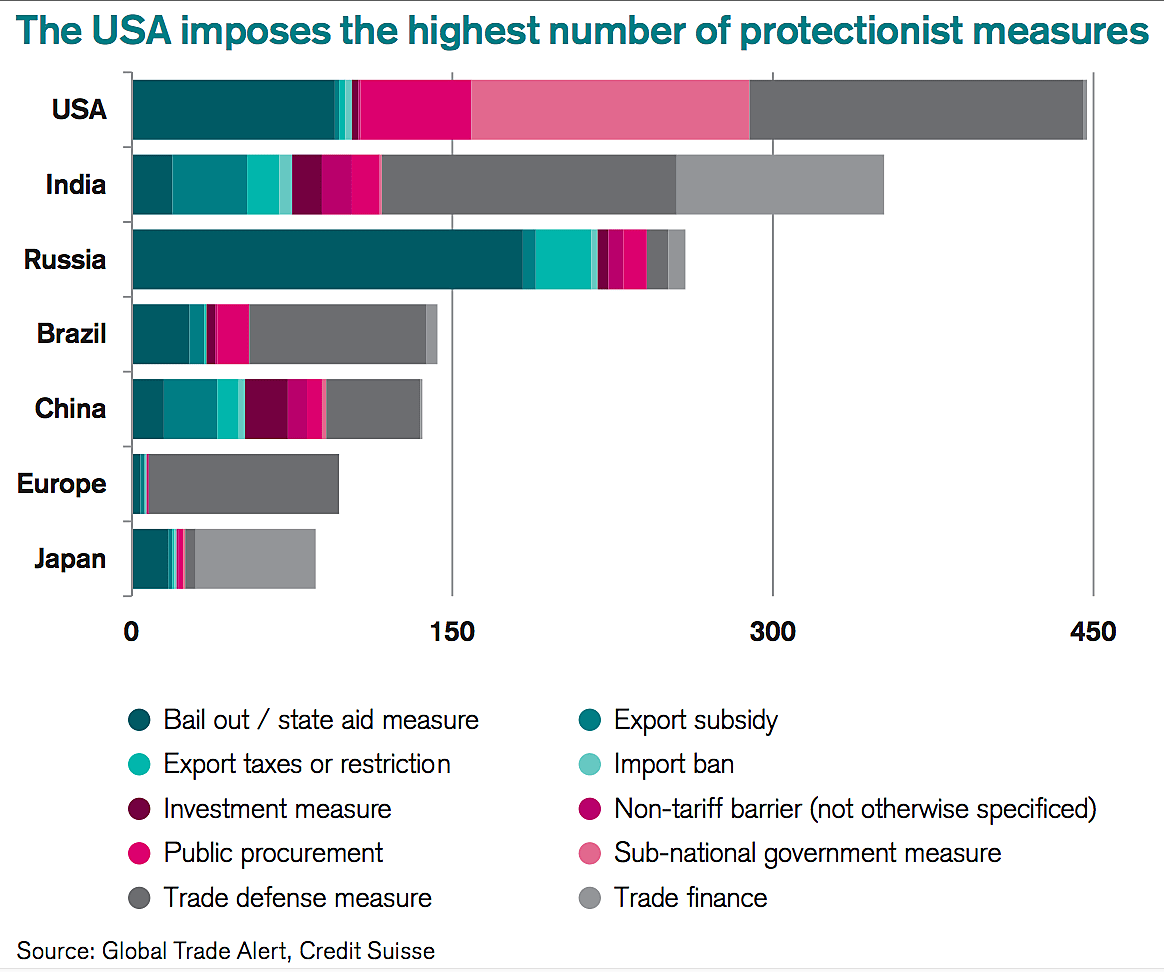
As for the free trade question, China has a higher mean tariff rate ~2% more, which is comparable to other developing countries. But viewing "free trade" in tariff lens doesn't present the whole picture. In terms of trade barriers US has more protectionist measures than China [1]. Go look up a list of WTO complaints to see who the largest free trade abuser is, a good visualizer [2]:
>China was involved in 63 disputes with 9 Economies from the time it acceded to the WTO in 2001 through 2018. China has been the complainant 20 times and the respondent 43 times.
VS
>United States was involved in 275 disputes with 42 Economies from the time it acceded to the WTO in 1995 through 2018. The United States has been the complainant 123 times and the respondent 152 times.
Or look up some US Chamber of Commerce surveys, Latest U.S. China Business Council's (USCBC) survey tldr was basically US companies overwhelmingly convinced Chinese companies receive (alleged) unfair state subsidies but they don't care because even with the tradewar, 97% of respondents said their China operations were profitable which is UP from 85% in 2015. Overall, business in China is good, select industries face more barriers than others (some technology, many financial services), industries with the loudest lobbying groups that skew the narrative.
[1] https://www.cato.org/sites/cato.org/files/styles/pubs_2x/pub...
[2] https://chinapower.csis.org/china-world-trade-organization-w...
[3] https://www.forbes.com/sites/kenrapoza/2019/08/30/us-compani...
https://www.wto.org/english/tratop_e/dispu_e/dispu_maps_e.ht...
https://www.wto.org/english/tratop_e/dispu_e/dispu_maps_e.ht...
That's not to say Chinese markets aren't protectionist, every country is, with the harshest measures reserved for strategically important industries, typically with extremely well funded and loud lobbying groups. A handful of large companies complain about tech transfer, but relative to all sectors their concerns are marginal - latest American Chamber of Commerce in Shanghai poll of US companies on top priorities for current trade talks and 0.4% of respondents thinks force tech transfer is an important issue. But those 0.4% of companies encompass strategic industries with disproportionate geopolitical ramifications, so their concerns are magnified for IR theater to distort the narrative. There's a reason the pivot to Asia and the narrative against Chinese development started when Made in China 2025 was announced to supplant western dominance in key high tech fields. It's unserious to rationalize US actions against China to preserving free trade - it's more geopolitical maneuvering to protect US industries, as others have mentioned it's the same story behind Japan with Plaza Accord that also targeted West Germany.
In 2005, in roughly the middle of the timeframe, the US economy was almost 6 times the size of China's.
Maybe you could expand on why you don't think claims should scale with the size of the economy, since you seemed to ignore the suggestion of normalizing for that.
>The EU was involved in 184 disputes with 27 Economies from the time it acceded to the WTO in 1995 through 2018. The European Union has been the complainant 99 times and the respondent 85 times.
VS
>United States was involved in 275 disputes with 42 Economies from the time it acceded to the WTO in 1995 through 2018. The United States has been the complainant 123 times and the respondent 152 times.
If you want to consider the scale of economy, then also factor in that US is one of the least trade-dependent developed economies in the world, i.e. trade-GDP is very low. Comparison of OECD countries including EU [1], US trades (low end estimate) half as much as EU, which makes the number of US disputes even more disproportional relative to unit of trade. Or the fact that US as a country somehow lodged more complaints than all EU members with their wildly disparate interests.
[1] https://data.oecd.org/trade/trade-in-goods-and-services.htm
Taxes, tariffs, import/export bans of goods or technology, etc. are all just tools in the arsenal of both sides they will use when it seems to give them an edge over the competition.
The fact of the matter is that both the US and China could survive (albeit with a lower standard of living) without external trade entirely. I don't think the same could be said for an all-out war.
An all-out war between the two countries would likely kill most of us and put the standard of living of the few survivors below what you and I would call 'civilization' - one side might lose harder than the other, sure, but the consequences would be essentially unthinkable for both.
1. its economic model was dysfunctional and a failure
2. Its moderate leaders (aka Gorbachev and his allies), decided to dismantle it, as they realized the model was a failure, and their only other option was to become extremely repressive, roll out tanks and kill people. (north korea is an example that given enough repression, even an extremely poor economy is not enough to dismantle a bad government.)
The soviet union was away behind the US (gdp per capita) in the 50s and early 60s, where computers were less developed and less important (to the general economy at least).
The soviet union failed, because centralized, collectivism, and having all the output owned by the state is a failure as a model.... as it goes against basic human nature.
https://upload.wikimedia.org/wikipedia/commons/c/cc/Soviet_U...
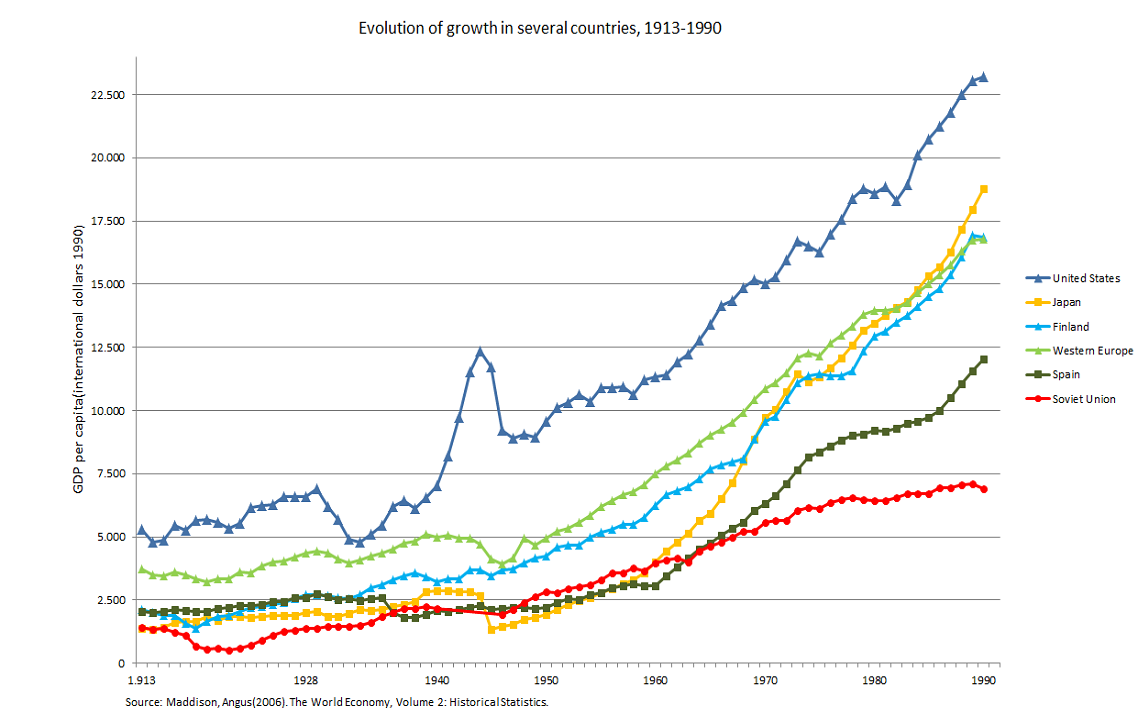
Look at Spain's economy, how it is transformed after Franco died and the fascist regime is removed and the country opens up, gets less centralized.
Another analogy is Argentina. Where there was too much central planing, and state dictated economy. Compare it against Canada, (open and capitalistic), and you see that the system is the main culprit, and not necessary computers.
The graph shoots up in 1960 and slows down in 1975. Franco died in 1975, so your assumption that fascism and central planning hurt the economy is contradicted by the data.
If Wikipedia is to be believed, the actual cause was that the old central planners were replaced by new ones who were actually competent and made policies to support industrialization: https://en.wikipedia.org/wiki/Spanish_miracle
https://en.wikipedia.org/wiki/San_Jose%E2%80%93San_Francisco...
https://tradingeconomics.com/russia/gdp
Obviously there were lots of reasons the Soviet Union collapsed (Chernobyl, for instance). But ignoring the importance of the computer industry in the information era seems like a big oversight.
Again, I was comparing data from the 50s and early 60s, where computers were just not that wide use yet and the computer industry was not even a blip on the overall economy.
You also can claim: Today's US entertainment output, equals half of USSR's GDP. Then US won the cold war because it's move industry. Than you can do the same comparison for medical, agriculture, etc... etc.. then you see the trend that due to its failed system, the USSR was behind the US in every field, and tech was just one of them.
I haven't, but why does it matter? I'm not saying communism is better than democracy, nor did I imply it. Things have been way more fucked up in North Korea longer than the Soviet Union survived, so just being fucked up is not enough for a government to fail (not that I'm optimistic about North Korea's future).
> Again, I was comparing data from the 50s and early 60s, where computers were just not that wide use yet and the computer industry was not even a blip on the overall economy.
I think most people on HN are familiar with the story of how computers won WWII, where Von Neumann used them to decipher German and Japanese encrypted communications. Also the Apollo missions were all controlled by circuits. Computers have been massively important (and expensive - the modern equivalent of ~100 billion USD was spent putting a man on the moon, and some of that includes developing IC technology) for a while.
> You also can claim: Today's US entertainment output, equals half of USSR's GDP. Then US won the cold war because it's move industry. Than you can do the same comparison for medical, agriculture, etc... etc.. then you see the trend that due to its failed system, the USSR was behind the US in every field, and tech was just one of them.
Except the Soviets weren't trying to replicate the movie industry because it wasn't particularly useful for them. But they immediately understood the value of computers, and put significant efforts into developing their technologies.
And the Soviets weren't behind in everything. Contrary to popular belief, the Soviets were ahead in the Space Race until Korolev died. If you want an example of petty politics ruining a nation's future - Korolev's death is my all time favorite. That man made Von Braun look ordinary. It's weird to think how history might have turned out differently had the Soviet Union not sent one of the most brilliant men in history to the gulags.
https://en.wikipedia.org/wiki/Sergei_Korolev
Ironically the US did something similarly stupid by refusing to allow Qian Xuesen to stay in the United States, effectively creating the Chinese space program.
> I think most people on HN are familiar with the story of how computers won WWII, where Von Neumann used them to decipher German and Japanese encrypted communications. Also the Apollo missions were all controlled by circuits. Computers have been massively important (and expensive - the modern equivalent of ~100 billion USD was spent putting a man on the moon, and some of that includes developing IC technology) for a while.
Sure, they have been important, but again, they're not the key. As others have pointed out, the USSR was economically behind the US even right at the beginning of the cold war. Technically, the USSR was able to fight the Germans specifically because of the billions of dollars in Material that the US supplied to the USSR. The American view of the Soviet Union has been shaped by the simple fact of MAD with nukes and various made up scares (e.g. the space race), but if you look at economic and sociological data (e.g. life expectancy), the US was ahead of the USSR for the duration of the cold war.
As the GP has pointed out, reasonable people came to the conclusion that the system could not continue to exist without massive repression and tried to change it.
Your other arguments don't seem to make any sense, and are just referencing historical tidbits.
Had the Soviets developed IC technology and the US failed to do so, do you still believe the Cold War would have turned out roughly the same? I suspect it would have bolstered the Soviet economy, allowed them to develop technology faster than their adversaries, and ultimately win. You're right, this is a guess, because it's impossible to know. I'm also not pretending it's an infallible argument, just as others have pointed out flaws in your theory (that the USSR failed because it lagged behind in terms of economic growth) elsewhere in this thread. I feel like you're focusing on the end of the Cold War, and I'm looking earlier and how it could have influenced those later conditions. It's like trying to understand Germany in the 1930's without considering WW1 - there's a reason it developed that way.
I don't think there was only 1 key thing that decided victory of the Cold War, I believe there were many key things. To clarify, a key thing is something important enough by itself to swing the pendulum either way. I already mentioned the development of IC technology by the US and the Chernobyl failure by the Soviets.
Anyway, I appreciate your perspective. Agree to disagree.
I think you're looking at this as a debate instead of a conversation. I don't care whether or not you agree with me. I'm sorry you found the idea so distasteful.
I'm sincerely trying to have a conversation here. I feel like you're frustrated because you're sure I'm wrong, and you're unable to convince me I'm wrong. But that's just the way the world works. In fact, it's a cornerstone of the very system you're so passionately arguing is superior (western democracy / capitalism - I realize these aren't the same but in this instance it seems relevant to blur the lines). Sometimes people are going to vote against you, even if they're "wrong."
Why not just accept that I'm wrong and move on? What makes you think it's even possible to change my mind at this point?
I can understand that you're frustrated, but at this point I'm not sure what your goal is unless you still think you can change my mind.
If you think your theory is still valid without any good arguments for it, you are free to continue spreading them. You will just not be taken very seriously by people who consider fact-based arguments as a foundation for reasoned arguments, which incidentally are many people in this particular forum.
For what it's worth, I actually appreciate this - even though it probably doesn't seem that way.
> You will just not be taken very seriously by people who consider fact-based arguments as a foundation for reasoned arguments, which incidentally are many people in this particular forum.
The upvotes on my comments suggest people found what I had to say interesting. Of course that doesn't make me right :)
Cheers.
"1. its economic model was dysfunctional and a failure"
The USSR had a good economy for some time. During Stalins brutal industrialization, growth rates may have even outclassed Chinas. E.g. 13% p.a. over 12 years, the numbers are controversial. I have a paper about it. Fact is, in WW1 and WW2 Germany faced a very different country.
The later decline may also correlate with declining oil production. The USSR sold a lot of Oil and Gas to the west.
"The soviet union failed, because centralized, collectivism, and having all the output owned by the state is a failure as a model...."
This is also true fro China and the last word, if the system is sustainable or not, is not spoken in this regards.
I tell you a secret: The western market oriented, capitalistic system is also bound to fail.
1. Due to the inherent feature to use debt to prefinance production, the economy has always to keep growing. It is not possible to use our current capitalistic system in a steady state economy.
2. Since wealth and economic growth are interlinked and energy is more or less limited, the system has to come to a stop sooner or later.
The argument goes that all the former Soviet, but current NATO/EU states (and states with factions who might want to join, like Ukraine) never wanted to leave Russian control.
I disagree with this, but I would note that it's too simple to say something is simply good/bad here. The Soviet Union despite its problems did have some notable accomplishments.
You mean "conspiracy theory".
I know you're pointing it out as a dubious argument, but stuff like this is what impressionable minds latch onto on the internet.
There was a massive article on the modern KGB under Putin in 2017(?), I think in the Atlantic. They basically managed to hack into some offline Pentagon systems by distributing infected USB drives around that location, through different outlets, in the hopes that an unsuspecting target will use a USB drive on a secure system, and then insert it on a wired machine. Boom. It worked.
If you were trying to steal data this way, how would you get it back out of the infected machine? Stuxnet didn't have this problem, because its goal was purely to sabotage.
[0]: https://www.theatlantic.com/magazine/archive/2018/01/putins-...
And the breach happened in Kabul, NOT the Pentagon.
One of the more interesting theories I heard for why the US won the Cold War is because Russia struggled to develop IC technology. The Russians were masters of espionage, and I would even give them the edge in mechanical engineering, but the United States' ability to master electrical engineering proved more important. They just couldn't build computers like the US, and computers proved to be wildly important for technological breakthroughs.
https://en.wikipedia.org/wiki/History_of_computing_in_the_So...
Now that Huawei has figured out how to do it without us, it's really become autonomous. This is great news for China, and will help them enormously in the ongoing trade war. And obviously it's not so great for the US.