Nothing wrong with that!
> They were so focused on building a nice looking bridge — and meeting deadlines
These are also good things.
To me sounds like the civil engineers started behaving more like software engineers. The independent peer reviewer they hired was not qualified to do the review.
> Louis Berger was not qualified by the Florida Department of Transportation to conduct an independent peer review and failed to perform an adequate review of the FIGG Bridge Engineers design plans and to recognize the significant under-design of the steel reinforcement within the 11/12 node, which was unable to resist the horizontal shear between diagonal 11 and the bridge deck.
This whole business of the engineers ignoring the cracks that the contractors kept needing reassurance about is also insane.
Things like these were common in construction before software engineering was a thing. It always makes me chuckle when someone defers to "if we built buildings like we build software" trope. We do, and worse.
Lots of constructions standing around the world are not up to the codes in zillion different ways. They are still standing because redundant nature of physical construction is more forgiving than execution on a Turing machine.
I read in an architect's memoirs that when he was a student back in the 1940s whenever his Architecture faculty teacher and his students visited a construction site to maybe change some small details (or at least they were perceived as "small" by said architects) oftentimes they were met with very angry construction site workers who would make the above architects think again about trying to force the implementation of those small changes. A similar story was told to me by my father (also a civil engineer) as happening in the 1980s, though the level of implied violence coming from the construction workers was a little more subdued. Wish that we in the software industry would be like those construction workers from time to time.
Why do you think I'm a fan of Ada? (And looking to get into VHDL, too.)
A cluster of burly construction workers holding spanners is probably more physically intimidating than whatever we software developers could typically muster.
Joke's on you, 100% of my code is redundant.
> Nothing wrong with that!
Well, in this case, apart from the structural problems, the bridge just looked cheap and kitschy because of the fake cable stays. So yes, there was something very wrong with that, but this problem is so common in contemporary architecture that we don't seem to recognize it anymore. There is just no way for an over-the-top designed building to have any dignity.
Except that it's not private money. It's public money.
This is the bridge equivalent of a town using a state grant to buy a Cadillac for the code inspector to drive around in. There is no place for that kind of behavior with other people's money.
If the university wants to build a bridge with all the bells and whistles with their own money that's fine. When they do that with public money there is an opportunity cost of the other improvements to society that money could have bankrolled. To claim that it is ok to spend public money on frills like this is to claim that the net difference between a boring pedestrian bridge and a fancy one (i.e, the "frills") is more important to society than the other things that money could have done.
> Nothing wrong with that!
Well, there's nothing wrong as long as they are not spending their money.
This exactly parallels the disaster that is the new span of the (SF-Oakland) Bay Bridge. What would have been a $400M fully-functional replacement instead became an $8 billion art piece that is less safe and needs far more maintenance.
To be fair, you can make that criticism of almost every monument and famous building in the world. If the Sagrada Familia didn't have all those over-the-top arched ceilings and all those do-nothing decorative carvings, it'd have been finished decades ago!
"The structure of the chapel, built in a great hurry in the 1470s, had given trouble from the start, with frequent cracks appearing. At Christmas in 1525 a Swiss Guard was killed when entering the chapel with the pope when the stone lintel to the doorway split and fell on him. The site is on sandy soil, draining a large area, and the preceding "Great Chapel" had had similar problems."
According to the narrator, although FIU has a department for ABC they weren't consulted nor involved with the bridge project (and were not happy about it?). No idea how accurate that statement by the narrator is.
Municipalities really need to carefully consider the balance of aesthetics, costs, and risks.
Part of the reason for that is Gray Davis wanted the bridge construction to start as soon as possible because he wanted to show the voters he was competent and effective instead of the hapless fool he is.
There was a process that involved many people and it failed.
The bridge was supposed to self-support without them during assembly, without a hurricane or marching band. This does not mean the cable stays were entirely decorative. They had a structural purpose, primarily to change the resonance frequency to be outside the range of ordinary human motion. They were intended to bear some of the load.
To me there were obvious problems, particularly the sharp non-articulated corners in the the concrete at the truss edges (high stress points), but of course my concerns would have been dismissed prior to the collapse. Lots of people, with even minimal understanding of mechanical design, should have been alarmed. Maybe that was the point of the design: make something that looks alarming and thus dramatic.
Shouldn't they be experts at building them properly then?
...
> A bad design with a good presentation is doomed eventually. A good design with a bad presentation is doomed immediately.
-- Akin's Laws of Spacecraft Design
The only reason this got noticed is because people died and bodies create opportunities for all the parties that should have stopped this stuff before it started to score virtue points and look like they're doing something cleaning up the mess.
If the (metaphorical or literal) tar and feathers came out every time taxpayer money was spent on a boondoggle like this you wouldn't have nearly as many boondoggles like this.
The bridge was the most hideously ugly bridge ever, behold: https://www.ntsb.gov/investigations/PublishingImages/HWY18MH...
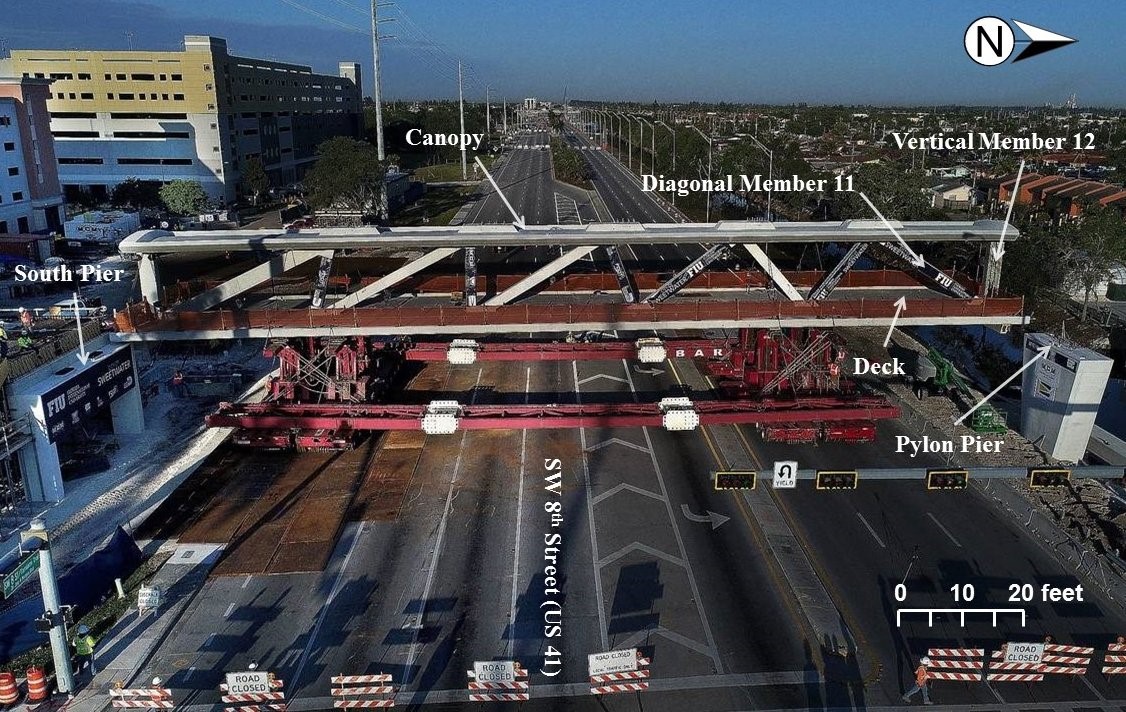
The first half of the story is that the stakeholders wanted an over-the-top bridge design, complete with fake cable stays, and out of hubris decided they would use an all-concrete single-truss Accelerated Bridge Construction (ABC) design because all-concrete would look better and the university's (FIU's) engineering department sort of specialized in promoting ABC.
What could have been a much cheaper nice looking normally-designed bridge (which would be open today) ballooned (or you could say, was hijacked) into a $10mm+ bridge disaster that would be comedy if people hadn't been hurt and killed. A majority of it was even paid for by federal grants.[1]
This is why we can't have nice things. They were so focused on building a nice looking bridge — and meeting deadlines — that they didn't/couldn't allocate sufficient resources to verify the design, verify it was built and moved into place correctly.
[1] see page 9 of https://www.transportation.gov/sites/dot.gov/files/docs/brie...