It’s fundamentally wasteful to dump millions of cubic meters of otherwise useful materials into holes in the ground. The long term costs are difficult to quantify, and ultimately becomes a public problem after landfills close.
Making waste plastic a commodity with actual value would address both the litter and intentional dumping issues through market forces.
That was exactly my point. When you actually dig into it, you find that current forms of plastic recycling (and, in fact, most materials) probably create more greenhouse gases than simply making new plastic, often by a wide margin. This article talks about how this new type of recycling might be more efficient in terms of reusing the old plastic, but not the net effect on greenhouse gases which is what we should be paying attention to.
If it takes considerably more energy to do this process then it does the old processes or just making new plastic, it could be a net loss for the environment.
If we're forced to choose between more landfills or more greenhouse gas emissions, landfills are an easy pick.
Burning the plastic for energy is also generally better than landfill, though that might change if we otherwise have a 100% renewable grid since it would no longer be displacing dirtier fossil fuels.
There's actual science I could link to but I'll just point out one obvious red flag that gets repeated a lot:
If you wash the plastic in water heated with electricity generated from coal as part of the recyclong process then it's got a worse carbon footprint than not recycling it.
Apparent solution proposed by the people who use this factoid: stop recycling plastic.
Solution for anyone not under the sway of the fossil fuel industry: stop burning coal for electricity.
Basically everything is bad for the environment if you use coal powered electricity to do it. Coal sucks as an electricity source.
edit to add actual science:
Bernardo, C. A., Simões, C. L., & Pinto, L. M. C. (2016, October). Environmental and economic life cycle analysis of plastic waste management options. A review. In AIP Conference Proceedings (Vol. 1779, No. 1, p. 140001). AIP Publishing. Available at: https://aip.scitation.org/doi/pdf/10.1063/1.4965581.
It's definitely not economical. Talk to someone who works in recycling today. China stopped accepting it and it's backing up. That doesn't happen to aluminum because aluminum is economical.
They also base their results on methane production. It's increasingly being captured for use as a fuel, and the EPA has required it of larger facilities for decades.
Moving away from fossil fuels is the obvious solution regardless, no argument there. If we did that, it practically wouldn't matter whether we recycled it or not.
If you are then anaerobic digestion of separated food waste/organic material are far better (again both economically and environmentally) than throwing it all in a landfill and trying to capture the gas later (especially as there other valuable/harmful outputs too). And that's what every well run government in the world is doing, because they've done the sums.
It definitely takes less energy (and thus fossil fuels and thus carbon) to landfill a plastic bottle and make a new one or plastic bottle makers would be much more adamant to recycle. We can safely rely amoral corporations to do what's cheapest.
I'm not anti-recycling and can't imagine who even would be. I'm in favor of whatever reduces greenhouse gas emissions the most. I just think that the biggest problem in modern environmentalism is that they are optimizing for something that isn't much of a problem (landfills) at the expense of something that is (greenhouse gases) without even thinking about it. It's well-meaning, they just don't even know that certain materials and recycling programs are making that trade.
I’m sure they can be. Here in New Zealand we made loads in river estuaries, on rivers and coasts. They break in disastrous ways. We are wrecking the place. https://i.stuff.co.nz/environment/114750318/erosion-continue...
Some landfills are mostly safe. In less well-off countries, where the is not enough funding to properly build and care for the myriad of ever-growing landfills, or without sufficient protection from corruption and greed, they are quite the opposite of safe and plastics play a huge part in it.
We have permanently smouldering dumps near almost every town. Some 20 or more years ago it wasn't much of an issue, as most trash burned reasonably well, and it reduced the volume, so it was practical. It wans't good or clean, but now there is so much plastic that it creates toxic clouds spreading through the town. Burning plastic makes horrendous smoke, and its impractical to extinguish the dump fire both politically and physically.
Recycling has helped a bit, but our landfills are not safe. They are literally poisoning everyone in the area.
Nobody would claim dumps are ok for the environment.
There is plastic in our biological waste: https://time.com/5431668/microplastics-human-waste-study/
There is plastic in some of the most remote places on the planet: https://www.npr.org/2019/04/15/713561484/microplastic-found-...
There are microplastics in our soil: https://www.unenvironment.org/news-and-stories/story/plastic...
And the ecological impacts of this are only beginning to be researched: https://www.theguardian.com/environment/2019/sep/12/worms-fa...
It used to be thought that the only evidence of humanity that might still be visible on Earth in a million years is a thin layer of slightly radioactive material around the globe, a result of nuclear weapons testing. Now we have written another, even more obvious and long-lasting signature into the planet: a thin layer of plastic pollution that in all likelihood will outlast anything resembling modern humans. (And I say that with an overall optimism about the lifespan of modern humanity.)
Because you can only recycle plastic that is collected. And the alternative destiny for collected trash is a landfill.
New recycling technology will do absolutely nothing to any of those other problems you pointed.
If what you meant to say was that recycling is only a solution for plastics that are currently going to landfills, that's a different discussion, but it's not what you said.
I'm admittedly no expert, but I'm _pretty damn certain_ this is not the case. (Do you know what leachate is?) I'm happy to be proven wrong by references to legitimate research backing up this claim, though.
I used to build landfill at the end of the last century. Landfill regulations vary from place to place, but in essence new landfills are some of the worlds largest plastic bags. NY used a double liner system (a bag within a big). It was 1 foot of clay (water moves slowly through clay) at the bottom, bentomat and 60mil hdpe liner "welded" together into a big waterproof mat. They put corregated pipes along the bottom to funnel leachate out for treatment. sand and fill with trash. The top with 40 mil Hdpe. They do that even for old landfills without bottom liners. The have to vent because landfills produce flamable gasses.
I hope these systems work well.
It's funny, it's been over 40 years since then (it was passed in 76) and people who weren't even born yet still think of landfills as dumps.
Here's a cool diagram from the EPA:
https://www.epa.gov/sites/production/files/2017-09/landfill_...
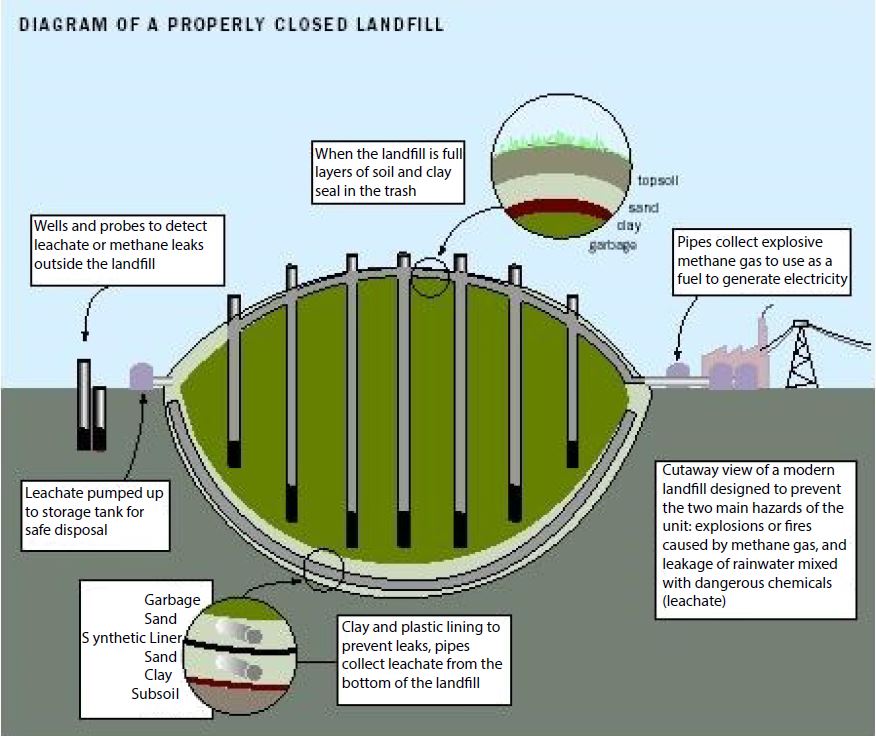
Do you have "references to legitimate research" stating that modern landfills are unsafe or is that just your default belief?
Let's focus on local conditions when looking for local solutions to local problems.
haha! landfill are cheap in third world country, and it's easy to guess they're unregulated... it's hard to be optimist here.
Just to be clear, I support the use of paper and heavy-duty plastic bags for a fee, because they are less likely to be caught by the wind and can be reused for a long time. I abhor littering. But I do not support guilt trips over landfill use in developed countries with highly regulated landfill designs.
Recent studies indicate that most of the plastic in the ocean comes from discarded fishing nets and gear. (Nets alone are almost half.) The idea that people are littering straws and water bottles and that that's what is clogging up the oceans is just way wrong.
I'd assume some are still using dumps.
How much extensive real world testing has been done with this synthetic layers? Is it meant to sit for decades bathing in a chemical soup? Or it is assumed that it'd only get wet? My guess is that they didn't use real world tests where people are throwing out chemicals that shouldn't be put in the garbage.
A human can design a perfect system and then someone else can come along and whether due to malfeasance or greed fuck that perfect system up.
No system is perfect for that very reason.
The solution is to generate less waste. Reduce, Reuse, Recycle -- in that order.
There won't be a problem if there isn't a problem to take care of.
>There won't be a problem if there isn't a problem to take care of.
Sure, and in fantasy land I'm sure there's just a switch you can flip to make that happen. Back in reality where you can't just eliminate all these sources of waste in a day, don't you think it's worth looking for practical solutions that we can implement in the short term?
Besides, the only thing I responded to was an internet know-it-all supposing that scientists and engineers hadn't considered a tear or the fact that people may throw away things they're not suppose to.
"Only around 1 per cent was left uncollected and leaked into natural environments. Though only a small percentage, this nevertheless represents a significant environmental problem, since the amount of plastic waste is so high overall, and since the natural degradation of plastic is so slow, it accumulates over time."
I admit that is a lot of supposition and pie-in-the-sky thinking though.
You don't get paid because the economics of recycling plastic are bad. You can simply make new plastic for cheaper.
So it is possible that a sufficiently efficient recycling process would lead to greater demand (and thus the willingness to pay) for used plastic, which would lead to more people recycling. That's basically what happens with aluminum.
But, you still find aluminum cans discarded by litterers all the time, because at the end of the day it's only worth a couple cents. And at the end of the day, 50% of those end up in a landfill anyway. So I don't think any amount of recycling tech is going to make too much difference in reducing that.
It might help a lot with ocean plastic though. That's made from fishing nets and (ironically) recycling plastic just dumped into the ocean.
There's a lot of work to do in explaining to people how waste management works.
Right, like microplastics from the tires whenever anyone drives anywhere?
Not really. Landfills are safe and clean and plentiful. Ocean plastic is a problem, but comes almost entirely from intentional dumping. Litter is a problem, but it seems silly to assume that someone who cannot be bothered to put plastic in a trash can will put it in a recycle bin.
The real issue is the carbon footprint of making/transporting items, plastic or otherwise. I'd like to see how this compares in that regard. If this uses more energy than just making new plastics it will probably exacerbate a real problem (global warming) in order to help with a fake problem (landfills) which, unfortunately, is pretty consistent with modern environmentalism.