I used to build landfill at the end of the last century. Landfill regulations vary from place to place, but in essence new landfills are some of the worlds largest plastic bags. NY used a double liner system (a bag within a big). It was 1 foot of clay (water moves slowly through clay) at the bottom, bentomat and 60mil hdpe liner "welded" together into a big waterproof mat. They put corregated pipes along the bottom to funnel leachate out for treatment. sand and fill with trash. The top with 40 mil Hdpe. They do that even for old landfills without bottom liners. The have to vent because landfills produce flamable gasses.
I hope these systems work well.
It's funny, it's been over 40 years since then (it was passed in 76) and people who weren't even born yet still think of landfills as dumps.
Here's a cool diagram from the EPA:
https://www.epa.gov/sites/production/files/2017-09/landfill_...
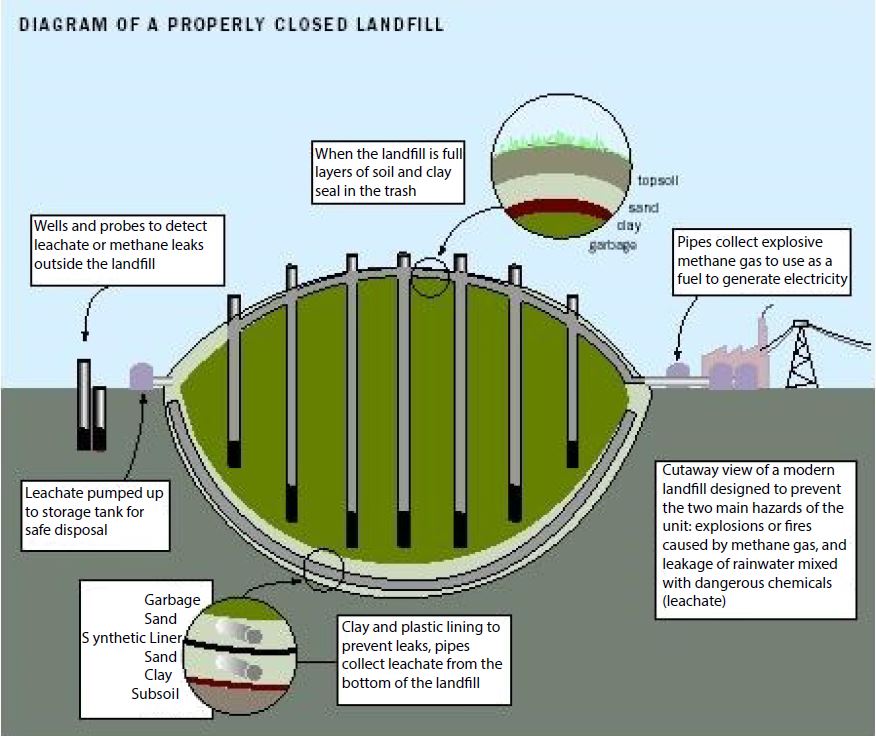
Do you have "references to legitimate research" stating that modern landfills are unsafe or is that just your default belief?
Let's focus on local conditions when looking for local solutions to local problems.
haha! landfill are cheap in third world country, and it's easy to guess they're unregulated... it's hard to be optimist here.
Just to be clear, I support the use of paper and heavy-duty plastic bags for a fee, because they are less likely to be caught by the wind and can be reused for a long time. I abhor littering. But I do not support guilt trips over landfill use in developed countries with highly regulated landfill designs.
Recent studies indicate that most of the plastic in the ocean comes from discarded fishing nets and gear. (Nets alone are almost half.) The idea that people are littering straws and water bottles and that that's what is clogging up the oceans is just way wrong.
I'd assume some are still using dumps.
How much extensive real world testing has been done with this synthetic layers? Is it meant to sit for decades bathing in a chemical soup? Or it is assumed that it'd only get wet? My guess is that they didn't use real world tests where people are throwing out chemicals that shouldn't be put in the garbage.
A human can design a perfect system and then someone else can come along and whether due to malfeasance or greed fuck that perfect system up.
No system is perfect for that very reason.
The solution is to generate less waste. Reduce, Reuse, Recycle -- in that order.
There won't be a problem if there isn't a problem to take care of.
>There won't be a problem if there isn't a problem to take care of.
Sure, and in fantasy land I'm sure there's just a switch you can flip to make that happen. Back in reality where you can't just eliminate all these sources of waste in a day, don't you think it's worth looking for practical solutions that we can implement in the short term?
Besides, the only thing I responded to was an internet know-it-all supposing that scientists and engineers hadn't considered a tear or the fact that people may throw away things they're not suppose to.
I'm admittedly no expert, but I'm _pretty damn certain_ this is not the case. (Do you know what leachate is?) I'm happy to be proven wrong by references to legitimate research backing up this claim, though.