News for hackers. Stuff that matters.
Re:A critique of the claim that passive investing is a bubble by talolard on Thursday September 05, 2019 @11:54AM (#20887945)
I think this article really misses the point that Burry was making, which is that if the indexs see a sell off they won't find the liquidity in the market to cash out their positions and will drive the market down.

This article seems to focus on all of the upsides of indexing, which are all true. However, those upsides don't negate the risk that is being pointed to.

Re:A critique of the claim that passive investing is a bubble by sambe on Thursday September 05, 2019 @12:12PM (#20888127)
These sections seem to address the point to me:

* "The tail is not wagging the dog" - index funds are a relatively small percentage of total share ownership.

* "Benchmark huggers have always been around" - owning ~the index was not started with index funds.

* "Active funds literally own the market" - the sum of portfolios of non-index funds ends up having the same profile.

* "Price discovery is a cop-out" - relatively small part of the trading volume.

* "Liquidity is not a huge problem for index funds" -no market impact to sell (v dubious if you ask me), unlevered.

* "Humans matter more than fund structures" - the absence of index funds did not prevent bubbles/crashes.

You can disagree with those points (I do with some of them) but that's a large part of the article.

Re:A critique of the claim that passive investing is a bubble by dcolkitt on Thursday September 05, 2019 @12:50PM (#20888515)
> "Liquidity is not a huge problem for index funds" -no market impact to sell (v dubious if you ask me), unlevered.

If you're talking about index mutual funds, then the author is just plain wrong. Any open-ended fund offering daily liquidity will trade, and therefore produce market impact, to meet its daily redemptions.

If you're only talking about ETFs, then this is technically correct. Besides the occasional index re-constitution, unlevered index ETFs don't do any trading. However it's definitely not true that there's no market impact. As the fund grows (or shrinks) the shares just don't magically appear in the portfolio. Somebody has to go out and buy (or sell) those shares, and like any trading volume, that creates market impact.

The mechanism that ETFs actually use is something called "Authorized Participants" (or APs for short). Basically market makers have the right to create or redeem shares in the ETF. To create new shares, they go out and buy all the stocks in the index, then hand a basket over to the ETF fund manager, who then hands back new shares of the equivalent value. And to destroy shares, the AP hand over shares in the ETF, and the fund manager hands back a basket of shares from the index.

If there's high demand for investors to own the ETF, that'll push up the ETF's stock price. As the price rises relative to the index value, APs will detect an arbitrage opportunity. They'll go out and buy the basket of stocks in the index at a cheaper price, then create new ETF shares at the richer price, and pocket the difference. Vice versa if there's demand from investors to exit the ETF.

The mechanism keeps the ETF price closely pegged to the index, because the further out of line it gets the more arbitrageur activity pushes it back in line. While also flexibly satisfying investors' specific demand for the ETF at any given time. Basically it delegates the role of trading from the fund manager, who usually doesn't have any special expertise in trading, to highly specialized trading firms and market makers.

However, as you can clearly see, market impact most definitely exists. If a flurry of investors rush to enter or exit an ETF, then a huge amount of trading has to be done to create or redeem the shares. Just because the APs create this trading impact, instead of the fund itself, is a distinction without a difference. The underlying stocks in the index are subject to market impact.

Re:A critique of the claim that passive investing is a bubble by milesvp on Thursday September 05, 2019 @01:37PM (#20889044)
I don’t know if this comment will enforce or counter what your saying, but It seems relevant.

There is already a very well known liquidity problem with index funds that track S&P500. Since stocks come and go from this list, index fund managers need to be very careful about how they buy and share these stocks so as not to greatly effect their prices, and cost the fund too much money.

So index funds already have a pretty big effect in markets. I suspect some of the stretegies used for these events will be similar to how managers mitigate short term mass enters and exits in a fund.

My bigger suspicion in general with index fund mass selling though, is that while they are meant to track the market over the mid to long term, they are actually priced seperate from the market, and this seperate pricing means that if there’s a mass sell off, then fund share prices fall, and others have incentive to buy them at a discount. Eventually both index and benchmark prices reach equilibrium. Maybe there’s total havoc in the market in the meantime, but this mechanism will mitigate it to some degree.

Re:A critique of the claim that passive investing is a bubble by navigatesol on Thursday September 05, 2019 @01:20PM (#20888846)
>If a flurry of investors rush to enter or exit an ETF, then a huge amount of trading has to be done to create or redeem the shares. Just because the APs create this trading impact, instead of the fund itself, is a distinction without a difference. The underlying stocks in the index are subject to market impact.

But the trading isn't the cause of the market impact, it's the redemptions that occur first, and force the trading. There had to have been economic or financial reasons for those redemptions to occur. The fact that when everyone tries to sell at one, there's aren't enough buyers is a story of the ages. That ETFs will suffer the same consequences in a run is hardly unique to them as financial assets.

Re:A critique of the claim that passive investing is a bubble by smogcutter on Thursday September 05, 2019 @02:45PM (#20889604)
Right? I don’t see what the fuss is about. If the argument boils down to “price and liquidity will drop in a sell-off”, well that’s basically a law of nature. I don’t see why index funds are a special case.
Re:A critique of the claim that passive investing is a bubble by diminoten on Thursday September 05, 2019 @01:31PM (#20888983)
I thought the whole point of the $150 million number was to demonstrate that no, daily liquidity doesn't create much trading volume.
Re:A critique of the claim that passive investing is a bubble by talolard on Thursday September 05, 2019 @02:45PM (#20889611)
I think they talk about it but didn't add up to a rebuttal or challenge of Burry's liquidity point. <

I think they claim is that their is a lot of "dumb money" holding indexed products that are likely to sell all at once when things turn south. By the structure of these funds, their will be large selling pressure on the underlying stocks and a good chunk of them don't have the liquidity to support that pressure. That doesn't mean their will be a metldown, just that prices will tank very hard and a lot of people will lose a lot of money + the economic effects that has I don't understand.

I was hoping the original article would tear that reasoning down, and while it did touch on various mechanisms it didn't give a cohesive thesis as to why that is wrong.

Re:A critique of the claim that passive investing is a bubble by throw0101a on Thursday September 05, 2019 @04:18PM (#20890308)
> I think they claim is that their is a lot of "dumb money" holding indexed products that are likely to sell all at once when things turn south.

There is no evidence for this. During the 2000-2002 and 2008-2009 index funds actually saw higher inflows:

* https://www.etfstrategy.com/three-reasons-why-indexing-and-e...

Re:A critique of the claim that passive investing is a bubble by fyz on Thursday September 05, 2019 @05:31PM (#20890812)
What would said dumb money be holding if not index funds? Single name blue chips? What would the blue chip holders do in the counterfactual world where there is a big downturn?

Perhaps there will be greater correlation between names in a downturn, but then again, factor-based investing might offset some of that.

Re:A critique of the claim that passive investing is a bubble by bwanab on Thursday September 05, 2019 @12:29PM (#20888297)
Right, but consider that the sub-prime mortgage market was a tiny portion of the overall mortgage market in 2007.

Derivatives written against sub-prime holdings tipped the balance when the fan was hit. There are tons of derivatives written against the indices, thus indirectly against those funds.

Re:A critique of the claim that passive investing is a bubble by AnimalMuppet on Thursday September 05, 2019 @12:42PM (#20888433)
No, not against those funds. Pass a royal decree that banishes all index funds from the face of the earth. The tons of derivatives written against the indices remain, unchanged.

Those derivatives might be "somewhat in the neighborhood of the funds" or something, but it's not analogous to mortgages.

Re:A critique of the claim that passive investing is a bubble by navigatesol on Thursday September 05, 2019 @01:23PM (#20888889)
>Derivatives written against sub-prime holdings tipped the balance when the fan was hit

There's a bit more nuance to it: those derivatives were a problem because a substantial proportion of them were concentrated in a single, widely-connected, entity (AIG).

The derivative market as a whole nets to zero; for every loser there is a winner.

Re:A critique of the claim that passive investing is a bubble by panarky on Thursday September 05, 2019 @01:03PM (#20888666)
Speculators may do no harm as bubbles on a steady stream of enterprise.

But the position is serious when enterprise becomes the bubble on a whirlpool of speculation.

When the capital development of a country becomes a by-product of the activities of a casino, the job is likely to be ill-done.

(John Maynard Keynes, General Theory, Chapter 12, page 142 in the Google Book edition)

Re:A critique of the claim that passive investing is a bubble by walshemj on Thursday September 05, 2019 @03:22PM (#20889917)
Liquidity can be a very serious problem for open ended funds and they have to keep cash on had to meet redemptions unlike closed ended funds like investment trusts.
Re:A critique of the claim that passive investing is a bubble by wcoenen on Thursday September 05, 2019 @04:06PM (#20890229)
Why would cash be involved for an ETF redemption? Doesn't the ETF manager just hand over the underlying securities?
Re:A critique of the claim that passive investing is a bubble by Expez on Friday September 06, 2019 @02:30AM (#20893537)
No, it's cash in and cash out. That's the entire point of an ETF, that it's very easy to buy and sell yet still tracking something complex.

Imagine if you'd invested in the Russel 3000 index, which aims at tracking the entire US stock market. If the ETF manager transferred the securities as you exited you'd now have to manually sell 3000 securities across many markets. The ETF has tools and processes for this, you don't. You pay them a fee for the convenience of not having to deal with the underlying assets.

Another example would be something like the iShares gold or iShares silver ETF. They hold precious metals in a secure vault on your behalf, for a fee. You probably don't want a delivery from an armored truck every time you exit the ETF! :)

Re:A critique of the claim that passive investing is a bubble by wcoenen on Saturday September 07, 2019 @02:07PM (#20905472)
ETFs are trade on exchanges for cash, but the fund manager is not involved in that. You simply sell your ETF shares to another buyer. Redemptions are something different that only "authorized participants" can do, and as far as I know the ETF share is traded (or actually destroyed) for the underlying securities in that case.

https://www.investopedia.com/terms/r/redemption-mechanism.as...

Re:A critique of the claim that passive investing is a bubble by perspective1 on Thursday September 05, 2019 @12:13PM (#20888132)
Exactly. The article, starting with the title, is pompous and overconfident. Burry made the unanswered point that in a sell-off large index funds will have to dump their smaller holdings at large discounts. We have never had a market crash with passive holdings this large (and consolidated in a small handful of funds)-- we're in unprecedented times. Burry's point is entirely plausible. And although that it wouldn't immediately cause a problem for investors who don't sell (price is not value), the newly discount-price firms may struggle immensely in terms of raising new capital and financing.
Re:A critique of the claim that passive investing is a bubble by thanatropism on Thursday September 05, 2019 @12:43PM (#20888445)
The title is terrible.

The fundamental problem he seems to be pointing at is that notional replicating portfolios can work like an engineering marvel in good times and become inoperable in bad (liquidity) times.

There were many elements to the CDO crisis -- including bad faith by the rating agencies and a prolonged asset-price mania much beyond this stock-market rally. The simpler metaphor is the emission of vanilla stock options. In principle, a bank is only able to offer options because he has the ability to replicate it and neutralize his risk. But if market conditions diverge from the asset replication model, then boom you get LTCM.

Re:A critique of the claim that passive investing is a bubble by notyourday on Thursday September 05, 2019 @12:55PM (#20888568)
> The fundamental problem he seems to be pointing at is that notional replicating portfolios can work like an engineering marvel in good times and become inoperable in bad (liquidity) times.

He is confused. That was the problem with the synthetic OTC instruments that he used which nearly tripped his winning position because no one wanted to actually trade with them. And even that was largely the case because he was buying not even CDOs but synthetic instruments that were derivatives of the CDOs.

Index funds on the other hand own the shares in companies that publicly trade where the market markers must provide liquidity hence a single trade at +/- 10% will not only move the quote but would trigger other buyers and sellers to decide to want to play.

Re:A critique of the claim that passive investing is a bubble by omgwtfbyobbq on Thursday September 05, 2019 @12:37PM (#20888376)
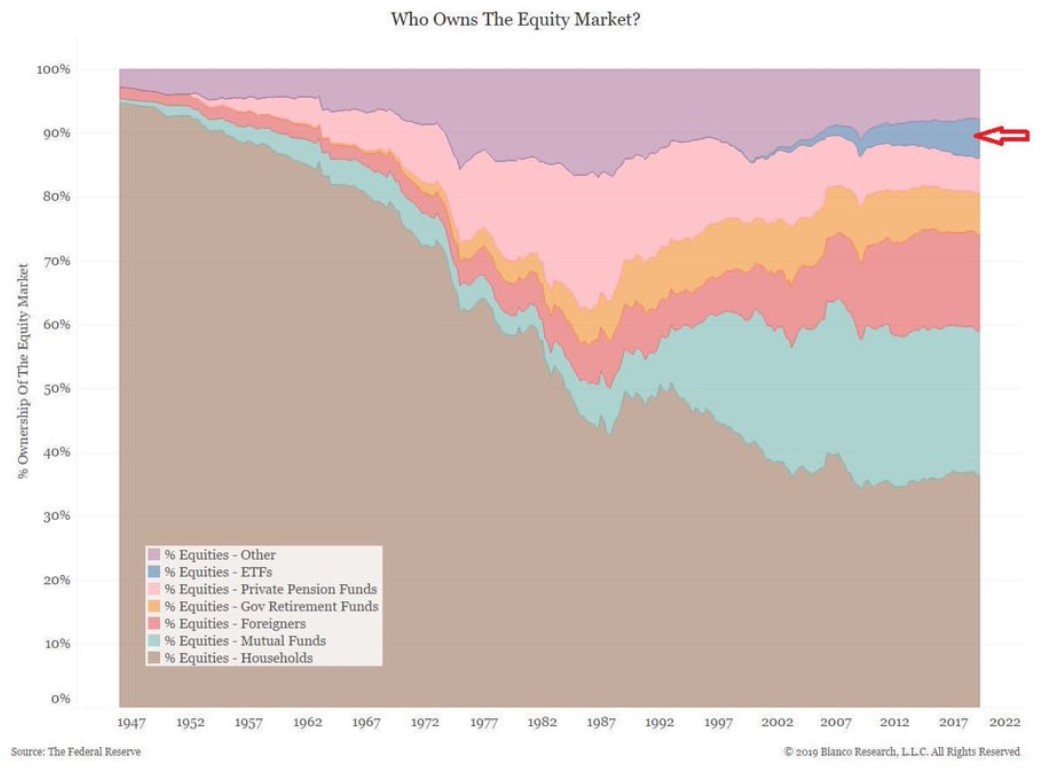
The idea that we've never had a market correction with passive holdings at current levels is accurate. It also was an accurate statement in 2008, and it also applies to foreigners and mutual funds now, both of which have increased their holdings of equities over time and both of which have substantially greater holdings than index funds.

https://awealthofcommonsense.com/wp-content/uploads/2019/09/...
Re:A critique of the claim that passive investing is a bubble by mcguire on Thursday September 05, 2019 @01:02PM (#20888660)
I think the point you want to make is that we've never had a market correction with the number of investors at current levels is accurate.
Re:A critique of the claim that passive investing is a bubble by doubleunplussed on Thursday September 05, 2019 @01:07PM (#20888724)
By symmetry, shouldn't the rapid growth of index funds imply the funds have paid inflated premiums to buy illiquid stocks? I suppose the 'bubble' claim is that they have, but that this is invisible because it has inflated the price of the underlying stocks as well so we still see the index funds priced the same as the underlying stocks.

At least for exchange-traded funds, it would seem that you don't have to actually destroy units of the ETF in the case of a sell-off. The ETF units would just sell at lower prices, just like when there is a 'sell off' of any stock - there are always equal numbers of buyers and sellers, you don't destroy units, you just move the price lower.

With index funds where you have an account directly with vanguard or whoever instead of buying units on an exchange, I'm not sure how it works in a sell-off. Perhaps they sell shares in the individual stocks, or perhaps they just try to sell off your shares bundled together by issuing more ETF units. I don't know what they do, but it seems like there are a bunch of options that should mean they don't have to sell off illiquid stocks on command.

I'm not sure. Happy to be enlightened. As much as I think about it, my intuition seems to consistently say that it's impossible for index funds to be broken in any meaningful way that's any different from the market itself or some sector thereof being in a bubble.

Re:A critique of the claim that passive investing is a bubble by rdm70 on Thursday September 05, 2019 @02:15PM (#20889369)
The thing is, price moves are not symmetric up and down. Down tends to be much more violent.
Re:A critique of the claim that passive investing is a bubble by FabHK on Thursday September 05, 2019 @12:35PM (#20888359)
> Burry made the unanswered point that in a sell-off large index funds will have to dump their smaller holdings at large discounts.

First, I think he didn't made that point very clearly. Second, why would they be sold at a larger discount than larger holdings? It is all in proportion - they own less and sell less of the smaller holdings.

(There are issues conceivable where you have a liquidity mismatch (bonds, real estate), but I haven't seen a solid elaboration of that point. It's the good old "people worry about bond market liquidity" meme that Mark Levine pokes fun at in his Bloomberg Column "Money Stuff".)

Re:A critique of the claim that passive investing is a bubble by OJFord on Thursday September 05, 2019 @12:48PM (#20888494)
> why would they be sold at a larger discount than larger holdings? It is all in proportion - they own less and sell less of the smaller holdings

His argument there AIUI was that the daily volume is not in proportion.

Re:A critique of the claim that passive investing is a bubble by FabHK on Thursday September 05, 2019 @12:56PM (#20888574)
Fair enough, so going back to a liquidity mismatch.

Will be interesting to watch the next market crash.

Re:A critique of the claim that passive investing is a bubble by intuitionist on Thursday September 05, 2019 @12:41PM (#20888417)
There are also a lot more liquidity providers than there were in the past, no? I know there are concerns that the high-frequency traders will turn off the computers in a crash, but if the index funds have to sell their small holdings at a deep discount, that’s an opportunity for someone to step in and buy them on the cheap.

I guess there are more legitimate concerns for funds that hold bonds or real estate or other less-liquid assets. But the solution to that is just, don’t put yourself in a position where you have to liquidate those funds in a crunch.

Re:A critique of the claim that passive investing is a bubble by rocqua on Thursday September 05, 2019 @02:36PM (#20889541)
The high frequency traders I know of are market makers. They want to make money by buying and immediately selling stock. Earning a spread, but never having an actual position. For them, the prospect of holding a stock that is undervalued by 10% for a few days is not good.

Other forms of algorithmic trading might still step in though.

Re:A critique of the claim that passive investing is a bubble by mrep on Thursday September 05, 2019 @12:03PM (#20888037)
How would they lose liquidity? Authorized participants [0] are always in the market for ETFs. If an ETF share price is crashing out of line with the index it tracks, they will step in and buy shares, swap them with the ETF issuer for the shares of the underlying stock in the index, and sell those shares for an arbitrage profit.

Even if one of the underlying stocks becomes illiquid, a big enough price divergence on all of the other liquid stocks would make it profitable to eat the loss or hold the illiquid ones (risky, but remember, there are many authorized participants competing with each other so if there is some way to make an easy arbitrage profit, they will find a way). You'd basically need the entire market to become illiquid.

[0]: https://www.investopedia.com/terms/a/authorizedparticipant.a...

Re:A critique of the claim that passive investing is a bubble by dcolkitt on Thursday September 05, 2019 @01:13PM (#20888767)
Burry's point wasn't that the ETFs would lose liquidity, but rather than the lightly-traded names in the index would.

If the index instruments have a lot more liquidity than the underlying names, then that means they won't be able to gracefully absorb the liquidity shocks from an unwind in the index.

Here's some back of the envelope calculations. Between SPY, IVV, and VOO alone, there's $500 billion in S&P 500 index ETFs. Consider if an unwind event leads to 20% of index assets being redeemed in a single day. That's $100 billion from the above ETFs alone.

Now consider a typical thinly traded single-name stock like Chubb Limited (symbol CB). CB makes up 0.3% of the S&P 500 by weight. So in the hypothetical scenario above, the APs would have to collectively sell $300 million worth of CB in a single day. Chubb's entire ADV is only $238 million.

Trying to sell more than 100% of a stock's ADV in a single day is guaranteed to produce huge market impact. The current liquidity providers in CB almost certainly cannot absorb that amount of trading volume all in one direction. In that scenario, Chubb's stock might fall by 20%, for something that had nothing to do with the company itself.

I think the overall point is that a lot of single-name stocks nowadays don't really have much of an individual market. Names like TSLA, FB or TEVA definitely have a robust market with a lot of traders still focused on company specifics. But a lot of the more boring, lower volatility, mid-cap stocks (like CB) mostly just trade along with the index nowadays. If there are technicals related to index capital flows, stocks like that are going to get taken for a ride.

[1] https://www.etf.com/channels/sp-500-etfs [2] https://www.slickcharts.com/sp500 [3] https://finance.yahoo.com/quote/CB?p=CB

Re:A critique of the claim that passive investing is a bubble by Raidion on Thursday September 05, 2019 @01:25PM (#20888913)
This is a really good explanation, but you would think market forces would kick in. If a company drops 20% (or even 3%!) from an event that doesn't effect the business itself, you're going to get smart money buying. I'd have a hard time believing some niche hedge fund somewhere wouldn't make a killing off this by providing liquidity.

This is under the assumption that there will be capital available to flow, if there isn't because of a truly bad scenario, yes it's a downward spiral, but it will take quite an event to get us to that point.

Re:A critique of the claim that passive investing is a bubble by dcolkitt on Thursday September 05, 2019 @02:53PM (#20889691)
> I'd have a hard time believing some niche hedge fund somewhere wouldn't make a killing off this by providing liquidity.

Typically the opportunists here would be stat-arb hedge funds. They bread and butter of their strategy is to isolate the non-explainable ("idiosyncratic") movement in single name stocks, then bet on that factor mean-reverting.

E.g. if Microsoft goes down 0.5%, but the market's up 1%, and the tech stocks are up 1.2%, and various other factors that move Microsoft don't explain it being down. Then they'll bet that the movement is driven by random noise, and buy Microsoft, betting that it will re-converge with where it's expected to be. They'll also use various techniques to isolate whether idiosyncratic movements are likely driven by company specific factors or market noise. Like NLP on a newsfeed to look to see if there are any breaking stories, or tracking recent analyst revisions on the stock.

Suffice to say that stat-arb funds in this day and age are very very good at this. In a liquidity unwind event, the signals stat-arb traders use would absolutely be lighting up. The biggest question would be whether stat-arb funds in aggregate have enough capital to counter the absolutely humongous flows that a potential index fund unwinding would release.

Another complicating wrinkle is that most stat-arb desks are no longer independent hedge funds, but units within larger multi-strategy funds (like Two Sigma or Millennium). There's good and bad. The good is that if there's all of a sudden massive opportunity the multi-strat fund can quickly reallocate more capital to the stat-arb desk.

The bad part is that stat-arb desks may be unwound due to arbitrary contagion in other parts of the market. If the multi-strat fund sees a big loss in another unit, it may pull capital from the stat-arb desk to meet margin calls or redemptions. For example this happened in August 2007 [0]. The subprime mortgage market blew up, then all of a sudden a bunch of esoteric stocks started behaving crazy for the next weeks. And that was largely because multistrat funds were pulling capital to meet margin calls on their mortgage portfolio.

[0] http://web.mit.edu/Alo/www/Papers/august07.pdf

Re:A critique of the claim that passive investing is a bubble by AlanYx on Thursday September 05, 2019 @01:37PM (#20889047)
The "smart money" would start buying, but I imagine the concern is that as passive instruments become the majority of the market, there wouldn't be a deep enough pool of assets held by "smart money" to provide offsetting liquidity in the way you describe.
Re:A critique of the claim that passive investing is a bubble by mox1 on Thursday September 05, 2019 @01:51PM (#20889168)
But wouldn't this reach some sort of equilibrium point?

IE if a smart person with a lot of money think there is no "smart money" left, wouldn't (s)he just start their own smart money hedge fund to provide / do this?

If nobody is left to do thing X AND thing X is basically guaranteed profit, isn't it natural for people to step in and do thing X?

Re:A critique of the claim that passive investing is a bubble by pas on Thursday September 05, 2019 @07:19PM (#20891511)
But we already have that. Gold. Or CHF. The problem is that it takes roughly 10 years to outshine the stock market.
Re:A critique of the claim that passive investing is a bubble by SubiculumCode on Thursday September 05, 2019 @01:53PM (#20889186)
I know next to nothing about investing, but I thought the article said that passive instruments are a very small portion of the market...and also that in house indexing has always been a thing.
Re:A critique of the claim that passive investing is a bubble by chawco on Thursday September 05, 2019 @02:19PM (#20889398)
But doesn't it seem like that, as total ownership of the market shifts towards passives, higher returns would be driven by funds running active strategies such as these, thus making them more attractive investments? It seems like this sort of thing chases an equilibrium.
Re:A critique of the claim that passive investing is a bubble by jonknee on Thursday September 05, 2019 @03:35PM (#20890012)
Yes, if indexes sell off any many times their average daily volume that means components will as well. That's fine. If something happens where people are selling the S&P 500 down 20% in a single trading session (the full day circuit breaker limit) there should be chaos amongst the components because shit has hit the fan. Savvy players will scoop up deals, most people will do nothing and life will move on.
Re:A critique of the claim that passive investing is a bubble by domnomnom on Thursday September 05, 2019 @03:17PM (#20889874)
I hate when people use acronyms without first defining them, they are literally impossible to google. What is ADV?
Re:A critique of the claim that passive investing is a bubble by aynyc on Thursday September 05, 2019 @03:22PM (#20889914)
Average Daily Volume
Re:A critique of the claim that passive investing is a bubble by all_blue_chucks on Thursday September 05, 2019 @01:32PM (#20888994)
Doesn't the "circuit breaker" process on the stock exchange exist for this scenario? To give people time to line up buyers when there is a sudden unexpected repricing?
Re:A critique of the claim that passive investing is a bubble by asdf333 on Thursday September 05, 2019 @02:39PM (#20889563)
yes, possibly. but i think that may feed back into some weirdness for the index funds

"i'm supposed to sell 500m of this small stock but i only got to sell 300m before it was frozen out...now my basket of holdings is slightly off from the actual index...hopefully i can rectify it tomorrow..."

Re:A critique of the claim that passive investing is a bubble by hyperpape on Thursday September 05, 2019 @04:03PM (#20890201)
This is a great explanation. Can you explain why this isn't a problem for actively managed funds, though? Do they just avoid stocks like CB?
Re:A critique of the claim that passive investing is a bubble by dcolkitt on Thursday September 05, 2019 @05:42PM (#20890896)
No, I think in such a scenario active investors would wind up getting just as whalloped as passive investors. By definition active investors in aggregate have the same average exposure as cap-weighted indexers to any given stock.

Arguably, after the crash they might be able to take advantage of the opportunity. If they concentrate into the stocks with the biggest price displacements, then as those stocks return to normal, they may make up some or all of their initial losses. Passive indexers can't do this, because they don't have the mandate to deviate from their pre-defined allocations.

But I think the broader issue is that excessive amounts of indexing present potential systematic risks for everybody. Burry's hypothesis is more relevant for policymakers than it is for investors.

As an individual, long-term buy-and-hold investor, low-cost index funds are without question the best option for investing. The problem is behavior that's rational on an individual level, may produce irrational results at the collective level.

Re:A critique of the claim that passive investing is a bubble by hyperpape on Thursday September 05, 2019 @06:34PM (#20891257)
I'm not sure I stated my question clearly enough. I'm not asking whether active funds would fare better than index funds in a downturn, though it's interesting to hear.

I'm asking for a comparison of two scenariors. In the index fund scenario, we're in the world where index funds represent a large and growing chunk of the market. In the active funds scenario, index funds aren't a thing. Why is it that in the active funds scenario, what you're describing in the previous post doesn't happen? Why doesn't a 20% marketwide downturn cause chaos in these smaller stocks? Is it because there would be higher volumes if those stocks were held by active funds? Or because the active funds wouldn't hold stocks like that?

Basically, I'm asking for a comparison of the scenario you described with what happens in a no-index world, because I can't quite think through the difference myself.

Re:A critique of the claim that passive investing is a bubble by dcolkitt on Thursday September 05, 2019 @07:32PM (#20891597)
That's an interesting point. While it's definitely true that any major unwind of that size will disrupt the market, there's some reasons to believe an ecosystem dominated by active investors would do better.

First as mentioned before, active investors have discretion. There's strong reason to believe that as the sell-off's happening that they'd move into the most dislocated stocks. That acts as kind of a negative feedback loop. It wouldn't stop a market-wide selloff, but would keep things more balanced between single-name stocks vis-a-vis the rigid rules governing passive index managers.

Second, by definition active funds are more differentiated from one another. Passive indexing produces a mono-culture with analogous ecological risks to what we see in nature. The typical active fund only holds about 50 positions at any given time. So, on the whole while active investors in aggregate hold 0.3% of their portfolios in Chubb, at an individual level most funds hold zero. And some minority may hold 1%, 5%, 10% or more of their assets in Chubb. So if one fund fails, that's less likely to spread contagion to every other fund in the universe.

In that type of unwind scenario, some funds will do pretty decently, and some funds will do horribly. But the point is there will be a dispersion of results. That makes the market as a whole more robust. Panicking investors are more likely to re-allocate their capital from the bad funds to the good funds, rather than pull all their out in a flight to quality.

Re:A critique of the claim that passive investing is a bubble by jancsika on Thursday September 05, 2019 @09:46PM (#20892303)
Wouldn't a random selection process for basket assets and/or weights do just as well as active fund management to stave off this systemic risk?
Re:A critique of the claim that passive investing is a bubble by pas on Thursday September 05, 2019 @07:28PM (#20891572)
The difference is hypothetical, because if enough people exit the active fund, even if the fund manager thinks it's a folly, eventually they have to sell whatever makes up the fund, and eventually those sells will push prices down. That's why crashes are fast and hard.

Yes in theory the manager can try to alter the composition of the fund by selling the stocks that are still going strong. But why would they? That just exposes them to known hazards even more.

So, probably the active funds will be the first ones to drop the small stocks first in a crash.

Re:A critique of the claim that passive investing is a bubble by BryanBigs on Thursday September 05, 2019 @07:58PM (#20891724)
When I actively managed money for mutual funds, we had limits on both total % ownership and how many days of volume we could own. We were small cap growth, so sometimes we could be stopped from owning as much of a company as we wanted because it was too illquid. Passive doesn't care - it buys what it needs to replicate the returns of the underlying. Also, it's well known that if a hedge fund (or mutual fund) is in trouble, they sell more of what they CAN rather than what they want. That's one reason why we always knew who else owned the stocks we did. Index funds have no leeway here. They need to sell - whether there is liquidity available or not. My gut is, there will be much less liquidity available during the next crisis than you'd expect. A lot of "non passive" investment is quant driven, which ends up becoming very homogenous in nature across different firms. Many also have momentum factors in play, where they buy short term positive momentum and sell the reverse. Once again,vthey don't have a lot of leeway for humans to say "this market is different".
Re:A critique of the claim that passive investing is a bubble by josu on Thursday September 05, 2019 @12:11PM (#20888111)
>You'd basically need the entire market to become illiquid.

Yes. It has happened before.

Re:A critique of the claim that passive investing is a bubble by asdkfjasl on Thursday September 05, 2019 @12:18PM (#20888192)
OK, but in that case is there a distinction between index funds and actively managed funds? Is this a risk that index funds are uniquely exposed to?

Also, another thing to keep in mind is that this only affects people who are trying to sell at the bottom. Buy and hold investors care little for liquidity issues during a crash.

Re:A critique of the claim that passive investing is a bubble by JumpCrisscross on Thursday September 05, 2019 @12:23PM (#20888236)
> in that case is there a distinction between index funds and actively managed funds?

Yes. Active managers can choose what to sell based on prevailing market conditions. Index funds must sell across the board. That could involve getting hosed on names in a short-term squeeze.

> this only affects people who are trying to sell at the bottom

There are lots of index funds. For a broad-market fund, you're probably right--a patient investor can ride out the bloodshed. For leveraged or specialized funds, on the other hand, a rout could permanently impair the portfolio.

Equity market collapses, furthermore, have a habit of transmitting into the real economy. A sustained downturn could impair funding conditions, which in turn could affect the fundamental characteristics of a portfolio.

Re:A critique of the claim that passive investing is a bubble by Mathnerd314 on Thursday September 05, 2019 @01:33PM (#20888999)
There are some escape clauses in Vanguard's index funds:

The fund may temporarily depart from its normal investment policies and strategies when doing so is believed to be in the fund’s best interest. ... Vanguard funds can postpone payment of redemption proceeds for up to seven calendar days.

And a lot of index fund investors are buy-and-hold so it's unclear if a recession would even cause a liquidity / redemption crisis.

Re:A critique of the claim that passive investing is a bubble by JumpCrisscross on Thursday September 05, 2019 @01:37PM (#20889046)
> And a lot of index fund investors are buy-and-hold

But index funds themselves aren't. They have to sell stock when units are destroyed and vice versa. In addition to other factors, this can result in weird tax effects as well as tracking error to the index.

Re:A critique of the claim that passive investing is a bubble by thanatropism on Thursday September 05, 2019 @12:36PM (#20888363)
Well,

1) To track the actual index, index funds must continually rebalance their portfolio. In a liquidity pause they may not be able to do this, thereby becoming a non-index fund. Actively managed funds have the portfolio they have -- unless they're defrauding the public somehow. An index fund that becomes a non-index fund would fall in this latter category.

2) The index (not the funds) is assumed to reflect all the information that can be used to make some money by arbitrage. This process is referred as "price discovery". But in a liquidity pause, price discovery grinds to a halt. Actively managed funds have their own idea of what are the fundamental prices beyond what the public leaderboard says; their price discovery is not beholden to the existence of a liquidity market. Actually -- if the market goes for years with very low liquidity, it becomes more likely that people who, say, are shorting Herbalife for fundamental reasons, have more knowledge than the index. In this way the index is like an AI that can become starved for data.

Re:A critique of the claim that passive investing is a bubble by pjmorris on Thursday September 05, 2019 @12:09PM (#20888086)
> basically need the entire market to become illiquid.

Which came dramatically close to happening in 2008, see, e.g. [0].

[0] http://pages.stern.nyu.edu/~sternfin/pschnabl/kacperczyk_sch...

Re:A critique of the claim that passive investing is a bubble by prostoalex on Thursday September 05, 2019 @01:20PM (#20888851)
> Even if one of the underlying stocks becomes illiquid

Burry’s money quote in the original Bloomberg article was on limited liquidity for a largish number of stocks - over a 1,000 stocks in Russell 2,000 weren’t traded heavily (by his benchmark).

Re:A critique of the claim that passive investing is a bubble by staticcaucasian on Thursday September 05, 2019 @11:57AM (#20887972)
Agreed. Burry seems to be getting a lot of responses but almost none of them seem to have actually listened to what he said (or even read the article). There is real risk from the index-matching synthetic techniques that these funds are using.
Re:A critique of the claim that passive investing is a bubble by human20190310 on Thursday September 05, 2019 @12:02PM (#20888035)
> ...will drive the market down

So what? Let the weak long positions panic and sell at the bottom. Everyone else gets a few years of discount prices to buy. The hardest hit will be those who are leveraged and arguably deserve to get hosed for taking that much risk.

If you don’t have to meet a margin call, you can ride out a crisis; if you’ve got cash in reserve, you can profit from it.

Re:A critique of the claim that passive investing is a bubble by rocqua on Thursday September 05, 2019 @02:44PM (#20889596)
Presuming you are saving for later. Besides a margin call, you might want to exit for, buying a house, going into retirement, covering a period between jobs, or to deal with a medical emergency.

Doing that during a crisis hurts. This risk diminishes the value of investments as a safety cushion.

Re:A critique of the claim that passive investing is a bubble by human20190310 on Thursday September 05, 2019 @05:38PM (#20890861)
Index funds aren’t a safety cushion. Vanguard rates it’s own S&P 500 index fund as a 4 out of 5 for risk. [0]

[0] https://advisors.vanguard.com/iippdf/pdfs/FS540.pdf

Re:A critique of the claim that passive investing is a bubble by throw0101a on Thursday September 05, 2019 @06:08PM (#20891091)
> Besides a margin call, you might want to exit for, buying a house, going into retirement, covering a period between jobs, or to deal with a medical emergency.

In all of those scenarios you should not be in stocks/equities in the first place. If there is a possibility of needing cash with-in the next 5 years, that money should be in either bonds or term deposits.

One's downpayment, first/next few retirement years' income, and emergency fund(s) should not be in equities.

Re:A critique of the claim that passive investing is a bubble by gridlockd on Thursday September 05, 2019 @03:10PM (#20889825)
After 1989 it took the Nikkei more than a decade to finds its bottom (and then another bottom in 2009) and it hasn't recovered since. How many years of "discount buying" are you planning in?
Re:A critique of the claim that passive investing is a bubble by lovecg on Thursday September 05, 2019 @04:39PM (#20890449)
Systemic risk. If a ton of smaller companies see their shares plummet all at the same time, there might be repercussions for the economy as a whole. It’s true that individual investors might be able to ride it out (and the same was true in 2008).
Re:A critique of the claim that passive investing is a bubble by throw0101a on Thursday September 05, 2019 @04:16PM (#20890291)
Why would they need to cash out their positions? Indexes seem to actually have inflows during bear markets. See Point 2:

* https://www.etfstrategy.com/three-reasons-why-indexing-and-e...

See also Vanguard's (biased) opinion:

* https://www.vanguardcanada.ca/individual/articles/education-...

The people using index funds generally don't think about their portfolios—which is the whole point of them. It's probably the cocaine-fueled traders that are causing all the ruckus.

Re:A critique of the claim that passive investing is a bubble by adventured on Thursday September 05, 2019 @12:31PM (#20888320)
Just the fact that the author chose to call Michael Burry's well thought out premise "silly" - tells you most of what you need to know about what is being pitched in the article. I've never seen Burry say anything that qualified as silly, even when a premise of his doesn't play out as dramatically as predicted. Silly is entirely contrary to his personality and analysis, it's attempting to lead the reader and argue via ridicule (where did we see that before?).
Re:A critique of the claim that passive investing is a bubble by ptero on Thursday September 05, 2019 @01:07PM (#20888721)
This is the way it felt to me, too. The author seems to be cherry picking some incomplete statements from Burry's article and tries to make them sound ridiculous, and sometimes resort to adjectives rather than arguments.

I am not a specialist and would love to read an informed analysis and counters to Burry's article. I was hoping that this is what the author tried (as the title suggests), but to me he fell far short of that goal. My 2c.

Re:A critique of the claim that passive investing is a bubble by C1sc0cat on Thursday September 05, 2019 @12:15PM (#20888146)
And ignores the current example of the neil woodford equity income fund.

This is a smaller example the liquidity problem that Mr Burry was making - it would much worse if a market crash did this to the realy realy big index funds.

Re:A critique of the claim that passive investing is a bubble by FabHK on Thursday September 05, 2019 @12:26PM (#20888271)
> if the indexs see a sell off they won't find the liquidity in the market to cash out their positions and will drive the market down

When investors sell that amount, it doesn't matter whether they hold the underlying assets directly, or via index funds or ETFs, or via actively managed funds. The market will go down. So, which part of the problem is uniquely due to index funds?

Burry hasn't made that point very clear.

There might be issues with (liquid) index funds that give exposure to inherently less liquid assets, such as bonds or real estate. There might also be issues with index funds that do not hold the assets themselves, but replicate the exposure synthetically by entering a swap with a third party, giving rise to tracking error, counterparts credit risk, etc.

However, as I said, Burry hasn't enunciated these concerns very cogently (at least in the extracts quoted by Bloomberg). This article here does nothing to address those concerns.

Re:A critique of the claim that passive investing is a bubble by peteradio on Thursday September 05, 2019 @12:35PM (#20888358)
Requirement to sell across the board seems to be the unique issue.
Re:A critique of the claim that passive investing is a bubble by vkou on Thursday September 05, 2019 @02:30PM (#20889483)
They aren't required to sell, unless fund-holders are selling their ETFs.

If those fund-holders were owning the stocks directly, instead of ETFs... Those same fund-holders would be... Selling their stocks. Causing the exact same downward price pressures.

Re:A critique of the claim that passive investing is a bubble by pas on Thursday September 05, 2019 @07:44PM (#20891653)
But people would see that the best bid is too low, so they would hold that part of their portfolio. (Because there's no point in realizing that huge loss.)
Re:A critique of the claim that passive investing is a bubble by rocqua on Thursday September 05, 2019 @02:41PM (#20889573)
If I sell my ETF, the AP buys it from me, and gets to redeem it for a basket of shares of fixed proportion.

Suppose stock X gets 1% in that basket. The issue is if stock X happens to be very illiquid, the APs selling stock X could drive down the price.

In a non ETF, managers could decide to relatively slow down the sale of X, to prevent crashing the price. However, in an index fund the mechanism dictates all stocks are sold in the same proportion.

Re:A critique of the claim that passive investing is a bubble by jonknee on Thursday September 05, 2019 @03:40PM (#20890048)
Authorized participants arbitrage all day, if they see dislocation they can certainly hold on to certain names.
Re:A critique of the claim that passive investing is a bubble by rocqua on Thursday September 05, 2019 @03:54PM (#20890141)
Arbitrage (as done by APs) is mostly about gathering an instantaneous spread. Much like market makers, that strategy is not about holding a position.
Re:A critique of the claim that passive investing is a bubble by jonknee on Thursday September 05, 2019 @04:02PM (#20890199)
Yes, but strategies change in a crash. It's possible no one learned from the 2015 flash crash, but I bet a lot of smart funds out there are ready for one. If a dumb AP is going to put out a crazy price someone is going to be there to snap it up.
Re:A critique of the claim that passive investing is a bubble by vkou on Thursday September 05, 2019 @02:49PM (#20889652)
An evil mirror universe twin of you, instead of owning an ETF, owns a bunch of shares of APPL, a bunch of shares of GOOGL, a bunch of shares of stock X.

If you are panicked, and are selling your ETF, your evil twin is panicked, and selling all their stocks.

This causes the exact same downwards pressure on the market.

I don't buy an ETF because I want someone to do financial malarkey with my money. I buy it because I want to own stocks, and I can't be assed to deal with my own brokerage account. Besides the convenience aspect, there is zero difference between the two.

Re:A critique of the claim that passive investing is a bubble by lovecg on Thursday September 05, 2019 @04:42PM (#20890468)
The argument is that the automation at scale that ETFs bring to the table changes the game qualitatively. How many people would really buy and sell thousands of individual stocks in a correlated fashion if this infrastructure didn’t exist?
Re:A critique of the claim that passive investing is a bubble by vkou on Thursday September 05, 2019 @05:51PM (#20890963)
No, they'd have a dozen individual stocks that they would own, and when you combine fifty million people, each owning a dozen individual stocks, you'd get a pretty accurate proxy for the S&P 500.

They'd still follow the same herd mentality that they would, had they owned ETFs.

Re:A critique of the claim that passive investing is a bubble by rocqua on Thursday September 05, 2019 @02:55PM (#20889716)
Unless everyone has an evil twin, there is less chance of everyone wanting to exit X at the same time. Hence there won't be a run on X.

Moreover, if my evil twin a) owned a managed fund or b) sold in a slightly smarter way, then they would lose less on X due to liquidity.

Moreover, the hit on Xs price also has a slight hit on the ETF value. Hence there is a small positive feedback loop.

Re:A critique of the claim that passive investing is a bubble by vkou on Thursday September 05, 2019 @03:29PM (#20889974)
Everyone thinks they will be smart about their panic-selling when a market crash hits, but the reality is, most of them won't be... And the decision you should be making is not when to sell, but 'how much to buy'.
Re:A critique of the claim that passive investing is a bubble by 0xcafecafe on Thursday September 05, 2019 @11:57AM (#20887973)
What if my index fund is actually just buying and holding the underlying stock as opposed to just a price tracking entity? In that case not taker for my fund = no taker for the underlying stock right? Will this not have the liquidity risk that Bury mentions?
Re:A critique of the claim that passive investing is a bubble by secabeen on Thursday September 05, 2019 @12:00PM (#20888005)
The index fund is holding the underlying stock, largely. The challenge is that if say 5% of their fund holders sell their shares in the fund, the fund has to sell the underlying stock to generate the cash to pay out. Most funds have a rule in their documents that if you are a large fundholder (holding 1% or more of the fund) and you sell, they can hand you stocks directly rather than selling them and giving you cash, but that doesn't work it it's tens of thousands of small fund holders selling.
Re:A critique of the claim that passive investing is a bubble by wbl on Thursday September 05, 2019 @12:05PM (#20888053)
So? They sell others buy. If I hear there is a squeeze and have cash I'll throw it in: who wouldn't? It's never the case that x٪ of the market can exit at once regardless of how it is owned.
Re:A critique of the claim that passive investing is a bubble by vkou on Thursday September 05, 2019 @02:37PM (#20889554)
So? If 5% of all stockholders sell their stock, that's going to cause a downward price movement, too.

What is special about an ETF, that makes this situation any worse?

Re:A critique of the claim that passive investing is a bubble by lmm on Thursday September 05, 2019 @01:10PM (#20888745)
> What if my index fund is actually just buying and holding the underlying stock as opposed to just a price tracking entity? In that case not taker for my fund = no taker for the underlying stock right? Will this not have the liquidity risk that Bury mentions?

In any crisis, the people who get really screwed are those who decide they have to sell, at any price. Instant liquidity - by whichever route - gets really expensive. An actively managed fund can at least decide which assets to sell to meet redemptions, holding those it thinks are undervalued at the moment. Whereas an index fund is effectively exposed to a crisis anywhere in the market.

Re:A critique of the claim that passive investing is a bubble by C1sc0cat on Thursday September 05, 2019 @12:16PM (#20888167)
They are mostly not doing physical replication (physically owning all the shares) but using synthetic means.
Re:A critique of the claim that passive investing is a bubble by 0xcafecafe on Thursday September 05, 2019 @12:37PM (#20888369)
Not really. The most popular index funds physically invest their capital in the stocks making up the index:

https://www.investopedia.com/articles/markets/101415/4-best-...

Re:A critique of the claim that passive investing is a bubble by C1sc0cat on Thursday September 05, 2019 @12:46PM (#20888471)
That wasn't what the Article being critiqued said though.
Re:A critique of the claim that passive investing is a bubble by 0xcafecafe on Thursday September 05, 2019 @12:53PM (#20888550)
Correct. There are index mutual funds and index etfs. The article seemed to refer the latter.
Re:A critique of the claim that passive investing is a bubble by FabHK on Thursday September 05, 2019 @12:38PM (#20888385)
Source? In the jurisdictions I'm familiar with, synthetic ETFs come with special warnings (even in the fund name), and they're definitely not the majority.
Re:A critique of the claim that passive investing is a bubble by sharkbot on Thursday September 05, 2019 @12:01PM (#20888011)
Not the author, but I think the article indirectly talks about the liquidity in the markets being far higher than it has been in the past.

Further, if there is a stampede for the exits, there still have to be buyers on the other side of the sellers. Those buyers will undoubtably include active managers along with those indexers with different time horizons and/or braver constitutions. Both will likely be rewarded for their patience.

Re:A critique of the claim that passive investing is a bubble by ptero on Thursday September 05, 2019 @01:21PM (#20888855)
> if there is a stampede for the exits, there still have to be buyers on the other side of the sellers

That is a key point in the debate. I do not see that above is necessarily true. Say a price of a low volume stock X is driven down below fundamentals just because index funds have to sell 1% of holdings and cannot find enough buyers for X. While price of X might be irrational fund managers might not be able to act on it because there would be a worry that it may go lower still if selling extends.

Could next round get X removed from index? delisted? "The market can stay irrational longer than you can stay solvent" is not an empty worry. My 2c.

Re:A critique of the claim that passive investing is a bubble by ambicapter on Thursday September 05, 2019 @12:05PM (#20888046)
This was mentioned in the article

> Liquidity is not a huge problem for index funds. But, Ben, what if everyone rushes to the exits all at once? Index funds and ETFs are going to cause a massive crash!

> When an index fund investor sells, they’re technically selling their holdings in direct proportion to their weighting in the index. So there is literally no market impact.

Re:A critique of the claim that passive investing is a bubble by FabHK on Thursday September 05, 2019 @12:41PM (#20888418)
> > When an index fund investor sells, they’re technically selling their holdings in direct proportion to their weighting in the index. So there is literally no market impact.

Yeah, I wanted to highlight that that's not true. Of course there is a market impact, it'll go down. The author might have wanted to say that there is no differential market impact, ie all shares would go down to the same extent (so that there is no impact, say, on capital allocation), but even that is not necessarily true, it clearly depends on the homogeneity (or lack thereof) of the liquidity/elasticity on the other side of those trades.

Re:A critique of the claim that passive investing is a bubble by vkou on Thursday September 05, 2019 @02:28PM (#20889469)
Umm, if there's a stock market crash, triggering investors to panic-sell their shares, what difference does it make that I'm selling off my Vanguard ETF, or my personal, non-ETF stock holdings?

I'm still driving the price down, causing other holdouts to sell off, driving the price further down. It's the definition of a market crash.

Re:A critique of the claim that passive investing is a bubble by davidw on Thursday September 05, 2019 @11:59AM (#20887990)
I think that was certainly a more interesting point compared to "who will do price discovery", which seems to be something that would likely find an equilibrium.

This article does mention it, but pretty briefly.

It'd be interesting to hear from people more familiar with the details of how all this works... perhaps there are some in the initial thread, but I haven't had time to skim it all: https://news.ycombinator.com/item?id=20877700

Re:A critique of the claim that passive investing is a bubble by imtringued on Thursday September 05, 2019 @01:36PM (#20889037)
That is fundamentally how markets work. If everyone sells and no one buys then prices are going down. Whether you are using an active or passive fund or pick stocks yourself doesn't matter.
Re:A critique of the claim that passive investing is a bubble by navigatesol on Thursday September 05, 2019 @01:12PM (#20888761)
>* if the indexs see a sell off they won't find the liquidity in the market to cash out their positions and will drive the market down.*

What is unique about no liquidity during a sell-off driving markets down? It's the definition of a sell-off. The fact there's no liquidity is what drives down the market in every sell-off.

Re:A critique of the claim that passive investing is a bubble by bradshaw1965 on Thursday September 05, 2019 @01:21PM (#20888853)
It's important to distinguish market cap based indexes and other asset class indexes. Small and micro-caps are notoriously hard to trade but mega-caps typically have much higher liquidity. There is a much higher chance of a micro-cap passive fund having a liquidity problem then a market cap index fund.
Re:A critique of the claim that passive investing is a bubble by solotronics on Thursday September 05, 2019 @02:05PM (#20889305)
I wonder what the breakdown is within the index ETFs on what money is in 401ks, Roth, institutional investor, etc. If a big portiton of it is retirement accounts those aren't moving much anyways.
Re:A critique of the claim that passive investing is a bubble by MandieD on Thursday September 05, 2019 @02:27PM (#20889466)
Except for all the near-retirees who freak out as they see their balances rapidly shrinking - and sell.

Like my parents did in 2008/9, and I didn't think to caution them not to. Ugggg...

Re:A critique of the claim that passive investing is a bubble by mcguire on Thursday September 05, 2019 @12:57PM (#20888594)
Are you arguing that index investors should not be part of the market at all?

A large number of investors leaving the market will see a sell off no matter what vehicle they're in.