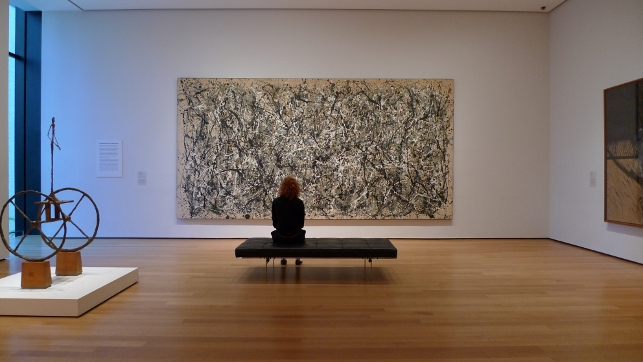
Regarding those soviet paintings, Goya depicted war and suffering, and is very well known and highly regarded: https://en.wikipedia.org/wiki/The_Third_of_May_1808 . But your point is the core of what the article is trying to get at. The people who evaluate art are looking for something that isn't being satisfied by the same criteria as i.e. journalism, cuisine, even music to a certain extent.
It's not a deep emotion, of course, it's a fleeting sensation, really, like smelling a flower or listening to a "boop boop" sound effect on the tram. It's a trite emotion, which is the best way to describe the reaction I get to Pollock - trite.
I think that particular Pollock piece would make for a great panel or wallpaper in a basement. There's a certain movement and a not-unpleasant interplay with the colors - again, similar to the "boop, boop" on various public transportation system sound effects.
You can call it "art" sure, I think "craft" would be better, or perhaps "decorative arts" is probably the best way to describe Pollock. I recall a youtube video of the painting of a countertop in a kind of "hip, modern" kitchen that had a similar aesthetic.
Of course those Soviet paintings of WWI are far more meaningful than Pollack's visually not-unpleasant background color mix.
This game is silly. Denigrating a work of art for being different from another work of art is not critique, it is bitterness. Life is short. Speak up for the beautiful things you understand, not against the things you don't understand.
Reguarding the representation of war, I’m afraid 200-year old paintings don’t do it for me anymore, modern warfare is so much more different and more atrocious and industrialized compared to how things happened two or three centuries ago that we do need the power of art to make us, humans, help us understand at least some part of it all. I pretty much admire the new-Hollywood directors who had the guts to put on screen what the Vietnam war meant for all those involved, from the local Vietnamese population to the US soldiers to the relatives of the US soldiers at home. For comparison the Iraqi and the Afghan wars were pretty much invisible for today’s artists, with notable and very few exceptions (like Brian de Palma).

If any notable art came out of the Iraqi wars it is probably hanging in Baghdad, we might find out about it eventually.
In the same way that Mao era paintings are valuable in understanding the history of early communist China, I believe the ISIS videos will be valuable to future historians in understanding how the radicalization and subsequent wars in the Middle East happened.
I got to see these in the Prado last year. It was a piety emotionally stunning experience.
https://en.wikipedia.org/wiki/Black_Paintings#/media/File:Fr...

https://en.wikipedia.org/wiki/Black_Paintings#/media/File:La...

Apparently, this is considered a very good result for abstract paintings: "Throughout the experiments, the students typically picked the professional pieces between 60% and 70% of the time."
http://blogs.discovermagazine.com/notrocketscience/2011/03/1...
http://www.allworldwars.com/image/008/SovietPictures063.jpg
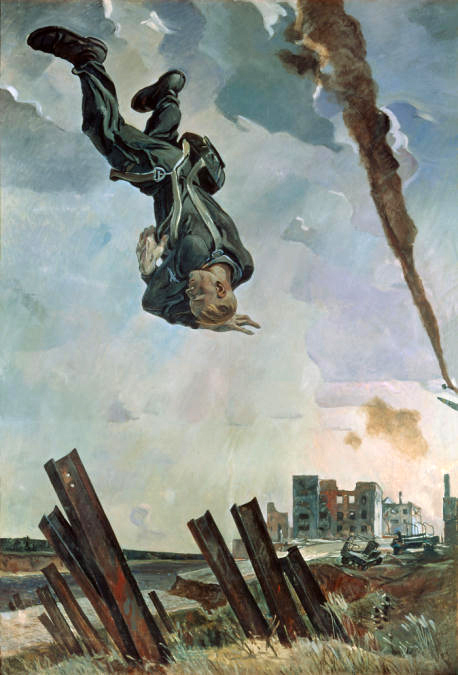
Dreamlike imagery, sleeping position, very vertical, contrasting colors, a strange bit of peace in war and imminent death, jagged fields that the man is hurdling towards.
http://www.allworldwars.com/image/008/SovietPictures041.jpg

The men seem to melt into the trenches and become part of the mud. The warm colors evoke a feeling of sunlight, yet feel horrific. The muted faces are reminiscent of Edvard Munch's Scream. little explosions, or are they grasses, pop off everywhere. Chaos
http://www.allworldwars.com/image/008/SovietPictures055.jpg

Good historical view of the hardships that women underwent in the absence of men. The little boy's face is almost plastic and is the only one seen in the painting. A lot of subtle commentary on the soviet system in here, as it ended up just like the old ways of the Czars
http://www.allworldwars.com/image/008/SovietPictures069.jpg

Just like a Degas, at least to me. Not seeing the face of the player leaves you guessing as to how this solider got to be where he is. Was he a pianist before the draft? How did he learn to play? The gun is on his back and prominently central to the painting. The scattered papers tell a story of a battle and fleeing in panic. The highlighter colors give a waviness to it all, a sense of uncertainty and serenity pervades the piece
http://www.allworldwars.com/image/008/SovietPictures057.jpg

Great use of sky, water and man. A private returns home, but to what? The war is over for him, but the peace is just as uncertain. Will the clouds of this spring day pour on him, or will it stay sunny?
http://www.allworldwars.com/image/008/SovietPictures019.jpg

The structure of the colors here is stark, obvious, yet wonderful. Black enemy, white allies, red sky of soviet victory. The use of triangular imagery. Very Picasso-y
http://www.allworldwars.com/image/008/SovietPictures065.jpg
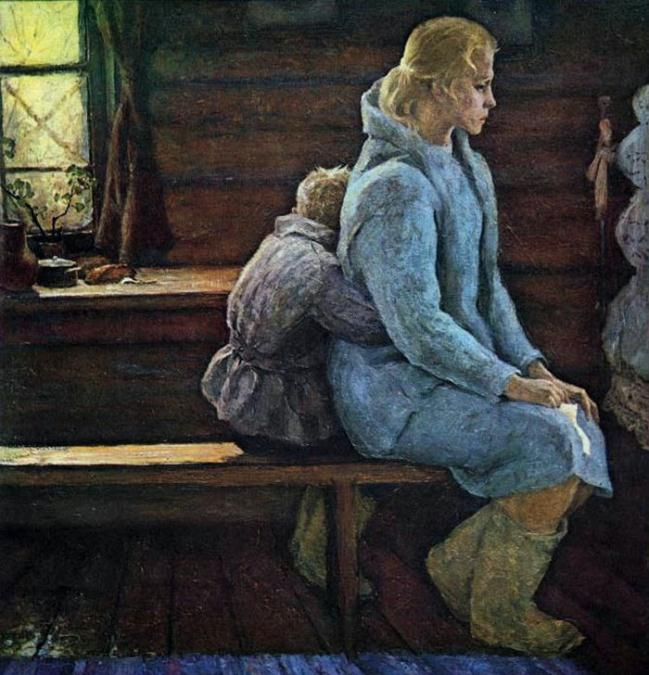
The news arrives and it is bad. Just like the immigrant-farmer mother picture of the US depression. The woman shines in the dark room, her child tries to support her, her back is straight all the same despite the news. She faces off-stage and is nearly pushed off the bench by her child, who is in the center. The little window, her former existence, is full of things and life, she faces her new darker life with what appears to be a shroud and a rifle leaned up against the wall. The letter still hangs brightly in her right hand.
This other painting on the other hand, I'd be very surprised if there's more to be gotten from seeing it in person that what's already on my screen. Going beyond that, a photo that captures the same emotions would be exponentially stronger for me personally too.
Your comment hits on something many people miss. We have photos today. We didn’t in the very recent past. I showed my grandma (96) photos on an iPad and her response was “there’s no reason to paint anymore”. She’s painted her entire life. Artists used to struggle to invent techniques for representing reality, now photos have made that less compelling and artists are looking for other challenges.
Pollock on the other hand wasn't focused so much on the content of what he was creating, but on the process. Pollock wasn't trying to make you feel a thing, Pollock was trying to make a statement about what it means to be art. Pollock and other modern artists aren't looking to provide a story in isolation - they're iterating and expanding on a corpus of techniques, and means of representation, and questions about what it means to be art. Do I need to draw a person to show human suffering? Do I need to represent reality to make something meaningful? Can I create something that is recognizable as art while working under these arbitrary limitations?
I think this is true of any art/skill/techne - once the art reaches a certain level of maturity and sophistication. For practitioners, the new frontiers are not in the content you create (because it's established that you can create anything) but the process by which you make it. Look at modern poetry, and literature. A lot of the time these are very tangled, frustrating pieces to read because they break with the forms we are used to and iterate on them. Many of these aren't written to tell a story, or to make you feel, but to explore how one tells a story, or how one paints a thought in words. You see this to an extent in programming - there's very little value to writing conway's tree of life in brainfuck or competing to see who can write the smallest program that can reproduce the mona lisa in ASCII, but we do it because these limitations are challenging and cool to us.
(I'd argue that a Rothko painting can show just as much poignancy as any of those Soviet paintings you showed above.)
The best paintings provide a connection with a subject - person, place or time - and maybe stir up some emotion about the scene. Some of my favorite are 16th and 17th century Dutch paintings of naval battles. The artists were the war correspondents of their time and their work is as moving as any photograph from a modern battlefront.
Pollock's paintings tell a story in their own way too. I worked in theater in high-school and college and also painting boats and for an industrial coatings company. In short, I spent a lot of time around paint. A Pollock painting reminds me of these workshops: of years, sometimes decades of overspray, splatter, drips, spills and all of the other marks of "work being done here".
The scarred and stained surface of the workbench from my grandfather's garage could hang in a museum. Sixty years of paint and oil; holes from when tools were bolted to it or when parts were drilled; cuts from countless handsaws; scorch marks from blowtorches and soldering irons.
The painting is like the artistic expression of the evidence of work accomplished.
Jackson Pollock's paintings are interesting because he was the first to apply his technique in a studied way. They don't translate well to the digital era, but there is a certain arresting physicality to them when you see one in real life. Many of them are huge, and are not displayed within a frame. You can get very close and see the layers of paint rising up and the aging exposed canvas beneath.
Pollock is more famous than these painters because his work is distinctive. These soviet painters are good at painting, and you obviously connect to their subject matter, but comparing their work from [1], its hard to distinguish any of them as individual artists as their styles are only subtly different, much like Pollock's early work was fairly derivative of the original abstract expressionists and much like someone today deliberately aping a Pollock would not be celebrated in the same way (if not derided as a hack).
That said, I don't think figurative art is objectively better or worse than abstract art. Its purpose is different.
I would have to google a lot but there was a nice mathematical investigation of this, in which the summary was something like that he produced a very consistent scaling of details from very small to quite large, in a way which matches natural scenes. Whereas fake Pollocks don't show this, and perhaps that is why they aren't as pleasing.
People are buying a pleasurable experience and each has a different taste. Some people want a light show and so go to a big rock concert. Some people want a pretty painting to look at while eating breakfast. So they buy a painting. Some people like the feeling of being better than other people. So they buy objects that, for them and their peers, are a badge. They demonstrate how much better their owners are than persons without such objects. Many people like this feeling and are willing to pay.
Some of these people buy flashy cars to show themselves off as they drive to work. Others buy paintings by the great masters and squirrel them away in a vault only to bring them out for dinner parties. In that context, a 2m$ urinal isn't all that different. It is an object that bestows barging rights on its owner. Compared to a great many cars and paintings, both of which come with substantial maintenance costs, 2m$ for a bit of porcelain is cheep.
While I sometimes question the talent required to create some of these pieces relative to other works, it’s difficult to really judge without context. Many of the things that I value in my profession no doubt seem silly or trivial to laymen as well.
When I was in college I would see art around campus take the form of random metal shapes welded together, concrete blobs, or Pollock-esque splatters and shake my head.
How can you judge a category of art for which there are no rules?
I can look at Michelangelo's "The David" and be awed to the core at how he was able to replicate lifelike looking veins in marble. It's difficult for me to even fathom his skill level but I recognize that it is much, much higher than mine.
But a sideways urinal with some marker on it? Anyone with no skill can do random things with random items and call it art.
"Any sufficiently advanced art is indistinguishable from garbage"
The artist had the audacity to put a urinal in a gallery. It's not so much that this was a particularly lovely piece of ceramic (though some may think so). The point is the meta-awareness that urinals don't belong here.
The rule-breaking is the art. The fact the emperor has no clothes is the exact reason people were talking about it. It's not that no one has ever seen a naked person before! But the emperor?! That's not supposed to happen!
Another aspect is photography allowed normal people access to create cheap reproductions of beautiful art. High-class people used to be able to distinguish themselves from the mob with beautiful things the mob couldn't afford.
But this does not work with cheap reproductions allowing one to signal the same taste.
In this way, there became an incentive for high-class people to acquire and inculcate a taste for art that is actively repulsive to distinguish themselves from those normal people who desire beautiful things.
Mostly this doesn't matter. They are only hurting themselves. But the effect of these incentives on public architecture has been pretty horrifying.
> Mostly this doesn't matter. They are only hurting themselves. But the effect of these incentives on public architecture has been pretty horrifying.
This is a very good analysis summary.
I respect Duchamp. He made his point so eloquently that none of the imitators are adding anything to the conversation.
I just found something!
https://designyoutrust.com/2016/07/guy-paints-over-shit-graf...
I think this is an interesting way to approach art, actually: you can walk through a museum admiring artists for how they were able to get away with something different.
Although, in this age of memes, maybe it's more interesting to see what holds lasting attention?
'First!', 'Frist!!!', 'FIRST!!!1111lol!' and other web comment poop is born of the same impulse.
That's actually the thesis behind my startup, Memes On Canvas: https://www.memesoncanvas.com
Further, I think it's easier to comprehend how difficult it must be to produce a realistic sculpture or painting or what have you, compared to an abstract piece. As the piece becomes more abstract, appreciating it requires, I think, a lot more contextual information that the viewer may simply not have.
Of course, some art may just be crap. Who's to say?
I'll use jazz as an example, since I'm most familiar with that history. You can start with something as approachable, if disorganized as "Jelly Roll Blues"[0], and polish the genre into "Take the A Train" [1] as it became more generally popular. After that, though, the bleeding edge of the genre self-protects itself away from the common ear by growing increasingly obscure, with bop [2], modal jazz [3], free jazz [4??] becoming progressively less approachable to the uninitiated ear, to the point that the the unfamiliar ear can hear the latter and find itself unable to recognize even as "music", while someone familiar with the genre can see the path and appreciate the work in context.
[0] https://www.youtube.com/watch?v=Zt203us6TME
[1] https://www.youtube.com/watch?v=cb2w2m1JmCY
[2] https://www.youtube.com/watch?v=Z2tvlp7RnlM
Check out some of the stuff Mike Gao is putting out with the use of his Polyplayground app.
Others have mentioned this, but I think the key here is that the "skill" you are referring to is what art theorists would call "craft." There is a degree of technical skill that goes into a work of art (e.g. sculpting realistic bodies in marble or being able to draw consistent shapes or human anatomy, etc), but theorists would say that the truth of the art is about what emotions and ideas it expresses in the viewer. In this way, since contemporary art often eschews craft, it can (in one sense of the term), be considered the most pure kind of art.
> How can you judge a category of art for which there are no rules?
Keeping the above in mind, art isn't about rules or judgement, but about the personal message it sends to the viewer. Because, after all, what are the "rules" you are ascribing to The David? Realism? If so, then what would you say about impressionist works by, say, Claude Monet?
I say this also as a humble engineer (even if I come off as standoffish, which I hope I'm not), who happened to take a few art theory courses at school, which by no means makes me an expert: so this is just my own experience and perspective.
The most powerful experience I've had with a work of art was with one of Mark Rothko's paintings. Sure, you can look at it as a plain wall of one or two colors in a plain square shape, but when I really got a good look at it for a prolonged period of time, I began to get lost in the colors and appreciated the nuances of the brushstrokes (it also helped that I had read John Logan's play "Red," which is a psychological profile about Rothko's method, which I recommend highly)
All of this to say that, yes, anyone with no skill can do random things with random items and call it art. Because the skill, the things, and the items are not the true characteristics of what art is. I don't think that "Fountain" should necessarily be marked as a masterpiece or objectively hailed as brilliant or anything, but I think to label it as "not art" misses the point (the point that it's trying to make a statement about art as a whole). Art is not about skill/craft, but about communication between the artist and viewer.
That's my perspective on it at least!
Why are you assuming that modern art is arbitrary, random and has no rules?
For that matter, why do you seem to assume the purpose of art is to be "judged" according to some objective set of rules?
Have you tried to study any modern artistic movements, or artists, and what those movements or artists were actually trying to express? It seems like you're mistaking complexity and technical skill for meaning, or assuming that only realistic depictions of nature have any artistic credibility.
>But a sideways urinal with some marker on it? Anyone with no skill can do random things with random items and call it art.
Don't assume that because something appears simple or obvious, that there is no meaning behind it. Maybe sometimes there isn't. Maybe the art at your campus was literally just there to look cool. Maybe some modern artists are taking the piss, like Duchamp, who was trolling the art society he was a part of with that[0].
Yes, you could assume Jackson Pollock was just throwing paint against a canvas and that can't be art because anyone could throw paint against a canvas, but like Marcel Duchamp and a lot of other modern artists, he was trying to say something[1], and that's what makes it art, not its reproducibility or realism.
Artists like Picasso and Mondrian were capable of creating traditional artwork in the classical style, but they became famous for their abstract work. I think it would be a stretch to say these people lacked talent or understanding of what art was, rather, they were trying to express their ideas in as minimalist a style as possible.
>"Any sufficiently advanced art is indistinguishable from garbage"
And any sufficiently advanced criticism is indistinguishable from ignorance.
[0]https://www.tate.org.uk/art/artworks/duchamp-fountain-t07573
[1]https://www.quora.com/What-do-Jackson-Pollocks-paintings-rea...
More like inference than assumption, based on occurrences like Pierre Brassau's art.
Although, ironically, the hoax itself makes it a valid form of performance art anyway.
This is the bullshit that makes people weary of modern art. If you disagree, you fail to realize that this post, and indeed hacker news itself, is postmodern performance/interactivity art. Your opinion is wrong and invalid if you disagree.
No one is actually saying that, though. The only people trying to invalidate anyone's arguments and opinions are the ones who disagree that modern art has any value. And no one mentioned anything about hacker news itself.
What I am trying to imply is that there is more than one valid interpretation of this particular event. That, even if paintings by chimpanzees weren't art,and the hoax wasn't intended as art, the effect of the hoax still serves the purpose of art.
Please stop being defensive and please appreciate that context is sometimes relevant to a discussion.
I was intentionally being standoffish in a manner so as to imitate modern art fanatics. See, you just don't understand the _performance art_ that is contained within a HN discussion (this is facetious).
I would agree that "ones who disagree that modern art has any value." are misinformed. And on the flip side, I would argue that those who believe _all_ modern art _has value_ and is _worthwhile_ are incorrect. There is a lot of shitty modern art out there that can and should be dismissed (I realize beauty is in the eye of the beholder) and by not doing so, you only hurt the worthwhile modern art.
I once saw a coca-cola bottle filled to the brim with cigarettes, placed into a red circle, in the SF MOMA. That isn't art; that's every weekend outside my apartment in college.
I would argue that replicating lifelike veins in marble is not the artistic part of David. That the craft - and surely many of Michaelangelo's contemporaries (and indeed many sculptors today) were also capable craftsmen when it came to sculpting. The art is the body language, expression, and overall "feel" of the piece.
This comes into sharp relief when you examine the work of someone like Robert Mapplethorpe[1] - who wanted to be a sculptor, but realized he could often achieve the same artistic goals with models and photography. He wanted to capture beauty and emotion through the human form - and the medium was just a means to an end.
All of this is to say that contemporary art is capable of communicating the same feelings as more classical artistic styles - and those feelings are really the point. The comparison between David and some college piece is also unfair. It has always been true 99% of everything is crap. What is the best contemporary art will only be apparent in retrospect. Stuff you see around a college campus is likely not even the best of contemporary art at the time it's created (that's why it's on a campus). Comparing that to art that has had 300+ years of societal filtering doesn't really make sense.
One of my favourite pieces of contemporary art is "Fuck Death" by Leon Golub[2]. I like its straightforward starkness and the way it seems hastily done - as if the painter was in a hurry because death is, indeed, coming. The technical aspects of this piece are, honestly, not very impressive. It's a very simple watercolour. But it speaks to me in a way that classical depictions of death, with all their craft and realism, really don't. That ability to communicate feeling is the art. The choice of medium or style is just aesthetic preference.
[1] https://en.wikipedia.org/wiki/Robert_Mapplethorpe
[2] http://interrum.tumblr.com/post/59580566966/bidartanalysis-f...
Edit: I am also a humble engineer, so I'm probably just re-inventing art theory 101 here. But I don't think contemporary art is as worthless as many seem to think.
But I don't appreciate those nearly as much as I do no-named postmodern pieces, even procedurally-generated ones. There are so many curious layers of questions that arise when staring into the abstract and being left to your own perception to pull out appreciable components. So much to wonder about the artist, his intentions, and his chaotic vision or process. It is far deeper than masterful material work.
Considering how absolutely we are able to control materials these days, particularly now that atomic-level artificial composition is within our power, I find the questions of what? why? why not? or even lol wtf? far more appetizing to modern curiosity.
It is not about what anyone can physically do nor if it's easy or hard. It is about the ideas and navigating culture and finding interesting connections. It is opposite of random.
It's like saying "But this textfile with some wierd file extension? Anyone with no skill can write random characters on keyboard and call it programming"
Don't get me wrong i hate contemporary art but there are many interesting and important ideas coming out of it.
It's just not made for general public anymore. And people in that bubble don't care. That type of art was replaced by tattoos, illustrators, photographers and even popular movies/games etc.
Of course it is also possible it s all just so much wankery and garbage, but you can't just assume that.
One text I ran into was by an Objectivist: https://www.amazon.com/dp/B00P9RV9PE/ - which goes into the motives and rationales for why the modern art went the way it did - and compares with other societies. Fascinating book.
Fundamentally, the Objectivist text comes down to roughly this
> – Proletarian: relevant to the workers and understandable to them.
Which is a description of soviet realism (something Objectivists might find startling).
http://www.russianartdealer.com/socialist-realism/
I also want to stress that the notion that art is subjective, or that it should make you feel, is wholly a product of the Romantic era and its challenge of a previous understanding of art as being an _objective_ thing with a ladder of values.
So I strongly concur with you here.
Pollack almost literally uses inkblots, like the Rorschach test.
Later edit: I mean, compare this Soviet painting called "The Last Letter" [3] to Pollock's "One, Number 31, 1950" (taken from the artist's wikipedia page). The first painting instantly made me feel the blood flowing through my veins, even though I had last seen it 7 or 8 years ago (when I also left a related comment here on HN), while Pollock's painting doesn't make me feel anything.
[1] http://www.allworldwars.com/Soviet%20War%20Paintings.html
[2] https://www.independent.co.uk/news/world/modern-art-was-cia-...
[3] http://www.allworldwars.com/image/008/SovietPictures065.jpg
[4] http://www.moma.org/media/W1siZiIsIjIyMzgwNSJdLFsicCIsImNvbn...