But why is you visiting it okay, but others not? It's like being stuck in traffic and hating on other drivers. In the article's case, it's their homes, so I can see it being annoying. But for landmarks that get popular, I don't see how one is justified in hating on other people going there. It's just a tragedy of the commons.
I also dislike how Barcelona and others are handling the problem. Taking tourists' money and harassing them.
I say this as someone who grew up in a mountain resort. Yes, it is annoying during winter when people flood to "my nature" and "my ski spots". But if it weren't for those people, my family or no one else would live there as there wouldn't be any jobs. So then it wouldn't be "mine" anyways.
The reason I brought it up in the first place is because only within the last 10 years has it really gotten “bad” — completely because of instagram.
instagram influencing is now a business. it's advertising without the clear disclaimers or statements for who is paying for that advertising and why
a lot of this advertising requires traveling to cool/famous/chic/rugged locations and taking photos or videos there, so that followers feel they are also there, and get to see a cool place through the eyes of their "friends"
it's more than just social points gamification, it's a business, it's advertising with real money involved, and these natural settings are becoming the new ad studios that it's cool to shoot in (besides places like venice beach and rue cremieux)
and when businesses/money get involved, the natural respect for the environment/others using the space disintegrates in the face of profit and time maximization
I suspect cheap flights and accommodation, changes in fashion (city breaks vs package holidays), more disposable income and free time are all contributing.
Flying is an unusual product that gets cheaper over time. Supply has increased.
Airbnb has had an impact on hotel pricing and availability.
It's commonly understood that not all prices change in lock step, but "inflation" is the general or aggregate change in prices, usually based on the change in the purchasing power of money. Choosing to finance or pay cash for a car or a house doesn't change the price of the item, just your cost of acquiring it - it exposes you to expected future inflation, in addition to the current price, because you will be paying back the incurred debt with less-valuable future dollars. The interest you pay also pays for the use of someone else's money for the period of the debt.
Note, too, that inflationary monetary policy is also implemented by creating money in other ways, like a printing press, and inflation can also be caused by supply/demand shocks, like changes in supply/demand of fundamental commodities, like oil.
Just an example: https://www.slice.ca/travel/photos/most-popular-travel-spots...
A lot longer than that: https://en.wikipedia.org/wiki/Grand_Tour
And a lot longer than that: http://ieg-ego.eu/en/threads/europe-on-the-road/the-history-...
I'm not surprised you don't see how anybody is harassing tourists; you're a local so you don't get harassed. That's doesn't mean it's not an issue.
The reality is that the rich Spanish sold the rest of you out for a quick buck. That's why there aren't any good jobs and any reason to stay. Those that stay whine and complain. Yet every Spaniard I've talked to in northern Europe talks openly about the whining and the lack of desire to get to the root of the problem or take responsibility.
They are Spanish. They live in Spain. They speak either Spanish or Catalan and have no obligation to speak English to you. It's "very rude" of you to not try learn some basic Spanish.
I'm native English and live in Poland. My interactions with Poles (who mostly speak English and are happy to do try) are vastly different if they can see I am trying also: starting the conversation in Polish before transitioning to English is a much warmer experience than just starting with English from the beginning.
It's the same in Spain as well. Start with "hola" or "buenos dias" and then something like "podemos hablar Ingles?" or "perdon, no hablo Espanol" and suddenly 99% of these "very rude locals" will be incredibly friendly to you.
You don't need to, and most don't expect, that you can fluently speak to them in the local language. But they do expect that you respect them enough to try.
travel isn't the problem. People experiencing their lives via the lens of their phone/camera is. Take pictures by all means. But taking pictures to get likes from strangers in order to experience it as a valuable memory is pathological.
Edit: I hate to bring my phone with me when in nature because I feel it robs me of the experience I could have actually enjoying the moment. My ex always complained "why you never take pictures of these special moments?" ... If I would have my eyes on the phone it wouldn't be special. 10 or 20 years later I still have rich memories of those times where it mattered and I guess not having a phone/camera with me at the time was big part that it actually became a great memory.
For me it is in the other direction. I do not avoid social media (think I am on most on them...) but interact sparingly (less than once a month). Still I am sometimes an obsessive photographer exactly because I know I have a terrible memory.
This weekend just been, I was flown to a location by said authority, given a car for four days and basically set loose to photograph whatever interested me. (I shoot with a drone.)
Anyway, at the first of the two fixed experiences of the weekend (an oyster farm), I was sitting near two girls who had driven 700km for a weekend in this location all because they'd seen a girl's photograph on Instagram, shared by the authority. Coincidentally, that girl was seated five metres from them and also in the area shooting for the tourism authority because of how powerful social is now. The authority chaperone was right there in the middle to witness the power of her daily work.
For anyone who cares, this is my work: https://www.instagram.com/__serio__/
This is the shot the girls had seen: https://www.instagram.com/p/Bs2aWsbHxT0/
I imagine the average HN user imagines these "travel couples" to be particularly obnoxious and I'm sure some are (like any subset of people), but this couple were very genuine and great people. Like me, they get out there because one hobby is photography; just a bit different to that of the typical landscape photographer.
No where we shot that weekend was anywhere near crowded. I almost always had miles and miles of pristine beach to myself. At this location, there would've been no one on that beach for 3-5 km in either direction, just 15+ dolphins playing in the waves.
Isn't this point a little disingenuous when you live in a country that's almost the size of USA or Europe, but only has 25 million inhabitants, and people from other countries have to travel far to get there?
(Can't edit my earlier comment, but the italics were from an asterisk/footnote rather than intended emphasis.)
Then the photography hasn't done its job yet. Will you like that beach more when it looks like this?
https://www.wonderslist.com/wp-content/uploads/2013/07/Bondi...
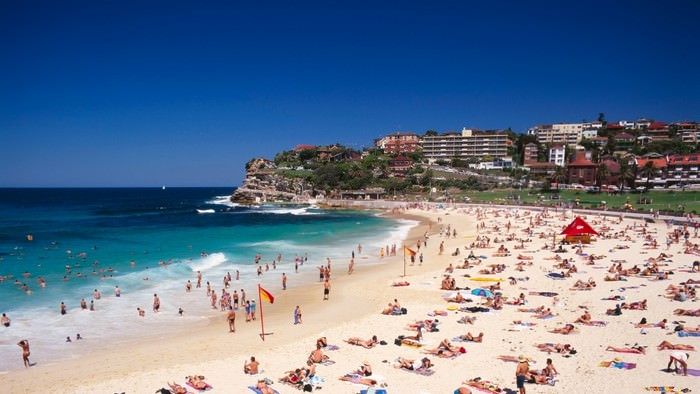
Everyone has a right to experience it, and I had the same experience or close to it on countless beaches in that area. We'd need a lot more people visiting before it got to even a hundredth of Bondi.
Any touristed location will reach an equilibrium with its crowds. There's always an alternative for those not keen on the hordes. Go to Simitai instead of Badaling. The Louvre has countless alternatives to the Mona Lisa's room. The Grand Canyon has dozens of vantages. You don't have to walk far from the central area of Zion National Park to have expanses to yourself.
Some people take yet another photo of a popular attraction. Others visit an online discussion and throw another viewpoint into the maelstrom as though it achieves much of consequence. Each to their own.
As far as I understand, you don't own the place. From my perspective, you are more selfish than these people. You don't want people to access public property because it "inconveniences" you? Seriously, what is wrong with the world.
The reason people didn't visit your place before because internet didn't make it popular enough and transportation wasn't that good. The fact that you were there first or had memories of it being empty doesn't make you own it (and thank god for that).
ps: I used to live in a very nice part of the city. I ended up moving because the outsiders "wrecked" it. But it is fair. I only rented an apartment and the nearby small mountain and sea was public property.
So nobody owns anything, or has exclusive right, but when each area is used mostly by the respective locals, it's more sustainable all the way around. That's the tension.
And I think that's what the original commenter was alluding to.
Like I just don’t get people going to the Trevi fountain in Rome. The place is so crowded that all they get is pushing their way to a tight spot where they can see some of the horses, take the same picture than the first 1,000,000 results on google image and then push their way out. What’s the experience?
And yet most people who go there still regard the experience as profound.
The gatekeeping people have around the right kind of travel is amazing.
Also, that place was not yours. Yeah, it sucks that you can't get 100% pleasure out of it because 1000 people are getting 5% of pleasure out of it...so maybe find a new spot? There isn't a shortage of wild places out there
I'll take a photo with them - it'd be 3 fat guys standing around shirtless drinking beers. :')
Either that or getting your photo with shirtless fat guys becomes the new point of the exercise (with people getting more likes the fatter the guys).
Foot traffic will degrade natural sites, with the fees they can better take care of these sites and ensure they don’t become overrun.
Bhutan has an interesting system for foreign tourists, they have a visa cap as well as a hefty visa fee. It’s one way to dampen demand to more sustainable levels.
Historically tourism has been very bourgeois, now it’s become ‘democratized’ bug that has untaxed externalities.
What is life if not an accumulation of experience?
It's not technically yours, sure, not in any sort of legal sense, but your cultural and historical connection to it is meaningful. Your SENSE of ownership over it wouldn't hold up in court, but that doesn't mean it's immaterial. It doesn't afford you the right to kick people out, but it does excuse some frustration over the crowd, and a sense that maybe they're not as entitled to it as the locals are.
No, no one can tell those people to leave. But I think tourists have a serious responsibility to consider how their presence impacts the area.
But there's a tension there, of course. It's selfish to hoard and hide things like this, and the world has a lot of wonderful things in it. But I think I'm more sympathetic to locals than I am tourists.
More broadly, the elevation of travel to a spiritual practice is a big time lie. I don't doubt it has some benefit but it's moral and spiritual inflation is similar to people's attitudes about aesthetic appreciation--you can be a shitbag and have good taste. You can be an utter bastard and be well-traveled.
Really? Because although I may not have travelled much, I can't say it's ever been "about me". Quite the opposite. For me travelling is about where I'm going, what I'm experiencing, who I'm meeting. I think your applying your perception of a subset of travellers on the body at large.
You could also speculate about much harder to prove thesis. For example, if travel & "global citizenship" helps avoid a great war, that's quite a lot of damage & destruction averted.
From a social media narcissism eating the world standpoint, it's also pretty bad to be spending thousands of dollars to travel somewhere just to shoot an instagram shot and hope for likes (imho).
20 years ago, you might have had 3-4 people on a given weekday sunset visiting to see the view. Now, that number is probably approaching 100. On weekends it's a throng of people, almost like standing room only.
It's a beautiful place, and it's inarguable that anyone should be able to see and enjoy it. But really, are most of those people there to see the beauty of the place? Would they be there if not for the opportunity to post it on social media? It's not like this is a hidden spot whose location was revealed by social media. It's a well known natural area. It just didn't get this crowded until it became hip to take photos of yourself in some beautiful place.
And then I realize, this is what people who live in areas with real tourism must feel like, except magnified to nightmarish proportions. Travel contributes greatly to carbon emissions, destroys environments, puts stress on local wildlife and people... just so that someone can have an ~experience~ for themselves.
The thing is, I think most people have a great deal of "interesting-ness" right near home. They just compete globally on Instagram, which requires a plane ride.
I don't hold this opinion, I'm just trying it on for size -- I've traveled to a lot of very beautiful places and had cool experiences, so it'd be hugely hypocritical. But yes, I really dislike the Instagram effect.