Coal kills on the order of hundreds of thousands of people per year. Fukushima killed zero. Chernobyl directly killed 60, and caused up to 4000 early cancer deaths over the next several decades on top of a population that would get millions of cancer deaths anyway, and that's with a bizarro linear no-threshold model almost unheard of in other latent estimates.
Nuclear is also very nearly carbon free. So if you start factoring in health effects of global warming, nuclear's even better.
They had 51 years, 51! to raise a damned wall 20 m. Had all the new information, improved models, latest computers and warnings... and they didn't do anything. Neither Tesco, nor the Japanese government were able to see it coming. Their lack of vision is really infuriating.
Then, too, I've seen no figures on the carbon costs of nuclear waste-management.
Australia is a top-3 uranium producer [1], we have 3 mines. That rounds to 0 in Australian mining terms. Olympic Dam is a monster in relative terms, and the production numbers are ... by tonnes Olympic Dam isn't even a uranium mine, it is a copper mine. And Olympic Dam [2] is a world class uranium mine afaik.
[0] https://en.wikipedia.org/wiki/Energy_density
[1] https://en.wikipedia.org/wiki/List_of_countries_by_uranium_p...
[2] https://www.bhp.com/-/media/bhp/documents/investors/reports/...
E=MC2 is an amazing thing.
[1] https://partofthething.com/thoughts/wp-content/uploads/ipcc-...
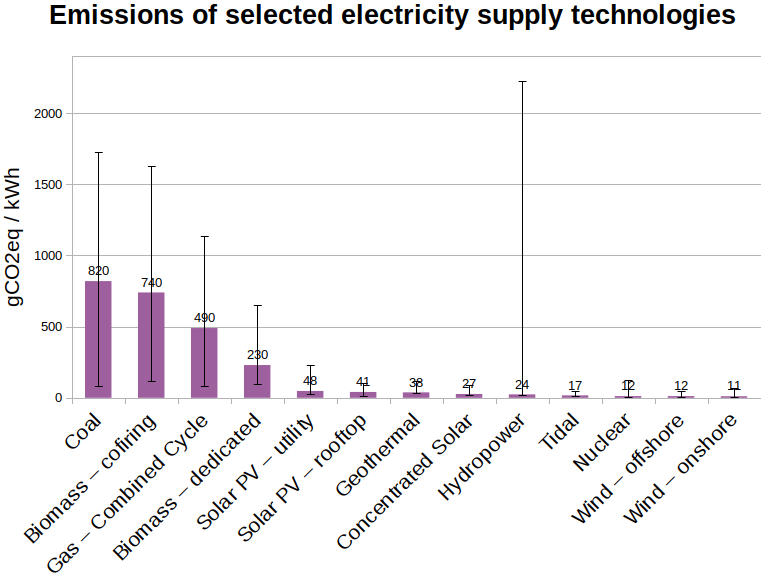
Source: Schlomer S., et.al., 2014: Annex III: Technology-specific cost and performance parameters. In: Climate Change 2014: Mitigation of Climate Change. Contribution of Working Group III to the 5th Assessment Report of the IPCC
Besides most countries with a nuclear weapons program end up with a lot of reactor-grade uranium lying about anyway, and those countries also happen to be the biggest polluters in energy
Yeah, there's plenty of very unpleasant chemistry involved in making PV panels and I strongly doubt that the wastes involved in the associated mining/manufacturing/disposal processes are treated anywhere nearly as carefully as nuclear waste (not to speak of the fact that due to sheer energy density difference, PV panels will produce far more waste than nuclear fuel/reactors).
Besides, there isn't enough uranium in the world to provide baseload nuclear power that would replace coal.
Fossil fuels kill millions a year related to pollution, and does make whole areas unlivable. About 16% of all fracking oil in the US gets spilled in nature every year[1], on top of crap like Flint. Coal is responsible for 80% of energy-generated related air pollution, worldwide[2]. They are not a good solution.
Natural sources are simply extremely limited in terms of access. Few countries can realistically really rely on these as a main source of electricity.
The, there's nuclear. We have fission, which is, while relatively safe (5 major impactful accidents since the rise of nuclear power, 3 of those being the three Fukishima plants), pretty damaging _when_ shit happens. However, are the damages realistically worse than fossil fuels? I'm not exactly qualified to figure this out myself but just looking at the numbers really doesn't make fission look that bad. Finally, there's nuclear fusion, which is a lot safer, while we've been making decent progress in the recent years, doesn't look like it's gonna run our cities any time soon.
So no, we shouldn't be burning coal, obviously, but if nothing's perfect, the logical option is the next best thing.
[1] https://www.bbc.com/news/science-environment-39032748 [2] https://www.ucsusa.org/clean-energy/decrease-coal-use
Flint's water contamination has absolutely nothing to do with energy production of any kind. It was caused by the city still having lead water pipes.
Edit:
> About 16% of all fracking oil in the US gets spilled in nature every year[1]
> [1] https://www.bbc.com/news/science-environment-39032748
That isn't at all what that article says. It says 16% of wells suffer a spill each year. The industry would never allow 16% of its product to simply go to waste, particularly considering how difficult and expensive those operations are.
And indeed, I misread, it's not 16% total spillage but 16% of them spilling at all. This one doesn't really change much to my point that having one in six fracking points spilling out is extremely damaging.
Until these three numbers become 0.0, 0.0, and 0.0, building more nuclear plants to displace them is an immense progress.
You are basically saying: Since you can't be perfectly clean, I'd rather you be as dirty as possible.
It's not even close. Nuclear is so much better than coal it's unbelievable.
Just to start with coal releases orders of magnitude more radiation than nuclear. https://www.scientificamerican.com/article/coal-ash-is-more-...
Then the number of deaths from coal, take a look at the numbers:
Coal: 100,000 deaths per PWh.
Nuclear: 0.1 deaths per PWh.
That means coal is 1 MILLION times worse than nuclear. I mean seriously, what else would it take to convince someone?
Let's see, what's worse? Taking 10 years to do something, or killing 1 million times as many people?
The real danger of Nuclear is it can make land unusable by people for centuries (this actually appears to be good from a biodiversity and ecological heath stand point because people do more damage to that than some radiation). But by contributing to climate change coal has the potential to put far more land under water.
If we had gone for widespread adoption of nuclear power on the scale of Japan climate change would not be a problem like it is today.
[1] https://news.nationalgeographic.com/2016/04/060418-chernobyl...
While global warming is easily solved.
Coal or nuclear are both bad but differently. Which one is less bad depends on your risk model
Not even that. People seem to forget that most utilized energy is eventually dissipated in heat in the atmosphere!
Any unlimited and extremely cheap energy source would only encourage more unsustainable consumption.
Not to mention that many industrial products that lead to pollution (e.g. plastic) are correlated to the cost of electricity. Give the world free energy and people will want a new smartphone every month.
(let's sit back and count the downvotes now...)
That's playing on feelings rather than making a rational argument. Regardless of whether I am for or against widely deploying nuclear energy, this is not the way to talk about it and create informed opinions. The media are already doing their best to play on feelings on this topic, we don't need to replicate that here.
It's just not that simple. We need to look at both sides, weigh the options, and find a solution which probably involves a mix where we compromise on having X m³ of earth dedicated for a long time to nuclear waste to save us in the short term. I'm not informed enough to give exact figures and make proper arguments, but reiterating known one-liners won't get us anywhere.
Regulatory capture and what's essentially corruption is not "physics and systems engineering", and they should be considered independently of nuclear power's inherent technical merit. And regarding ramp-ups and ramp-downs, I have never heard of anyone suggesting nuclear power for anything other than base load, so I don't see how this would be an issue?
I notice that no one brings up that all recent plant construction in the US has been cancelled except one -- which could get killed any day. And no new nuclear plants are planned or proposed for the US.
Nuclear VS "delay cutting emissions" is a false dichotomy.
With adequate transuranic/actinide burning and breeding/reprocessing capacity the time constants for waste disposal won't be anywhere that long. Discounting nuclear energy because of stupid once-through fuel cycles seems a bit unfair.
France per-capita CO2 emission is 1/3 the US rate and 1/2 the German rate. This is due to their heavy focus on nuclear power for electricity production. The data shows we should be moving to nuclear rather than away from it.
As far as "never" being able to clean up an accident, how could you take such an absolutist position? Do you really believe that with a reasonable research effort we won't understand how to reprocess nuclear waste and/or accident debris within 50 years? We couldn't even fly until a little more than 100 years ago. Our understanding of the physical world is growing more rapidly than any of us can really appreciate.
To say we can "never" clean something up is to completely disregard the exponential rate of increase of both scientific knowledge and technological capability. Given progress in the last 100 years, it is reasonable to conclude that nuclear waste is a 50 to 100 year problem at worst.
Geez, did we toss out cars or aircraft after a few accidents? Did we stop trying to go into space after some accidents? Did we stop trying to cure cancer after some deaths? No, we learned from the mistakes that were made that led to the accidents and fixed them. The development of nuclear power should follow the same iterative process all other technologies rely upon. Obviously we work as hard as possible to risk reduce the process, but iteration is how science turns into safe and practical technologies.
https://en.wikipedia.org/wiki/List_of_countries_by_carbon_di...
This probably requires a new kind of physics to be discovered and eventually applied. It's absolutely not clear how this should work.
Fluid Dynamics is Newtonian physics, Bernoulli equation already exists since the 17th century.
>>The truth is that accidents like this can never be cleaned up or salvaged.
I mean that depends on how pedantic you want to get with a "never" and whether you think "sequestered" is good enough or only "salvaged" is acceptable.
Current nuclear isn't great and is incapable of solving climate issues by itself. It still seems like a more viable option than continued reliance on fossil fuels.
you need to be addressing the larger chunks of these pie charts:
In fact, there are apartments here in Amsterdam that stay a cool 20C in winter with little or no heating at all, just the warmth from the water boiler flue running through the heat exchanger of the air ventilator.
Nationally sponsored infrastructure plans to replace existing buildings with energy class A at scale would put a big dent on energy consumption.
EDIT: "20 years from now" is still faster than any nuclear generator getting built.
That it takes so long now in the west is because we're not building enough of them, thus losing the advantage of experienced workforces and inability to leverage mass-manufacturing of standardized designs.
It's also slow because of onerous safety regulation seeking to make nuclear too safe, when we consider the result of a slowdown in commissioning of new reactors, thus increasing the reliance on coal killing way more people than if we were to hypothetically mass manufacture relatively unsafe reactor designs from the 60s today.
"The country [China] has the capacity to build 10 to 12 nuclear reactors a year. But though reactors begun several years ago are still coming online, the industry has not broken ground on a new plant in China since late 2016, according to a recent World Nuclear Industry Status Report.
Officially China still sees nuclear power as a must-have. But unofficially, the technology is on a death watch. Experts, including some with links to the government, see China’s nuclear sector succumbing to the same problems affecting the West: the technology is too expensive, and the public doesn’t want it."
https://www.technologyreview.com/s/612564/chinas-losing-its-... (China’s losing its taste for nuclear power. That’s bad news.)
> That it takes so long now in the west is because we're not building enough of them, thus losing the advantage of experienced workforces and inability to leverage mass-manufacturing of standardized designs.
Can you provide evidence that the cost of nuclear would be comparable to solar and wind if built at scale?
> It's also slow because of onerous safety regulation seeking to make nuclear too safe, when we consider the result of a slowdown in commissioning of new reactors, thus increasing the reliance on coal killing way more people than if we were to hypothetically mass manufacture relatively unsafe reactor designs from the 60s today.
I'm unsure you can sell nuclear to the public or politicians as "it's expensive because it's too safe". It's unlikely we're going to relax safety regulations when cheaper alternatives already exist (solar, wind, natural gas, storage). We're not increasing our reliance on coal, we're temporarily increasing our reliance on natural gas (which is driving coal and nuclear out of business).
EDIT:
"but pointed out that it taking anywhere near 20 years to build a nuclear power plant is clearly off by an order of 4x at the very least."
I’d prefer nuclear reactors not be built in the developed world to Chinese standards.
All options are trade offs, and I don't understand why "perfect" keeps preventing us from just getting "better".
The truth is that accidents like this can never be cleaned up or salvaged. It's time to move away from nuclear, as other countries have already figured out.
Fortunately for us in the US, the last nuclear plant under construction today will likely be cancelled, as the last two were. There are no plans to build another one here. That doesn't relieve of us of the chance of a homegrown Fukushima on American soil, but it shows that the future isn't nuclear for environmental and cost reasons -- of which "decommissioning" costs billions, even if there's no meltdown.