They had 51 years, 51! to raise a damned wall 20 m. Had all the new information, improved models, latest computers and warnings... and they didn't do anything. Neither Tesco, nor the Japanese government were able to see it coming. Their lack of vision is really infuriating.
Then, too, I've seen no figures on the carbon costs of nuclear waste-management.
Australia is a top-3 uranium producer [1], we have 3 mines. That rounds to 0 in Australian mining terms. Olympic Dam is a monster in relative terms, and the production numbers are ... by tonnes Olympic Dam isn't even a uranium mine, it is a copper mine. And Olympic Dam [2] is a world class uranium mine afaik.
[0] https://en.wikipedia.org/wiki/Energy_density
[1] https://en.wikipedia.org/wiki/List_of_countries_by_uranium_p...
[2] https://www.bhp.com/-/media/bhp/documents/investors/reports/...
E=MC2 is an amazing thing.
[1] https://partofthething.com/thoughts/wp-content/uploads/ipcc-...
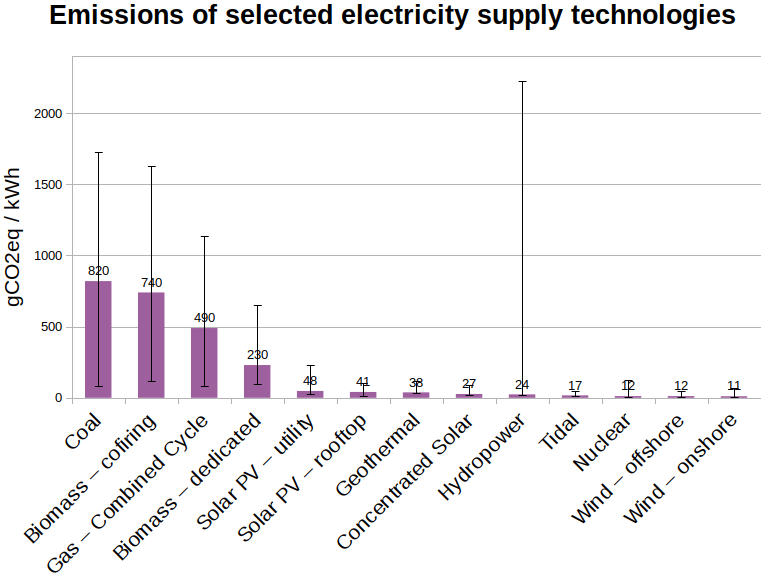
Source: Schlomer S., et.al., 2014: Annex III: Technology-specific cost and performance parameters. In: Climate Change 2014: Mitigation of Climate Change. Contribution of Working Group III to the 5th Assessment Report of the IPCC
Besides most countries with a nuclear weapons program end up with a lot of reactor-grade uranium lying about anyway, and those countries also happen to be the biggest polluters in energy
Yeah, there's plenty of very unpleasant chemistry involved in making PV panels and I strongly doubt that the wastes involved in the associated mining/manufacturing/disposal processes are treated anywhere nearly as carefully as nuclear waste (not to speak of the fact that due to sheer energy density difference, PV panels will produce far more waste than nuclear fuel/reactors).
Besides, there isn't enough uranium in the world to provide baseload nuclear power that would replace coal.
Fossil fuels kill millions a year related to pollution, and does make whole areas unlivable. About 16% of all fracking oil in the US gets spilled in nature every year[1], on top of crap like Flint. Coal is responsible for 80% of energy-generated related air pollution, worldwide[2]. They are not a good solution.
Natural sources are simply extremely limited in terms of access. Few countries can realistically really rely on these as a main source of electricity.
The, there's nuclear. We have fission, which is, while relatively safe (5 major impactful accidents since the rise of nuclear power, 3 of those being the three Fukishima plants), pretty damaging _when_ shit happens. However, are the damages realistically worse than fossil fuels? I'm not exactly qualified to figure this out myself but just looking at the numbers really doesn't make fission look that bad. Finally, there's nuclear fusion, which is a lot safer, while we've been making decent progress in the recent years, doesn't look like it's gonna run our cities any time soon.
So no, we shouldn't be burning coal, obviously, but if nothing's perfect, the logical option is the next best thing.
[1] https://www.bbc.com/news/science-environment-39032748 [2] https://www.ucsusa.org/clean-energy/decrease-coal-use
Flint's water contamination has absolutely nothing to do with energy production of any kind. It was caused by the city still having lead water pipes.
Edit:
> About 16% of all fracking oil in the US gets spilled in nature every year[1]
> [1] https://www.bbc.com/news/science-environment-39032748
That isn't at all what that article says. It says 16% of wells suffer a spill each year. The industry would never allow 16% of its product to simply go to waste, particularly considering how difficult and expensive those operations are.
And indeed, I misread, it's not 16% total spillage but 16% of them spilling at all. This one doesn't really change much to my point that having one in six fracking points spilling out is extremely damaging.
Until these three numbers become 0.0, 0.0, and 0.0, building more nuclear plants to displace them is an immense progress.
You are basically saying: Since you can't be perfectly clean, I'd rather you be as dirty as possible.
Coal kills on the order of hundreds of thousands of people per year. Fukushima killed zero. Chernobyl directly killed 60, and caused up to 4000 early cancer deaths over the next several decades on top of a population that would get millions of cancer deaths anyway, and that's with a bizarro linear no-threshold model almost unheard of in other latent estimates.
Nuclear is also very nearly carbon free. So if you start factoring in health effects of global warming, nuclear's even better.