This is specifically one of the reasons I ended up switching to a Lenovo Thinkpad X1 Yoga, even though I'd planned to buy the new MacBook Air. The Thinkpad's SSD is officially user-replaceable and I bought a 2TB WD Blue SSD for less than a third of the cost of Apple's upgrade. Even an NVMe SSD would have been half the price of Apple.
One caveat is that although Lenovo has excellent official repair videos (https://www.youtube.com/watch?v=PqrspYc21PY), I must be doing something wrong, the Phillips & JIS heads in my iFixit Mako toolkit don't seem to fit/grip the Thinkpad's SSD screw. I'm worried I'll strip the screw if I keep trying, so I guess I'll take it to a Lenovo repair shop for some help.
There's update bios to fix that issue according to reddit.
[0]: https://www.amazon.de/gp/product/B07CGJNLBB/ref=ppx_yo_dt_b_...
https://www.alza.de/samsung-970-pro-1tb-d5319060.htm
276,47 EUR w/o VAT, 329 EUR with VAT. Currently, that's some 377 USD.
https://www.samsung.com/us/computing/memory-storage/solid-st...
Granted, it's a heck lot more expensive at 1TB for $700. It seems the only reason for this drive to exist is actual transfer speed because in any other way seems worse than the T5.
If you're willing (to pay) and able (to plug it in) to use Thunderbolt 3, there are several commercial products that use an NVMe internally and boast up to 2500MB/sec.
It's also not a 2.5" drive since it's obviously smaller.
1tb SSD are already significantly cheaper than what they are charging. They don't seem to base their pricing on cogs.
Spinning rust drives will likely give you up to ~110 MB/sec.
A SATA SSD will likely give you to up ~550 MB/sec, a 5x increase.
An NVMe SSD will double the write and quadruple the read speed of a SATA SSD, in 1/3 the size.
Yes, any SSD is likely good enough for your average user to feel like a computer is fast. If anything you do is even remotely heavy on I/O, more speed = better.
But focusing on sequential read speed misses the main improvement that SSDs give you over HDDs: random reads and writes ("seek speed"). Reading or writing lots of small files from an HDD will ruin your transfer speeds unless they're written sequentially, whereas a SATA SSD will do quite well and an NVMe SSD will do really well. This is the cause of the noticeable speedup when you upgrade to an SSD.
Well done HN, just when I thought you couldn't get more ridiculous, you one upped yourself again.
Whether or not these use cases are common enough to disprove the "99% of the time" claim is debatable (these kinds of use cases may be far less than 1%) but regardless, check these out:
https://www.storagereview.com/samsung_970_pro_1tb_review
- 10x latency improvement in SQL Server stress tests between slowest and fastest SSD
- 3x rendering time improvement from slowest to fastest SSD
Now, for anything I do in my daily life as a software engineer? Yeah, SSDs were fast enough years ago. Only time I even scratched the surface of their performance was when I copied a VM from one drive to another.
Relative to each other what really matters are your 4K random read/write IOPS and some measure of reliability. Back in the day there were in fact huge differences between certain SSDs (Samsung controllers vs. Indilinx Barefoot [1] back in the early '10s). Today it's a non-issue.
SSDs years ago saturated the SATA III bus with respect to peak transfers. We're talking an order of magnitude these days, with SATA capping out at 550-600MB/s burst (my MX500) vs NVMe's 3GB/sec (970 PRO). That doesn't paint the real picture to a large extent because 4K random IO is still <<100MB/s in either case.
Large DRAM buffers vs. unbuffered can make a big difference too. Reliability these days from any of the big players is usually very good, since their NAND only comes from a handful of big players -- ditto for the controllers. I guess if you buy shady "Kingston" knockoff SSDs with recycled NAND that's a different matter.
tl:dr; yep, you're right. Any modern SSD from a big player is a good bet, beyond that it's just gamesmanship.
I purchased a 500GB EVO 860 only 7 months ago for $139.99.
Just checked and it's currently $82.99.
For only $8 more than I paid for that 500GB SSD, I could now get a 1 TB SSD.
(Naturally, I've barely used that drive, which was slated for secondary storage, and now I wish I had waited.)
I've destroyed a few Samsung 840 Evo drives in a few servers and didn't lose a single byte. Failure condition was a very degraded read speed. It took a few hours to copy the 120GB to a fresh SSD
Despite the S.M.A.R.T data is less predictive on SSDs, they do have it, at least for SATA disks...
You can read it on Linux by running:
"nvme smart-log /dev/nvmeX"
I have a spun-down RAID farm as longterm. It's worrying me that the unit the disks are in is a SPARC based motherboard now over 10 years old. Those caps don't last forever.
I have all the parts I just haven't formatted my SSDs to go into the NAS yet and I'm not sure if I will
I can get 400 megaBYTES per second on my iphone from external sources
Inside my network I can get faster
Dont want the NAS to be a bottleneck for my wireless convenience
edit: still megabits
The point is that I am trying to avoid bottlenecks and Im not sure my NAS with SSDs does that
This thing is 30TB in 2.5" format, while the largest capacity HDD I can remember hearing about is 15TB, and that's in a 3.5" format, which is about double in physical volume and weight.
I can't wait for the day when something like this becomes economical, so I can stick two of them in a compact portable NAS for 30TB of redundant storage that I can bring with me anywhere.
Not to mention, SSDs on average seem to have more predictable failure modes that scale based mostly on usage, and tend to be overall more reliable than HDDs that can often suddenly die on you with no warning.

https://images.anandtech.com/graphs/graph9451/75923.png
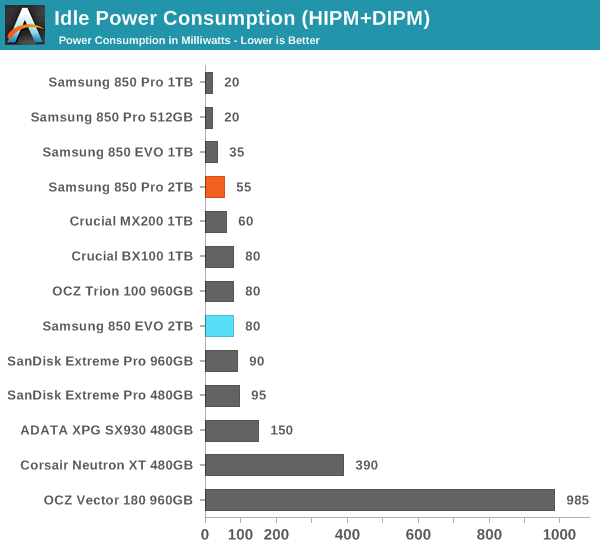
Full article:
https://www.anandtech.com/show/9451/the-2tb-samsung-850-pro-...
For example, I bought a 1TB samsung mSATA SSD in 2015 for about $320 and it's enclosure for $15. The equivalent SSD today is about $150. So instead of a 3x price decrease in the past 3 years, it's more like a 2x price decrease.
Please feel free to create a similar list with 2.5", mSATA or m.2 drives, it probably is even more shocking.
The other awesome thing about those 3 I linked is that the interface also has changed: Micro USB 3.0 => UBS-C Gen 1 => Thunderbolt.
- 2015 $600: Samsung T1 http://www.thessdreview.com/our-reviews/samsung-portable-ssd...
- 2016 $430: Samsung T3 https://www.storagereview.com/samsung_portable_ssd_t3_review
- 2018 $200: Samsung T5 https://www.androidheadlines.com/2018/12/samsung-t5-portable...
Another incredible exciting point is the amount of competition coming up, it's not just 2-3 large vendors anymore.
If things continue at this pace it seems sensible to expect a 10TB SSD consumer drive for under $1000 within a couple of years.
Note: not afiliated at all, just a happy consumer.