News for hackers. Stuff that matters.
Re:SSD Storage: 2018 in review by baroffoos on Monday January 14, 2019 @06:31PM (#18907582)
I await the day I can fill my NAS with SSDs. Might save on power usage as well.
Re:SSD Storage: 2018 in review by elorant on Monday January 14, 2019 @06:49PM (#18907694)
Not sure if it's a good idea though. SSDs tend to fail without warning. I guess that's why we have RAID but still I wouldn't want my backup storage to be so volatile.
Re:SSD Storage: 2018 in review by ggm on Monday January 14, 2019 @06:53PM (#18907722)
You think HDD can't fail without warning? OK, I get that SSD don't implement S.M.A.R.T but..
Re:SSD Storage: 2018 in review by MartijnBraam on Monday January 14, 2019 @07:01PM (#18907774)
SSDs do implement smart and usually do give an early warning.

I've destroyed a few Samsung 840 Evo drives in a few servers and didn't lose a single byte. Failure condition was a very degraded read speed. It took a few hours to copy the 120GB to a fresh SSD

Re:SSD Storage: 2018 in review by segfaultbuserr on Monday January 14, 2019 @06:59PM (#18907759)
> I get that SSD don't implement S.M.A.R.T

Despite the S.M.A.R.T data is less predictive on SSDs, they do have it, at least for SATA disks...

Re:SSD Storage: 2018 in review by Unklejoe on Tuesday January 15, 2019 @09:33AM (#18911320)
NVMe drives have it as well, at least the Samsung ones.

You can read it on Linux by running:

"nvme smart-log /dev/nvmeX"

Re:SSD Storage: 2018 in review by wtallis on Tuesday January 15, 2019 @05:59PM (#18916505)
smartmontools can grab most of that info too, even on Windows.
Re:SSD Storage: 2018 in review by ggm on Monday January 14, 2019 @07:25PM (#18907905)
In which case, even less reason to hate on SSD for home storage in RAID shells.

I have a spun-down RAID farm as longterm. It's worrying me that the unit the disks are in is a SPARC based motherboard now over 10 years old. Those caps don't last forever.

Re:SSD Storage: 2018 in review by Fronzie on Tuesday January 15, 2019 @12:05PM (#18912673)
and the magnetized bits on an HDD have an expected livetime of 25 years. Unless read-and-rewritten every so many years
Re:SSD Storage: 2018 in review by gammateam on Tuesday January 15, 2019 @12:52AM (#18909103)
I had planned on doing this but even with gigabit wifi, and half gigabit transfer speeds for the SSD, NAS encryption algorithms seems to cap the transmission speeds to around 100 megabytes per second

I have all the parts I just haven't formatted my SSDs to go into the NAS yet and I'm not sure if I will

Re:SSD Storage: 2018 in review by zamadatix on Tuesday January 15, 2019 @06:53AM (#18910513)
100 megabytes per second sounds more like the limit of a gigabit connection than an encryption algorithm. Most NAS boxes of the last 5 years should be doing encryption offload on the CPU via things like AES-NI instructions which should be hitting ~500 MB/s per core.
Re:SSD Storage: 2018 in review by gammateam on Tuesday January 15, 2019 @09:57AM (#18911497)
Figured someone would say that

I can get 400 megaBYTES per second on my iphone from external sources

Inside my network I can get faster

Dont want the NAS to be a bottleneck for my wireless convenience

edit: still megabits

Re:SSD Storage: 2018 in review by detaro on Tuesday January 15, 2019 @10:11AM (#18911633)
iPhones "only" support WLAN with a theoretical max of 867 Megabit per second (802.11ac with 2x2 MIMO), so no, you don't get 400 Megabytes data transfer to it.
Re:SSD Storage: 2018 in review by gammateam on Tuesday January 15, 2019 @10:31AM (#18911818)
Youre right, lets keep dividing by 8

The point is that I am trying to avoid bottlenecks and Im not sure my NAS with SSDs does that

Re:SSD Storage: 2018 in review by oofabz on Tuesday January 15, 2019 @01:52AM (#18909283)
Even if the throughput is no better, SSDs will have much better latency and IOPS.
Re:SSD Storage: 2018 in review by fro0116 on Tuesday January 15, 2019 @08:40AM (#18911028)
Not to mention sheer storage density that has already far outpaced spinning disks (just not at an affordable price, yet): https://www.theverge.com/circuitbreaker/2018/2/20/17031256/w...

This thing is 30TB in 2.5" format, while the largest capacity HDD I can remember hearing about is 15TB, and that's in a 3.5" format, which is about double in physical volume and weight.

I can't wait for the day when something like this becomes economical, so I can stick two of them in a compact portable NAS for 30TB of redundant storage that I can bring with me anywhere.

Not to mention, SSDs on average seem to have more predictable failure modes that scale based mostly on usage, and tend to be overall more reliable than HDDs that can often suddenly die on you with no warning.

Re:SSD Storage: 2018 in review by glitchc on Monday January 14, 2019 @09:12PM (#18908355)
SSDs consume more, not less power, to comparable spinning HDs, especially in always-on scenarios. Once started, the amount of power required to keep a platter spinning is miniscule.
Re:SSD Storage: 2018 in review by bufferoverflow on Monday January 14, 2019 @10:16PM (#18908617)
Re:SSD Storage: 2018 in review by imtringued on Tuesday January 15, 2019 @04:33AM (#18909910)
Those HDDs have more than 10 times more capacity. This means you need more than 10 times as many SSDs. Even with the most efficient 0.5W SSD that means all 10 of them would consume 5W which HDDs still manage to beat. In reality that 0.5W SSD is an outlier and they consume 1W so in truth the power consumption is closer to 10W for the same amount of storage. That's above the least efficient HDD. Perhaps bigger SSDs enjoy similar "economies of scale" but what you linked tells a completely different story.
Re:SSD Storage: 2018 in review by bufferoverflow on Tuesday January 15, 2019 @06:46AM (#18910477)
No. Actually the image I posted before is outdated. Modern 1TB/2TB SSDs consume a lot less. Milliwatts.

https://images.anandtech.com/graphs/graph9451/75923.png
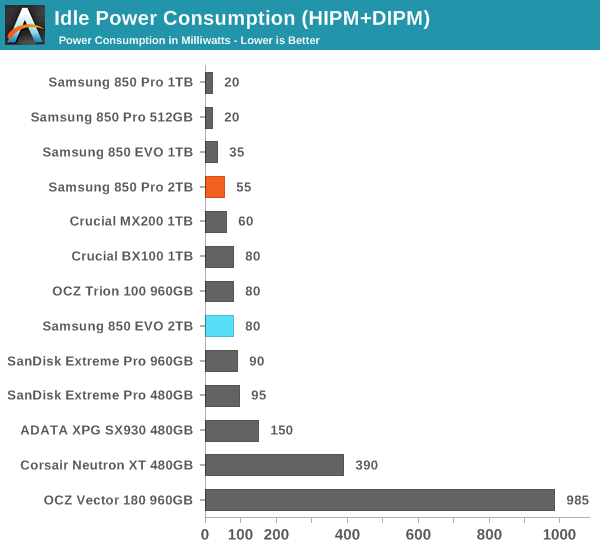
Full article:

https://www.anandtech.com/show/9451/the-2tb-samsung-850-pro-...