Seems heat really kills these things :)
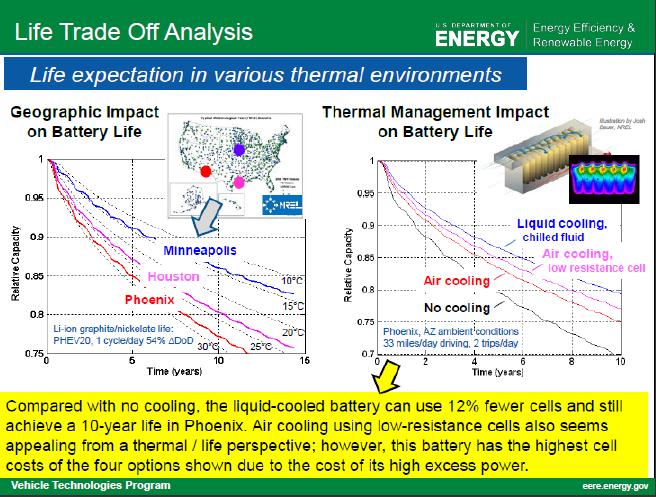
I found a life expectation chart for 3 US cities at [0].
It's well know that high temperatures (while in use and while in storage) degrade li-ion batteries[1]. However, electric cars have thermal management systems to try to protect the batteries from this effect (extreme heat and cold). Tesla have active water cooling, while Nissan Leaf use a simpler air cooling.
They also use different battery chemistries that handle temperatures differently. If you have a look quick look at this talk[2] you'll hear that Nissan is using a chemistry that experience higher degradation under high temperatures than for example Tesla's choice.
[0]: https://images.hgmsites.net/lrg/hot-weather-bad-for-electric...
[1]: https://www.plugincars.com/lithium-ion-batteries-can’t-stand...
The Leaf was notorious for not actually cooling the battery so I can see how they would do better in Norway. Maybe the newest generations have improved on that. I'd be curious if that was the same for Tesla though, which supposedly keeps the battery temperate under much better control.
And your vehicle is exposed to more moderated temperatures if parked indoors (even the pad of an unheated garage retains heat).
Plenty of parts of the US and Canada deal with much colder temperatures for months at a time.
https://cleantechnica.com/2018/07/15/tesla-range-plotted-rel...
It would be nice to see plots for ranges of temps below 0C or temperatures where AC is desired.
I think a lot of people think of Norway in winter like they think of N. Minnesota in winter.
With a combustion engine you use waste heat, but with a battery engine you use resistive heat and that comes right from your battery.
A/C also uses battery, but heat uses more energy.
Recommendation #2: pre-heat the cabin
Recommendation #3: if/when driving in stop&go traffic, use the regen energy directly for heating to save some charge/discharge cycles.
Recommendation #4: along with #2, use some phase change materials to “charge” some thermal batteries.
#1&2 are a thing. Not sure about 3 and 4.
3 may require some predictive modelling to know if you’ll be driving in stop&go or not.
I believe this is because most vehicles do a fixed amount of regen(which goes into the battery) when the foot is off the accelerator, but no additional electric braking when the brake pedal is used. I think that's because current regulations have pretty much stopped modifications to the braking system in cars, and prevent tweaking it to do electric braking when available to do cabin heating, and mechanical braking otherwise.
[1] - https://www.amazon.com/J-Jinpei-Lightweight-Intelligent-Temp...
I can't speak for all cars, but mine uses a heat pump for heat. Should have similar efficiency to A/C as that is exactly what a heat pump is.
http://cdn.agilitycms.com/mesca/productdownloads/mem-201806-... (page 13)
House geothermic heating is very similar, except the collector is buried under the ground where the temperature doesn't really go negative C (until -30C and depends on the soil, etc). Overall for EV cars in cold winters producing heat is a non-trivial task.