Factor #1 is the battery. It's far and above the biggest safety feature. Factor #2 is that nobody else makes electric cars as big as Tesla. The Model 3 is 9" longer than a Leaf and a full 21" longer than a Bolt. That means WAY more crumple zone -the crumple zone is the first thing to go in a small car, making room for legs- and that's the biggest safety difference between cars.
I think you're also underestimating the impact of the battery. The center of mass makes it practically impossible to roll, a huge source of injuries and deaths. It's also incredibly resistant to pole and many vehicle intrusions, since those happen either on or just above the battery, which is extremely strong compared to normal cars.
The battery also lets almost the entire front and back of a Tesla be used as a crumple zone. Nobody else is really doing this. The Bolt has the second best battery among EVs for sale currently, and it's still shaped and positioned pretty much like a gas tank. It blocks a lot of crumple zone. The engine in any normal car is totally incompressible and massively limits the crumpling- worse, the higher end, larger cars will still have correspondingly larger engines, limiting safety. They might have a foot or two of crumple distance, while the entire hood of a Tesla can absorb impact. Even the motor can snap up and back if needed.
In a Tesla, you automatically combine 3x the shock absorption with an extremely strong safety cell and the strongest anti-rollover feature of any car. It's zero surprise they do incredibly well in crash tests.
He posits the question that what is it Tesla does differently that might be a moat - and your answer to the question indicates they might just have something
So Evan's main argument seems to be, Tesla is a bit like Apple in that they make a highly restricted set of products, but all their component parts are hyper-specific to the product, meaning they go to town on integration - there are no factory line compromises to be made between product X and a batch of a thousand product Y tomorrow.
Your answer suggests that using an existing factory line to build your electric cars seems a good idea, but then all you can do is replace the space where the fuel tank goes with the space where the battery goes. That means they lose out on a "free" safety upgrade of putting the battery in the middle of the car.
So Tesla's approach - can it be mimicked by incumbents - sure - by those willing to throw away their existing factory capital and reinvest.
And it does make the idea of "the org chart of the car company is seen in its dashboard" as even more important - if the ideal position of the battery is compromised by the current factory investment, what else in the way car companies are organised is sub-optimal in a new world?
This also explains to large degree the momentum these compabies have once the move. And don't even talk about first time pass yield for the Model 3 compared to other companies out there.
EDIT: Typos
It seems like the thing that helped American auto makers "bounce back" after things went extremely south before 2010 is also their biggest Achilles heel outside of being inherently gas-based vehicles: their choice to create entire lines of cars that's profitability hinged on the interchangeability and cross-model compatible frames and parts is also the reason they can't simply "re-tool" or redesign any of their models without completely scrapping the ideas and starting from scratch.
In a sense I almost feel like if these car companies decide to do as much they may have to entirely scrap previous car models and start anew. Imagine Ford saying goodbye to the F-150 / general truck models, the Mustangs, the Explorers. Chevy and Dodge saying goodbye to the cars and trucks they are able to sell to law enforcement, military, and government.
I really can't. Maybe I'm oversimplifying things but from my outside, rookie POV it seems like these are huge reasons due to the fact that their entire manufacturing supply line is reliant on this model that's helped them all but die off in competition to foreign auto makers.
They're betting their entire North American future on light trucks and SUVs.
https://evannex.com/blogs/news/excuses-excuses-big-auto-can-...
They're putting new nests in existing machines. The fundamentals are largely unchanged. Yeah, the dies in the presses for forming body panels change shape. But they are still made the same way. And, for example, the shape of the engine mounts are not compatible from one year to the next...but the vehicles all have engine mounts.
Changing the form of engine mounts or getting rid of them all together is in effect the same thing and purely driven by design. In fact, getting rid of engine mounts makes production a lot faster and cheaper. So yeah, retooling in that regard means re-tooling. They will loose some benfits from their plattform strategies, but that is the main reason most EVs from traditional car makers are, as of now, based on existing plattform. Given a positive business case new plattforms will be developed soon enough, if need be. And EVs can still benefit from other common parts.
EDIT: The exption to the plattform usage is BMW, they went the opposite way. Also to develop knowledge on the use of composite materials that can be used in oter model lines. So yes, there are some generalizations in my post one can find counter examples to.
During assembly the dimension of a particular beam don't matter that much. The fact that this beam has to moved through an assembly line does. Once you remove that beam assembly is getting a lot easier.
You are right regarding swapping a fuel tank for a battery. But that was before they went to re-tooling assembly lines for EV vehicles. So it is easoer to run both cars through the same, specialized line. But that is the whole point, isn't it? Once these manufacturers did the re-tooling that doesn't matter anymore. And as soon as number go up even existing plattform are not that important as the are now.
You're right, I'm not an ME. I'm a controls engineer...and it's the same software, controls, and 90% of the machine that run your different tools for different years.
But the quoted sentence is the important one. You can change the shape of a beam...but that beam is there in your process because you assume that there's no structural battery pack to take the load instead, or that there is a huge, heavy, rigid engine block under the hood that needs to be accomodated. If you changes those assumptions you would need more than new tools to go on the current presses and robots and conveyors, you'd need a whole new process.
I have installed brand new machines less than a mile south of Greenfield Village at the Ford Product Development Center, where they're willing to spend millions on new equipment to develop new products but not really thinking about building new processes.
The little differences can have huge impacts: Tesla batteries are just a few inches wider than the Bolt's, but those few inches mean wiring has to go through the roof or side rails instead of a more conventional route. That's a really seriously large change for some cars. They potentially have to run wiring before the interior, drive or battery goes in- completely changing the factory floor.
but now if you want that integrated glass screen, you put software division and that new CTO just hired from AmaGooSoft, right at the top of the tree - want your lights susystemn to have screen real estate - talk nice to the new guy. If you think the other division heads will take the new guy lying down, I have a bridge to sell you.
The point being that it's easier sometimes to let Schumpter destroy a company with the wrong PoV and let the market raise a couple of others with the right pov. After POV is worth 20'IQ points.
To chase it down a little more, is it true that legacy car companies don't use the "skateboard battery" approach, since this hypothesis predicts they would not?
Having a massive production capacity in batteries means not only EVs, but also battery storage for utilities, power walls, possibly electric aviation, utility drones, etc.
edit. It's been pointed out that the steering column has not been a safety issue for decades. However, I suppose the point remains about the added safety of lacking an engine, that is not having a block of metal ready to apply a large force in the drivers direction during a head on collision. But I'm happy to be corrected on this point too.
It's not 1960 anymore. We have collapsible columns and we no longer have steering gears mounted on the frame forward of the axle (we have racks mounted on or in the vicinity of the firewall). Steering column in the driver's face is a non-issue and has been for decades.
As a first responder who has responded to hundreds of MVAs, I have never seen nor heard of a steering column being shunted into a driver by the engine block. Perhaps in the 60s or earlier, but steering columns are designed to crumple.
Traditional internal combustion engines have breakaway motor mounts these days, to allow the motor to detach from the chassis and drop down towards the roadway to minimize intrusion into the cabin, but having a motor crushed into your feet is only somewhat better than having it shoved into your lap, I suppose.
That said, the front compartment is a big messy jumble of boxy components. This may not impact(!) safety much, but does show how far GM is from the level of integration Tesla attains.
[0] http://gmauthority.com/blog/wp-content/gallery/2017-chevrole...
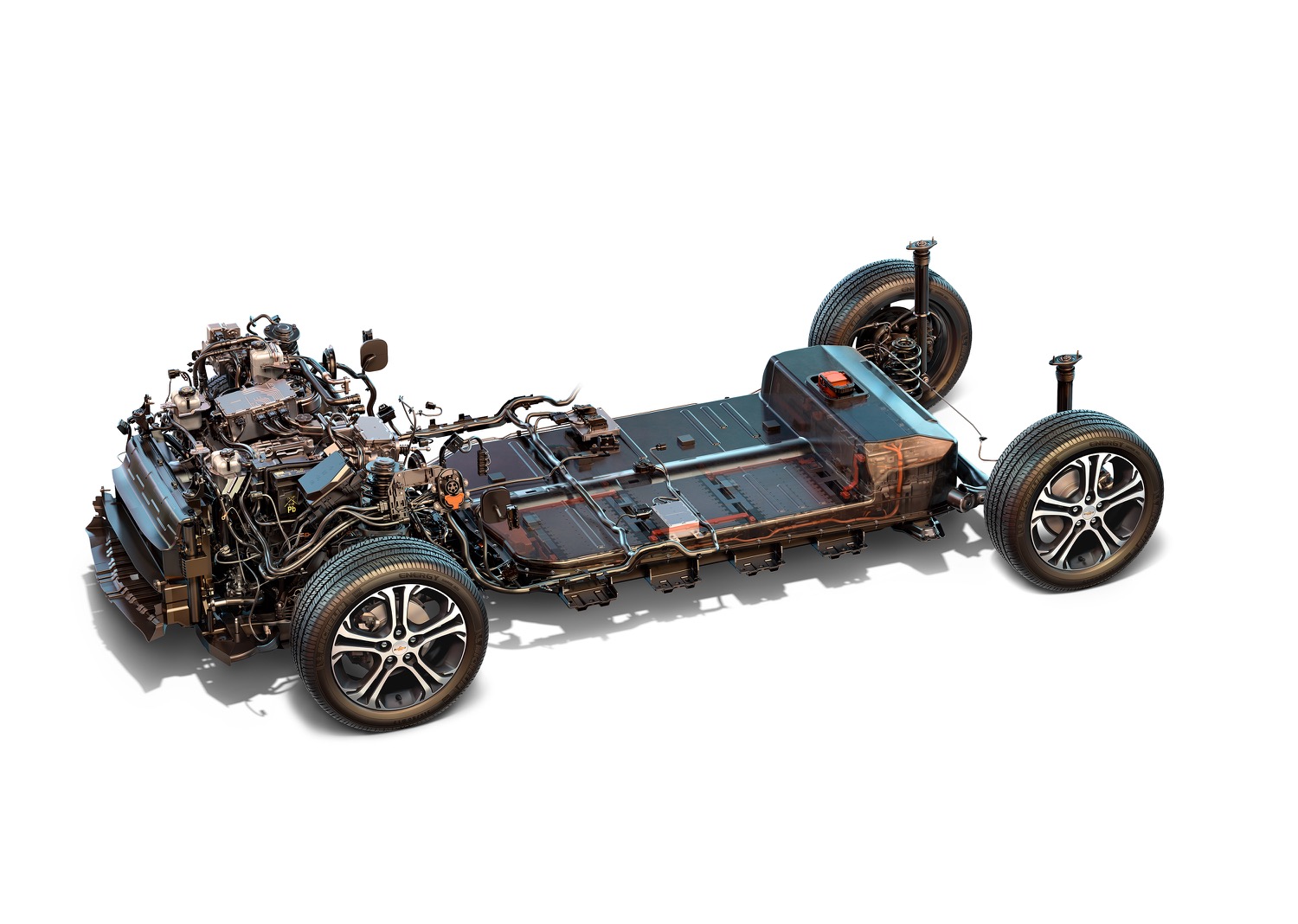
The bolt battery also has no internal ribs, just a couple pretensioning bolts (to prevent vibration). It's only slightly stronger than a gas tank in an impact. Tesla batteries have huge internal ribs/separators that make the battery very resistant to deformation and intrusion in an impact.
The Tesla battery is also about 10% wider, which makes a HUGE difference. A side impact in the Bolt will be through your leg before it hits the battery. In the Tesla the battery will be hit around the same time you are, making it an extremely integrated part of the safety cell. Its much more complex to build this way, since theres no undercarriage to route things through.
This is just an interesting aside note, but my mother was recently involved in a frontal collision while driving her 2016 hyundai i30. In what was approximately a 60-70 kph impact with another car, it was enough to shatter the aluminium engine block in several places, and the engine sort of crushed flat.
I'd never seen a block do that before, at least not in a relatively low speed collision. Wish I'd taken some photos of it. But it made me wonder if modern cylinder block design incorporates any failure points in their design for such a scenario...
Of course maybe it could have just come down to the randomness of crash dynamics.
And it is no surprise that the engineering at Tesla is competent. After all, Tesla does have a good contact to SpaceX, where actual rocket scientists work :). In any case, SpaceX is a great source of expert knowledge on material science and structural strength.
When NHTSA checked that the most fatal (but less common) crashes where off center, they started testing that way and all grades crashed (pun intended). and all makers had a hard time to improve because engine and engine bay designs made it very difficult, but that was the goal of the new test: go for the high hanging fruit for those car designs.
the tesla battery chassis doesn't have the engine, so it is easier to make changes that will beef up their car in the very same way other makers did for full fontral collision before. basically they are " cheating" the same way makers "cheated" on the full fontral collision test before.
it is very likely that other kind of crash tests, that are not even tested by anybody because internal combustion engine cars always did so well on those, are extremely fatal on teslas. but we will never know because nhsta just put teslas in the same test battery as any other car. we lack the 50+ year of continuous self improvement cycle the crash tests had with other designs so far.
edit: I'm not saying I agree with GP, just explaining what I think they meant by stating that they were "cheating."
Doesn't this just say that NHSTA is ignoring other areas where things could go wrong?
You're not being very charitable here; you're assuming the parent has bad faith. Why can't we just be a bunch of people having fun together on the internet?
A good faith argument could be made to discuss how the crash tests like any sort of benchmarking are likely to lead to optimization for the tests - you get more of what you can measure - so one needs to be careful that the results are broadly applicable. This of course would apply to all makers, not just Tesla. But that is not the argument the parent made.
Still, I prefer to follow Hanlon's razor, and not assume malice. This kind of mistake always seem obvious in hindsight, but if it was, why was there no one warning about it at the time?
It seems more likely that crash tests represent our best understanding of common crashes in the real world, in order to build vehicles that protect their occupants best.
(/sarcasm)
From the nhsta site (https://www.nhtsa.gov/sites/nhtsa.dot.gov/files/documents/12...)
Observations on various aspects:
* "Because the lower the flash point, the more hazardous the fire risk, flammable electrolyte solvents in Li-ion batteries are more or less as hazardous as conventional vehicular fuels."
* "Because the narrower the flammability range, the less hazardous the fire risk, flammable electrolytic solvents in Li-ion batteries are about as hazardous as conventional vehicular fuels, and certainly less hazardous than hydrogen."
* "Because the lower the minimum ignition temperature, the more hazardous the fire risk, flammable electrolytic solvents are not as hazardous as conventional vehicular fuels."
* "Because the lower the minimum spark energy, the more hazardous the fire risk, flammable electrolytic solvents are probably about as hazardous as conventional vehicular fuels."
* "Because the lower the maximum flame temperature the lower the exposure risk (skin burns) to fire, electrolytic solvents are expected to pose no more of a severe risk to burn injuries than conventional vehicular fuels, gasoline and diesel."
* "Because of the probable similarity in the magnitude of the maximum flame temperatures, if the combustion of the electrolytic solvents were confined, the resulting overpressure that could build up would maximize at about the same levels as for the other flammable fuels, meaning that the burst damage that would result from Li-ion explosions would also be comparable to that from conventional vehicular fuels."
* "The thermal energy expected to be released upon initiation and combustion of the electrolytic solvents would be less than that of gasoline and diesel fuel."
You assume there are such crash tests, but don't describe any specific ones. I am guessing that is because none exist, but perhaps I am mistaken.
With regards to why aren't all other manufacturers doing as well, just glancing through the web site of the NHTSA I cannot figure out how they decide what to test. In their current list of vehicles to test I do not even see Tesla so I will assume manufacturers can submit cars independently of being requested by the NHTSA.
Now when comparing cars at https://www.nhtsa.gov/ratings we only get stars which four is pretty common in the price range but you can compare and find cars that have the same star rating. Volvo's tend to still get 5 stars across the board
As it wrotes, probability of injury, its beyond the stars rating. They provide technical reports on the site, which you can download. These are more detailed results, where injuries also measured and explained, like Head Injury Criterion. Just curious and checked other manufacturer, and see "worse" results. But also realized reading these documents that these tests are depend on many factors...
Toyota was caught overoptimizing for crash tests recently. They designed their Sienna minivan for small overlap driver's side impacts, but didn't reinforce the passenger side because there wasn't previously a test for that. Now there is. Oops.
"While Toyota has modified the structure of the vehicle to improve driver-side protection starting with 2015 models, the automaker did not make the same changes to the passenger side"
https://jalopnik.com/the-toyota-sienna-bombed-the-toughest-p...
I'm not suggesting Toyota is the only one who designs their cars to precisely pass the tests, either. If Toyota does it, I think it's almost certain other major manufacturers take a similar approach. Volvo has a reputation for being more holistic, but who knows if it's deserved? But any major manufacturer can optimize for crash testing, and it's more economically efficient than going the extra mile, which means it's likely that's just what they do.
Seems like the drivers side is far more likely to encounter that sort of collision.
Or a car is unexpectedly stopped in the right lane because of an accident or a police stop. I came around a corner with no visibility today to find a police car attending to a wrecked vehicle on the right.
Second, one of the basic rules of the road is that you have to be able to stop within your sight distance.
Driver side offsets were a bad type of collision, and they were particularly bad in older body on frame cars before that sort of testing, and when there were a lot of 2 and three lane roads.
http://www.thedrive.com/news/23955/subaru-admits-to-falsifyi...
They do have to make trade-offs, true. But every other company has to do that as well, some tend to one side others favor different characteristics. Tesla, to stay on topic, is no exception there. SOmeone else discribed the test philosophy and the impact on car design very well.
Is it still cheating if there is a loophole that allows that substitution of steel?
Takata was a scandal, even more so as it was Japanese supplier. I just hope we don't use exceptions to the rule in general discussion now, are we?
https://www.bloomberg.com/news/features/2016-06-02/sixty-mil...
Their battery packs are using Inconel instead of steel. Inconel is a super-alloy generally used in aerospace applications, such as SpaceX's superdraco rocket engines.
SpaceX was the first rocket company to use friction stir welding at massive scale to manufacture their rocket bodies and as a result, developed some novel methods to do it. They transferred this expertise to Tesla, which is one of the things that makes the Tesla vehicles safer. Their welds are simply stronger due to FSW techniques.
That's not to mention less obvious things such as the expertise in aeronautics and wind tunnels from SpaceX helping Tesla design more efficient body styles, etc.
If you follow the news and especially Musk's twitter and interviews; there's nothing at all easy about what they're doing. The sweat and hours Tesla puts in to making their company successful is far beyond any of the other typical "corporate" car companies.
If batteries weren't more volatile than gasoline we'd store them in thin sheet-metal or plastic enclosures (like we do with gasoline) instead of enclosures so substantial that it makes sense to use them as a structural member in the vehicle.
Maybe instead of saying that batteries are more dangerous so they put them in stronger boxes you should instead be demanding to know why gasoline cars do not put their power source in a safer container.
That was purely a rollover issue.
They didn't catch fire with any noteworthy regularity. I'm not sure how you can say otherwise. Ford used that same basic fuel system (modified in size and shape for the application) from the early 90s up through the late 2000s in their trucks (Ranger platform included) and full-size vans. There is nothing particularly bad about it. It's actually one of the best OEM fuel systems out there since it uses stainless steel for all the hard line and braided stainless over nylon(?) for all the soft line though based on some of the Rangers I've worked on I think they started making the lines coming off the fuel sender out of non-stainless steel sometime in the 2000s.
>he ZJ grand cherokee fuel tank recall (totally unsafe without a tow hitch installed behind the tank)
Rest assured, we'll have these same issues with EVs when the Chryslers and Kias of the world start making them en-mass.
> Heck, on my dads 66 chevy, if you forget to put on the gas cap and drive off, the gas will literally fall out of the back of the car).
Don't you think it's a little disingenuous to compare a modern Tesla to a 1966 Chevy? The 66 Chevy didn't have seat-belts or airbags either. It's 50yr older, what do you expect. Pickups had the gas tank in the cab through most of the 70s.
>Maybe instead of saying that batteries are more dangerous so they put them in stronger boxes you should instead be demanding to know why gasoline cars do not put their power source in a safer container.
Repeat after me class "liquid fuels do not provide their own ignition source."
EVs are the way of the future but trying to pretend that sitting on top of a box full of nasty chemicals that contain a bunch of electrons that really want to be elsewhere is safer than sitting on a jug of nasty liquid fuel, all else equal is just that, pretending. That's why Tesla makes the battery a structural member. They can't in good faith protect it much less than that so they may as well go a little overboard and reap some benefits in terms of chassis rigidity and then use the resulting safety as one of their pro-EV talking points.
How else should we arrive at the optimal amount of safety? What moral formula, if not the averted costs of accidents, do you propose?
In this world at least, resources are not unlimited. An ultra-safe car that cost a million dollars would not be very useful to many people.
As for why Tesla would go beyond that, I can think of several reasons: it might be betting that its customers place a higher subjective value on the feeling of security, it might think that higher safety is important to fend off unfavorable press/regulation, etc. It could also be that the costs for Tesla to increase safety are lower than for other car companies for some reason (e.g. older car companies have already invested into older sub-optimal components). But these are all rational, self-interested reasons just like the avoidance of liability.
This is what they are doing in China, with LSEVs:
https://www.wsj.com/articles/chinas-giant-market-for-tiny-ca...
Not much different than "world's fastest" claims...just find the current fastest car and exceed it by something measurable.
That's quite an illogical statement.
1) If they were giving it away, that would be normal to make a loss. Giving away has to be free, isn't it?
2) If that was easy, why aren't the profitable cars not safer? Tesla has far less money to spend (and to profit, in your view) on the Model 3 than their competitors. Also, the Model 3 is a mid-sized premium model: why aren't the competitors most high-end vehicles not safer? There's nothing easy to make the safest vehicles among all cars sold in the US, irrespective of loss and profit.
3) Will you review your comment after Tesla release its Q3 financial reports? Because if they are actually making a profit on the Model 3 while ramping up production, I'm curious to hear your opinion when Fremont is at 10K unit/week and the Shanghai factory starts producing Model 3 (by 2020).
Cynically I’d suppose the incumbents are heavily optimised to maximise shareholder value so vehicle safety might actually be reduced to maximise profit given expected liability from damages (Fight Club comes to mind) while Tesla is still idealistic and expends a certain amount of profitability for absolute safety. Is this really the case or is there a better explanation for it?