Like, I get his point that experience beats expertise, and some experts don't really know any more than the general public. But he drives the point so hard that his later work is unreadable. He'll devote more time to bullying some breed of academic than he will to making his actual point.
This stuff doesn't work for things that can be classified as weak signal. Stuff like your resume, or name of your company. I follow author of Destroy All Software screencasts on Twitter and remember him mentioning that some companies refuse to buy his screencasts because of the seemngly silly name of his company (Destroy All Software). They think such collabaration is going to reflect on them badly. The signal is weak, it's just a few words on a screen, so it's easy to say no.
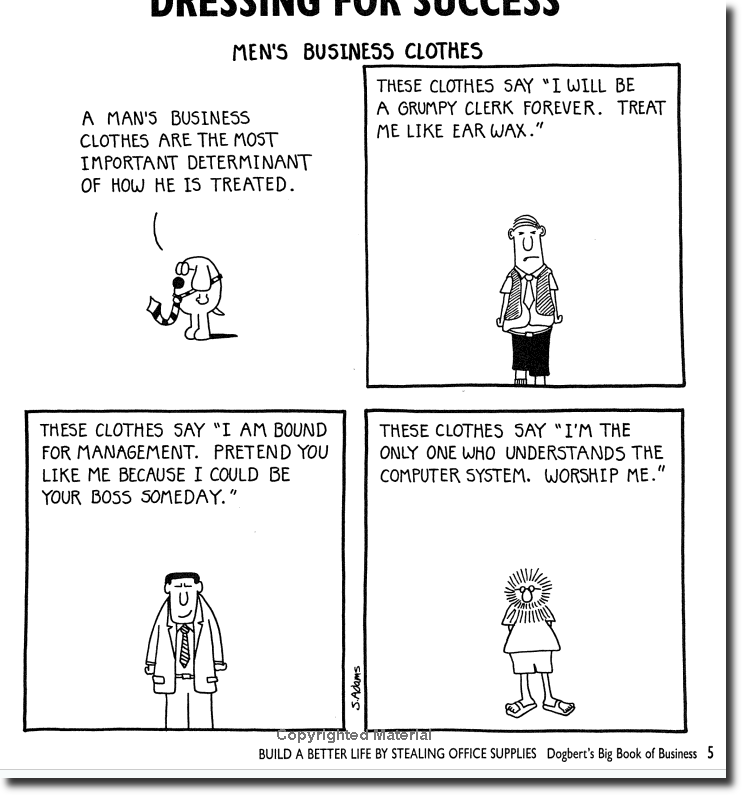
Clothing has relatively weak effect compared to your style of communication. You can't dress your way up to being a CEO of a multimillion dollar company, but you can talk your way up there. I don't mean lying, manipulating, and playing office politics. I mean being as intense as Gary Vaynerchuk. Just watch his videos, you can see effective he is at dealing with people. In my real life I have never seen anyone who comes even close. Everybody around me is ridden with flaws: some have severe speech impediments, some are too passive, some lack ambition, some (everybody actually) are too anxious, some are just clueless.
I think it's smart to aspire to be more like Gary Vaynerchuk. I don't want to be like Paul Graham, or Mark Zuckerberg, or Elon Musk, or Linus Torvalds. They are interesting people, but they are not free. They are stifled, rigid, and not cool. They manage to be successful leaders despite their crappy social skills. I mean, have you seen Elon's interview on Joe Rogan? Cringy! I mean, I love Elon Musk, but he should emulate Tony Robbins or somebody, it would be one of the most effective things for Tesla. I know very little about Tesla, but I'm sure there is a lot of failure going in communication when Elon is involved.
I'm also thinking of Naomi Wu drawing a tremendous amount of flak for skimpy outfits on Youtube, despite her pointing out that it was extremely hot in that part of China and not much skimpier than regular streetwear.
I envy women because I feel like they have way more options for dress and style than we men do. My choices are: t-shirt and jeans, button-up and khakis, some variant of those two, or one of the many contemporary men's styles that seem closer to caricatures than real life
I was thinking of this excellent thread: https://mobile.twitter.com/sehurlburt/status/965453047965958...
Are yoga pants really more serious than khakis and a polo?
(I would code yoga pants as casual because they're sportswear, unless worn under something else as opaque tights which are professional. Woman wearing shirt+chinos will incur a minor penalty for gender non conforming dress unless it's a uniform in which case you're working at Best Buy)
>Woman wearing shirt+chinos will incur a minor penalty for gender non conforming dress
We just live in different worlds I guess. I've seen women dress like that all the time, and no one is looking askance at them, not even minorly.
I don't see why Elon should change, except for appeasing and idealized perception what a successful CEO should behave like. Intensity is just one way of being successful or making people believe you are worth investing in. Gary's brand is the intense hustler that plays well with his target group of youthful entrepreneurs - or corporate clients who like buying creative services from an agency head who acts like that. Elon plays increasingly a mad Genius persona - not sure if intentional or not. I don't think he cares what would be potentially the best image he should portrait for Tesla. Instead he just acts in whatever he feels that day and pushes things he believes in forward.
Most people in my industry are focused on looking really impressive and presentable to sway clients (CTO's). I'd rather look like one of their engineers than a sales guy.
I can't really say if I'd be more successful if I looked liked everyone else but I can say people certainly don't forget me.
This increases the chance of said skills contributing to the pursuit of a wide range of future passions.
At some point in my life I became obsessed with software and very quickly went from zero to getting paid. Now I am, as one of the other comments in this thread said, a 'white suit' consultant. I work in SV from NN time zones away and have been given complete autonomy over the project I'm working on. Some would call that a dream job. It's certainly different from the 'dark suit' consulting I used to do, where who I was / how I appeared was just as important as what I delivered.
A close friend of mine, on the other hand, has risen to the top of their industry and is one of the most driven and hard working people I know -- but they are decidedly not obsessed with or passionate about their field. It's just their career. They take it seriously and always give 100%, but catching an after-work conversation from them would be along the lines of 'fuck this nonsense'.
Years ago I suggested this person 'find their passion', hop careers, start a company, whatever. They never did. They're still doing well in their career and they still have a 'meh' relationship with it at the end of the day. When I say doing well I mean they're senior management and close to being offered a CEO/MD title.
Passion certainly helped me succeed in software. But it's not something I cultivated. It was something I needed to do, wasn't at the time and which was manifesting in other ways (e.g., baroque engineering hobbies). I didn't find or develop my passion for software, I just, one day, found that this obsession was a good fit for software. Because it's one of the more lucrative fields to be in today, it was an easy decision to pursue it.
But there are plenty of successful people who are not obsessed with anything. The majority probably. They strive towards excellence, because that is their character, but they could have done a dozen other things with an equal amount of dedication and wouldn't have fallen in love with any of them.
Obsession can be an advantage and the minority that have found a fit between their obsession and a lucrative career tend to think it's necessary. I did for a long time. But at the end of the day you're just creating value. You can choose to do that which just as much success as those who need to.
On the other hand, you could just as easily be obsessed with something that's not lucrative or even self destructive. Sometimes that pays off (e.g., someone obsessed with BASE jumping may eventually find sponsors). Sometimes not (they die before reaching that point).
I think a lot of this passion talk boils down to 'we had an aptitude for X when X was in demand and a good way to make money'. People are over-generously distilling that to 'passion=money'.
Instead of trying to find a life passion, seek to master some valuable and useful skills. Leverage those skills to find work where you have more autonomy, control, and impact. This can help with personal fulfillment.
If you are lucky enough to develop a sense of larger purpose that your work contributes to, then great! But seeking this directly might be a mistake. Meaning seems to emerges from other efforts -- pursuit of excellence, indulging in curiosity, solving real problems, connecting with others, and so on.
I think this is a relatively practical and effective mindset, especially for many HNers.