"All humans are created equal and endowed with rights" is a radical proposition which we are still working out all the implications of after several hundred years; any deviation from that (ie "some humans are intrinsically (not as a result of their actions) inferior") starts you down the road of partitioning society and justifying worse and worse treatment of those deemed inferior.
I think this cuts to the heart of the issue - and demonstrates the problem with this line of thinking.
I also think you're missing the point of the Solomon story. When Solomon proposed that solution, one woman said "No, no - give her the baby." That woman was willing to compromise. She was willing to compromise all the way, to lose the entire dispute, to preserve the important thing they were fighting over.
Solomon didn't actually plan to cut the baby in half. On many social issues, there is a negative-sum, "burn it all down" solution that leaves both sides worse. Which side reaches for that option? Which side is willing to sacrifice the deeper issue in order to "win"? That's the side that deserves to lose.
I think a better visualization of the problem is "you can't cross a canyon in less than a single bound". Sometimes there is no meeting half way.
Last but not least, compromising is sometimes not an option. It's like the paradox of tolerance where the only thing you have to be intolerant to is intolerance. Because allowing that is basically killing your options. It's like allowing bacteria to kill you because you are pro-life and not willing to kill them.
In the case of free speech, anything that would lead to someone else losing their freedom for the same should not be allowed just to have "a compromise". Hate speech is not free speech any more than contract killing is just a financial transaction. And just like contract killing, hate speech should be punished the same as the crime it instigated to. You instigate violence, you have to be put in the same jail cell as the people who threw the punch.
For any mass murder you can find people blaming some ideology or another as being the root cause.
It's a dangerous path to follow when a party in power wholly believes in jailing people for "hate speech" as they will be silencing and jailing their ideological opponents.
Yes, there nearly always is an ideological "cause" or justification for mass murder? That's why everyone's so concerned about it in the first place, it's both a warning sign and a facilitator of genocide.
There is no such thing as "hate speech." It has no legal or rational construction. Hurt feelings and strenuous objections are no basis for law.
That must be a real conundrum in countries that have laws against it. Presumably clearly defined. I think you're onto some paradox here...
Hate speech is not about hurt feelings. But if that's what you understand from it with almost the entire human knowledge available to you a simple internet search away I'm sure no comment here can provide you some relief.
Telling me my shoes don't match the belt is not hate speech. But instigating people against a whole class (race, religion, ethnicity, etc.), usually suggesting violence or some otherwise harmful methods, is. And it ends up with people hurt, lives and whole communities destroyed. You'd understand a lot better if you were at the receiving end of it. Things are very easy to overlook when they never hit close to home.
But just in case, lmgtfy: https://en.wikipedia.org/wiki/Hate_speech
Personal anecdote.
When I moved to the UK in the 1970, there was a little platform in Hyde Park called Speaker's Corner. Anyone could step onto it and make a speech about anything, anything at all; they could do so in the strongest terms, without being bothered; there was always a small audience standing around, and often lively debate would result.
Most of what was said on that platform would now be characterized as "hate speech" by people of your ilk. And the times were not exactly peaceful; there were IRA bombs going off in England at least once a week. Yet the authorities made a point of not interfering, because memories of WWII were still recent, and the right to free speech was considered sacrosanct.
Draw your own conclusions.
Unfortunately you set off a flamewar with that personal swipe. Please don't do that. Your comment would have been great without that bit, and there would have been no need for the nasty tit-for-tat of the below.
Perhaps you were free to be racist, but certain kinds of speech affecting the power structure were definitely not free.
I think the conclusion can be drawn even without the rest of the comment. There will always be some bigot dying a little inside seeing the world is evolving and they're left behind.
Spewing out some hate for a couple of other bigots is not that much of a big deal. But today's "Speaker's Corner" has an audience of (tens of) millions. And the bigot doesn't stand up in front of anyone, they do it from afar, in anonymous comments, in podcasts, from behind a mask. If you can't understand how much of a difference that makes than maybe you belong to that age and not this one.
And there's one thing your ilk doesn't understand: you're free to make that hate speech. You shouldn't be free of the consequences. Which is why I said it should be punished, not censored. If it's censored then people might mistakenly take those bigots for worthwhile human beings :).
You'd understand the power of hate speech better if enough voices called for violence against bigoted sexagenarians or something like that.
Oh, one other popular thing in the '70s was KKK which you obviously fully support because it happened so it must be right.
Draw your own conclusions.
I would conclude that you don't know how to argue, and that's why you prefer to take away your opponents' right to express themselves.
On the flimsiest of evidence, you label me with a number of repugnant attributes (bigot, sexagenarian, left behind, stupid, hateful, KKK), and then, having established guilt by association, you politely suggest I shut up.
I could demonstrate to you my political positions are actually further left than yours, but I won't bother, because in a discussion, what counts is the strength of the arguments themselves, not the identities and group affiliations of the speakers.
My identity, my convictions, are irrelevant. My arguments are what matters. And you haven't engaged with the central argument: that democracy cannot function without unrestricted free speech.
You do realise that a sexagenarian[0] is just someone in their sixties, right?
And I would conclude that you believe actions have no consequences when it comes to whatever you like to do. That being free to say or do something means being free to get away with anything that comes out of that. The political position is relevant, this is a combination of character traits and education. Or lack of. You all google "free speech" and only bother to read the first line. Just like the other hicks who think democracy is the right to do whatever the heck they want. You're free to call for violence against others just as you're free to be punished for the consequences of that call.
Well guess what, freedom of speech also considers the harm principle. This is further down the page, too much for most of those people to absorb. [1] "Liberty consists in the freedom to do everything which injures no one else".
Speech is like a weapon. They're not prohibited, and you're free to use them any way you see fit but you have to bear the consequences of misuse.
But the further you go towards the extremes (left or right) you find that people are having a harder and harder time understanding this concept of consequences. It's in perfect correlation with the drop in education and usefulness to society. Low education, low income, spineless, always blaming someone else, and running from the consequences of their own actions.
You're here to "negotiate" something that is already law and principles already accepted by many for centuries. To give a nice shine to something every person with the least bit of decency and education knows is wrong. You even have a hard time understanding the difference between not having your actions censored and not suffering the consequences for those actions. You have no arguments, you have a keyboard and an internet connection, and you don't even take full and productive use of those.
Agreed. And there are laws on the books for this; there always have been. The more recent concept of "hate speech" (to return to your original post) is entirely redundant, unless its intended use is censorship.
If the fact that something is "a recent concept" made it wrong we wouldn't really have concepts, would we? Hate speech and hate crimes are pretty clearly defined.
See what I was saying about that good use of the internet? You'd rather be here trying to prove me wrong rather that spending the time by yourself finding out why you're wrong.
I realize you didn't start it, but guilt amortizes out pretty evenly once people start going at it like this.
Another problem, a much bigger one, is most of what people claim to be "hate speech" these days simply isn't. Post certain factual stats on race or Islam on HN, and you will get banned for hate speech. It's hurt feelings, and they often clash with reality.
It is better to lose the whole war than to lose what you value the most. Losing could mean many things,not just loss of possession.
I'm a liberal-ish person, and I think most states could use more tax revenue. I'm also concerned about climate change. This is a pretty mainstream set of positions.
In 2016 there was a ballot initiative proposed in Washington state that would levy a tax on carbon emissions, and offset it with cuts to other taxes. The result would be revenue-neutral (or slightly revenue-negative). It was opposed by the usual suspects (energy companies), but also some environmental groups and the state Democratic party.
Part of the liberal argument was that the initiative wasn't perfect. Given a new source of revenue, liberals saw many needs that could be met, instead of tax cuts. But that wasn't the deal on the table. The initiative failed, and we got the "dead baby" of no carbon reductions, no spending on other needs, and a less efficient tax system.
Details here: https://ballotpedia.org/Washington_Carbon_Emission_Tax_and_S...
A similar example: the recent court cases by state AGs to ban certain types of CAD files from being published.
I consider somone to have a balanced point of view if they can recognize that all solutions have tradeoffs, frankly discuss the tradeoffs of different solutions, and argue why their proposed solution is the most attractive option. I think it is also important to recognize how sure we are about the effects of different things. Some things we are very sure about. Others (like predicting market reactions to government policy), less so. The world is complex and any argument that isn’t complex probably isn’t balanced.
As an example, if I ask someone what their least favorite part of their favorite programming language is and they say, “nothing, it’s perfect,” I can safely assume they are a partisan idiot. One can believe an extreme programming language like Elm is the best solution available and still have a balanced view of it.
All humans aren't created equal, not even close. A 4 foot tall person without arms will never play basketball as well as a healthy 6 foot tall person.
Even if you meant to say "all humans should be treated equally", it's still a ridiculous proposition, because people are different, and thus should be treated differently. Will you let a person with the history of child abuse to babysit your children? I know I wouldn't, no matter how much they tell me they had changed.
As a counterpoint to yours, Aristotle was famous for his golden middle principle. That in vast majority of matters(notable exceptions: murder, theft, adultery) you can only achieve happiness if you do and experience everything in moderation. Don't ignore your desires, but also don't submit to them completely.
Who gets to say who is right?
For every position that we think is good radical now, there are many more that were not. A slow moving, boring society is one I'd like to live in.
Exciting times make for short lives.
While you're bored and comfortable,others are in horrific pain and suffering.
It seems you prefer comfort and well being over doing what's right. In essence,if you (not society) believe doing something is right,you should at the very least not be be vocally against others who are doing it.
Edit: People downvoting need to look at a political spectrum of the left and research the viewpoints of progressive, democratic socialist, and socialist individuals in history. They would all denounce these radical identity politics positions as liberalism that don't end up helping anyone in any way -- especially joining together the working class. This only splits the working class. Identity politics is liberalism and liberalism is very close to centrism, not left politics.
>On Thursday, March 14, 78 “non-black” leaders traveled to Atlanta from 17 states for a planning meeting of the Poor People’s Campaign Steering Committee. They came from Native American, Mexican American, Puerto Rican, and white communities, representing 53 organizations. “It has been one of my dreams that we would come together,” King told the gathering. Their “declaration of unanimous support” for the Poor People’s Campaign, writes Stewart Burns, was “a breakthrough of major proportions, the high point of the entire campaign.”
https://www.theatlantic.com/politics/archive/2018/04/mlk-las...
Fred Hampton on Race: https://youtu.be/fJSqZrVjDds?t=1m14s
Identity Politics is incompatible with progressive or further left politics.
So your comment is a good "for instance" of why YouTube does what it does as an algorithm. In essence, what YouTube's algorithm does is the exact same thing that we, as humans, do in any given discussion. We just don't get to the extremist content as fast as YouTube's algorithms get us there, so we don't notice that tendency in our face to face discussions.
In a very real way, YouTube is trying to be more human. With all of the negative implications that entails.
I am completely in favor of the internet as an uncensored communications platform. However, in a war of ideas, there is a giant chasm between making a propaganda video of any sort available to watch in an archive and showing the stickiest propaganda video to those who are most likely to be retained watching it.
When I was at NIPS last year, the only person I heard get really angry about something, from an ethical standpoint, was relating to deep fakes. If you are a researcher or a project developer, you need to think really hard about what you are building, because soon you won't be the one building it.
edit: I don't think YouTube should solely be singled out for bad recommendations. Netflix has a lot of junk science on their platform and my assumption is their algorithms are bumping it to the top. In their case they have to proactively go out and pay for licensing for those videos, which is really inexcusable.
Yes. As I think that it is quite obvious the majority of current AI is only superficially designed to help me, while fundamentally they are designed quite successfully to f#ck me and get my money, I have occasionally tried to figure out ways to somehow level the playing field against the current crop of AI, but it is difficult. One of the only tools actually having any effect is adblocking. And if I engage in that, I am blamed that I strip content creators of their income. I guess the fundamental problem is that nobody has any economic incentive to fight against the current AI army, while a large bunch of people seem to actually enjoy getting manipulated (to buy unnecessary stuff or get radicalized to some fringe ideology) by our machine overlords.
It's not so much about taking the videos down, as the recommendation algorithms pushing people in the extremist direction.
If someone doesn't have the cognitive abilities to consider the veracity of a video that's on them. Let me watch what I want.
https://art19.com/shows/the-ezra-klein-show/episodes/109611f...
To paraphrase one of the better soundbites in the show: YouTube is like that friend in high school who always outdoes you no matter what you do. You're vegetarian, she's vegan; you're moderate left or right, she's at the more extreme end of the political spectrum; etc.
So much of it is just straight reporting. “X said this, Y said that.” No analysis, no critical thought as to whether any of those few points worth presenting at all. Just clips of people’s claims, totally unchecked.
If I wanted to know what a candidate or CEO said without any analysis, I could just read their press release.
I still read a lot of news, but I don't like the dish I'm being served, exactly because it is not just straight reporting but rather is a non-stop stream of journalists' personal political opinions masquerading as analysis and news. I actually would prefer to just read their press releases unfiltered, if there was an organisation that aggregated the ones I'd happen to be interested in, in a trustworthy way.
It seems the "news", in general, is a buffer overflow of malicious information that serves to override our logical thought processes with negative emotions and irrational tendencies.
I was thinking about this recently. I doubt that it’s primarily an inability to compromise (though that exists when the politics are tied to tribal sense of identity), but more that each of our personal Overton windows is defined by about as many binary bits as we have slots in our working memory — if you can write an article with the title “Five Time My Side Was Epic” or “Five Times The Other Side Was Evil” then you can be blind to the mistakes of your own and the goodness of the others.
Might even be less than working memory, because we sometimes double-count.
This comic summed it up rather well https://pbs.twimg.com/media/DHQGsnPUQAAfMgB.jpg:large
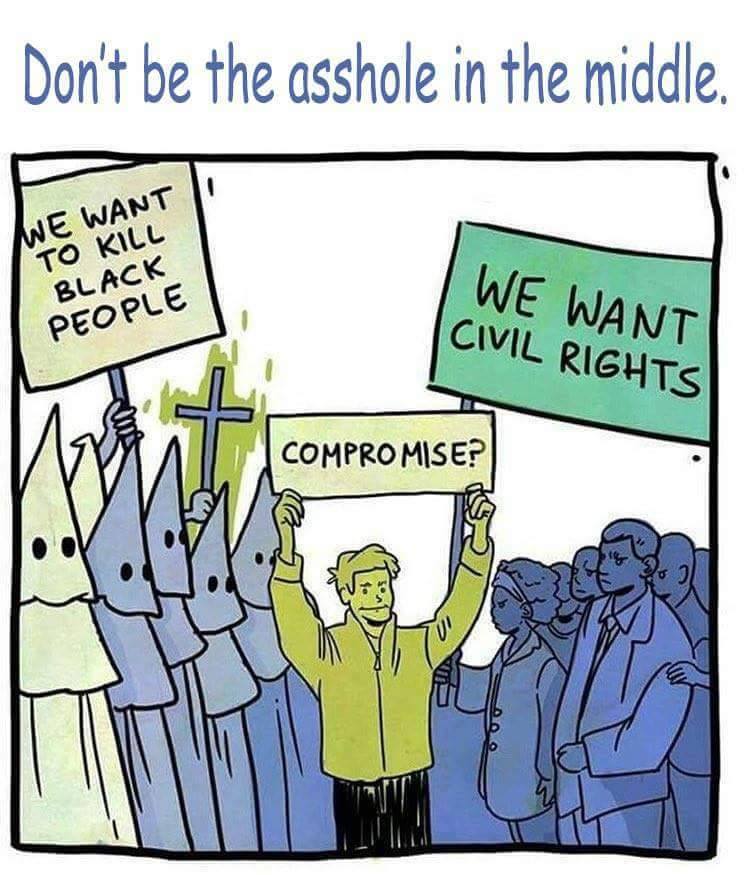
What are you willing to compromise when it comes to the right to exist? Only some get killed?
Its of course a hyperbole, but I think thats the mechanic that leads to ever increasing factions that are completely opposed with extreme positions. You always had issues you were not willing to compromise on, but you rarely came into contact with people holding the completely opposing position. Of course there was the city whack job, but he was just that. Some guy. The point of reference was on representatives of "the other side". Politicians and so on. Which had to press (ideally of course) for a position that was the middle ground of his constituency, which was generally not the most extreme one to not scare away more moderate voters. Real conflict here came from fundamentally opposing that consensus of a large group.
With the death of political parties and movements you dont have that representation of the found consensus of the other side anylonger. Everyone can get a platform on the internet and the most extreme positions get the biggest coverage. If you hear often enough about extremist whackjobs in some group, you will sooner or later look for a group opposing those whackjobs.
https://www.aljazeera.com/news/2016/07/poll-americans-fear-e...
I think we can witness that for a while now. You dont think "your side is right", its just that the perceived alternative is absolute horror.
Instead of “five ways my team is awesome and five ways your team sucks”, you’re saying the average person is more like “Five ways your team sucks and no that guy is not my team true Scotsman true Scotsman”?
I could buy that.
"Five ways your team is pure evil" but yes.
Vegetarianism is a good example. Many, though not all, vegetarians are going to be going in that direction due to some form of objection to how animals are treated. But when you surround them with nothing but other people who hold views that are at least as far away from the mean, they're going to suddenly seem quite trite. And this pushes people ever further down one path or another.
By contrast when you have a diverse array of views, the real position of stances can be clearly seen. That is to say for one that agrees that eating meat implies inherent mistreatment of animals, vegetarians are already taking a more active stance than ~97% of Americans. The same would be approximately true for those that e.g. go for fish + veggie diets. But in a world where those 3% are surrounded by only those 3%, vegetarians are extremely 'conservative' in their views.
The whole thing is people need to surround themselves with a good number of people they disagree with on things. But this is not an easy thing to do, and so most people do not. And in fact even things like voting systems on these social media sites discourage such behavior. Many people do not downvote as a matter of something being inappropriate, they downvote because of disagreement. And that pushes views that go against the plurality's grain further and further out of site to the point that people no longer even think they exist. And of course on another site the exact view bias is instead being pushed to the top with everything else being removed out of the groupthink. It's not a very dangerous problem for a democratic nation.
I agree with this sentiment. I think, however, a more fundamental problem lies with peoples' attitude toward their own ideas and towards the ideas of others. People have an apparently irresistible tendency to moralize; to consider their ideas as "good" and contrary ones as "bad". Once the moralizing starts, reasonable discussion becomes difficult if not impossible. Disagreements quickly devolve into the two sides calling each other evil.
Given this I would rephrase your statement as, people need to surround themselves with those who hold their opinions more lightly and who avoid moralizing. When people acknowledge that their opinions are simply their personal preferences rather than moral truths, genuine discussion becomes possible. In your example of vegetarianism, consider the different response one might get if one says, "I prefer to avoid eating meat" versus "Eating meat is wrong". The first opens up the possibility for mutual understanding, the second is sure to launch a flamewar.
Well, that sure sounds like 'moralizing' to me, and I don't think you realize it. If you don't care much about anything, well ok. But that's no virtue. It sounds close to the relativism that talks of "true for me" and "true for you".
For example, I think we have no right to kill and eat animals, much less subject them to horrific lives. (So I'm vegan) This to me isn't a 'personal preference' or 'opinion'. It is a major moral and ethical issue, much like, say, slavery was/is. People disgusted by slavery didn't say it was 'simply their personal preference' not to own slaves, that it was merely their 'opinion' that slavery was wrong. That would have been ludicrous. We'd still have slavery if people had talked like that.
And no doubt you had pro-slavery people in the 19th C giving the same lofty advice: "People need to surround themselves with those who hold their opinions more lightly and who avoid moralizing. When people acknowledge that their opinions are simply their personal preferences rather than moral truths, genuine discussion becomes possible..."
---
Even for things like slavery, most people look through a revisionist lens of times, both past and present. This [1] article from WaPo states some 30 million today are enslaved -- more than at any other time in history. It's certainly sensationalized, but only in magnitude - not reality. The more important takeaway from the article is the locations of where slavery is most prominent today. And it's in countries that failed to economically and technologically evolve.
Something often ignored in favor of softer factors for the ending of slavery is is this [2]. That extensively sourced article goes into the price of a slave in the US in the mid 19th century. In price terms relative to how much each individual earned per year, a slave would cost more than $200,000 in modern day dollars -- a single slave cost as much as a house did. And that's before you get into housing, feeding, and ensuring the good health of your slave. You'll find abolitionists moralistically arguing for literally thousands of years, and even 'Lincolns' dating back to as early as 7AD (China in that case).
The thing you won't find is slavery persisting in areas where it became uneconomical. And an even more serendipitous occurrence is that this was happening at the very time that the industrial revolution was driving urbanization creating a massive pool of low wage labor. And on top of this all rising productivity also meant that paying somebody a wage was no longer as burdensome a cost to bear. These factors are arguably what genuinely meant slavery in the United States was finally brought to an effective end. And similarly the reasons it continues to 'thrive' in other areas today is not for lack of moralistic arguments, or even laws against it, but simply because of the economic factors are, for various reasons, not yet in play.
[1] - https://www.washingtonpost.com/news/worldviews/wp/2013/10/17...
I think a good litmus test for an argument is whether you approve of things that such a view can be logically extrapolated to imply.
such a view - What 'view' are you taking me to hold? You can with some precision tell what is a 'logical extrapolation' of it or not? I'm not sure what you mean here. (Except I suspect you mean something like Kant's categorical imperative.) Sorry. I'm unable to see what view of mine you've extracted and then extrapolated.
And here you must certainly realize that your argument can be used, and indeed is used, to justify the most heinous of ideologies.
Which argument? Saying you must certainly realize that your argument seems just a condescending bluff. No....well, I'm not sure, I don't know what you are calling 'my argument'. Maybe if you filled in the dots here a bit; I don't know what you mean. (You know nothing about me. I'm a huge fan of Sam Harris' book The Moral Landscape. I say that because going by what you're saying about my 'view'/argument, you've put me in the opposite camp to that.)
Ultimately,
It's fascinating what that word's doing. (I'm not sure exactly) Sandwiched as it is between 'moral self assuredness' and 'moral absolute'..
most people look through a revisionist lens of times, both past and present
I'm not sure what you mean by that.
The thing you won't find is slavery persisting in areas where it became uneconomical.
Is that at all surprising?
Well, I don't remember any abolitionists in ancient Greek, Rome etc. It was just the natural order of things, an accepted part of life, necessary to civilization.
There indeed were absolutely abolitionists even as far back as Ancient Greece. I've no doubt the view even predates written language. Check out this writing from Aristotle [1]: "Others affirm that the rule of a master over slaves is contrary to nature, and that the distinction between slave and freeman exists by law only, and not by nature; and being an interference with nature is therefore unjust." It's even interesting that he also rather directly alluded to the exact logic I laid out above, "..if, in like manner, the shuttle would weave and the plectrum touch the lyre without a hand to guide them, chief workmen would not want servants, nor masters slaves.." Reading the classics is always surprising that such wisdom and clarity could be had by a people thousands of years past. At times it seems much more so than even modern man. Perhaps division and diversion are not conducive to the development of sound reasoning abilities.
For instance do we have a rule that people ought not steal because it's amoral to take that which is the property of another without their agreement, or because if theft was legal then we'd see substantial harm to society? ..That's an instance of my suggestion? Are you asking that or..
your suggestion that that views based more on moral perspective, rather than rational logic, ought be able to, at least in some cases, be used as imperatives in and of themselves. I don't think I suggested that; but that's how it sounds to you, ok. I'm not sure what based more on moral perspective means exactly.
Talking about your first paragraph: Rational logic seems a very strange term to use in this (or any) context. Reason, I guess you mean. Oh, so for you, ethics are based either on reason, or some mystical/religious thing. And I'm in the second camp? Your In my opinion sentence sounds exactly like Mill's On Liberty. You're talking purely about law, where the discussion was about ethics, I thought.
My motivation to write in this thread initially was objecting to the suggestion that it's better to say "I prefer to avoid eating meat" versus "Eating meat is wrong". It sounded like 'tone policing' - it's easy to insist people remain calm when you're fine with the way things are. And that "preferring" in its vague mildness, like preferring one restaurant over another, scarcely captures how I feel about such things. It would sound bizarre to say that you prefer not to be murdered, to be tortured, to be a slave etc. Probably I misunderstood the guy I first responded to, then you misunderstood me etc.
It sounds like we are in agreement, far as I can tell. I don't believe in the kind of 'moral absolute' people get from their holy book/religion. However, plain utilitarianism doesn't fit our moral intuitions either etc etc.. I'm vegan because I don't want to be killed, abused, eaten, and I figure animals don't either. And I can very easily avoid that, so I do. But I don't just prefer that; I think everyone should. It's only from habit/custom that the reality of the situation hasn't dawned on most people yet. Well, the 'consensus' seem to be today, dogs and cats deserve ethical consideration, but not cows, pigs, sheep, fish etc. There's nothing reasonable about that. It's all-too-human to think only white people matter, when you're white, or that only humans matter, when you're human. Like The Moral Landscape says, the origin of most moral/religious/ethical feelings, customs etc is that they produce better outcomes, a better world, for people, than their contrary. And whether they actually do that, can be determined a lot more often than people think; some beliefs, customs can be said to be objectively bad. Thanks.
The distinction and issue I am considering is between those imperatives we ought desire to encode into law as opposed to personal beliefs or opinions that ought remain something executed only at an individual level. What I've proposed is that unless an act can be shown to be unambiguously and directly harmful to a society, it ought be considered an opinion, rather than an imperative or something that is wrong enough to justify its prohibition by law. So again using the same example, would the existence of legal theft cause a clear and imminent harm to society? There would be nobody, excepting perhaps the insane, that would argue that it wouldn't. What about if if society ate meat? There's no clear argument against it without major appeals to moral views, which should relegate it to the realm of an opinion.
To go in the opposite direction, if we accept the idea of creating imperatives or laws based on moral views, it can rapidly lead to endorsing very absurd notions. For instance the countries and individuals that believe individuals should be executed for being atheist, or homosexual, or engaging in perceived blasphemy against their god or gods do so while appealing to moral views. Such actions cannot be argued to be causing directly harm to society, but they can be argued to be harming the 'moral fiber' of a society from some group's subjective perspective. These are the sort of views that ought remain subjective opinions, instead of legal and enforceable imperatives.
What about if if society ate meat? There's no clear argument against it
So I think you're saying things like this because you're only considering humans (and I guess cats and dogs). The whole thing about 'ethical vegetarians' or whatever you want to call them, is they are people who don't just consider humans and nothing else when thinking about who is harmed (or rather, not just humans, cats and dogs). It seems entirely arbitrary to draw that line at the exact point between humans and everything else. At least, it's not easy to think of a reason to do this, except we are humans or I was brought up doing it this way etc, which aren't very good reasons. Whatever particular quality you choose, the line isn't there. Intelligence? Some animals are smarter than some humans, etc. For me and a lot of people, being able to feel pain, suffering, is a good line to draw. Anyway, I'm no expert, I haven't read or thought about this stuff for decades, there's a large literature on the subject, which it sounds like you don't know about, and shouldn't be saying things like "There's no clear argument against it" when you have no idea whether there is or not. (Christians think there's no clear argument against their god or their ridiculous mythology, well, it's clear enough if you aren't already a believer.) But from the evidence, it seems reasonable that animals deserve ethical consideration, not just treated like, well, like slaves, like pieces of 'meat' waiting to be exploited by humans. There's no clear argument they don't, I'd say. Although there's no clear argument is an unfortunate phrase, being so subjective.
It's why I think slavery is a useful comparison - they're not just ethical questions, but questions about who is to be even included in the ethical circle, who is worthy of consideration, respect, decent treatment. Before even considering whether they're getting it.
Also, I don't think I've heard the term moral views used like that before, it's sad that it's such a bad phrase for you. Although I'm in Australia, the country isn't full of religious people running around proclaiming their insane god-given morality unlike some, e.g. the USA.
As a simple test here you can envision a thought experiment. Take two of the most extremely amoral individuals who disagree on everything subjective except for their own desire for self preservation and growth. And of course we have to assume they'll always tell the truth when answering these questions, and also know the other person is also telling the truth. Any law you can get these individuals to agree upon is like to be a rational law. And you'd find they would agree to not kill each other, to not steal from one another, and so forth and so on. The things they would disagree upon would be moral laws -- eating meat, belief in a god, sexual behavior, usury, relationship views, etc.
You are arguing that people ought not be carnivores or omnivores because of moral views.
I've tried to understand what you mean by the term moral views, which I've never come across before. I've tried to explain the reasons behind my thinking that people shouldn't eat animals. Given the reality and the science, it seems the most reasonable position to me. You just seem to ignore all that each time and reiterate exactly the same claim, that I have no reasons at all, that it's identical to people arguing for execution for homosexuals with no good reason at all except god says so. I don't at all buy the way you talk or think about this stuff. I don't think there's much point continuing. Thank you very much for being so civil and patient, I appreciate it! The last time I tried understanding someone's unusual views about ethics/morality on here, the guy ended it with "You sound like a retard." haha.
I've never said you have no reasons. I've said that your reasons are moralistic in nature. In other words arguing that stealing is unlawful because is stealing is bad, as opposed to arguing that stealing is unlawful because of the predictable cause and effect sequence of events that would lead to chaos and likely the very literal destruction of modern society if it were legal. Arguing based on morals is a concept that inherently feels right, as one takes a stand for what they feel is just and right. Yet it's the very sort of behavior that stands to regress and undermine the very nature of modern free and liberal societies.
Exactly. Except that you don't need to surround yourself with people you disagree with, so much as with opinions and points of view that differ fundamentally from yours. And this constitutes the basic argument against the new censorship ostensibly targeting hate speech.
Simply that we're biological creatures. The response to a stimulus is proportional to the strength of the stimulus. Also see: supernormal stimuli.
There is no sufficient dampening factor towards the extremes because the stimulus/response mechanism evolved well before we were vertebrate. It wasn't designed for sentient beings able to manipulate their environment to such an extent that it becomes such a powerful feedback loop.
For those unfamiliar with the theory of supernormal stimuli, think about super hero comic book characters. In particular the female ones. They are simultaneously both incredibly attractive and would seem grotesque if you were to encounter a real human being with the same body proportions.
The fact is that our response to stimuli which are "larger than life" just keeps increasing. It's not that it stops or saturates, it's just that usually there are counteracting stimuli saying e.g. "this is deformity and thus unattractive". But the balance between these varies per person (and per moment, per instance, etc), and it basically becomes a screaming match between two opposing forces.
Sometimes the opposing stimulus is too weak, can't be cranked up to eleven as much, or is simply nonexistent. Especially with abstract stimuli based on social constructs, especially inside filter bubbles or echo chambers.
Sadly it is these unopposed stimuli that survive a screaming match, not the balanced ones. Which is exactly what we're seeing today.
Combine this with Baudrillard's theories on simulacra and the hyperreal, and you get our current Strange Times, heading towards a breaking point until either someone gets a fucking grip on things, the collapse or possibly something even weirder.
It's not necessarily that most people don't like balanced views. It may be just most people aren't excited by balanced views. Extreme views are more emotion provoking, even if you disagree with them. But if the algorithm actually sends you nothing but extreme views, you may eventually start having doubts and become a new convert. The joke's on you.
It's like the pickup advice (I smell downvotes again) that when it comes to women, it's better to be outrageous than boring.
More extreme stuff gets viewed more. More views means more ad revenue and a higher tier. That only incentivize people to make even more extreme stuff.
When these were webpages with a handful of a handful of ads didn’t matter that much. Now one of the largest media platforms on the planet is actively pushing this stuff (unintentionally) at everyone so it’s actually having an effect.
It says we are the way that we are. The human brain is full of little quirks and cognitive biases that unavoidably shape our behavior, at least on the large scale. Anyone who builds a system or an organization or a movement ignores them at their peril. This happens to be one of them.
While I understand the attractiveness of conspiratorial hypotheses, I think there is a simple explanation that applies to recommendation systems generally: such systems are designed, overtly, to identify content the user is likely to react positively the, based on what information it has about population-wide preferences.
When it knows nothing (or nearly so) about your personal preferences, the only thing it can do is recommend the most widely accepted content. As it learns more about your preferences, it has more basis to predict things that you will find meert your preferences that are less widely supported in the population at large—so, over time, it naturally rexommwnds more content that is extreme.)
How is it not a hundred times more terrifying than the conspiracy theory, that google chooses to keep such a system online?
There is a review posted around here of the book 'seeing like a state' that talks about how the modern world is not optimized for human needs, but the needs of the state to collect tax. It makes many good arguments on why it is the case.
From my brief experience with neural networks, they work very well for some kinds of tasks but you never know why they calibrate themselves this way. One of uses of neural networks that impresses me the most is Keldon AI, the free (open source) app for Race for the Galaxy board game. Traditional game AI is notably bad with "fuzzy logic" - when you're unable exhaustively calculate everything, and your opponent is just getting some cards. Well it turns out machine learning doesn't care about that. It cares that if it has X cards in hand and you have Y cards in hand, and the table looks so and so, playing card Z has C chance of landing a win in the long run. Or something like that. And it works! But if you look inside the rftg app, you'll just see piles of numbers. Just weights. SO when you play against it, you see what it played, but you're never sure why, and it can't explain itself. Zeynep actually talks about this, but in more sinister context. For instance deep learning algorithms are eerily good at detecting bipolar people. They can take advantage of people with various mental disabilities and disorders. Think of the consequences. What if this is used to create your personal profile and share it across shops you visit.
I actually don't think it's learning personal preferences like you suggest either.
It likely is a collaborative filtering method. You get served what people "similar to you" have watched most. Similarity is based on your watching behavior. If you watched 1,2,5,6,7 and someone else 1,2,6,7,8. You will be recommended 8 as well.
It would be interesting to come up with an algorithm that suggest favorites of subgroups of viewers you don't belong to.
> The YouTube algorithm I worked on heavily promoted Brexit, because divisiveness is efficient for watch time, and watch time leads to ads.
https://www.twitter.com/gchaslot/status/1036323806242066432
Not clear what exactly technically he is referring to, whether your explanation fits. I suppose an algorithm that tended to cluster people together could be described as divisive.
Our own society is becoming paperclip maximizer! We want to spend more time watching interesting videos and more dopamine shots.. And the company and people working for it, even indirectly, oblige.
We worry that there will be an AI where all of what it does is a consequence of giant misunderstanding of human nature. But what if there is nothing to misunderstand about humans, but it's rather our own design flaws that cause our desires, when being taken as an objective function to be ruthlessly maximized, lead to society that is, at best, extremely dull.
Yeah, similarity of “preference” is approximated, in any recommender system, by this or some similar analysis of behavior with respect to content.
In fact, YouTube is very left-leaning internally - if they were deliberately biasing content, you’d expect it to be biased in the other direction.
This is the fundamental question. Every YouTuber quickly figures out that the more extreme content you produce the more views you get. This is how something as silly (but harmless) as the Atheist Youtube community degenerates into idiots raging about feminists and denying 9/11. YouTube is just a market where the endless demand for extreme content can find a ready willing suppliers.
What it looks like is that YouTube is just a mass demonstration of the Fundamental Law of Group Polarization [1]: low cost communities must enforce high cost penalties. The easier it is to enter a community the more extreme the community must fight outsiders and punish internal deviancy -- otherwise the community will simply dissolve. This is the logical conclusion of Iannaccone [2].
YouTube communities, being based on videos that absolutely anybody can post and watch, is as low cost to enter as it gets. Given such bare minimum entry costs, YouTube viewers rationally want "proof" that everybody else (the video creator, the paying supporters and the supporters who just watch/subscribe/like) really are dedicated and it's worth sticking around in the community. This proof comes in the form of producing and consuming more quantity of video hours and more extreme content.
The genius of YouTube it that it implicitly understands the "race from zero" dynamic at work and every feature of the site is designed to exploit it. People get hung up on the algorithm but the algorithm is a very small part of it. Everything about YouTube: its anonymity, its system of subscribes and likes and the very prominent display of these numbers, the YouTube format which so often includes somebody staring directly into a camera trying to make direct eye contact with the viewer, the confessionary content, the RL social events -- invites users to prove that they are truly dedicated members of these low cost communities. (Google really missed the ball with paid donations, btw. The company is so hung up on advertising they didn't realize that YouTube viewers would leap at the chance to just give straight cash to their favorite creators.)
In conclusion (1) Google could turn off the recommendation algorithm tomorrow and it would at best slow down YouTube's extremism (2) there's enormous profit to be made given the fundamental dynamics of the site because (3) there's nothing unique about YouTube here, we see the same dynamics at work in politics, religion, sports, and plenty of other free sites like reddit and Facebook. Once you have people participating in these low cost communities the communities will naturally polarize in order to preserve themselves. This is not going to change any time soon, really, it's the new norm.
[2] http://citeseerx.ist.psu.edu/viewdoc/download?doi=10.1.1.475...
Regarding the recommendation algorithm: it's utter bullcrap. The simplest and dumbest collaborative filtering for category and popularity system that they can get away with. Yet it works. YT is addictive.
I read a paper on this some time ago... and now can't find it. There are many blog entries that discuss the evolution of the Skeptic community and the whole anti-SJW out there but can't find the actual researcher who was quantifying this using YouTube data.
Being more 'extreme' is the easiest and most obvious way to do that, even if being more extreme means virtue signalling in more ways, or being more of a victim, or being richer, or having more cars.
https://news.ycombinator.com/item?id=15891014
She remarked that Youtube's recommendation system invariably pushes people towards more extreme views on anything, not just politics. Interested in vegetarianism? Here's something about veganism. She has a hypothesis it works this way because the goal is to make people spend as much time on a site as possible, and feeding people progressively more extreme content works for that.
My comment: what does it say about us humans that we fall for progressively more extreme stuff? Perhaps that few people actually hold balanced views and nowadays a compromise is looked down upon and a mark of a weak character?