People make this comparison a lot, but it’s not fair. Rust is far simpler, in terms of number of features of the language, to that of C++. It’s fair to say that Rust is far more expressive than C, but this just represents an initial learning curve that is higher than C, but not as high as C++. The type system is fairly simple in Rust, but it can be used to create very complex things. It does take time to be able to read it, but the guarantees you get from it are very powerful.
> a C replacement should keep the procedural nature of C, with closures perhaps, but not go further in terms of paradigm
Why leave all of the language development of the last ~50 years on the table? Iterators in Rust are amazing, algebraic data types (enums) allow for simple state machine constructs, lifetimes guarantee memory safety, default immutable memory and single mutable owner mean no more concurrent memory modifications. It’s safer than Java, and as fast and memory constrained as C, what’s not to love?
These are amazing features, that allow for amazingly stable programs. To put it succinctly, you get to code once, and then rely on that code for a long time, to focus on building features, not bugs.
The ability to mix object code from multiple languages (FFI) is critical, and that's why C is the common denominator for FFIs.
In short, at the moment, if you want a stable ABI, you must export an un_mangled C interface. This is easy enough. One of my favorite sites is this for FFI stuff: http://jakegoulding.com/rust-ffi-omnibus/
It covers a bunch of languages, and suggests techniques for overcoming any complexity in exposing higher order types.
That is not true in mainframes, Windows (ongoing replacement of Win32 with COM, it is lot of fun to do COM in C, more so UWP), Android (JNI, AIDL), Web (JavaScript/WebAssembly), iOS/macOS (Objective-C runtime), Fuchsia (IDL).
The point isn't to stay in a C-like world. The point is that it must be possible to specify an ABI, file formats, and so on, in the host language. Yes, we can use external IDLs (even user them as DSLs if you like). I know all about and have worked with quite a lot of them (e.g., ASN.1, XDR, and many many others). But when you get down to a certain level, a light-weight approach really pays off. For example, at the system call level, and for many sufficiently simple file formats and such. At a higher end in complexity, on the other hand, then ASN.1 and friends pay off instead, mostly in a) obtaining interoperability with implementations written in other languages, b) managing extensibility.
Another thing is that some of us think about how things work at many levels. It's nice to be able to think about an interface and accurately picture what goes on at a low layer. It's difficult to do that with HLLs. But HLLs can easily have features that allow fine-grained control of or exposure of low level details, and that's what I'm saying I want to have as an option.
UWP on the other hand extends COM to support inheritance and value types across calls, and the lowest Microsoft was willing to go on their high performance components was the Windows Runtime C++ Template Library, now replaced by C++/WinRT bindings and updated MIDL compiler.
And you could even use that from C back in the day if you #included the "Windows.*.h" headers that shipped with the SDK - they had a bunch of #ifdef __cplusplus etc in them. Not sure if that stuff is still there or not.
And I wouldn't say that Rust's safer than Java either. Memory access errors are basically non-existant in Java and it has quite robust concurrency primitives and libraries.
I find Rust simpler, more concise, and nearly no footguns.
Edit, I didn’t see your Java comment:
> I wouldn't say that Rust's safer than Java either.
Here’s why it is safer: It has the same set of guarantees about memory safety as Java. In terms of concurrency, it is safer because of the single mutable reference guarantees across threads, enabled by a better type system. The type system is stronger, which allows for more details about code to be put into types, like algebraic data types of Rust, without the limitations of Java’s non-generic enums.
And the big one: no bare nulls allowed. This reduces a huge set of logic errors. Now Java is getting Value types in a future release which will allow for a true Option type in Java, ie one that cannot itself be null, the other points still stand.
On top of that, in large applications the GC can become an Achilles Heel, where it eventually pauses the application with dire consequences. Rust of course has no GC. And a great side effect of this is that Drop (java Finalizers) actually work in Rust, which is amazing.
Basically for these reasons, Rust is safer than Java.
My personal opinion is that they have similar complexity, but in general Rust decides to clearly define behaviour as much as possible and fail fast, preferably at compile time. This can be seen when comparing features: memory management is there (supported by the borrow checker), smart pointers are there, references & pointers are there, generics are there (even if not exactly the same), integer and floating point handling are there, concurrency is there (compile-time checking is nice), macros are there (albeit different and perhaps less error prone), string types are more complex than cpp, enums are more complex (but also more powerful), operator overloading is there, iterators are clearly more complex (and the functional aspects in general), etc.
So the average programmer will have to learn a similar amount of concepts or even more in Rust's case.
Where Rust is indeed simpler is error handling and building.
--- I figured you would bring up concurrency, and while Rust's compile-time verification is really nice, Java also has a simpler form in threading annotations. Additionally, I believe it's rare to use such low-level primitives in Java.
Nulls (and type system holes in general) are a correctness issue, not a safety issue, unless we want to argue that all bugs are safety issues.
GC pauses are a performance issue, as you already know.
Saying that Rust threading is safer than Java's is technically correct and Rust is probably a bit safer than Java because of that, but it's hard to argue that Rust should be chosen for a project because of that (this is the whole point of saying X is safer than Y). Java is super-simple to learn compared to Rust.
I just wanted to make it clear how and why I've formed that opinion.
> unless we want to argue that all bugs are safety issues
Yes, I can definitely be accused of expanding the definition of safety to include all things that cause programs to crash in horrible ways. I look at it as differing levels of guarantees the language makes for you, and Rust makes many more at compile time than others. This adds to the learning curve you mention, is it worth it? Completely depends on if you see those guarantees as valuable.
C++ as a language is a lot more complicated. It has a lot of features with weird corner cases that interact in unfortunate ways.
> And I wouldn't say that Rust's safer than Java either.
Depends on what you mean with safe. If you mean memory safe, then they are about as safe. Rust has fewer runtime failures due to concurrency and null pointers though.
Honestly, after hating C++ for years, trying to use Rust made me appreciate more about C++. I wish someone would make a language which took the best parts of both.
We'll just have to agree to disagree, because having the compiler watch my back and preemptively guard against unforeseen pitfalls is about the warmest comfort I could ask for. :P
And yes, I meant memory safety.
Rust doesn't let you do that, at least not without conciously deciding to use unwrap() everywhere.
Precisely. Rust is what C++ would be if it didn't need to be backwards compatible (though I'm not a fan of some of the syntax choices in Rust). Unfortunately, there's a reason C++ needs to retain backwards compatibility and its for that reason that Rust isn't going to replace C++ anytime soon.
> That's what they mean, they love C because you can't really do OO with it.
Until they invent GObject or one of the other OO on C libraries. The anti-C++ sentiment is more because compiler support was really quite dire until fairly recently (C++ 11).
So Rust can make inroads into existing C++ code bases where it makes sense faster than we think, without replacing C++ wholesale for a long time. Firefox itsef is likely such a codebase.
Basically they can only talk to each other through a C interface.
C's paradigm is really about working with memory. Anything that restricts memory access with bound or type checking is going to feel like "not C"...
https://dlang.org/spec/betterc.html
It's kind of a subset of D language, without dependency on GC or runtime. It feels like cleaned up C. Of course without runtime, most of the standard library doesn't work, so you are on your own for the most part, but then, C doesn't really have that much of a standard library to begin with.
I do not think C programmers are anti OO. Infact, a lot of C patterns are modeled on OO (struct + function). I think the appeal of C is that you are able to write the fastest implementation any given algorithm, something that just isn't possible in most other languages.
Maybe you can, but lots of the C code I've seen in the last years was pretty inefficient compared to what one would have gotten from a reasonable C++ or Rust implementation:
Examples are inefficient strlen() operations due to the default "string" type, unnecessary copies and allocations of things like strings due to ambiguous ownership, unnecessary null checks to quiet down static analyzers in the absence of non-null references, and extra indirections or allocations in order to work-around missing compile-time generics (besides macros), etc.
If you told this out loud during the 80's and early 90's everyone would just laugh.
The argument in favour of at least some polymorphism is that it helps to minimise highly repetitive code that would be avoided in C through aliasing, type punning or other pointer conversion.
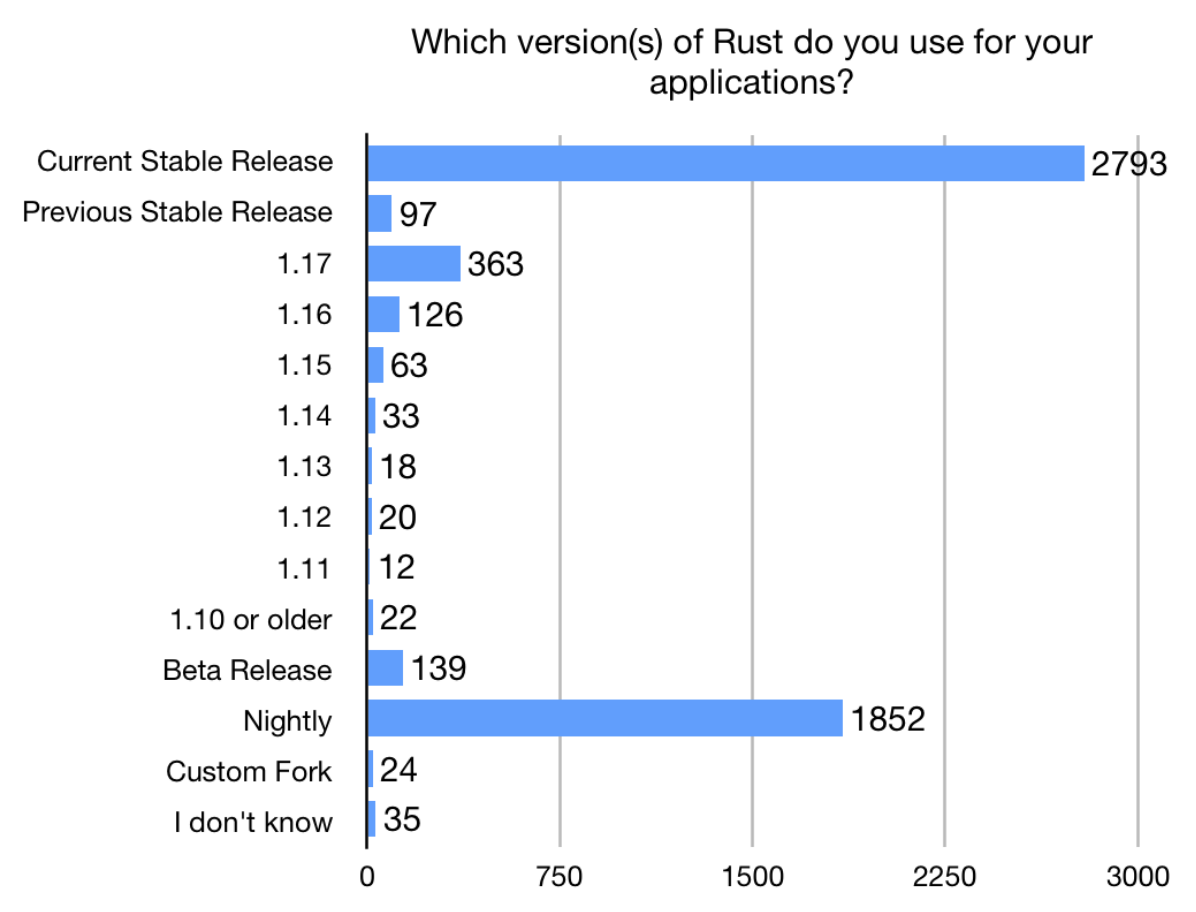
I consider myself an experienced developer, but unlike other new technologies, which I almost always learn just from documentation, with Rust I often turn to community for help. I understand that this complexity is neccessary and I wouldn't Rust to be easier, of course. But still, with Rust's complexity and overwhelming amount of information that's already out of date with the best practices - it sometimes seems that over a half of google results on stack overflow are still about pre-1.0 Rust. And when we (people who learn Rust) turn to the community, it usually tells us (in the most helpful and nice way, of course) "just use nightly".
I wish Google didn’t customize results so much; I rarely see anything pre-1.0. It really makes it hard to figure out how to best help :/
At this point, the only major library that requires nightly is Rocket, and Actix-web has been rapidly ascendant due to (rumordly) being used in production by Microsoft, and working on stable.
The data, from last year’s survey, (which means even more stuff was nightly only, for example, the RLS) where you can choose multiple options https://blog.rust-lang.org/images/2017-09-05-Rust-2017-Surve...
This just means that the Rust language does not have the feature of being simple. Of course, there are sane subsets of C++ also (e.g., do not use new/delete), but this does not mean that C++ is a sane language. The same goes for Rust, probably.
Well, at least you have the good grace to admit that you haven't used Rust. :P
What a snarky reply from someone who already knows that Rust is not simple. The person you replied to was right, and yet you cast doubt on what he guessed to be true.
> This just means that the Rust language does not have the feature of being simple.
I really don't know what it means for a language to be sane, so it didn't make any sense to me that you were replying to that part. My bad.
Of cause you can find a sane subset of c++ / rust that most comfortable with. But once your project accept c++ / rust, nothing can stop them using the other "features" of the language.
Trying to enforce code style drain lots of energy from the project. Maybe a good linter can help......
https://codegolf.stackexchange.com/questions/2203/tips-for-g...
Late 90's advocacy was much more on the lines of "OOP lets you reuse code" and "widget libraries are great, and they all but require OOP". One of those is blatantly correct.
I have a feeling that such a language will offer too little to offset the costs of switching
2. There were no good, cheaply available implementations of Ada. GNAT was originally quite awkward and finicky when I first poked at it, years after seeing Ada in a class (and I can't remember what compiler we used there).
3. Most importantly, no common, popular systems picked it up as the preferred systems programming language. MacOS had Pascal for a while, Windows went with C or C++.
Why do you consider inheritance a bad feature of OOP?
OOP can become spaghetti very quickly. Especially as people mistakenly allow children to modify parent memory directly, protected non-final fields in Java. Once that happens and as the inheritance higherarchy gets deep, understanding what a field actually is at any point becomes very difficult.
Interface and trait inheritance at least removes one piece of confusion by only allowing functions to be inherited, which makes code much easier to reason about.
Sometimes I want to derive a supertype. Sometimes I want to re-use behavior but I don't want the new type to be expression-compatible at all. But inheritance says that if I'm re-using code, I must accept certain expression substitution relationships between my code and the code I'm re-using.
As with anything, there are reasons to use it and situations where it makes sense. But it just seems like a very niche connection to use as the basis of a language design.
Interface-only inheritance and composition instead of inheritance (with components or otherwise) is almost always simpler and thus more error-proof. Even if sometimes you have to repeat yourself a couple times, decrease in mental complexity is definetly worth it.
I wouldn't call the Rust semantics "OOP". But it has a pretty complete implementation of type classes, with class inheritance.
Rust might have gone too far the other way. Yes it strives to be a modern language, with a lot of functional programming features and "OOP" done right (aka no inheritance, simply method polymorphism). To me Rust is more a C++ replacement than a C replacement.
A replacement for C should try to be as simple as possible while fixing C weak typing mess with strong typing for instance, including when it comes to pointers (for instance like in Ada where you can't just take the address of anything you want, you need to declare it as aliased to begin with). In fact Ada tries hard to make pointers redundant which is a great thing. This and range types and bound check arrays( Ada has a lot lot of great ideas, and "C style" Ada is a treat to use).
So a C replacement should keep the procedural nature of C, with closures perhaps, but not go further in terms of paradigm. C aficionados often claim they love C because it's "simple"(it isn't) That's what they mean, they love C because you can't really do OO with it.
On the other hand, Rust macros are exemplary of what a good macro system should be.