You actually can. It's the oldest trick of the industrial age, mass production and economies of scale. A good rule of thumb is that increasing production of a physical good by a factor of 10 will drop the unit cost by half. For non-tangible goods the effect is even more pronounced. The fist copy of Microsoft Windows might cost 1 billion dollars to produce, while every next copy is essentially free.
What this new breed of money loosing company signifies is a shift of business models to the software-eat-world paradigm: high upfront capital investment, zero marginal cost, exceptionally strong consumer lock-in (thus profits) once you break through and dominate the market. There is nothing fundamentally different between Amazon Prime and MoviePass, they are both loss leaders designed to increase foothold in the market, with a view to later use that dominance to dictate the rules. One was built on good economics and well executed, the other is not and will fail, but it's essentially the same business move.
> The fist copy of Microsoft Windows might cost 1 billion dollars to produce, while every next copy is essentially free
You'd have to split R&D costs by the units sold here. If you spend 1B and sell 1000 copies a price of 100$ per copy won't help you.
Then you have the secondary effects of lock in (with software/services) that makes every sale also reduce the cost of a future sale or economies of scale (physical goods) that again make volume more desirable.
This doesn't contradict the adage about having to sell at a per unit profit, but it complicates figuring out what number that is and can lead to some non-intuitive results, which does trash the value of the adage as a simple way of looking at things.
Not saying every company that is selling at a loss to get customers in hopes that they'll mysteriously figure out how to later profit is doing so correctly, but some are. Oversimplification adds little value to these problems.
MoviePass sells subscriptions and then buys tickets. For each extra subscriber they've got an increase in marginal cost. You might argue they can make a profit by charging more for the subscription than they pay for the tickets, but there's lots of factors working against that:
1. When they IPO their suppliers will know their revenue and can demand high prices to match, seriously threatening their marginal cost.
2. Their suppliers already have scale and so will be difficult to leverage - further hitting marginal cost.
3. Their suppliers are extremely capable of producing a competing product undercutting them- destroying the lock-in component. The suppliers control access to the content not MoviePass.
Amazon stopped making /losses/ rather quickly. They /invested/ in the health of their business and future opportunities instead of delivering profits to outside investors.
Arguably, a better structure for incorporation does exactly that; it provides benefits to it's employees and the community it serves.
There is a lot of trust here that Amazon is secretly really profitable not just growing because their profit margins are unsustainably low. It wouldn't be the first time a large company engaged in questionable accounting if it turns out their unit numbers are actually not as good as they claim because of some accounting shenanigans.
It's completely different to retail, which historically has low margins and has to compete with Walmart.
I'm not saying I necessarily agree with this assessment.
I mean unlike 99.9% of the first wave of DotCom startups they managed to avoid actually going bankrupt.
* Microsoft * Boeing * T-Mobile * WaMu * Amazon * Concur * Real Networks
And three of the seven were in severe financial distress. It was like, "hmmm is it time to leave Seattle?"
https://static.seattletimes.com/wp-content/uploads/2017/04/c...
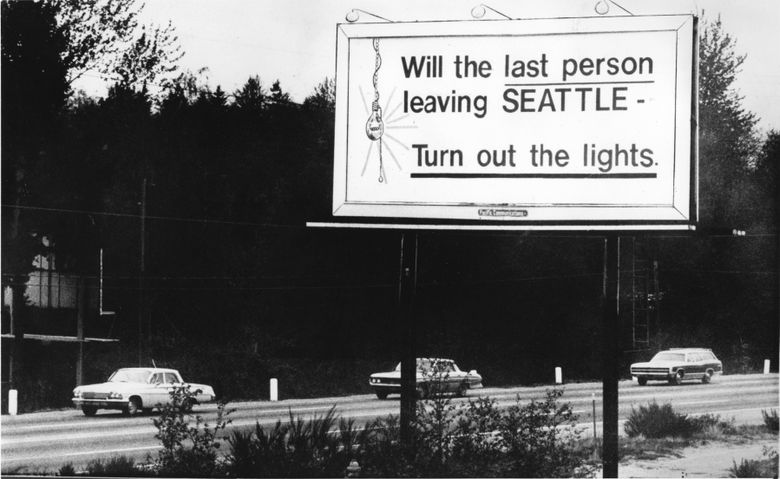
I feel like a lot of startups are simply using investor money to give unreasonably inexpensive products to customers.
For software companies, there is often a point where growth simply makes you profitable because your costs are relatively fixed. For my own B2B startup, we had plenty of graphs that showed at exactly the point where we no longer subsidizing our customers businesses and instead making a profit. Sadly we ran into a few road blocks and ran out of cash before hitting that golden mark. But, when your costs rise linearly to the number of customers you have, then you can never achieve profitably through growth alone.
I believe "frupidity" is the in house nickname for this.
That's a huge distinction, if you start having to raise more debt or equity in order to fund your growth it's going to negatively impact the long term free cash flow per share of your business and will make it harder for your to generate outsized returns.
Their latest 10Q shows GAAP pretax income of $1.9 billion.
If you're referring to total change in cash which was -$4.2 billion, that's because they reduced their accounts payable by $10.2 billion from paying all the suppliers after the holiday season. Looking at the consolidated statement of cash flows of a seasonal business very, very easily leads to misunderstanding the business.
Operating cash flow was $18 billion for the year ending 3/31.
Long-term debt was $3bn in 2013, increasing to $8bn in 2014 and $25bn in 2017. Capital leases have also gradually increased from $2bn in 2013 to $8bn in 2016 and $13bn in 2017.
The three different cash flow calculations in 2012-2015 were $4.4bn (0.4+2+2), $1.7bn (-0.1+1.3+0.5) and -$2.4bn (-0.4+0.2-2.2).
As forecasted, the divergence of these metrics has continued.
I can go to any movie I want at any local theater. That is a lot better than subscribing to five different plans, one for each theater.
I sure hope that Moviepass and the theaters can figure out a way to make it work.
If you're visiting the cinema very regularly, this saves money.
They can do this because they own the theatre, so when a subscription is used, it only costs them the _opportunity_ cost of one seat - which is very little, unless the showing is sold out, and they still make money on snacks. As MoviePass doesn't own the theatres, they pay the _retail_ price for every ticket a subscriber uses.
2) with reserved seating, I'm much less likely to buy a ticket if the showing is almost full, so those filled seats can reduce additional ticket sales.
If they develop software than that is treated as expense or buy movies that gets expensed.
Their core retail business is not that profitable. It goes from 0-3%. Its pretty much the same as walmart or any other retailer.
AWS is more profitable than their entire retail business.
Because Amazon isn't about making short term profits. Amazon is about becoming the middleman for as much of the economy as possible by facilitating the transformation of the economy into its network/computation intermediated version. Amazon isn't so much a money loser as it is an economy absorber. It has been that since before day zero. That idea predated the notion that Amazon would sell books.
This is semantics. If I make $100 on a $60 spend, and then choose, like Amazon, to reinvest the $40 in the knowledge that it will improve efficiency next year, my "profit" is technically $0, but my company is not worth a lot more than $40.
If like MoviePass, I spend $100 (of borrowed money) on revenues of $60, with no clear explanation of how I've added $40 of value to the company, that's a bit of a red flag. Saying "I'll figure it out eventually" is a bit touch and go.
Your sink costs are sunk and your investment costs are optional.
Turning a profit (paying dividends) or reinvesting is a decision every investor relations team must make, simplifying the subject it is based on whether you predict your company will get the investor more money (by stock price growth/future dividends) than if he invested in other equaly risky set of assets.
I don't believe this is the case for Moviepass.
* eBay is a platform for sellers to connect with buyers
* Many think that Amazon is a online retailer, but it's not; it's a platform. A huge percentage of the items sold on Amazon are owned by small businesses who are leveraging Amazon's platform (website, warehouses, logistics, delivery.) If eBay had been more ambitious, eBay could've replicated what Amazon has done.
* Facebook is a platform for people to connect with other people
* even Google is a platform; it's basically taken the entire Internet and added ads to it. The Internet itself is Google's content, and that content was created by other people
And that's why MoviePass is doomed. If MoviePass had become a platform where movie theaters could unload excess inventory, then it could succeed, but the current model is simply selling movie tickets at a loss.
Now the thing that Amazon has for it that Moviepass does not is that Amazon gets to collect user data and use that to sell more for itself. Moviepass seems to get to collect user data, however it doesn't own the theaters so it must find partnerships with the bigger theater chains. They're hedging that they can create such a large user base and show that they can bring a lot more traffic to theaters and with that increased traffic (and lower ticket price for the customer) will sell more concessions.
For Moviepass to work ticket prices must go down (at least for them) while theaters still make more money because of larger concession sales.
What's the categorical difference between the two business models? Guess it's the fact that when MoviePass tries to change prices it will force every user to opt in all over again. Opting in is part of the everyday user interaction for Amazon.
(And heck, Amazon don't even need to raise prices, they could be very profitable just by investing in growth less. But their investors are clearly happy with the current state of affairs).
For example my local VUE in the UK I can get a ticket on Mondays for less than $6 full price is $16
I suspect that its the paying up front for a year when a substantial majority of its customers wont goto the cinema
That's what I meant by integer multiples. If Moviepass was $60 a month it might be sustainable. But it's not, it's $10.
Moviepass doesn't get any of that sweet concession stand money and they'd have a hard time convincing theaters that they should unless they start leveraging their user base (i.e. threatening to drop MoviePass from working at Cineplex) to pressure theaters. Even then they add so little value to the system that it'd be hard for them to do that while sustaining a competitive advantage against new market entrants.
MoviePass is just a terrible idea to be in as an independent business.
The MoviePass price is per month. There is NO cost per viewing.
You could in theory see up to 31 movies for your single $10 payment.
I was paying $40/month for MoviePass, and most months they still lost money and me, and I saw a lot of movies in a theater that I would normally have waited to see at home.
PS. Staff at indie theaters tell me that 70-80% of tickets are purchased with Moviepass cards.
On the other hand, I don't think AWS is the low cost leader for equivalent services. I use AWS because of the breadth of services.
It's a matter of how you define profit. Or rather, whose profit you're looking at. (And, ergo, what profit is actually driving the business forward.)
Wait what? No. They were a loss leader because they kept doubling down on a bad business models until they made headway on the reseller market to push themselves as an online retailer, which brought them out of the red. Only after the massive success of AWS, did they solidify as the most successful retailer because THAT got reinvested.
Notice, Google tries to follow this EXACT model, as it has for decades. It has little profit to show for chasing this fable-strategy because it doesn't work. Grabbing Doubleclick was a minor misstep (there were far superior companies to choose from), but at least they got youtube and were able to keep the boat floating (with a little Ad Tech dust). Riding their search engine product as far as it will go and then building an ad network on top of their search+youtube is where Google has settled.
Amazon has been looking into advertising for the last couple years and will probably be less successful than Google without a big new thing, which is unlikely to come from this mythic "reinvestment". Why does this fairytale story about Bezos keep getting pushed? Successfully keeping a company running is not the same as him being nigh prescient about how to manage the resources.
The key difference with Amazon is that Amazon could choose to be profitable at any time- just raise prices ever so slightly, reducing growth in customer demand, and the stop building out its enormous logistics empire and new businesses. Amazon could have had profits for a very long time, but Bezos understands that re-investing money in the company grows the value quickly. Plus, you only pay taxes on profits.
MoviePass can't really do that. They don't have potential profits that they can just stop re-investing. They aren't spending money on investments- they just don't have income high enough to cover the costs of their product. And lots of other start-ups have the same problem right now.