As an aside, there exist green threads in JS, namely node-fibers, although it's only a Node.js extension.
You actually can reflect on module exports and dynamically change them with node modules; you can't do it with ES modules, but that has the significant advantage of enabling static analysis.
Proxies absolutely can trap the property assignments you mentioned, but Vue can't take advantage of this because Proxy can't be polyfilled in older browsers.
As for the enumerate handler, it would only have worked with for-in loops, which are a legacy feature. The iteration protocols used by for-of are a much more flexible solution. It might seem silly to have both for-in and for-of loops, but the context of the language is that it can't just go and break older websites. Same goes for == and ===, etc. Linters come in very handy for dealing with this.
Your criticism is better than most, which usually just point out some "wat" moments with mis-features like implicit coercion, but you didn't really make a case for having to do "all things by hand" in JS.
Aren't Web Workers real threads, and supported natively in browsers? (Haven't used them myself, maybe there's some limitation that excludes them from the criteria above...)
https://developer.mozilla.org/en-US/docs/Web/API/Web_Workers...
I also bet that I couldn't make 'in' work for proxy with empty abstract target, but maybe it's just me. Btw, 'in' and 'of' are two separate iterators, one iterates array elems and the other iterates object's keys -- something essential to metaprogramming. My whole point on in/enumerate is that it considered legacy by someone special.
And on Vue: I didn't know that, but if Vue can't take advantage of Proxy, can I?
for-in is a legacy feature; due to dynamic inheritance, it's generally not safe to use without also calling Object#hasOwnProperty() every iteration. for-of is not for "array elems", it uses the iteration protocols that are implemented for all built-in collection types, not just Array, and some DOM types, and can be implemented for any user types. Protocols are a much more flexible and clean approach to metaprogramming than overloading the for-in looping construct would be.
You can't use Proxy if you need to target legacy browsers like IE9, and Vue needs to, since it's about 15% of all browsers.
And yet even that advantage got thrown out from the language with the introduction of "import()". Apparently static analysis is a non-goal (see discussion in [1]).
[1]: https://github.com/tc39/proposal-dynamic-import/issues/35
The threadless/nonblocking model is "interesting" but in my opinion its wholly suitable for user-oriented scripting as it forces a style of development that doesn't block.
The null/undefined thing actually makes sense to me. The concept of "Null" is a swirling vortex of uncertainty in most languages and it's nice to see it get some more nuanced treatment.
There's something about the bloody-minded pragmatism of javascript that appeals too ... it's very much a language that has evolved from the bottom up based on need, and much of it is very much community driven. You see problems solved in interesting and unusual ways that you mightn't see in a more stringently stewarded language.
I wouldn't use it for everything. I wouldn't prescribe it for beginners to programming either. But it's great for what it does. I like lots of other languages too, but I respect their applicable limitations. It's a nice language.
All this makes a lot of people react emotionally and makes talking about JS itself (like many other mass-adopted technology) very hard.
Is JS nice? Yeah, as my personal opinion - but we can all say that it is good enough, evidenced by the ecosystem and the things people create with it.
I'm wondering what would be an example of a great language? Because we know that there are only two kinds of languages: the ones people complain about and the ones nobody uses
Being the closest thing to lambda calculus with enough syntactic sugar on top to make it practical is a large part of what makes Haskell great.
People with mathy backgrounds that don't blink at the phrase "lambda calculus" won't consider this, but a lot of people struggle with math.
If you can't put it in the hands of a 6th grader (in the public school system with no special tutoring) and have a reasonable chance of it being understood (n.b. I self-taught myself early JavaScript when I was in the 5th grade, and picked up PHP the following year), it won't ever be "great".
Maybe it could be amended to "since many programmers learned to program using languages with a syntax inspired by C, wildly different syntaxes learned at a later stage are more difficult to them", which is a more reasonable proposition. This could be fixed by teaching programmers other languages early on.
Haskell is no more or less intuitive than JavaScript. It's just different.
I can teach someone Python or JavaScript in a few weeks, at a casual pace, where they can accept input from STDIN or a file, do some calculations, and produce output to STDOUT or another file.
Haskell? I'd need a dedicated fucking thesaurus on-hand for them to grok the paradigm, and it would take a few months before they could achieve the same result.
I have another point here:
If the only languages that are considered great are the ones that make people feel smarter than everyone else for being able to understand, we don't need great languages.
Most of us need easy, practical languages that help us solve problems and don't get in our way. (Most of achieving this property comes down to ecosystem rather than language design.)
This is one of those assertions people should have to demonstrate with actual experiments.
I can teach someone how to write buggy, unmaintainable code that seems to work but actually doesn't in Python and JavaScript. So? :)
Yes, because that property is totally absent from Haskell.
https://github.com/RNCryptor/rncryptor-hs/issues/2#issuecomm...
Oops. Surely the JS and Python implementations are just as bad?
https://github.com/RNCryptor/RNCryptor-python/blob/649ca23a5...
https://github.com/RNCryptor/rncryptor-js/blob/08250e00a1140...
(END SARCASM)
My point here is that, while working with a "great" and/or "better-designed" programming language can be beneficial, it's the ecosystem that really counts.
My argument is that people who claim "writing Python is easier" usually ignore that it's writing buggy/throwaway code in Python that is actually easier (aka "look, I can write bugs fast"). Writing large, maintainable and bug-free code in Python is not easier than in other languages -- it's arguably harder, but since that's debatable, I won't argue it here.
Even a "perfect" language is faulty if the barriers between its current state and mass adoption are insurmountable.
Completely reform education in this country to make purer languages like Haskell more palatable for younger generations than, say, PHP, and I'll totally be wrong in 50 or so years.
I'm arguing that "Python is easier" is false, simple as that.
- Beyond toy examples, writing Python isn't easier. Writing reliable, easy to maintain, bug-free Python programs is just as difficult, and your average person won't be able to do it right off the bat.
- You don't need to really know what a monad is in order to write Haskell as a beginner; that's a red herring.
If you want to argue that it's easier to write toy examples in Python, without regard for good programming practices, then... it'd still be debatable: if I remember correctly, some years ago there was a post here about someone teaching Haskell to highschoolers, to great success. They found it fun and easy.
Where did I say it "can't" be better?
It's this learned setting for our precepts that makes other languages intuitive or not. If we were all learning fortran or pascal in college it might be different, but we're not.
That said, having C-style syntax is clearly not a pre-requisite for the success of a language as is attested by the success of Python, Ruby, various flavours of BASIC and other less loved languages like COBOL ...
But "intuitive" is very important for getting traction. Once you can "intuitively" model a problem in a language such that somebody familiar with the problem can understand what's going on, then that's intuitive. I'm talking about a different kind of intuitive here.
Most people engage with computers on imperative terms, i.e. they want to tell it to do things. Imperative languages are "intuitive" because they allow you to map out a list of instructions in order.
So for instance, when you're writing a program to make a cup of tea you issue those steps one by one. You don't want to have refine the model into a functional space, do a handstand and flip the bag into a mug with your little toe while inducing a small raincloud and microwaving the drops on the way down.
Similarly true object oriented langauges (I'm not talking about C or Java here, where classes are glorified structs) model how we think of information in terms of object-relations.
Functional languages to me as an experienced programmer are "intuitive", but even I sometimes flinch when I'm exposed to a stack of lisp ellipses ...
Modern programs seldom look like a list of imperative actions anyway, beyond toy examples. They look weird and unintuitive. If you can make the leap to "this is what an actual imperative program looks like nowadays", you can make a leap to declarative/functional programs just as well. Doubly so if you don't have to unlearn years of conditioning about how programs are supposed to look :)
It currently is a self-inflicted hurdle. I don't pretend this problem doesn't exist. One way to fix it would be to start teaching programming in a different way, and with different languages.
Are there anecdotes of non-absolute-beginners failing to understand that? For first-year students, sure. Do working software engineers have trouble with it? Do they have bugs and/or lower productivity because of it?
> If you can make the leap to "this is what an actual imperative program looks like nowadays", you can make a leap to declarative/functional programs just as well.
My own suspicion (completely unsupported by data) is that some peoples' brains find imperative languages to be more the way they think, and some find functional languages to fit their way of thinking better. You could run an experiment to test that - you'd take a group (call it A) of functional programmers, and a group B of imperative programmers, and measure their productivity. You'd then split the groups in half. A1 stays functional; A2 starts programming in imperative languages. B1 stays imperative; B2 goes to functional. Two years later, you measure everybody's productivity again. What I expect you'd find is that some of the people who switched (either way) increased productivity, and some declined.
What you might find is that everybody who switched from functional to imperative was less productive, but that might be because the (somewhat rare) people who are already functional programmers are almost exclusively the ones whose minds work better that way. You could fix that by starting with students or with fresh graduates, and arbitrarily assigning them to group A or group B. Then you'd have to wait a couple of years to measure their productivity the first time.
The difficulty, of course, is figuring out a way to at least somewhat objectively measure their productivity...
Sorry, I was unclear: I was talking about beginners. My argument was about intuitivity and "it's easier/harder to learn programming this way". Software engineers are already down the road of "I'm used to this, therefore this is the best way" :P
If I understand you correctly, what you say is entirely possible: that some people think best one way or the other, and that there is no universal paradigm that is more intuitive.
I don't recall ever having trouble with that myself, but that's anecdote, not data...
True.
> C-like syntax is NOT intuitive! Reading C code is a learned skill.
Also true.
> Haskell is no more or less intuitive than JavaScript.
This does not follow. I have to learn the syntax of any language, true. But that doesn't mean that all languages are equally easy/hard to learn. I learned C by reading K&R over Thanksgiving weekend while in college. I understood everything except argc and argv, even though I didn't have a compiler to experiment with. I had to learn, true; I wasn't born knowing it. But I found it to be pretty intuitive to learn.
I doubt I could have understood Haskell from reading a book over a four-day weekend, without being able to experiment, no matter how good the book.
And, sure, there could be someone out there to whom Haskell syntax is intuitively obvious, and they look at C and wonder what all the crazy symbols mean. But I suspect (but cannot prove) that such people are less common than those who find C more intuitive.
TL;DR: No language is innately known. But some can still be more intuitive (for most people) than others.
Note well: I do not take any position on JS vs. Haskell as far as how intuitive they are.
I don't think the relative intuitiveness of Haskell vs JavaScript is a settled matter. I'm arguing one or the other may seem more intuitive because of past familiarity with similar languages/paradigms.
For example, some people -- though not in this thread, thankfully -- make much about Haskell's allegedly weird syntax and/or operators. Never mind that its syntax is not particularly large, but also there's nothing immediately intuitive about a lot of C code in comparison. What's with all those "{}" and ";" and "*" and "&"? Parsing operators, especially with parens and pointer dereferencing involved, can be difficult, even without deep nesting, and even experienced coders occasionally trip over some production C code. Yet no-one uses this as an argument for C being "too difficult" or "too unintuitive". I argue this is because C was a language they learned long ago, and it has colored their perception of what is familiar or "easy" about programming languages.
What I mean is, nice as these are ... is there always going to be a bit of waste when you use them?
Guy next to me at work was trying to build a web app with haskell for a hackathon, and I was blown away by how little the community had to offer for basic things he couldn't get working.
So yeah, languages people complain about, and ones nobody uses.
It looks lovely, and it's something I'd very much like to learn some day but I can't for the life of me think of what I would use it for. Are there any killer apps out there for it?
At least with lisp, I can configure emacs ...
You could start your own project. You could contribute to an existing project. You could evangelize Haskell at your job, if possible.
All of these are hard, of course. It'll be easier to use a more mainstream language. But if Haskell strikes your fancy, maybe it's worth the effort?
Yep. Sure. Just as soon as I get done shaving this Yak ;-)
    Hugs> last [0,1/3..2] > 2
    False
    Prelude> last [0,1/3..2] > 2
    True
That's not to say other dynamically typed languages (including js) or even statically typed languages are all that much better. But I would say ruby is really showing its age with the number of warts and hacks that have accumulated.
It sounds like most of your criticisms are criticisms of dynamic languages. Ruby gives you a million and one footguns, but they are beautiful and elegant footguns.
Maybe 5 years ago. For nowadays, I beg to differ: https://github.com/jashkenas/coffeescript/wiki/list-of-langu...
A significant amount of the choices there produce generally better-performing code than the hand-written JS, there's also the WebAssembly.
Generally, the alt-js languages provide 'source maps' so that developer tools know to map errors in the 'transpiled' code to their source, and it's possible to avoid JS to a practical degree.
https://developer.mozilla.org/en-US/docs/Web/JavaScript/Refe...
>almost every example of an issue that you have with the language seems to be resolvable using Proxy objects. I don’t think that light threading, introspection, scoping, etc is resolvable with proxy objects. If it is, it would be nice to know how.
Here the code of the model implementation: https://github.com/zandaqo/compago/blob/master/src/model.js
V8 (and probably others) now has some special cases for async functions (and generators, I think, but those are much more rare) to show useful stack traces with the lineage of async calls. For example, this code shows the stack trace you'd expect when run in latest Chrome or Node.js.
  async function c() { throw new Error('Some error'); }
  async function b() { await c(); }
  async function a() { await b(); }
a(); ./file.src:
func api_foo()
for x in objs
x.a = fetch(x.b)
ui.btnok.enabled = yes
commit()
I also find that python has reserved a whole bunch of keywords that I can't use as function names, making APIs hard to create with appropriate names. You also have to pollute your code with self everywhere.
It is also really slow, has no where near the number of libraries on github as javascript, is not a client-side language, doesn't have anything like babel, which can allow you to do a lot more than reflection/introspection (but not the same things exactly), etc.
Python is one of the imperative languages with fewer number keywords in existence. Compare for example the number of keywords in Python[1] with Javascript[2].
Maybe you're confusing the built-in functions in Python language, like len() or str(), however since they're functions you can reassign them (not a good idea, however in a limited scope it works).
[1]: https://en.wikipedia.org/wiki/Python_syntax_and_semantics#Ke... [2]: https://www.w3schools.com/js/js_reserved.asp
> It has so little syntax you can't tell the difference between various things. A variable declaration, a reassignment, a keyword, a whatever else, they don't have any visual distinction from each other.
The fact that you don't know the difference between keywords and built-in functions makes your argument weak. But I will bite, if you're having difficult to make the distinction between a keyword and a variable you probably have a very bad editor. Syntax highlighting helps a lot here (like in almost every other language).
> You also have to pollute your code with self everywhere.
I really like the fact that self is explicit in Python. It makes OO patterns more explicit (there is no magic variable like self or this, just a parameter that is passed as the first argument in any Class method) and it helps making a distinction between attributes and local variables. Really, I would go even further and make super() a method from Object, so instead of calling a magic method super() I would call:
    class Test:
        def __init__(self):
            self.super().__init__(self)
> has no where near the number of libraries on github as javascript
Most JavaScript libraries in GitHub are pure toys/garbage, though. Python has a number of useful libraries and if you don't concur with me, please give examples of areas where Python is lacking a good library (I can easily give an example for JavaScript: ML and scientifc computing).
1) In scientific/ML CPython libraries, most critical parts are compiled anyway, and the core language is fast and expressive enough to provide a nice and fast interface to it; so your statement makes little sense without more context
2) Python != CPython
Python is really neat to quickly experiment platform independent but it's definitely extremely slow.
The difference between 'npm install' (and even an added 'gulp') and the chickens I've had to sacrifice at crossroads to get Python packages working is notable.
Oblig XKCD - https://imgs.xkcd.com/comics/python_environment.png
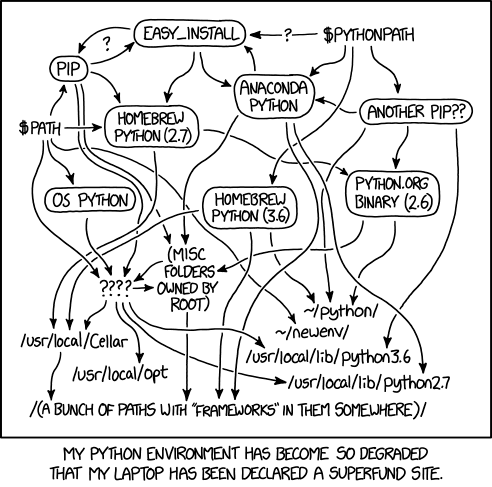
Yes, you need to get the right version of Node, just like you need the right version of Python. I've had both largely just work with directions of "Version Y.X", where Y is defined. I've also had the occasion where it still broke with a specific version where both Y and X were defined.
In general, if I have the right version of Node (and I agree, I'd prefer package.json to also indicate the version of Node that was used to initialize it), things work when installing from package.json. Things also generally just work with Python if I have the right major version of Python, and an environment file. My issue is more that the 'simple' steps a lot of people do when creating Python projects -don't- use an environment. They just use whatever is installed globally on their computer, and they pip install any dependencies, then write a readme to pip install things with, rather than lock it down with a virtual environment.
It's kind of ironic, really. With the Zen of Python stating "There should be one-- and preferably only one --obvious way to do it" why is it that it's so common for people to not do the thing that makes it reasonably portable?
I mean, I currently am working with some code that, as part of its readme, has a pip install of a lib -off of master-, and yes, obviously that caused problems. Is the author not a Python developer? Well, he's a researcher. Why is the obvious thing for someone coming naively to develop in the language not building a portable environment?
I think this is why the situation is bad in Python: we have too many non-programmers in the community, that simply want something to work and get on with theirs life. If they can get by it by installing a bunch of libraries by running some command incantations as root, they're happy enough.
You don't have this problem with Node because the only niche that Node really matters is Web, and WEB DEVELOPERS know that their environment should be reproducible.
*: Even in Node this isn't really true, since we have yarn vs npm. Ruby is way more stable thanks to bundler.
The impact of those people in the ecosystem is zero, though. They don't inconvenience anyone by producing badly-written libraries, they literally do their job, produce what they want to produce and everyone is happy. I'm not sure why they get lumped in with "this problem".
I don't know why I hear this a lot, it certainly doesn't echo my experience. I've rarely had dependency problems, even the regular requirements.txt (without pinning to specific versions) tends to work well enough on reasonably current code. Pipenv pretty much solves the problem by introducing a lockfile.
It doesn't impact the ecosystem very much for sure, however I wouldn't say that the impact is zero.
Also, I think scoping rules in Python are terrible. I always end up with a namespace that is a mess. And you can't do something like this in a clean way:
    counter = 0

    def add(n):
      counter += n

    add(1)
    add(2)
add(3)That's what nonlocal is for: https://docs.python.org/3/reference/simple_stmts.html#the-no... Just stick "nonlocal counter" in your function and it works.
Also nonlocal implies that other variables are local, which is not true. E.g., the following works without "nonlocal" keyword:
    counter = [0]

    def add(n):
      counter[0] += n

    add(1)
    add(2)
Your example works because you are mutating an existing object, not reassigning a new one.
It's a disingenuous comparison IMO.
What's messy about it?
    >>> (lambda f: lambda x: f(x) * 2)(lambda x: x + 1)(100)
202clos = 42
def foo(x): return x + clos
def bar(y): return y * clos
higher_order(foo, bar)
What's so hard about that?
You could do this with a lambda construct in Python; but this only works if the function has a single expression-statement; it doesn't work e.g. when you have a bunch of assignments inside the function you are inlining.
Sure, it's ugly but I think it's a silly challenge. Complex functions defined in the function call are un-maintainable anyway IMO.
I'd hate to see Python become as popular as JavaScript and to have it be used as the defacto standard in browsers because honestly, it's nowhere near as enjoyable to use as JS.
It feels to me like JS is more for people who want to write "clever" code and Python is for people who want to write boring, more maintainable code. It doesn't help that JS has a gentler learning curve and attracts more people who just want to get things done without thinking whether those things should be done that way.
IMO JavaScript is for people who want to get things done quickly and efficiently and have their program work everywhere. Python is for people who like to think they are doing things “the right way” as if there were such a thing.
Indeed I can't. I can say no to "JS is more enjoyable than Python", which is what you said in your upstream comment.
> JavaScript is for people who want to get things done quickly and efficiently and have their program work everywhere
If by "everywhere" you mean "in a browser", sure. I don't see how that's related to the common definition of "everywhere", though.
> Python is for people who like to think they are doing things “the right way” as if there were such a thing.
I don't know what you mean by that.
As a concrete example, here's a library I made that relies on symbols and dynamic inheritance to extend the built-in data types: https://github.com/slikts/symbol-land
  ./file.js:
  function foo(ctx) { // @export
    for (let x of ctx.objs.iterate()) {
      x.a = await fetch(ctx, x.b);
    }
    ctx.ui.btnok.enabled = true;
    ctx.commit();
  }
  autoexport(module, x => eval(x));
(Thank you and all commenters here for sharing your code and experience. In particular, symbol-land looks very interesting and haskell-y.)
Destructuring would make your example look better: foo({ui, commit, objs}), and then there's no need for typing out ctx. Another thing that's not needed with for-of loops is .iterate().
Using eval() is a very strong anti-pattern, and it's not needed there anyway. JS has the `with` statement that allows running code with a specific context, but its use is discouraged as it's really bad for readability and hard to optimize.
Destructuring looks good here, you’re right. Actually, this thread somewhat relaxed my js hostility and I see it as an alternative that has reasonable tradeoffs (but still not as a friend though).
The Function constructor is a better alternative for eval(), but still only as a last resort. eval() itself has no use cases.
I find that most JS criticism is ill-informed, because people are too quick to jump to blaming the language due to its reputation. Not that I'd call JS a great language, but it has redeeming aspects.
Other problems exist, which are just stupid (null/undefined, in/of, ===, ;, this, etc) or minor design choices like coersion and lexical rules. But these above are stoppers for turning JS into something great. It is now a BASIC-level language with scoping and sugar. Yeah, you can write like that snippet presented in an article, but you are forever stuck with doing all things by hand, from asyncing to orm, from exporting to update scheduling. I don’t find that great in any way, especially when that is the only semantics you have in a browser.