Are you are saying that, in a scenario where there are more results for one sub-query than for another, Google has an obligation to assume someone is searching for the sub-query it finds more politically acceptable? This seems like a bad idea to me. We should want to reduce the political/social influence of Google, rather than think of ways to give them more tools of influence and assuming they will have a positive effect.
These two things are completely different
"Because you live in SF, if you search restaurants you probably want results pertaining to restaurants close to SF"
"Because subject X-A is socially unacceptable, if you search for subject X we will only show results pertaining to subject X-B"
In reality though, the world is a complex place and the ideal pretend version can only be implemented in a carefully controlled environment such as a movie, a theatrical presentation, a video game or a situation where all participants agree to or are pressured into behaving in a way in which that pretend world is real. When the rest of the world leaks in, it is impossible to maintain that pressure on everyone.
About the best we have so far is "safe search" since pornography and obscenity follow fairly regular patterns. Political correctness though is constantly evolving and requires a trained academic to determine if each piece of information should be censored or allowed. Ideally in the future we'll have google glass and advanced AI classifiers constantly scanning our vision and providing us with tape delayed audio of the outside world in order to present the world to us and filter any politically incorrect content 24/7.
For now we have to do it ourselves and ignore any inconvenient facts that may make maintaining the illusion difficult. This constant struggle to deal with cognitive dissonance can be tiresome and one should restrict oneself to heavily moderated news feeds and not using search features for now. To create the carefully controlled virtual world in an interface to the rest of the world such as Google is an overwhelming task because you would need a highly sophisticated trained AI agent to maintain that illusion and to even invent information, such as lists of Nobel award winners from disadvantaged peoples, in order to maintain the illusion.
That is the opposite of how it works. Affirmative action is accepting that the world has bias against certain groups, and attempting to take that into account. Political correctness is about realizing that certain groups have been marginalized or traumatized and some words perpetuate that. In a perfect world neither are necessary.
At least that's the way it works in reality. Maybe this reality is politically incorrect too and you are saying that we need to implement meta-political correctness in which the means of creating an ideal world must be hidden to instead pretend that the implementers know the exact and particular circumstance of each person they are selecting based on facts other than merit and are weighing all of them appropriately in correcting injustice. By pretending that this ideal world in which knowledgeable administrators skillfully and in each individual case correct injustices, this will somehow make it become a reality.
Statistics show that man are the new minority in the campus. But it is surely will be frown upon by some AA activists if a that program is extended to cover male. If AA is said to what it is trying to accomplish, then that shouldn't be controversial at all.
I think this is presumptuous. We can try to find out, why not?
Yes, because implementing something like that would be near impossible from a legislative standpoint. Legislation has to be spelled out and enforceable or it will do nothing.
And affirmative action is not there just to prop up the numbers. It is there to push companies to hire minority groups.
There are two reasons for this. For example, on college campuses, the supreme court has upheld that it is lawful to use race as a factor in admissions because a well rounded or diverse student body is a desirable trait that will produce better outcomes for all involved. Including the white men.
The second is that it is trying to undo the many, many years of oppression (i.e. slavery) that carries generation to generation.
Programs like affirmative action are trying to tip the scales for these descendants to give them a chance to compete. After all, they were systematically disenfranchised as a race. It makes sense that we attempt to systematically bring them back up to speed with the rest of the population.
>we just assume .. numbers need to be fixed first and then the rest of it will follow
We don't have to assume anything. It is both empirically evident (as well as just "duh") that getting a higher percentage of minorities into jobs and higher education will result in a higher percentage of their children having the opportunity to do so without something like affirmative action in the future.
This viewpoint has served me with a perfect success rate in all of my interpersonal reactions, including relatively combative ones (handing a beer can a drunk has thrown on the street back to him and asking if he could throw it away next time, random example).
Are there any specific example of things you think are incompatible with optimism without horse blinders?
Agree. It hides problem rather than fixes it. And since it is often enforced in a top-down manner, communities that outside of the PC spectrum felt being deprived of their opportunities, this very resentment is further diving the society.
What is "political correctness?" Are we referring right now to the alt-right manufactured bogeyman? That is my sense.
I am replying in the following manner only because I believe the discourse around this subject is usually poorly defined. It is not an attack of you or yours, but my attempt to help us all better understand what we're talking about:
By saying "filter through it," what do you mean by "it?" What are the rules of the filter you are applying?
When you say "expected," who is expecting this of you? What has indicated to you that there is this expectation, and what are the consequences of bucking that expectation?
What are the filters in California? What are the filters in the deep south? Is there any federally legal relevance? For example, you could face legal issues if you make sexually connotative comments to a female coworker, and though you are more likely to be pursued and charged in California than in the Deep South for it, is that how things should be? Shouldn't women feel comfortable with their coworkers regardless of local culture?
The problem is what makes a woman feel uncomfortable is culturally driven - when you have such a mix of cultures at work people are bound to make innocent mis-steps.
Californian companies have a tendency of looking at it by race and gender identity. Do you assume the best of people or do you assume the worst?
I understand where you're coming from - maybe you're referring to things like "micro-aggressions" and other things many of us would find silly? Yup, definitely something that needs tackling. I've never argued that there would be a clear algorithm for "this makes people uncomfortable to the point that it should be illegal, this does not."
Luckily, our judges and court system are pretty good at exactly this sort of thing. I think a law on the books that goes something along the lines of "nobody should be made to feel sexually uncomfortable at work" starts the definition, and then subsequent court cases sharpens it. Sorry, Tim saying "great haircut!" doesn't count, but oops yea Janice saying "quite the cucumber you're hiding away there, Bill," while waggling her eyebrows does. Etc.
What makes you think that?
Millions of Americans have been negatively impacted by bad laws on the books.
> I think a law on the books that goes something along the lines of "nobody should be made to feel sexually uncomfortable at work" starts the definition
You have just killed all chance of workplace romance - and more than 50% of people have dated coworkers.
We have sexual harassment laws on the books already.
Why would you negatively impact millions so a few people don't have to feel mildly uncomfortable (and obviously it's mild or it would be sexual harassement which is already illegal)?
It seems to me that there's an enormous contingent of people who wants to yell about the influence of Google and Facebook and then yell even louder about how they're not actively intervening to skew content towards their political preferences (ie increase their influence massively). This split-personality approach is baffling to me.
I'm getting a sense of that from your post.
I come across thoughtful people all the time who have a baseline assumption of intelligence and intellectual honesty that doesn't match almost any group you're likely to actually come across. My prior for people having obviously contradictory views is simply higher than yours.
It happens even more easily if you're lumping people into a single group, but the individuals that you see speaking out about one topic are different than the individuals that you see speaking out about another.
The upshot is that from your described experience you cannot conclude that any group is being self-contradictory unless you personally witness the same person contradicting themselves in different discussions.
It's pretty straightforward to understand the view.
1. It would be better if Google and Facebook didn't even have the power to skew content.
2. Since they do have that power and seem determined to use it they should be judged on their choice to use (or not use in this case) and implementation of content skewing.
If I search for "restaurants", it shouldn't give me restaurants in Shanghai because that's the city with the largest population. It should give me Northern California, since that's where I live and Google knows that.
Similarly, Google might reasonably infer that if someone is searching for their own race, sexuality, or religion, they're probably more interested in information or support groups than porn. Not that both can't be served as results... just... priorities of what people are looking for.
Sure, if they have data to back that assumption up. My interpretation was that the parent commenter wanted them to make assumptions just based on politics, which I think is a bad idea.
Ideally it should know nothing about me!
Don't they already do this for porn? I thought that feature was in place years ago. It's even a minor Internet joke that Bing is only good for porn (since they're more lax about letting porn into their results).
At some point you've got to accept that googling "hot teens" won't get you resources on the treatment of hyperthermia in young people.
> Are you saying that ...
vs
> You are saying that ...
Shouldn't helping connect poeple with what they're looking for be the bottom line? Even if you have to manipulate your algorimths natural results to do so.
This isn't fixed by telling Google it's their fault and they should hide things, that's just looking away and covering things up. The true fix is making the input better, which requires society being better, which it isn't (at this point).
Because they are not. And neither is Google.
TPB, as described, is in a moral gray area - "We know some of the uploaded stuff is immoral" - so they delete what's immoral (their judgement - child porn/copyright stuff/anything between), they arbitrarily decide what you see
Google is in an algorithmic gray area - "The algorithm decides what's best for you, we want the best for you, but we won't judge what's best for you" - so they do nothing and hope for the best (and least damage), the algorithm arbitrarily decides what you see
Both seem like different routes to the same hell.
Edit: Spelling, clearer wording
TPB said "We are not responsible for the content people upload." Except then they deleted CP, probably for many good as well as self-serving reasons: CP is bad, obviously, but also brings bad press (hard to get the public on the side of piracy when it leads to ease of CP access), as well as the holy wrath of pretty much every criminal federal agency in countries around the world, as opposed to just whatever branch of whatever agency is in charge of copyright protection. Doubt they could get hosting in any country if they didn't take the CP down.
But by taking CP down, they demonstrated that they do and can monitor content, that they can take it down, that they do take responsibility for at least some of it. Legally that's a shot in the foot, I thought, but they still find hosting so who knows.
Whatever proxy they are using to find relevance is broken in this regard, and it's important to recognize that there is still an engineering problem despite, or despite it looking like, a political problem.
They did exactly this in 2004, when searches for "jew" brought up anti-Semitic website "Jew Watch" as the top result (because, as a linguistic quirk, "Jew" tends to be used in a slur-like way and Jewish organizations tend to use "Jewish," and the algorithm at the time considered those as different words): they placed an ad at the top of the page with an explanation of the "Offensive Search Results," distancing themselves from the content and explaining the "Jew"/"Jewish" thing.
https://en.wikipedia.org/wiki/Jew_Watch#Google_Search_result...
http://sethf.com/anticensorware/google/jew-watch/jew-watch-c... (and yes, that's Netscape Navigator!)
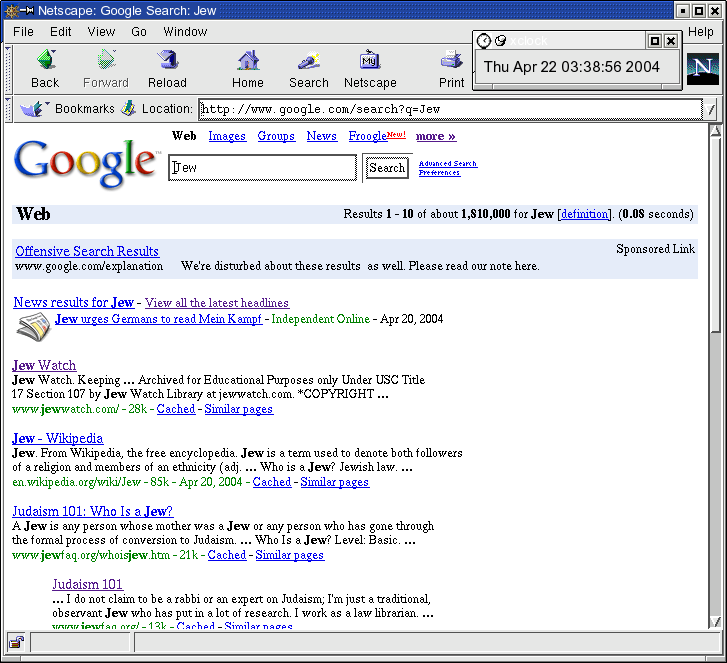
http://web.archive.org/web/20050123081919/http://www.google....
This is a hard problem. There are many search queries, there are many clusters of similar search queries that address partially overlapping (topic,audience segment) pairs. Deriving sentiment scores from these segments is difficult without any feedback mechanisms. Choosing which segments to focus on is difficult or counterintuitive and depends on the topic and audience and characteristics of the audience. Once a topic and audience segment is identified for remediation, the task of effecting change is again topic and audience specific (resistant to automation).
This is a hard problem. Neither a brute force "human review squad" approach nor an automated "deep learning" approach will provide 100% coverage through all time. Does that mean that they shouldn't try? No, of course not, and they almost certainly try every day. However, it's inevitable that they will be subject to sniping articles no matter what they do.
There are many search queries to watch, but 'black girls' was persistently problematic for a long time. Noticing when a cluster of queries gets that status might be extremely resource intensive if that status was highly ephemeral; it's not. It's work that can be done asynchronously, and run daily at most. Is this simple? Nothing involving software is, imo. But it's probably much simpler than many other machine learning-driven pieces of Google's product.
Also, there are tons of feedback mechanisms available and actively used by Google. Every user interaction with search results is available to Google; a lot of these stand in for quality of result: did the person refine their query after seeing crappy results? Did they click a link and then press 'back' really quick? All of these factors already feature in Google's algorithm.
In general, there's the "safe search" option that's on by default; but if someone has turned it off, then it's reasonable to assume that the default, most common intent of looking for "girls" actually is sexual, and if they were looking for something else (say, "black girls support group") then that would be a comparably rare situation where extra words should be added to the query.
This isnt that different from search engines for specialized databases. I used to use meta-search engines that woukd have checkboxes or selection menus to focus search on specific topics or collections. It was very useful. I still do it for technical papers using the "site:" operator to limit search to known-good sites for them.
In the old days it was "most linked page with those keywords," right? So if you searched "gay man" and got a bunch of gay porn, is it necessarily google's fault that the internet is more gay porn that it is resources for gay men to discuss LGBT issues? Is it google's fault that news agencies more typically report on crime by black people than white (or that black people are more likely to be convinced/arrested in the first place?)
I think Google is responsible in 2018, now that they offer extremely tailored results. Duckduckgo, maybe not. But if Google is going to say "we're going to show you listings for restaurants in SF in your simple 'restaurants' search because we know you live in SF," I think they should also say "we're going to show you results for LGBT resources when you search for 'gay men' because nothing about your query indicates a desire for pornographic content."