They did exactly this in 2004, when searches for "jew" brought up anti-Semitic website "Jew Watch" as the top result (because, as a linguistic quirk, "Jew" tends to be used in a slur-like way and Jewish organizations tend to use "Jewish," and the algorithm at the time considered those as different words): they placed an ad at the top of the page with an explanation of the "Offensive Search Results," distancing themselves from the content and explaining the "Jew"/"Jewish" thing.
https://en.wikipedia.org/wiki/Jew_Watch#Google_Search_result...
http://sethf.com/anticensorware/google/jew-watch/jew-watch-c... (and yes, that's Netscape Navigator!)
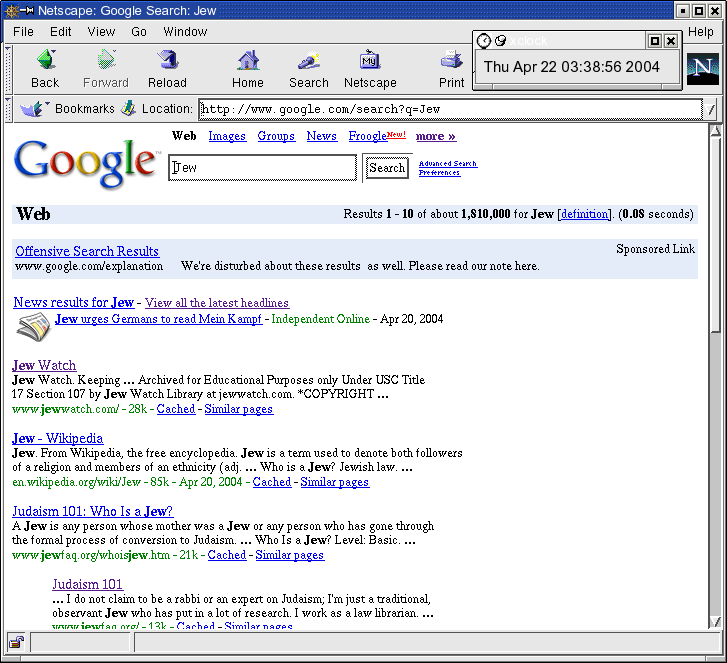
http://web.archive.org/web/20050123081919/http://www.google....
This is a hard problem. There are many search queries, there are many clusters of similar search queries that address partially overlapping (topic,audience segment) pairs. Deriving sentiment scores from these segments is difficult without any feedback mechanisms. Choosing which segments to focus on is difficult or counterintuitive and depends on the topic and audience and characteristics of the audience. Once a topic and audience segment is identified for remediation, the task of effecting change is again topic and audience specific (resistant to automation).
This is a hard problem. Neither a brute force "human review squad" approach nor an automated "deep learning" approach will provide 100% coverage through all time. Does that mean that they shouldn't try? No, of course not, and they almost certainly try every day. However, it's inevitable that they will be subject to sniping articles no matter what they do.
There are many search queries to watch, but 'black girls' was persistently problematic for a long time. Noticing when a cluster of queries gets that status might be extremely resource intensive if that status was highly ephemeral; it's not. It's work that can be done asynchronously, and run daily at most. Is this simple? Nothing involving software is, imo. But it's probably much simpler than many other machine learning-driven pieces of Google's product.
Also, there are tons of feedback mechanisms available and actively used by Google. Every user interaction with search results is available to Google; a lot of these stand in for quality of result: did the person refine their query after seeing crappy results? Did they click a link and then press 'back' really quick? All of these factors already feature in Google's algorithm.
In general, there's the "safe search" option that's on by default; but if someone has turned it off, then it's reasonable to assume that the default, most common intent of looking for "girls" actually is sexual, and if they were looking for something else (say, "black girls support group") then that would be a comparably rare situation where extra words should be added to the query.
This isnt that different from search engines for specialized databases. I used to use meta-search engines that woukd have checkboxes or selection menus to focus search on specific topics or collections. It was very useful. I still do it for technical papers using the "site:" operator to limit search to known-good sites for them.