Pretty simple, really.
And yet. While mega corps (FANG et al) horde cash, and management & bankders gets their cheddar, Joe Average investors are getting screwed, and no one's freaking out.
I mean, you should be able to answer those questions, otherwise you've put yourself into a tautilogical little bubble ("There is nothing new/just fearmongering, so I don't need to pay attention to it. I didn't pay attention to it, so I didn't hear anything new". Return to step 1)
"The Russia stuff has always seemed like fear mongering to me. It’s a big scary enemy messing with our political system."
Are you saying that countries don't really mess with other countries political systems? Because they do it all the time (including and maybe especially the US).
This basically reads like you saying that "bad/scary news isn't real, because I've decided that bad/scary news sounds like 'fear mongering' and couldn't possibly affect me". I mean, war is a thing. People and countries do hostile things to each all the time, often disastrously. Reporting on this isn't fear mongering.
It started when I noticed that the news barely covered the US bombings of hospitals and funerals overseas. There was very little coverage of the US supported war in Yemen where thousands of innocent civilians were being killed.
At some point CNN went crazy over MH370 and gave an uneventful search for the plane wall to wall coverage while US weapons killed people overseas.
I had to go to The Intercept to learn about drone killings in any real detail.
And then I remember in particular when Bernie Sanders had just had his largest rally yet, the PBS newshour failed to mention it while devoting 8 minutes to Donald Trumps twitter comments.
So when the media that hated Trump (a position I am not criticizing) started talking about allegations of Russian interference with the elections, I waited for the evidence. But after a couple of months of anonymous officials making this claim and that claim but no hard evidence in the matter, I tuned it out.
I’ve since stopped following mainstream news, so if they’ve come up with genuine evidence by now then I’m just out of the loop. It’s fair to say I’m uninformed here but I do recall that for some time at the beginning, no evidence was presented.
Lately I use my time to educate myself in other ways. I’m 10 hours in to PBS’s 18 hour documentary on the Vietnam war. I’ve never learned so much about that conflict. I’ve been watching some John Pilger documentaries on YouTube, and trying to understand why people all over the world still live in destitute poverty even in the outskirts of wealthy cities. I’m trying to understand my libertarian friends who say that broad social programs are unfair, while I see images of people with nothing dying from poisoned water or preventable disease. But I’m also trying to understand why socialism was unfair (John Pilgers documentary about Japan was enlightening there). I’m trying to find a way to care for the poor and give them more power without giving power to despotic governments that will siphon aid money into their personal accounts (as in the IMF funded nuclear power plant in the Philippines that was never finished, but poor local tax payers are still paying off). I’m also working on a week long robotics course to teach to some university students in Africa, and the associated robot I built as a teaching aid. I leave in less than a month and it’s been a busy time.
So when I see news that sounds like baseless claims about “The Russians” on channels that don’t cover the murder of children but do feast on images of a bare ocean where a missing airliner hasn’t been found, I just tune it out.
My life has improved since I stopped using Facebook and removed the normal political feeds from my reddit. I’ve been political my whole life and to this day I focus heavily on politics, but the information I want is scarcely carried on those normal news feeds.
> I’ve since stopped following mainstream news, so if they’ve come up with genuine evidence by now then I’m just out of the loop. It’s fair to say I’m uninformed here but I do recall that for some time at the beginning, no evidence was presented.
National security officials don't generally present the support behind their conclusions to the public, and even when it became a law enforcement case, the evidence is only sparingly provided before a trial. There are pretty good reasons news media does report on announced intelligence and law enforcement positions before those agencies provide detailed support; blaming the media for the underlying evidence not being immediately presented is, well, somewhat naive.
OTOH, since then, while still little evidence has been directly provided to the public (because criminal investigations are ongoing and investigators are reluctant to tip their hand), we do actually have both the confession of an attempted colluder and a pile of indictments (which are grand jury findings of evidence providing probable cause to believe particular persons committed particular crimes.)
Mueller laid out very specific evidence in publicly available indictments. It’s published on government website, you can read the whole thing for yourself.
Another indictment filed today:
https://www.politico.com/f/?id=00000161-bf68-da6b-ade9-fffc2...
The tone of your statement suggests you don't have any way to know the facts of the Russia investigation, or what to believe.
That's bullshit. Mueller is gathering the facts and hard evidence in a very methodical, professional manner, and laying them out in criminal indictments, citing the relevant facts and evidence. You don't need the "mainstream media" to be informed on this subject. There are now direct sources you can go to.
Obviously, not everything is out yet, there is more to come. But what Mueller has already produced is very enlightening.
And your "couple of months" quip rubbed me the wrong way, too. How long did you expect an investigation of this scope to take? Did you expect Mueller to publish every single fact and testimony as he received it? Questioning the people involved, without necessarily letting them know what you already know, is a good way to quickly find out who is being honest with you.
There’s lots happening in the world. The mainstream news media wants to focus on a few pet issues and I just don’t feel well informed when I listen to repeated hand wringing about the same subject. Today I’ve been spending most of my work day listening to the political debates in South Africa after their state of the union. It’s a fascinating subject and one that I feel comfortable assuming is not well covered by US news outlets.
You obviously care about the Russia investigation. Great! But you accuse me of being generally uninformed just because I don’t follow this issue. Please. I don’t care about every twist and turn of this investigation. If they can convict somebody great, but I don’t see the value in following all this when so much else is going on in the world.
I understand a certain degree of skepticism around the conclusions of national intelligence services, especially on topics directly related to government, but the fact that such services do not immediately release the information underlying their conclusions is not unusual even in cases that have the strongest support; about the only time they’ll publicly release detailed evidence is if action is being sought by some body like the UNSC, or to the extent necessary after the matter moves from intelligence to law enforcement to the courts.
The interference that Russia has done is unprecedented in the modern era. There are dozens of election every year. Please provide some evidence of that extent of interfence happening "all the time".
https://en.wikipedia.org/wiki/United_States_involvement_in_r...
Interference that Russia has done with its internet trolls is nothing compared to bombings and assassinations that US has been doing. If you look at South America you'd have to apply blacklist filter to see which countries US didn't mess with.
metawhataboutism: when hypocrisy is pointed out scream "whataboutism". It sounds like a fancy term and shuts down the other side pretty well.
There is the real possibility that if Russia didn't interfere in the Brexit referendum and the US election that alternative outcomes could've happened. Both decisions were down to single percentage points.
If Trump isn't elected then you have the possiblity of the US joining the TPP, taking a leadership role with the Paris climate change accord, no massively expensive tax cuts etc. Those are fundamental decisions that effect every single American.
Globalization has already done quite enough hollowing out and selling out our blue collar workers. We don't need the same with more vigor.
US placed sanctions on wealthy Russians through Magnitsky act, which they didn’t like, so Putin ran an intelligence operation to get someone elected more likely to overturn it. This is still about putting the interests of the wealthy first. They see each other as peers and allies regardless of nationality.
2007 LA Times: "Dishwashers, waiters and others whose jobs and dilapidated home addresses seem to make them unpromising targets for political fundraisers are pouring $1,000 and $2,000 contributions into Clinton's campaign treasury. In April, a single fundraiser in an area long known for its gritty urban poverty yielded a whopping $380,000. When Sen. John F. Kerry (D-Mass.) ran for president in 2004, he received $24,000 from Chinatown."
http://www.latimes.com/la-na-donors19oct19-story.html
https://en.wikipedia.org/wiki/1996_United_States_campaign_fi...
https://www.nationalreview.com/2017/07/chinese-illegally-don...
I really don't see how you wouldn't. "Russia" investigation I think includes not just the investigation itself but the insinuations and rumors around it. The time and money spent talking about it, writing about it and so on.
It started with the Russians hacked our elections idea. As in KGB agents in the bushes in Wisconsin with laptops twiddling bits on voting machines. Remember the Stein's recount. /r/politics was abuzz with everyone sure how it will be discovered and Trump will swap places with Hillary next Tuesday. https://patch.com/michigan/detroit/hillary-clinton-could-sti... except in the end it gave Trump 3 more votes.
Then it went to Trump colluded with Putin. And how at the G20 they were exchanging secret coded hand gestures between them: https://www.cnn.com/videos/politics/2017/07/20/trump-appears...
Then Comey's hearing. People took the day off to watch Trump's collusion being exposed. /r/politics talked about him being impeached next Tuesday again. It turns out that Trump was mean to Comey and nothing else happened.
Then it was the piss "dossier". That surely would impeach him next Tuesday after it came out. Except that it didn't.
Notice how the goal post keeps moving every time and how it's always "next Tuesday" when the impeachment is coming. This is not unlike the doomsday cults where the day comes and then you'd think, finally the followers will see it was a scam and go home. But in a counter-intuitive way many stay and become even more zealous.
In the end some Russians were indicted because they were internet trolls. Half supported Trump while others supported BLM, Muslims for America, Bernie Sanders and Hillary. Even organized an anti-Trump protest in New York. I was invited and almost attended that one. It's sure good thing to catch those and worth a few weeks of reporting, but not a whole a year of hysteria? Didn't all the media companies, the blogs and the journalists who should have known better play into the Russians plan to destabilize and demoralize the country. It looks like they did. Did they "collude" as well perhaps? Are they secret agents, maybe? (/s)
The saddest part is really the opportunity cost. Some were working on fixing the DNC, there is effort in flipping some legislative seats in Congress with good results. But a lot more could have been done had the effort not been wasted on the "Russians".
Those rates have very clearly not impeded their exceptionally high standards of living.
> "Comparisons of corporate tax rates should focus on the measures that reflect what companies actually pay, not the top statutory rate. Proponents of slashing the corporate tax rate often note the U.S. statutory tax rate is the highest among developed countries. But many U.S. companies use an array of targeted tax breaks and loopholes to significantly lower the taxes they pay. These include tax subsidies for certain types of investments (such as in research and development) and for particular industries (such as oil and gas).
The Joint Committee on Taxation estimates that in 2016, while the corporate income tax raised $300 billion in revenues, targeted subsidies delivered to companies through the corporate tax code cost about $270 billion. As a result of these subsidies and other tax avoidance measures, many large U.S. companies pay very low rates. For example, Pfizer paid a rate of about 7.5 percent on its $12 billion in worldwide pre-tax income in 2014. Studies generally also find that U.S. companies’ tax rates vary widely by industry and type of investment."
https://www.cbpp.org/research/federal-tax/actual-us-corporat...
The former effective US corporate income tax rate, for all corporations, was higher than Finland, Sweden, Norway and Denmark's statutory rate.
The effective rate for the S&P 500 was higher than the statutory rate for Finland, Sweden, and comparable to Denmark. And that's for the elite of the elite of tax avoiding companies. eg:
"The average effective tax rate among S&P companies that had posted calendar fourth-quarter results as of Friday was 24.11 percent"
https://www.cnbc.com/2017/02/13/tax-cuts-sp-500-may-not-get-...
"The United States’ corporate tax ranks relatively high on all three measures [among the G20]. The U.S. has the highest statutory rate (39.1 percent), the third highest average effective tax rate (29 percent), and the fourth highest marginal effective tax rate (18.6 percent)."
https://taxfoundation.org/cbo-report-compares-us-corporate-t...
You can't use taxes paid as a percentage of revenue because it's meaningless. A retailer with a 3% profit margin would have a ~1% effective tax rate because 97% of their revenue goes to tax-deductible expenses.
But if you use taxes paid as a percentage of profit then you're not counting any of the tax avoidance, because the way international tax avoidance works is to shift profits to sister companies in other countries instead of the one with a high nominal tax rate.
FANG pays ~10% on income.
Our official capital gains is 20%; I have no idea what the effective rate is.
But I still regret attributing low wages solely to shifting tax burden. Labor glut is probably the biggest factor.
Though I do think automation will be biggest factor in the near future.
Healthcare is obviously dramatically expensive in the US, with per capita costs about twice that of the next highest spending nations. For most employed Americans, that ends up becoming a $5,000 to $10,000 'perk' in their compensation (which isn't counted in wage figures). If you make $50,000 at a full-time job (the median figure for full-time), you're liking getting a health insurance plan that is worth upwards of 10% of your salary.
Buffett likened healthcare costs to a monster that is eating the US economy. It's spot on. There's a trillion dollars per year there in excess costs, that if even half went into labor competition, would do wonders for giving wages a jolt at the median.
https://i.imgur.com/rNa2smF.gif

Which can be lined up with this chart, showing the extreme cost inflation in healthcare:
https://kaiserfamilyfoundation.files.wordpress.com/2015/08/8...

Not if Joe Average invested on FANG stock.
Argh.
Suppose you have a company with a business worth a billion dollars. The company makes $200 million in profits, so now they have a business worth a billion dollars and $200 million in cash, so now the total of the company's shares are worth $1.2 billion.
Suppose they have a million shares. When they make the money the price per share goes from $1000 to $1200. If they pay the dividend the share price goes back to $1000, but each shareholder now has a $1000 share and $200 in cash, so they still have $1200 in value.
If, instead of paying a dividend, they pay $200 million to buy back a sixth of their shares and each shareholder tenders a sixth of their shares in the buyback, then at the end of it for each original share the shareholders now have... wait for it... $1000 in shares and $200 in cash. Or, in particular, for every six shares they had they now have $6000 in shares (5 x $1200) and $1200 in cash. Which is basically the same thing.
But then the taxes are due on the ~17% profit from share price appreciation instead of on 100% of the dividend. And the shareholders who would have reinvested the dividend back in the company simply don't tender any shares and don't realize any taxable gains at all.
And then if the price per share gets too high they can have a stock split.
Of course, you also get almost the same effect by leaving the cash inside the company and letting shareholders who want immediate returns sell that percentage of their shares on the market, and if the cash is inside the company then it can be inside a foreign subsidiary in a jurisdiction with lower corporate income tax rates. Which is how the tax code encourages multinational corporations to hoard huge piles of cash.
People who are investing with a long-term view in mind might prefer stock buybacks because it defers the taxable event until sale. I prefer stock buybacks when I'm planning to hold my shares. With a dividend, I have to pay taxes on the dividend before I can reinvest that cash by buying more shares; with stock buybacks, the share price just increases by that amount over time instead.
I haven't actually looked at whether this is true though.
Healthcare is the new company car.
Total compensation (including non-wage benefits): http://research.stlouisfed.org/fred2/series/RCPHBS
Cost index (attempts to control for composition changes): http://research.stlouisfed.org/fred2/series/ECICOM
https://www.bloomberg.com/news/articles/2017-09-19/rising-he...
Though given the extraordinary profitability of companies right now, surely not the only factor. Some of those profits could be redistributed to workers. Not sure how to do that without potentially causing damage though.
Because it does that inherently when it decides what form of business organization to allow in the first place. Corporations are creatures of government, not nature, by creating them and setting standards for what the rules are for governing them it is favoring a particular type of company. But taxing them and then creating a variety of more-or-less tax exempt categories with different behavioral restrictions it is favoring one type of company over others.
Even if it chose not to charter corporations (or similar, newer types like LLCs) and only to allow sole proprietorships and partnerships, that would be favoring one type of company over others.
The question is not whether the government should favor certain forms of business organizations -- there is no way that it can avoid that. The question is what forms it should favor and how.
https://www.researchgate.net/publication/30522170_The_Impact...
As "minimum wages across state borders using contiguous counties" (Dube, Lester, Reich) demonstrates (confirmed by Seattle's recent experience), it doesn't cut employment:
https://escholarship.org/uc/item/86w5m90m
In spite of this, an association of restaurant owners in California spent a lot of their own money on these billboards to express touching concern for the employment prospects of their employees:
http://kron4.com/2014/07/18/new-sf-billboard-says-workers-wi...
It's now 4 years later and sadly, their predictions were startlingly accurate. Nearly every restaurant server in San Francisco and Seattle is now an app.
And Amazon announced they were locating a second headquarters elsewhere. You could argue that has nothing to do with minimum wage, and probably not since Amazon doesn't have their minimum wage operations in Seattle. But Seattle has done things like passing an unconstitutional income tax targeted at Amazon (now winding its way through the courts) that likely factor in to such decisions. Along with other heavy tax increases, like sales taxes, property taxes, and a proposed "head tax" that appears to be targeted at Amazon.
Personally, I don't go out to eat in Seattle anymore. Too expensive.
April 1, 2015 - 135,100 employed
December 2017 - 149,600 employed https://fred.stlouisfed.org/series/SMU53426607072200001SA
Nothing is ever static in economics, it's very hard to do A-B experiments.
I could say an absolute statement that throwing more wood on the fire would make it hotter. If it also happens to drop into the lake, that doesn't prove me wrong. In any such statements, there's an implicit assumption that other effects stay the same, that I am not dropping the fire in the lake.
Seattle has undergone enormous change in the last 5 years due to Amazon. Ignoring that in any cause/effect analysis of the overall city invalidates the analysis.
What happened was exactly in line with the papers I cited predicted. 1. Large profit hit, 2. small price hike, 3. no effect on employment (employment actually went up, possibly for other reasons).
The reason you believe what you believe is because you swallowed a lot of kool aid. The people concerned about 1 happening want us to think will 3 happen. In Seattle it didn't. In well run studies it didn't.
In propaganda and poorly run economic studies it does.
The minimum wage hike to $15 was only in Seattle.
> In Seattle it didn't.
The cite did not break out Seattle data from the region.
> In propaganda
It's propaganda to cite statistics for a region when only one part of the region is being discussed.
Yeah, not that one. The one I cited by the UK low pay commission where it found a minimum wage hike was accompanied by a 11% drop in profits and a slight increase in prices (and even then only in the food service industry).
I doubt that anybody has studied the profit drop in Seattle. As an economist, it pays not to look too closely at certain topics and that is definitely one of those topics. It would not help your employability to study that topic at all.
Your employability goes up, however, if your research helps to find results that restaurant associations or "walmarts" with a bit of cash to splash around might find useful.
David Neumark and William Wascher are keenly aware of this, which is probably why they took Card and Krueger's landmark study and twisted it until it showed employment going down after a minimum wage hike.
This sentiment has always bothered me. It assume that whatever "profit" exists, must continue to exist, nay increase, and that it is a zero-sum game. One could argue that paying your workers more make them eligible to purchase your products ala Henry Ford and the Model T.
Henry Ford raised wages because his staff turnover was killing productivity and because he fell out with his shareholders and decided to spite them. The man wasn't an angel. He was an anti Semite and a Nazi sympathiser ffs.
Edit: also interesting point Mark Andreesen made: we don't have too much automation, we have too little at least in some sectors. If things keep going as they are now, a TV will cost $10 and health insurance and college $1,000,000.
Here's some random critical analysis on the topic: https://randomcriticalanalysis.wordpress.com/2016/09/25/high...
I think a more likely factor is that automation has reduced the number of jobs relative to the size of the labor pool. In that situation more workers chasing fewer jobs will tend to drive wages down. (Again, elementary economics.)
Another factor may be that large employers that dominate a labor market can exert downward pressure on wages that workers are not able to resist if there are not other jobs available. (Not IMO elementary economics.)
Maybe you should give the guy you paid to paint your garage a voice in your management of your home.
In continental Europe, nobody expects it to work like that. It's a different mindset. If you work in a large firm, the works council has a say (to some degree) in management decisions. It's not always perfect – politics are everywhere – but it is completely normal and expected by bosses and workers alike that employment is a relationship, not a transaction. And for the most part, it seems to be working.
To someone who grew up in that culture, your wild-west thinking seems a bit, well, primitive? Or uncivilized?
One should challenge that setup by asking the question: has contintental Europe's policies resulted in high wages?
France has far lower wages than the US, with 1/4 to 1/5 the wage growth rate of the US over the last two decades. Germany, Britain, Spain, Portugal, Greece, Italy, Austria, Belgium, all have considerably lower wages than the US.
Continental Europe also includes dozens of nations that are dramatically poorer than the US, both in terms of median income and median household net worth.
Wouldn't it be more primitive or uncivilized to be using the French approach, since it has resulted in dramatically lower wage growth for decades now? Wage growth in France averaged 0.5% annually the prior two decades. In the US, 2.5% wage growth is considered very slow, with 3.5% to 4% being average in the 1999-2009 time frame. If their system works so well, where's the wage growth (and we're talking about the last 20 years, not a blip of time)?
So is the average citizen is probably better off in Europe than in the US.
Data: https://www.citylab.com/life/2017/04/euro-vs-american-middle...
Also, Europe is catching up on the US average income too, which is really more relevant than what the past or current average is. It means that recent US policy is not working in favour of the average citizen.
Western Europe isn't seeing faster wage growth than the US. Economically the US is pulling away from Germany, Britain, Italy and France. US income and GDP growth rates have been far higher the last 10 and 20 years than most of its peers.
Economically speaking, Germany's GDP hasn't net expanded since 2007, when it was $3.44 trillion (it was $3.46 trillion for 2016). France and Britain are similar. French GDP was $2.66 trillion in 2007, it was $2.46 trillion in 2016.
In that time, 2007 to 2016, the US added GDP larger than the entire German economy (about $4.5 trillion).
It's practically impossible to generate broad wage gains if you don't grow the whole economic pie. That's why French wages have been so stagnant for so long, despite all the supposedly labor friendly approaches there.
The US middle class has contracted because more people have moved up and out of the middle class and into the upper classes, than have moved down and out (that's true over 10, 20, 30 years of time):
https://www.washingtonpost.com/opinions/is-the-middle-class-...
https://www.forbes.com/sites/timworstall/2016/06/21/sure-the...
The formerly extremely poor 1/2 of Europe in the East has seen dramatic improvement since the end of the USSR. You can see that dramatic improvement in several countries like Czech, Slovakia, Romania (more recently), etc. Many are still doing very poorly at growing their economies, including Bulgaria, Moldova, Hungary, Belarus, Macedonia, Albania, Ukraine, Croatia, Bosnia.
The median incomes of Latvia and Lithuania are still around 1/4 that of the US, Estonia is closer to 1/3 that of the US.
The study cited directly in the Washington Post opinion piece (and indirectly, by way of a WSJ opinion piece, in the Forbes piece -- good effort there passing off the same underlying study as if it were two independent sources) excludes adult children living with parents from the analysis, which makes it completely broken, since that's a living pattern that is known to be more common among adults with lower income relative to the cost of living, and which has been observed to increase over the time period the study addresses. [0]
So, yeah, if you ignore a growing share of young adults that are unable to afford to live independently, the share of the remaining population that is in higher economic strata by income is greater.
Clever spin, but not really a good representation of the reality.
[0] See, e.g., http://www.fanniemae.com/resources/file/research/housingsurv...
That study also makes adjustments for household size. Further, average household sizes are smaller today than they were in 1980, by about 10%. That trend has been persistent, with household sizes shrinking considerably since the 1950s/1960s.
The upper middle class expanding from 12.9% of households to 29.4% of households, cannot be explained by your premise.
The change in adult children living with their parents between 1994 and 2016, is a mere 4%. From 27.5% to about 31.5%. And most likely that figure is set to decline a bit from here given the very low unemployment rate.
That 4% change, for example, could explain some of the drop in the poor and near poor, from 24.3% of households to 19.8%; and the lower middle class falling from 23.9% to 17.1% of households. However it very obviously fails to explain the change on those two combined. And it entirely fails to explain the epic increase in the upper middle class.
No, barring a grant to do so, I'm not going to dig into the paper’s source data and rerun the analysis without the methodological errors, of which the treatment of the demographic noted is just the most glaring, should be obvious to even a layman at the time who had been basically attentive to the news, much less anyone seriously trying to do honest analysis. Among the other methodological errors (and this is not intended to be an exhaustive list):
(1) The paper commendably recognized that current money income is a different thing than class, which “knits together multiple factors such as income, wealth, education, prestige, and cultural sophistication”, and then proceeded to use money income alone to measure class mobility on the assertion that it “current income is closely related to all the factors associated with social class and because data on current income are readily available.” While prestige and cultural sophistication are clearly hard to get annual statistics for, education and wealth distribution are not; there is no excuse for not including these of the intent to is assess a feature which includes them.
(2) Related to #1, Rose does not justify his thresholds as meaningful class thresholds,
(3) Also related to the use of money income as a proxy for class, Rose justifies using fixed real income thresholds (which mean that changes in the median inflation-adjusted income with even with no distribution change within the non-excluded population will result in upward “class” mobility, which, even to the extent that money income correlates to class, doesn't seem to correlate with how it usually correlated with that concept) with the only justification being that that's how the federal poverty line works (which is true, but it's worth noting that this is both a controversial thing about the federal poverty line, and dubious in relation to class generally even if it is appropriate to the purpose of the FPL; there's probably a good reason to think that what is right for the FPL corresponds in some ratio to the boundary for the lower class, but that with successively higher classes income mapping to the class is not simply a constant multiple of the poverty line.)
(4) No justification is given for the method of calculating “family of three equivalents” (using the square root of the ratio of the actual household size to 3 as an income divisor to get the “family of 3” equivalent income.) Note that if one views the FPL as having a reasonably constant relationship to class boundaries as Rose suggests in his justification of the use of constant real-income thresholds, this method of size adjustment is tolerably close for families under 3 (though off in different directions for size 1 vs. size 2) but artificially pushes families over three upward in “class” because it understates the additional income needed to stay at the same level with more family members.
http://www.multpl.com/us-median-real-income-growth
https://www.nytimes.com/2014/04/23/upshot/the-american-middl...
https://i.imgur.com/55Y0vZQ.png

Are you suggesting you think that kind of housing valuation in relation to the size of the economy, is sustainable? The gap between US housing vs Canadian housing vs economic size, is not subtle, it's extreme. The same kind of housing debt vs economic size representation, is why Sweden's median net wealth level is lower than the US median. Having housing be such an extreme share of the economy, usually has predictable consequences (which the US previously took a hit for).
You'll also need to adjust that 2014 middle class story, for the fact that Canada hit an economic skid shortly thereafter when oil imploded, and the dollar went up a lot (as have most US assets). That occurred almost immediately after that story. The dollar going up a lot by itself is enough to have dramatically altered the wealth balance in question. The Canadian Dollar was around 0.95 to 1 at that time, it's now at 0.78.
I think this is a super interesting phenomenon, and I honestly don't understand how the migration from middle to upper class works in practice, particularly in the face of technological un(der)employment. (And nobody has been able to explain it to me.)
However, the exact same is happening in the EU as well (graph: http://slatestarcodex.com/blog_images/techun_polarization.pn...) so it's not like it's some libertarian US-only miracle (or that labour-friendly rules would prevent it from happening for that matter).
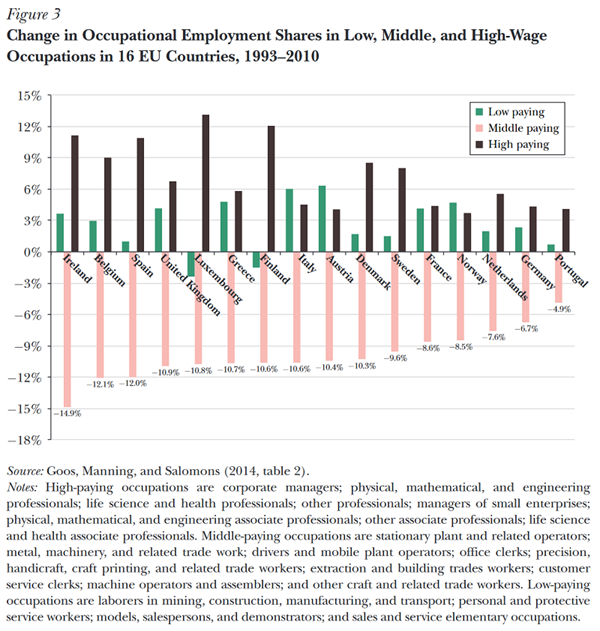
I've responded to the GP about how the US study cited is misleading, but the graph here seems to be worse, as it seems to simply misrepresent the data in the cited source, "Goos, Manning, Salomons (2014; Table 2)". Looking in the paper that it appears to be referencing [0], Table 2 shows -- instead of the across the board decreases in share of jobs in the low wage sector with increases in the middle and high wage sectors shown on the graph -- increases in most countries in both the low (Finland and Luxembourg being exceptions) and high (all countries) sectors, and decreases in the middle wage sector (again, all countries.) The first sentence of the conclusion of the paper states: "The employment structure in Western Europe has been polarizing with rising employment shares for high-paid professionals and managers as well as low-paid personal service workers and falling employment shares of manufacturing and routine office workers."
[0] http://personal.lse.ac.uk/manning/work/ExplainingJobPolariza...
Nice dismissal with the logical fallacy of appeal to emotion!
If I want my house painted (or a similar task), I go to a good professional. He asks me what I want. I usually give broad instructions like “I want it to look good” or “I want a good quality to price ratio” or something like that. Then I ask what he suggests and/or what he would do if he were in my shoes.
I usually get a pretty damn good answer. At “worst”, I am presented with some trade offs, and I pick my poison.
If I don’t trust the painter (or other specialist), then I probably have not done enough due diligence.
>Maybe you should give the guy you paid to paint your garage a voice in your management of your home.
Probably not. Managing my home far exceeds the responsibility to paint my garage. However it would be wise for me to give that guy a voice in how best to paint the garage. He is, after all, a professional and knows more about painting garages than me.
Yes. The parents can choose to listen to the au pair's opinions, or not, but the decisions are made by the parents.
Your distinctions between an investment and a business, a contractor and an employee, are arbitrary legal definitions. They aren't economic ones.
I would argue that not only are these definitions not arbitrary but they meaningfully reflect the differences in the relationship across legal, ethical and economic spheres based on the length and type of the business relationship. For instance there are very meaningful legal, economic and ethical differences in responsibilities for the seller and the buyer when leasing a house (long term) vs booking of a hotel room (short term).
If you agree to provide X labor for Y $, and later say you are "ethically" entitled to Y*2, how is that ethical? Ethically, you should stick to what you agreed upon.
I consider my education an investment, by your logic that makes it a business.
Economically speaking, making an investment and expecting a return on that investment, makes it a de facto business. This is even recognized by the courts, as they've decided that a partner who supports the other going through college, is entitled to a share of the others' earnings afterwards.
The laws in those countries are more similar to a time in the US where income was much more evenly distributed than today’s US laws. For those of us interested in improving the wage distribution for those in the bottom half, this is worth discussing. If you don’t think there is a problem, no need to comment.
Absolutely, they do. That does not imply the laws are not arbitrary.
> If you don’t think there is a problem
The US remains a country where poor people want to immigrate to in enormous numbers. Maybe they see something you don't.
Also, the share of GDP spent by the government has gone up, up, up along with increasing inequality. Maybe you should look at that? Somebody is paying for that. I suspect it is a cause of increasing inequality. The spending is so enormous that to ignore it when discussing other economic trends seems unrealistic.
How can work councils help that.
Nothing will change until the Beveridge condition is restored - more jobs than people that want them.
How few times has the lowest tax rate been cut?
In the past twelve months, the unemployment rate has fallen, from 4.8% to 4.1%. Meanwhile, the laborforce participation rate has also fallen, from 62.9% to 62.7%. This is not easily explained by traditional labor economics. It seems like there is a broken link somewhere in the chain.
Why haven't we seen wages rise with the falling unemployment rate? Why aren't discouraged workers moving back into a labor market with 4.1% unemployment?
data source: https://www.bls.gov/news.release/empsit.a.htm
Wages aren't going up because there is nothing forcing them to go up. The upper class just takes their rents and insists paying more wages would tank the economy.
Participation is going down because there's little reason to seek employment if you know the employer is just attempting to shaft you. You produce $40/hr, but they'll pay you $8/hr. You can't negotiate, they'll just find someone who is desperate.
I believe HN misses this issue sometimes because on average tech workers are pretty young. However, anecdotally, in my last office (in the same organization) we had a team of 10. 5 of my coworkers there were over 60 years old... Those people are going to retire soon and hopefully live good long lives outside of the labor pool.
When you include these tax categories you will also note that there was a shift to these regressive taxes at the same time the highest income tax rates were cut. And to further reinforce this feedback loop there was also a move to reclassify income to long term capital gains profit which is taxed even lower than the highest income tax.
All of these policy shifts combined to create greater wealth inequality, and wage stagnation.
California, New Jersey, Florida, and Missouri have all recently reduced sales taxes. Tobacco and gasoline taxes have generally increased, however.
https://www.economist.com/news/finance-and-economics/2171710...
France and Germany have works council that gives labor a voice in business decisions (a seat on the board). Maybe the solution is as easy as giving workers a voice.