Because there is a huge and complex domain of human motivation, appreciation for hard-earned things vs. taking them for granted and so on. USSR tried doing exactly that with the planned economy and trying to distribute the wealth more or less evenly and failed miserably. Mostly because people lost motivation for achievement and started blatantly faking numbers and statistics since the connection between the results of their work and their life quality was completely lost. As someone who survived that crash, I would really hope that SV can learn from others' mistakes rather than repeating them.
Actually if you look at where they started and where they got, they did a pretty good job in raising the very poorest our of poverty, electrifying the country, and really eliminating a lot of the abject poverty that was most of the country at the time of the revolution. Changes that the former (imperial) regime seemed uninterested in making.
Even into the 1950s and even 1960s quite a lot of people, including a surprisingly large amount of US government officials, thought that there was a chance the USSR could surpass the USA. I think such people were delusional, since the signs were pretty clear at the time (I was a child at that time, but I did study the USSR in the 1980s when it was very obviously not a threat to the west).
Don't get me wrong: the USSR was founded by a bunch of bloodthirsty assholes (Lenin, Stalin, Trotsky et al) and, for various reasons developed into a, yes, evil system. I don't blame it entirely on the people involved -- I think anyone who tries to follow that model, even with good intensions (and it's not clear the Bolsheviks had good intentions) is going to end up with a shitty result.
But dispassionately one thing they did accomplish was the thing you said they failed miserably at. And it's unlikely the Menshevik republicans would have pulled that off.
That's the funny part about it. USSR was basically an engineered society with eliminated "overhead" of debating, negotiating, marketing, private risk-taking, etc. It worked extremely well while the goals to achieve were basic and everyone agreed on them. If you're living in a glorified mud hut in the 20th century, it's a no-brainer that the goal #1 is to build industry, powerlines, etc.
Except once the common needs were satisfied, the system ran into stagnation. How this would be resolved in the West is a risk-taking individual starting a company, organically growing it into a bigger business, eventually creating workplaces, and in some cases - entire industries. Planned economy can't have that - the only way to create something new would be through getting state funding, i.e. being in good terms with the inner party circle. It's the same reason why big corporations often can't quickly adapt to changes lose to lean startups despite unimaginable resources available to them. Except when your entire country is one inefficient corporation, you're really fucked.
IMO, Russia is still greatly suffering from the lack of the "overhead" removed by the USSR. The majority of people expect someone else to plan and decide for them, they don't get the concept of watching for your own interests, they alienate and despise hustling and blame others for their misfortune. I really hope that's not the way U.S. is heading, because I'm not sure there is an easy way out of this kind of a trap.
You are vastly understating the magnitude of the USSR's problems.
https://en.m.wikipedia.org/wiki/Russian_famine_of_1921–22 https://en.m.wikipedia.org/wiki/Soviet_famine_of_1932–33 https://en.m.wikipedia.org/wiki/Holodomor https://en.m.wikipedia.org/wiki/Soviet_famine_of_1946–47
Another large portion were peasants, but they reported to a master.
And the Tsar himself was bogged down in decision making about minutiae to the degree that he had little time for strategic thinking.
Of course, starting from 1917, it was not that hard to achieve progress, because the starting point was so low. NEP (the New Economic Policy of 1920's) was very efficient - but it was unorthodox in Stalin's theories, so a lot of people ended up dead or in the camps.
It puzzles me why socialists all over the world last year celebrated the October revolution (start of a new tyranny) but not the February revolution (end of old tyranny). I suppose it is because of romantic sentiments, and not knowing what actually happened.
GNP:
    Country 	1890 	1900 	1913 	1925 	1938
    Russia/USSR 21 180 	32 000 	52 420 	32 600 	75 964
    Germany 	26 454 	35 800 	49 760 	45 002 	77 178
    Britain 	29 441 	36 273 	44 074 	43 700 	56 103
    France 	19 758 	23 500 	27 401 	36 262 	39 284
They were holding their own late into WWI and actually had an agreement to obtain Istanbul, which the Bolsheviks revoked (hard to fault them) along with all that they gave up in the separate treaty with the Germans. Imagine them sticking it out to 1918 with gains from being on the allies and the revolution averted. They would have been as well positioned as anyone in Europe.
What? How is having all your industrial infrastructure destroyed and 20 million of young, able-bodied males killed an advantage?
What does it matter, if 90% of the population lived in near complete destitution?
The economy crashed after the revolution
I can’t find any evidence that there was any economic significance to that war aside from loss of the fleet and human life. Bruised imperial egos for sure and likely contributing to an image of a week government, but I’m hard pressed to see how it could have had any impact on the industrial output of the country.
Well-known events like the Potemkin mutiny may be dismissed as not impacting industrial output, but there was a large-scale general strike which actually lead to "1905 revolution" [0]. The loss to Japan was of course only a partial factor, with bigger contributor being the overall economic downturn of early 1900's.
There were some direct impacts from this revolution. There was large-scale unrest in Kingdom of Poland (the Russian-held part of partitioned Poland). Finland (then a Grand Duchy in the Russian empire) abolished Diet of Finland in favour of a new Parliament of Finland, with universal suffrage for both men and women. And in mainland Russia, the absolute monarchy was abolished in favour of a parliamentary monarchy.
However, this was too late for the Russian empire to recover.
Depends on in what column you put the ~10% of the population they murdered.
I would think of them as "not raised out of poverty".
http://southpark.cc.com/clips/154073/blankets-covered-in-sar...
This was centuries before the germ theory of disease became mainstream in the late 1800s, and no one on either side had a clear understanding of what was going on.
Divine intervention was probably the most common theory.
The 90% dieouts happened several centuries ago. That's plenty of time to repopulate.
I can only derive from them that someone thinks that what I wrote is wrong. Maybe I am missing something and I just do not know.
Also of course some people use it correctly, which confounds the data.
they did a pretty good job in raising the very poorest our of poverty
https://en.wikipedia.org/wiki/Droughts_and_famines_in_Russia...
there's a big difference between a welfare state and full out socialism; the difference is largely about power... Socialisim is about giving the workers control over the means of production. The welfare state is merely about seeing to it that people don't starve.
We're rich enough, in America, at least, that with tax increases, we could provide the minimum for everyone, and pay for it out of the sorts of taxes we pay now (only, of couse, somewhat more)
There was a lot of effort in that direction here and in the UK in the '70s; there was a lot of criticism that the public housing, for instance, wasn't very nice, but what really ended it was the rise of the political movement that backed Thatcher (in the UK) and Reagan (in the US)
One argument against such programs is that they could allow people to have a lifestyle where they choose to never work, yet live a comfortable life and have lots of children. It seems like this could cause extreme population growth, but in a very bad way. Am I missing something, or is there a solution to address that problem?
2) If the market honestly has nothing for someone to do (or it’s of such low value that it falls below minimum wage), is it really a tragedy if they don’t work?
In extremely poor societies, where there are no pensions or social security for the old, the best way to make sure you have food and shelter when you're too old to work is to have many children.
But of course, in societies where you (can choose to have) everything (basic) provided for you, there are indeed some who have many kids but don't bother to actually raise them. This is how underclass is created.
Somewhere within that gap is a decent system where poor people don't starve but are still incentivized to improve their situation.
I also don't really see how having children relates to any of this.
On the other hand, automation will probably force us into a welfare state one way or another.
So, I'm talking largely about rich nations like the USA. Here? it has been a long time since the population was restricted by food, so we can neatly sidestep that problem without resorting to Swift.
I do think it's important to design welfare programs to aid people who are leaving poverty. I personally don't think this should be done by cutting off the support if they don't work... But I do think programs like the Earned Income Tax Credit which help smooth the transition from being dependent on welfare to supporting yourself are super important...
(And I think the Earned Income Tax Credit is generally considered a good model of this; the idea is that instead of cutting out benefits as soon as a person gets a job, the government continues to supplement the income until they are doing well.
a basic income that everyone gets addresses a similar problem, and a basic income + a strongly progressive income tax could probably do something similar.
[1] https://www.ers.usda.gov/webdocs/publications/84973/err-237....
The corollary to "if X has what they need to live they won't work" is "the only reason X works is to not die".
While on a high level it can feel that way, especially at the lower rungs of society (where people get the worst kind of jobs). But ultimately humans have a lot of motivations for doing things.
Unfortunately many people cannot act on these motivations because they are too busy trying not to starve/get evicted/die from illness. A world where no one has to worry about these is something we could all work towards.
Of course the earth only has finite resources, but with our level of technology it is entirely feasible to sustain billions more people. The growth and progress of humanity is dependent on ever increasing available intellect to solve the worlds problems. If we ever want build massive civilizations spanning the solar system, it’s going to take trillions of humans. I’d rather believe in that kind of future than a stagnant “garden of eden” earth where we self limit our own progress.
Why do you think that would happen? Is there any basis for having that concern?
The argument is that if we give people a basic sustainable way to live and the least motivated to improve their condition will likely fall back to the basics.
Either way, socialism is about control of the means of production, and my point is that you can have a welfare state without changing the control of the means of production, as long as you have a means of significant taxation, which we have in place in the US already.
https://www.libertarianism.org/publications/essays/excursion...
That's a ridiculous statement, of course, but it demonstrates that the economic notion of value can diverge wildly from most other reasonable notions of value. The seemingly inoffensive "economic value = value" approximation is actually a trojan horse used by libertarians to sneak the more objectionable aspects of their theories past casual observers and put a tautological halo over markets and their preferences.
It's a point worth keeping in mind when considering complaints that X system doesn't optimize economic value.
The price mechanism means that people have to make trade offs, and for anyone living outside of poverty, that's often a good thing.
To use a simple example, if you're a gamer you may want both a PS4 and an Xbox One, but if you only have the money to buy one, you have to choose which one you'd rather have. If you remove the price mechanism you've absolved the individual from making that choice, and you'll get greater demands for material goods as a result.
Resources should be allocated where they are needed the most. The price mechanism doesn't do that. If you don't have any money, a system based on the price mechanism doesn't know you exist no matter how great your need.
Okay, but putting aside shared ownership and artificially limiting choice, how do you set limits on consumption?
Let's use a different example. Someone owns a car that they maintain themselves. Their car breaks down, but instead of requesting a new part to fix it they request a new car. How does the government choose which is the appropriate action to take? Before you answer, consider that this is just one decision out of millions that a government would have to make within the space of a month.
If a lot of people think new cars are important, then a computer can allocate a lot of resources into making new cars. This would of course mean we'd have less resources for everything else and peoples needs start changing as a result. If you can easily get a new car but notice that the quality of healthcare is decreasing, the next time the system asks your opinion on resource allocation you vote for more healthcare.
So in your example I guess there would be a democratically decided amount of resources dedicated to making new cars. If that amount is high, the computer would probably give him a new car as soon as one was available. If it's low, society would be fixing and sharing cars and using the freed resources on more important things.
We'd need to test what works best. I don't have the details of such a system because it doesn't exist. All I'm trying to say is that we could come up with other ways to allocate resources than the price mechanism with our current level of technology. What I just came up with is just one way you might go about doing it, I'm sure we could figure out a working system. Of course such a system would have it's own faults, but I believe we could come up with something better than the current system, where the "needs" of a billionaire are more important than the needs of a million people in poverty.
The thing is, I used to think along similar limes to you. When I was in my 20s I saw the Zeitgeist films and found the ideas behind the resource-based economy to be compelling. A way to meet everyone's needs without relying on money. However, as time went on and I thought more about what living in such a society would be like, I saw that it wasn't the answer I was looking for.
To give you some idea of what changed my mind, I'd suggest we look at variety. As the phrase goes, variety is the spice of life. Centrally planned economies, whether resource-based or otherwise, would see variety as inefficient and attempt to cut down on variety. You gave an example of it earlier when I asked about the PS4 and Xbox One. Whilst it's true we don't "need" variety, it is something we collectively want.
For all its flaws, money gives people the chance to make choices based on what's best for them, with far fewer restrictions on what's possible. These days, I'd much rather see something along the lines of universal basic income than a resource-based economy, though I recognise UBI has its flaws too.
Sometimes too much choice can even be a bad thing. https://www.theguardian.com/lifeandstyle/2015/oct/21/choice-...
I believe people would quickly get used to less variety. But if variety isn't just a product of a system based on competition and people really desire it, there are no rules against it in a planned economy based on direct democracy. People could suggest and vote for different types of the same thing if they feel there's a need for such a thing.
money gives people the chance to make choices based on what's best for them, with far fewer restrictions on what's possible.
Most people have quite large restrictions on what they can choose due to the amount of money they have. Sure if you're wealthy enough you probably have more choice in the current system, but for the majority of people I believe a planned economy would increase the amount options they have in their lives.
Capitalism frequently also results in economic waste and artificial shortages, it's not like communism has the monopoly on that.
But this is the case for lots of people with a fixed salary.
Define "we". World-wide, "we" are doing an absolutely amazing job of eliminating poverty.
https://ourworldindata.org/wp-content/uploads/2013/05/World-...
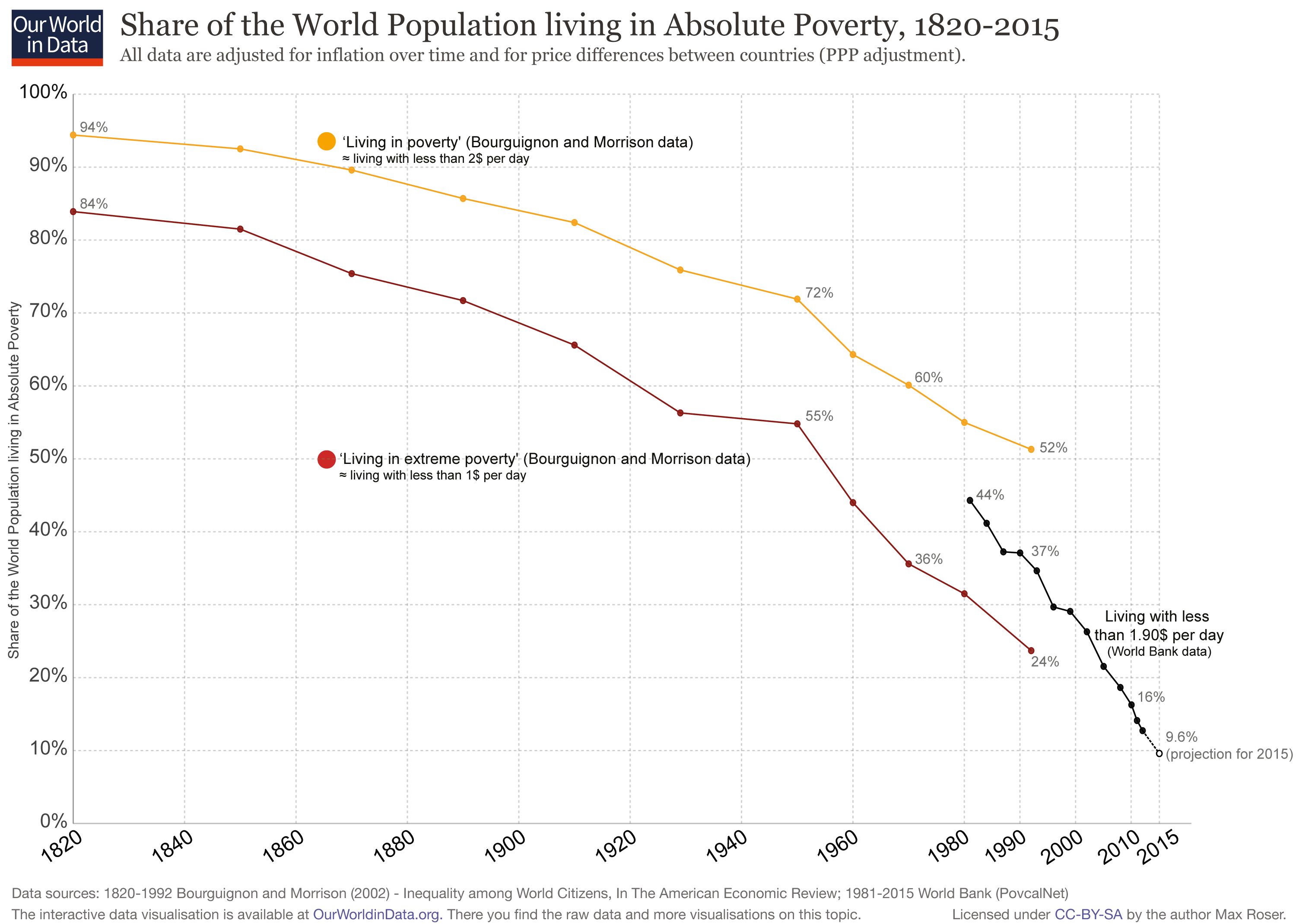
https://ourworldindata.org/extreme-poverty
Also, most industrialized economies don't really have absolute poverty: anyone who is poor has the right to social benefits to alleviate it, to provide the basics of food, clothing and housing (as well as other basics such as education).
So for example, in Germany, we talk about poverty being on the increase. But that is relative poverty, meaning a certain percentage of the average. So we can "increase" poverty by simply improving GDP w/o raising the bottom as much as the increase in GDP.
There’s already an enormous number of fees. Check out midway through [1] where it lists out the various fees JP Morgan got in their 2014 EBT management contract with New York State (it was the first example I came across, there may be a newer contract publicly available).
The federal portion alone (there’s a state-level component as well) of the cost to administer EBT services in 2017 were $4.2 billion [2], so there’s plenty of fees between recipients and food stamp money already.
That said, iirc it’s illegal for a third party to insert a fee related to EBT services. In fact, most of the fees that are charged aren’t directly visible to the recipient, but are rather charged on the backend as part of the administration costs.
Looking at the screenshots for the FreshEBT app, there’s a coupon section and the ability to find stores that accept SNAP benefits. It’s more likely that they’ll monetize via retailers and manufacturer promotions rather than via recipients themselves. Plus the marketing analytics components of being able to track EBT spending habits and tie it into all the other type of data you can collect by having an app installed on people’s phones. Not that there isn’t potential qualms about that monetization strategy, but that type of data is already available to the largest retailers and isn’t a new level of monitoring. And it shows the company’s incentive isn’t actively detrimental or predatory to the users like inserting fees, as you suggested.
[1] http://prospect.org/article/how-big-banks-are-cashing-food-s...
[2] https://fns-prod.azureedge.net/sites/default/files/pd/SNAPsu...
We have the wealth on earth, yes, but fundamentally people are selfish. I think this behavior is largely driven by fear of losing everything, even for those most privileged.
I think it's a little more complex than that. Something that still doesn't seem to be well understood in the non-profit field is that of dependency.
The idea "give a man a fish and you feed him for a day; teach a man to fish and you feed him for a lifetime" should be the guiding principal of pretty much all non-profits (with the only exception, in my opinion, being for disaster relief). The idea being that the end goal is self-sufficiency.
I'm not a millionaire, nor am I likely to become one in my lifetime, but I recognise my own patterns of donating to charity, and I can see the charity/non-profits that I'm most likely to donate to are either involved with disaster relief, or are doing something that makes a lasting change. When I've donated to charities outside these groups, I've resented the expected "thank you for your donation, can you donate any more please". At that point, the charity has become, in a small way, dependent on my generosity, with no end in sight. I'd imagine there's similar resentment for millionaires and billionaires also.
But I toatally agree that for-profit companies have incentives that can become problematic when their customer base doesn't have anywhere else to turn.
You need to read the article more carefully, it says "But FreshEBT isn't a typical Silicon Valley product."
That's like saying nobody should ever be without water because of rain. There's more wealth than what's needed to provide necessities but it isn't located everywhere its needed and getting it there is often virtually impossible.
Because of that, other people are working on technological problems.
The cheaper it is to feed people, from a technological standpoint, the easier it is to solve the political problem.
On the other hand the US's failed state building exercises in the middle east is an example of the complete opposite. The US was/is literally burning money in an attempt to 'improve' another country. None of the nonsense about 'went for the oil' makes any sense when you look at the total cost, the destruction of a potential trading partner, etc. It is the 'oh no he is killing his own people/keeping his own people in poverty/pillaging his country for personal gain' type of mentality that enables the kind of self determination rejecting behavior that the US has been engaged in for a very long time. There are things that we can and should do to prevent atrocity, but we have consistently failed to strike a balance with helping states develop and have instead repeatedly opted to overthrow governments and destabilize regions, often in the name of improving the lives of their citizens. (Just look at the humanitarian disaster that has been the Arab Spring.)
basically how to unplug yourself from the economy to restore foundations to survive better when you're on the border of the system
Exponentially increasing cost is a problem for the most technocratic plans you can imagine. And in a democratic society not only will groups that have tons of children grow rapidly, they will also increase their share of the voting power at the same rate.
Also, Orthodox Jews have been around for a long, long time and are still a small minority almost everywhere. Small ideological sects with large families historically don't seem to take over the world.
It only seems that way because pre-1960, the world was entirely dominated by sects (e.g. religions) with large families. All the old religions are very traditionally pro-natalist for a reason. Go forth and multiply!
If the population didn't grow, it was only because there was just no more food to feed more mouths. So it was for all of human history until recently.
It's only now that there is a significant group of people who choose not to have large families, and who have the birth control technology to make it happen. As with past sects who followed this path, they will dwindle as a proportion of the population. We are in nothing like a steady state, and high-fertility groups absolutely will own the future, just as they owned the past.
Topical here is The Most Important Graph In The World:
https://www.unzcloud.com/wp-content/uploads/2015/09/Populati...

This line of reasoning is so strange, like government is some sort of alien being, not an institution of the people, for the people.
Taxes are how you buy civilization. Voting is how you decide what sort of civilization you want.
"I heartily accept the motto, 'That government is best which governs least' ... But, to speak practically and as a citizen, unlike those who call themselves no-government men, I ask for, not at once no government, but at once a better government."
>“One of my ambitions is to help our users put more food on the table,” says Jimmy Chen, the founder of Propel. His company makes a mobile app called FreshEBT that helps people among the U.S.’s 43 million recipients of the electronic benefit transfer (EBT) service to stretch their food-stamp benefits as far as possible.
I read "we're here to somehow insert fees between you and your food stamp money". The self delusion of these people is incredible.