As a preliminary matter, it’s important to recognize that net neutrality principles and protections in different forms have actually been around since 2005 and even earlier. So the flourishing of the internet and everything relying on it during that time occurred under the protections. A few years ago, however, the courts struck down one form of net neutrality protections (those that had relied on Title I of the Communications Act), so then in 2015 the FCC put net neutrality protections back in place under Title II instead (they also expanded the earlier protections, e.g., to include protections against abuses related to interconnection, which had not been the subject of net neutrality protections before 2015). Now, in 2017, the FCC under Chairman Ajit Pai is proposing to repeal net neutrality protections altogether (and the courts’ earlier decisions effectively foreclose a return to net neutrality protections under Title I). So that would be entirely new territory for the internet.
Why do we think that’s bad? Well, as I explained in my own public comment in the current proceeding (https://ecfsapi.fcc.gov/file/10717583023587/FINAL%20RIF%20Co...), we’ve seen how companies behave in the absence of net neutrality protections, specifically in the area of interconnection before it was regulated in 2015, and their unregulated conduct harmed consumers. In essence, they made a deliberate business decision to let the quality of internet access degrade, knowing that it hurt consumers, to try to squeeze revenue out of edge providers like Netflix and backbone providers like Cogent and Level 3. Plus, we know that many consumers have few ISPs to choose from, so competition isn’t as effective a check as in other markets. So I believe strong net neutrality regulations are needed to avoid harms to consumers.
https://en.wikipedia.org/wiki/Verizon_Communications_Inc._v....
https://en.wikipedia.org/wiki/Net_neutrality_in_the_United_S...
Going back to the early 2000s, the FCC has espoused broadband neutrality principles that prevented discrimination against certain types of traffic. In 2005, the FCC articulated these principles in what became known as the “four freedoms” and used them to stop network providers from discriminating against traffic that competed with their own services, for example: in 2005 the FCC stopped phone company Madison River’s blocking of Vonage VoIP calls that competed with Madison’s call service; and in 2008 the FCC stopped Comcast’s blocking of online video services that competed with its on-demand cable offering.
Comcast sued, and in 2010 a federal appellate court ruled that Title I didn’t authorize the FCC to make Comcast comply with the FCC’s net neutrality policies. So the FCC then issued a new regulation in 2010 that, among other things, banned blocking and other “unreasonable discrimination.” Verizon then sued, and in 2014 the same court ruled that anti-blocking and anti-discrimination rules couldn’t be imposed under Title I. The court suggested, however, that the FCC could issue such rules if it reclassified broadband internet in a way that put them under Title II. In 2015, the FCC issued neutrality rules under Title II, and when ISPs again sued, the court this time upheld the rules and they are currently in effect.
Chairman Pai’s FCC wants to repeal those rules, even though the court held that they were valid in 2016, and even though the courts orders from 2010 and 2014 essentially preclude the FCC from issuing neutrality rules under Title I.
If you want to take a really deep dive into the history of neutrality, which goes back 50 years, I recommend reading this: https://www.wired.com/story/how-the-fccs-net-neutrality-plan...
It's not encouraging to see that your broad, summary statement is nonsensical.
A for-profit business firm prioritizes their profits over their consumers by definition.
I am sympathetic to the cause of net neutrality but surely you can do better than this ...
There is simply not enough competition to rely on the free market to keep net neutrality as a fiscal priority.
Until the oligopoly is broken up, and everyone has competitive access to the internet, we need some way to ensure that net neutrality happens.
Without net neutrality, businesses using the internet itself , and even free nonprofit services will be unable to compete with large corporations like Facebook, Google, etc. because they won't be able to afford to pay ISPs for the right to reach customers without unreasonable bandwidth constraints.
You're answering a question I didn't pose.
I wasn't even specifically speaking about net neutrality - something I am sympathetic to.
I was lamenting the fact that the level of discourse is lower than I'd hope it to be. Knee jerk "that guys not on my team" responses aren't helping to encourage me.
I am clearing up some points you seem to have misunderstood or glossed over.
> > > "In short, the regulation is needed to protect against ISPs prioritizing their profits over their consumers"
> > It's not encouraging to see that your broad, summary statement is nonsensical.
> > A for-profit business firm prioritizes their profits over their consumers by definition.
Since, as you pointed out, a business prioritizes profits over customers, there needs to be an incentive for these businesses to prioritize their customers. That incentive is either competition or regulation.
The first choice is not currently workable, since competition between ISPs is impractical.
This is the same problem that net neutrality exists to prevent, just in a different problem space: Without a free market, competition is unfeasible.
> Knee jerk "that guys not on my team" responses aren't helping to encourage me.
Could you elaborate on what you see as a "knee jerk response"? I am not seeing any here.
Could you explain why that is?
When a company like Comcast or Verizon owns, or owns the rights to the existing infrastructure, they can refuse to sell or lease that infrastructure to other businesses, thereby stifling competition.
That is the current state of affairs.
For a competing business to be successful, it needs infrastructure, most of which is currently controlled by 6 large companies who do not want competition, so competing businesses fail.
I don't think we are disagreeing, but if we're being pedantic and frame the discussion to axiomatically state that, by definition,
1) business firms value profit over people
we should also pose that
2) large companies do not want competition
continuing,
3, .., 98) the human condition, etc
finally,
99a) arseholes
99b) and why we can't have nice things
because, defending that "businesses value profit over people" as a fact of life instead of, well, fighting it as something undesirable (like stealing, mass murder or poisoning a town's water supply), kind of sounds to me like a lot of twisting and turning because deep down you really want to retain the option to value profit over people, for yourself, your own business, because surely you can be trusted to responsibly mind your own business unlike everybody else who believes the exact same thing and on that note I refer back to my earlier points 3 up to and including 99b.
When there is healthy competition, businesses will consider fulfilling their customers' needs as the best way to increase profits.
When there is not healthy competition, businesses will be able to increase profits using methods that go against their customers' needs, because their customers have no alternative.
That is why we can't have monopolies.
But we do have monopolies, so we need a workaround: regulation.
DSL can barely compete anymore.
The only reason that it can is that there is no competition.
What are the obstacles to (1)? There's the complaint in a sibling thread about "digging up the street to put in more cables". I suspect that if homeowners were given the choice of putting up with that in exchange for substantially reduced costs and/or higher bandwidth, many would take it, possibly enough for majority votes if it's the city government that makes that choice. The other question would be, is it economically feasible? There are high fixed costs, and some maintenance, and in exchange I guess whoever owns the new infrastructure can charge the use of it to new, competing ISPs. It'd probably pay for itself over some time horizon, but is the return better than investing the money in something else? I don't know the numbers on that.
Basically, what you have with ISPs is this:
Can you provide any specific criticisms of arguments made in this article? It's a long one, so feel free to address just the "cable TV" or "telephone services" sections. I've reproduced three paragraphs of the section on cable TV below.
https://mises.org/library/myth-natural-monopoly
Cable television is also a franchise monopoly in most cities because of the theory of natural monopoly. But the monopoly in this industry is anything but "natural." Like electricity, there are dozens of cities in the United States where there are competing cable firms. "Direct competition … currently occurs in at least three dozen jurisdictions nationally."[1] ... The cause of monopoly in cable TV is government regulation, not economies of scale.
Also like the case of electric power, researchers have found that in those cities where there are competing cable companies prices are about 23 percent below those of monopolistic cable operators. Cablevision of Central Florida, for example, reduced its basic prices from $12.95 to $6.50 per month in "duopoly" areas in order to compete. When Telestat entered Riviera Beach, Florida, it offered 26 channels of basic service for $5.75, compared to Comcast's 12-channel offering for $8.40 per month. Comcast responded by upgrading its service and dropping its prices.[1] In Presque Isle, Maine, when the city government invited competition, the incumbent firm quickly upgraded its service from only 12 to 54 channels.[2]
In 1987 the Pacific West Cable Company sued the city of Sacramento, California on First Amendment grounds for blocking its entry into the cable market. A jury found that "the Sacramento cable market was not a natural monopoly and that the claim of natural monopoly was a sham used by defendants as a pretext for granting a single cable television franchise … to promote the making of cash payments and provision of 'in-kind' services … and to obtain increased campaign contribution."[3] The city was forced to adopt a competitive cable policy, the result of which was that the incumbent cable operator, Scripps Howard, dropped its monthly price from $14.50 to $10 to meet a competitor's price. The company also offered free installation and three months free service in every area where it had competition.
[1] Thomas Hazlett, "Duopolistic Competition in Cable Television: Implications for Public Policy," Yale Journal on Regulation, vol. 7 (1990). http://digitalcommons.law.yale.edu/cgi/viewcontent.cgi?artic...
[2] Thomas Hazlett, "Private Contracting versus Public Regulation as a Solution to the Natural Monopoly Problem," in Robert W. Poole, ed., Unnatural Monopolies: The Case for Deregulating Public Utilities (Lexington, Mass.: Lexington Books, 1985), p. 104.
[3] Pacific West Cable Co. v. City of Sacramento, 672 F. Supp. 1322, 13491340 (E.D. Cal. 1987), cited in Hazlett, "Duopolistic Competition."
That is true, but the effect depends on the cost of entering the market. There is a certain point at which the cost of entering the market is high enough that it will not be profitable to compete with incumbents, while remaining low enough that a monopoly will turn a profit.
For example, suppose a railroad must pay $100M/year to maintain tracks in a given region, and the region's customers will pay the railroad $101M/year for service (so the railroad makes $1M/year in profits). Assuming that all railroads have the same costs, it would never make sense for a second railroad to serve that market, because the only way to turn a profit is to capture the whole market. Also note that even if the railroad loses 50% of its customers, it will not see its maintenance costs reduced in proportion -- the railroad must also pay for the trunk line it uses to reach the market at all, as well as for things like the switches used for tracks leading to potential customers.
In fact, contrary to what the article suggests, there is a real example of the natural monopoly phenomenon in the history of railroads. Numerous railroads were built to serve the NYC metro region, but they only competed with each other near major urban centers (NYC, Newark, Philadelphia) and not at all in between. The Pennsylvania Railroad and the New York Central competed for traffic between NYC and Chicago, for example, but they did not actually compete for the many customers in the markets along their main lines, which were actually hundreds of miles apart. For the most part none of the railroads bothered to compete with incumbents further from urban centers, and instead used mergers to expand their businesses into "new" markets rather than overbuilding. The result was that their customers had no choice for first- and last-mile service; the only choice was in which line would carry goods between the first- and last-mile railroads. The railroads were willing to overbuild to gain very large customers, but not for the many smaller customers in less dense regions.
For reference, here is the 1918 map of Pennsylvania Railroad routes:
https://en.wikipedia.org/wiki/File:Pennsylvania_Railroad_sys...

And here is the New York Central:
https://en.wikipedia.org/wiki/File:New_York_Central_Railroad...

(You may notice a bit of a "hole" around northeastern Pennsylvania, around the Southern Tier of New York; that market was served by other regional railroads, but again, competition was limited to urban centers like New York City and Buffalo.)
That is probably the biggest issue I can see with the article: it focuses on service in urban centers or for very large customers (e.g. an aluminum plant in West Virginia), but there are numerous small towns that also need service. I was an undergrad in a small city in New York that had a small airport -- served by just one airline. There were just not enough customers in the entire region for any other airline to bother. Sure, in dense metropolitan regions there is plenty of room for overbuilding and for competition, but half the country lives in the flyover states. Again using the railroad example, one of the arguments for subsidizing Amtrak's Empire Builder route is that it provides service to a number of small towns that have no other options, not even bus companies.
One final point: The choice is not really between monopoly franchises and competing companies overbuilding; another option is to mandate infrastructure sharing to reduce the incumbent advantage. That approach has worked well for ISP service in a number of countries (formerly the United States); it works well for electricity in various places in America. Yet another option is to have the government build the infrastructure, and lease or otherwise allow private enterprises to use it, something which has worked well for roads since antiquity.
Or 10 energy cables over your street because energy competition would be great?
Even in a perfect world, infrastructure is a natural monopoly.
The government could handle all the big scale infrastructure and let small players handle the last mile, but that's not the case and even if it was, people would still complain.
Competing businesses could even work together to improve existing infrastructure.
The problem is that existing monopolies do not dissipate without external pressure, because it is not to their benefit.
We have 6 monopolies now, and we need to actively break them up. Short of that, we need to regulate them.
We expect that if there were a competitive landscape, the companies that succeed would find a balance between profit and providing the services and quality that customers demand, but we don't have a competitive landscape, so we need to ensure that happens by other means.
[0] My take on why this is ok, and why we don't really want the proliferation of these sorts of companies: https://news.ycombinator.com/item?id=15858078
Governments exist to benefit their citzens. A free market is a great benefit thanks to competition forcing out businesses that don't prioritize their consumers.
This assumes perfect competition though and it assumes a lot of things that are not realistic such as there being no barriers to entering a market. Clearly there are massive barriers to becoming a new ISPs so some non-zero amount of regulation is reasonable.
tl;dr: It's reasonable for a captialist government to intervene when the free market fails to incentivize businesses to benefit citizens.
you have to pick one!
The Internet of today isn't the Internet of a year ago, let alone the "~20 year" time frame you mention. Yes-- the Internet of 20 years ago didn't need regulation because the profit potential was minimal. It only makes sense, with more and more commerce moving to the Internet, that the entrenched telecommunication interests would move more aggressively to "tax" the use of the Internet.
I'd love to have more competition in the Internet access space, but I don't see that happening anytime soon. The existing telecom interests have lots of regulation and lobbying power at their disposal to exclude competitors. I'd argue the existing interests need to kept in check until the regulatory climate changes to allow more competition in the ISP space.
In many cases the market can be left to its own devices to regulate themselves, but in some cases especially concerning infrastructure, interfaces, shared resources and basic human needs and rights we need regulation by the society that is not oriented to maximize profit in one business year but to create lasting and preservable goods.
Back to the net neutrality: I don't know if it that great for the market own regulation if you make it more difficult for consumer to objectively compare the offers of the different ISPs because you don't force them to release this information in a standardized format anymore.
1. Net neutrality is to not treat differently (to not change speed/latency/access) of a packet depending on source, destination or content/protocol. A "neutrality infraction" is e.g. throttling some streaming services and not others, or blocking access.
Note that this is NOT the same thing as prioritizing packets depending on behavior (amount and size to same destination, etc) and other parameters (like DSCP); this is called Quality of Service (QoS), which can be done without violating Net Neutrality.
2. There has been some of those "not neutral" behaviors (we need a word to define this!) in the last 10-15 years, but much more in the last few, as economies change and ISPs realize they can be nasty. The regulation was needed because these violations started to occur more. You only hear the cases of the US, but you don't hear of other countries. (e.g. Youtube and Movistar/Imagenio in Spain)
3. The problem of ISP monopolies is a different issue, and Net Neutrality doesn't change it a bit. If anything it helps. Since Net Neutrality is the _default_ state of computer networks, you wouldn't need to do anything special to comply. But if other companies are playing nasty, new ISPs would probably be forced to do a similar thing, as most people would want the cheap/free "internet".
4. That's the broken window fallacy. Let's create a problem so there can be more companies offering a solution. Also it wouldn't guarantee that there is at least one ISP everywhere offering unrestricted internet access at a reasonable price, which would stifle innovation and free market in web services.
edit:
Source in English about Telefonica Movistar throttling https://www.ft.com/content/f07c61d4-ea24-11e2-913c-00144feab... (I can't find much but I did suffer the problem and could confirm with a VPN)
Nice table I've just found (not about NN in general, but rather about the bittorrent protocol) https://wiki.vuze.com/w/Bad_ISPs
AG Schneiderman didn't address this point, but my take on it is this:
We allow these monopolies to exist because the infrastructure they require to operate by necessity must make use of public land and resources. In the case of wireless companies, radio spectrum is limited, so not just anyone can set up a wireless company. In the case of land-line/cable companies, we really do not want to allow just anyone to dig up our land or set up utility poles in order to run cable and fiber.
So we compromise: we only allow a select few to operate on the airwaves and to lay cable, but we regulate them in order to try to disallow them from engaging in the anti-consumer activity that you can only engage in when you have little or no competition.
There are perhaps other options, such as disallowing the people who build the infrastructure to also operate it as an ISP, and instead lease access to ISP companies at non-discriminatory rates. That brings other problems, too, though it might overall be better. At the end of the day, we have the system we have, and we need to make the best of it. If we could come up with a better system where net neutrality regulation wouldn't be necessary, that would be great, but we still need that sort of protection in place while we work to change our current system into something else.
Why aren't we de-regulating power companies too?
1. Zero rating. Wikipedia+facebook is free, everything else counts towards the cap. This was a subject of major debate in India.
2. First party zero rating - YouTube and Vonage count towards the cap, your ISP's streaming video or VOIP service does not.
3. Negotiated zero rating. "binge on" and similar, which is basically vendor neutral but limits the type of content excluded from the cap.
4. Extremely small caps. If YouTube counts toward the cap and TV doesn't, you won't cancel your cable package. This gives cable+ISPs a big incentive to keep caps low.
I view #1 and #2 to be clear violations of NN, and #3 as borderline. #4 is just a consequence of ISP monopoly - but it's not NN.
Given a scenario, ask the following:
"If enforced, will this give the users a financial incentive to pick one information source on the Net over another to get the same content?"
If the answer is YES, then the scenario is a violation of net neutrality principles.
So for the 4 scenarios you listed, the answers would be YES, YES, LIKELY NOT, and NO*
(*only because we restrict the test to sources on the Net).
https://arstechnica.com/information-technology/2015/11/comca...
Would you really require cable ISPs provide you an internet bandwidth of X and video bandwidth of Y instead of internet bandwidth of X+Y?
Consider an alternate history, where TV was invented after the internet. ISPs propose to offer TV service (exempt from data caps of course) at the expense of last mile bandwidth, which is otherwise subject to caps. I think that would be recognized as a net neutrality violation.
It feels unreasonable because we know the cost of providing television service scales with the number of subscribers, not the usage per subscriber. Of course, that's also true for internet service outside peak hours - a fixed monthly cap does not match the unit costs of providing internet at all.
I think pragmatic regulation would exempt existing cases like this. We wouldn't permit a new case like it in the future, though.
In theory, the problem you refer to should be addressed by anti-monopoly laws (NN is a tool to address a different problem).
The other problem with data caps is that they aren't a good description of bandwidth use. Bandwidth isn't a bucket of water that runs out after a certain amount has been poured. Bandwidth is the maximum flow rate of pipes connected to an infinite reservoir. Capping transfer speeds makes sense, because there is only so much that can be delivered during the same period. Capping transfer amounts doesn't make sense, because that kid streaming 10TB of torrents can push most of her bandwidth usage to off hours like 3am on a Wednesday, rather than getting it all during peak hours like 8pm on a Friday.
I.e.
You can buy 5GB volume. Everything you do counts against it.
Or do you mean selective pay-for-what-you-use-and-your-ISP-doesn't-prefer?
I.e.
You can buy 5GB, the ISP chooses what does and doesn't count against that.
From NN point of view: The former is fine. The latter isn't. (The whole king-maker problems)
The Internet did not exist for 20 years without regulation. Title II was the reason you had a choice among various dialup ISPs in the 90s; line-sharing requirements gave you a choice among numerous DSL services until 2005 when the Bush administration deregulated those services.
In fact, almost immediately after DSL line-sharing requirements were dropped, and with cable line-sharing never implemented, the abuses started and the FCC began regulating ISPs more directly. That was a decade ago, and the 2015 rules were a response to a court ruling that only Title II regulations could be used to impose net neutrality.
Personally, I would favor a reinstatement of the line-sharing rules or a hybrid approach in which an ISP can either be subject to net neutrality regulation or to line-sharing rules. That would give us the best of both worlds. Unfortunately, Ajit Pai's plan is just deregulation, without any proposal or effort to set up a competitive market. At best most Americans have either no choice or a choice between DSL and cable; in a competitive market we would have multiple DSL, cable, and fiber services to choose from, so that if we need the technical characteristics of one type of service we can still benefit from some level of competition.
The government "allowing" monopolies to exist is an example of the government NOT doing something. Besides the matter of conflating federal anti-trust, state governments & the FCC as being essentially the same thing, if government intervention is defined to include non-intervention then conveniently literally everything is the government's fault. The government "allowing" the lack of net neutrality is also "more government" by this definition.
The FCC strictly controls who can use wireless spectrum for the purposes of protecting the monopoly status of those who pay big bucks to buy spectrum from their auctions.
Further, you do know that ATT was once a national / quasi-govt run monopoly?
Lastly, its not just the Feds, CLEC / ILEC classifications at the local level virtually ensure only the big players can ever call themselves a "phone company".
The government doesn't create local communication monopolies. Anyone who suggests otherwise is either lying or hasn't thought very hard about the subject.
side note: given constant need to dig up the streets to lay cable, wouldn't the local government opt to install a large conduit.
On the other hand, most Verizon maintenances I've noticed are almost always done at night. It's a good guess that most telecomm providers are not as inconsiderate as public work performed, owned and run by gov't. I likewise won't mind them digging and patching up streets every now and then.
Government is not the barrier to competition.
So Comcast shaping Netflix when Cogent won't pay their share to upgrade their peering point is probably still legal, but they would probably have to go to court to prove that it was "reasonable network management" and depending on the technical prowess of the court, could easily go the other way. The outcome is that telcos lose a lot of negotiating power to content providers.
More last mile providers probably wouldn't solve this problem, because people pay money for what they actually want (streaming video) rather than what they say they want ("free speech") and an ISP that protected freedom of speech would be protecting nazis, white supremacists, fake news, etc.
Thanks for the points. A few further thoughts.
1. There are two sides to every connection. Couldn't Netflix itself traffic shape?
2. Can I pay for QoS from an ISP for elevated service (for instance say I also have VOIP service for my office and want low-latency to trunk)? Doesn't my elevated status neccessitate shaping of others packets (for mine to arrive with lowest latency, others must be delayed)?
3. Lastly, given that all communications (everything from postal mail, to TV, cellphone, etc) relies on oversubscription, QoS traffic shaping is baked into the pie, there is no network access without shaping. Literally every single packet is shaped constantly along the way. Given this fact, QoS is the not optional. It is in fact the entire business process. Thereby, how could an ISP ever be shown to not be engaging in "reasonable network management"?
NOTE: I'm asking these questions somewhat rhetorically. My point always when NN discussions arise is to try to engage in actual technical discussion about the matter for the purposes of illustrating to others that its largely an undefined, impossible to enforce concept. In fact, the idea is impossible. To my repeated disappointment, few people - even on technical places like HN - bother to think about the technical aspects. To me this shows that NN is like a mind virus. Its the 2015 version of "won't someone think of the children" from the 80's. It is a crafty bit of wordsmith that makes it impossible for people not to support. Who could be for a "non-neutral" net? All of this is crafted for the politicians benefit, since they gain the power (and their monopoly lobbyist).
It's not like Netflix is generating petabytes of unsolicited traffic. They're providing the traffic Comcast's (or verizon's, ATT's, or whose-ever) customers are requesting. Net Neutrality is Wheaton's Law, writ large:
Don't be a dick. (To your customers, or the content-providers who produce what your customers want.)
Westinghouse (e.g.) can't charge me more for power to run GE (e.g.) appliances. Comcast (e.g.) shouldn't be able to extort customers for access to (e.g.) Netflix.
But if the user can get a faster speed through a VPN than without (as it has happened with Netflix vs Verizon), the tubes are NOT the limit, but a clear violation of Net Neutrality.
[0] As in: if shaping is done, you don't look at the source, destination or content.
Each network provider that the packet is passed thru inspects the destination address in order to determine which pipe to send it on to get it closer to its destination. If that pipe is congested, the packet can't turn around and find another route. It has to be dropped and retransmitted. This is true for streaming video packets as well as others like email, video game, etc (although most video games use UDP which cannot retransmit, if it's dropped, the game jitters)
So if I'm an ISP downstream from a congested pipe that happens to be transiting a lot of streaming video, I know that all of the users of that pipe who are not streaming video are having a bad experience - slow text web page loads, jittery video games, garbled voip calls, etc. So what I can do is selectively drop some of packets from the video streams (I can tell which ones the heavy users are if I record the source IP and count the # of packets per stream), and those streams will generally gracefully downgrade to the next lower streaming quality. This relieves the inbound congestion because the sender stops sending as much data to users downstream of me, and allows my other customers to play video games without lag, make voip calls, load web sites without long delays, etc.
So clearly the pipe needs to be upgraded, the question is, who should pay to have that pipe upgraded? That's between the ISP and the transit partner, they have peering agreements to determine how that cost is shared. I think it's important to look into who failed to live up to their contractual obligation to shoulder the shared costs.
BTW - going thru a VPN on Verizon just means that the traffic is getting to the customer through a different upstream provider than the one that BGP specifies because it originates from a different network, one that isn't as congested as the BGP route from Netflix. You would need to look at a traceroute to figure it out.
Also:
> [Level3] tells me that it actually offered to give the necessary hardware to Comcast (at around $50,000 per port) and that it offered to do "cold-potato" routing deep into Comcast's network, dropping off streaming traffic near the customers who requested it, for instance.
source: https://arstechnica.com/tech-policy/2010/12/comcastlevel3
> Who paid for the delivery of all this on-net traffic, then? The customers. In Level 3's case, this means that CDN customers like Netflix would pay Level 3, while Comcast's cable modem subscribers would pay Comcast. Very simple, very clean, and according to Level 3 now, this is the way the Internet should be connected.
> But after winning the Netflix deal this autumn, Level 3 suddenly wanted to pass far more traffic over its links with Comcast. Comcast balked; Level 3 suddenly looked less like a transit vendor and more like a CDN.
You are correct that they had an existing settlement-free peering agreement. But that agreement had traffic ratio requirements which Level3 broke because of its Netflix contract. So they can offer whatever else in the world that they want to seem like "nice guys" - free routers or cold potato routing or whatever. But Comcast is not obligated to allow Level3 to break the terms of their agreement so Level3 can make tons of money off Netflix at Comcast's expense.
- At least according to Level3, it was not standard practice in the industry to charge for peering (not transit - the final destination for the packets was in Comcast's network), regardless of traffic ratios.
- You could say that it should be standard practice, but that would be unfortunate because Comcast effectively has a monopoly on fast connections to its own customers. Since it's much easier for consumers to switch video services than ISPs, failing to reach a deal would be much worse for Netflix/Level3 than for Comcast - so there would be little preventing Comcast from charging as much as it wanted.
This was more true in 2010 when Netflix hadn't yet started creating original series. These days it arguably has more leverage due to being the exclusive provider of those series... but it would still be a huge risk, a huge money-loser for them to walk away from Comcast, or any other ISP, and get into a cable-blackout-like situation. Anyway, cable blackouts feel distinctly unlike how the 'open' Internet is supposed to work. Netflix is one thing, but what about, say, would-be competitors to Netflix that currently have few customers and almost no leverage?
- It would also arguably be double charging - charging consumers and backbone providers for the same packets. If you buy "Internet access" with 100Mbps download speed, but that actually means "100Mbps down from companies that pay the toll", are you really getting what you paid for? Admittedly, transit providers have similar practices, but the level of competition for transit makes that less of an issue.
- Also, most Comcast end-user connections have much higher download speed than upload speed, so even if users were saturating their (paid-for) connections in both directions talking to Level3, Level3 would still be sending more data than it received. In other words, rules about sending and receiving similar amounts of data never really made sense for peering between a consumer ISP and a backbone provider, even if this was less visible in the past.
I agree it sucks to be a consumer and get shafted by these shitty deals, but let's at least be honest about how we got here and what the powers that be are actually gunning for.
I'm genuinely curious: What do you believe the powers that be are gunning for?
NN means an ISP cannot place artificial speed limits on packets that I send or receive, based on the contents of the packets; e.g. the protocol, the port, or the destination address.
NN rules have already existed for several years, for the full specification see http://transition.fcc.gov/Daily_Releases/Daily_Business/2015... . This is a widely accepted concept so if you want to support your argument that net neutrality is "impossible" you'd need to rebut what this actually says.
To be clear, I don't disagree with your post. I just chose it as an outlet to vent my frustration that language and words are so hard.
At the very least, instead of saying "see, I told you it wasn't easy," why don't you summarize the responses you have received and formulate a set of rules that would satisfy as many as possible?
The percentage of content providers that deliver to telcos directly is almost zero. Netflix is one of the biggest notable ones, but even they don't always do it.
That said - a peering agreement can have a variety of terms so a gamer isn't likely to be privvy to that. But if you see latency and loss on a certain link, you've likely identified the problem. Typically both parties are bound to solve it if its the actual peering link, a fair amount of the time its an individual ISPs problem so that ISP would be obligated to upgrade its internal link(s) to meet the demands of its customers.
Some time ago (2014) I convinced (forced under contract) a very large last-mile carrier to fix/upgrade its internal links after I browned out a few counties with my paid-for usage. Its not that hard, it just took a lot of phonecalls on my part and calls with our finance department... I guess the alternative was for them to let me continue browning out their customers for a section of the San Francisco bay area, having them ragequit and switching to someone else. Or wasting thousands and thousands of hours with customers complaining about terrible service.
Good on you for getting a big telco to live up to their agreement. I doubt that lack of tenacity is the problem in cases having to do with large isp/video streaming/cdn players.
Personally, I think our bits and bytes should be treated as our other methods of private communication are (theoretically, anyway)--allowed to pass back and forth between two parties, unimpeded, without having been tampered with or spied upon. But that requires regulation.
Unless they own the land itself, they can't prevent others without the use of government as their tool.
2. Because the "gentleman's agreement" behind peering has broken down, and the last-mile telecoms realized they can demand money from both sides.
3. Because any entity the size of the govt has many parts. The NY AG is not working at the FCC, nor do they work at federal antitrust organizations.
4. It certainly would, but the incredible infrastructure investment needed to bring meaningful competition to an area ensures that most companies and investors don't want to commit to such a low ROI.
On point 2 - All of these agreements work, sometimes the agreements where more money is at stake take longer to sort out but they do get sorted out. The biggest fact involved is that when the agreements are slow to get sorted out, the parties involve lose customers and revenue.
On point 4 - in areas where competition for the last mile is able to exist, it does in fact exist. If you want to address the last mile there are a lot of other things that can be done aside from hamstringing ISPs.
#4 If you check the Broadband Initiative Data for 2013 (last year of available data) at https://cdn.arstechnica.net/wp-content/uploads/2014/09/fcc-b..., you can see for the fastest speeds of 50Mbps down, there's at most one provider for 82% of America.
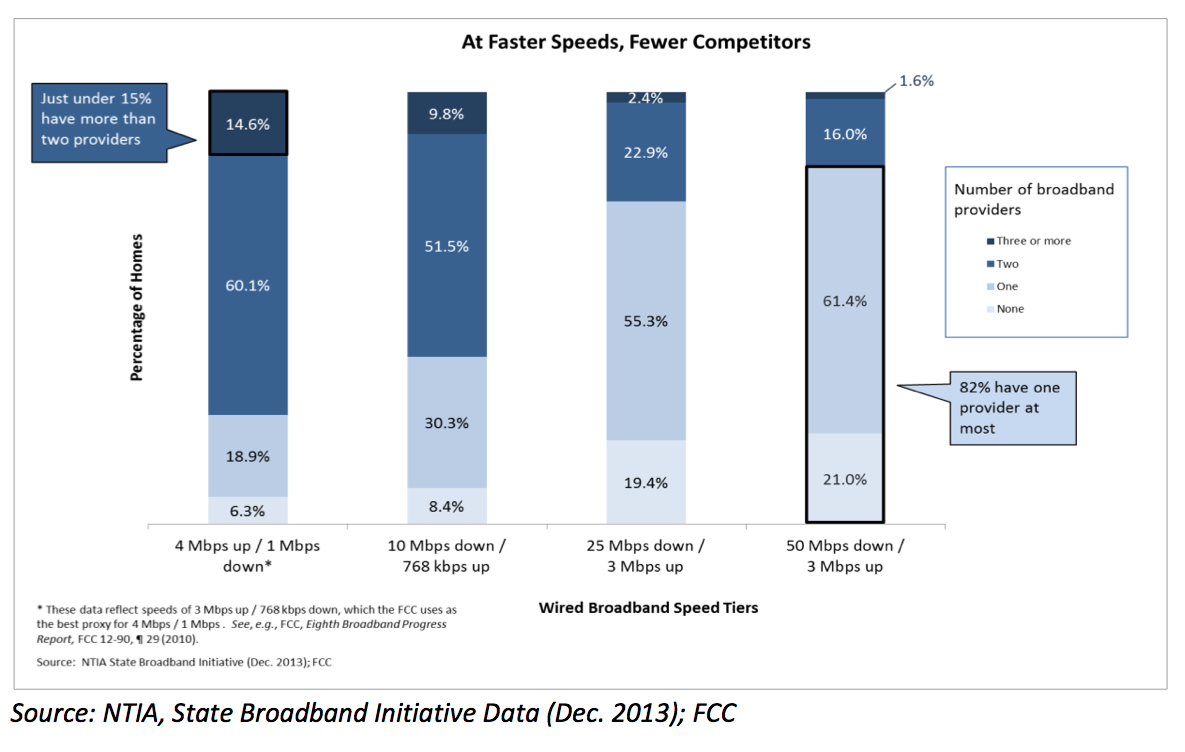
I'm not suggesting hamstringing ISPs at all, but bringing them to heel since they won't willingly do so. E.g., here in NYC, Verizon is being sued for being unwilling to keep its contract to make FiOS available to every residence (https://www.nytimes.com/2017/03/13/nyregion/ny-sues-verizon-...)
1. Please define "network neutrality" - if possible do so without using hand-waving nonsense words, but technical definitions. What strictly defines a "neutrality infraction"?
2. If the internet existed for ~20 years without the need for regulation, why now?
3. Please explain how is the very same government who allows the communication monopolies to exist, supposed to also ensure that they are "neutral"? It seems awfully convenient that the solutions to problems that government creates is to have more government.
4. Wouldn't more competition be a better course to ensuring a freer net?