I do understand that less nuclear means more coal and that this is a difficult decision.
But nuclear fans claiming that the problem with nuclear reactors is just "stupid Russians" disqualify themselves immediately.
Have we? The problems aren't just in Russia, but they're drastically less bad than Chernobyl.
Three Mile Island was essentially a worst case for internal meltdowns, and didn't involve any actual radiation release. Fukushima was vastly worse, but the problems revealed were remedied at similarly-designed reactors worldwide. (And most of those weren't nearly so exposed to severe storms.)
I'm honestly not sure what you're referring to with French and Dutch reactors, I'll have to look into that.
But overall, most of the things profiled as "severe problems and gross negligence" appear to have caused zero fatalities and zero radiation release. I know organizations like Rolling Stone have been running accounts of how the NRC is terrible and American nuclear plants are in crisis, but the problems raised don't actually amount to radiation risks.
I've never seen a convincing claim that the examples of actual release or meltdown risk, as opposed to mere sloppy management, are 'legion'.
> more coal and that this is a difficult decision
10,000 fatalities from coal per year in the USA alone. I agree that there's a tradeoff here, but I honestly have no idea why it's 'difficult'. Even the Chernobyl disaster is going to kill fewer people than coal kills when everything goes according to plan.
I'm not sure this is enough. "We almost head a nuclear meltdown in a densely populated area but zero fatalities so far!" is not inspiring confidence that there will be no fatalities in the future.
> 10,000 fatalities from coal per year in the USA alone.
Where did you get that number?
Three Mile Island isn't evidence of safety just because no one died, what matters to me is that there was no realistic route beyond "shielded meltdown". A lot of the fears raised by opponents of nuclear appear to be outright impossible. (Sadly realistic fears, mostly around hot waste disposal, don't seem to get as much coverage.)
The coal number is deaths from health effects of coal burning. Estimates vary widely, but 7,500 is a minimum and 10k is conservative. It's worse per capita and per watt in other countries, too - US plants are cleanish and US coal is low-particulate. Moving China onto nuclear power would be a vastly bigger gain (even per watt) than the US.
Accidental deaths are nontrivial for power sources, but don't dominate pollution effects. Coal is mostly pollution-derived because it's so dirty, oil is a mix because rigs are dangerous, wing & solar are wholly accident-based simply because there's no lethal pollution there. Nuclear causes approximately zero deaths of any kind, but again, tail risk.
US source: https://www.scientificamerican.com/article/the-other-reason-...
Global deaths/TwH source: https://www.nextbigfuture.com/2011/03/deaths-per-twh-by-ener...
In addition to the yet unsolved waste disposal problem you mentioned, there is the problem of mining the nuclear fuel. This can be quite dangerous to the miners, especially in countries with lax security standards. I would expect the most deaths due to nuclear power happen there.
The category of reactor that Chernobyl belonged to is grossly outclassed in terms of safety and 'meltdown' by multiple "modern" designs (produced primarily in the 50s through 70s). Even some operational since the 70s.
Chernobyl, that accident, is much more a story of piss poor crisis management set to the backdrop of poor government systems and the weaknesses of authoritarian regimes than a nuclear scare story. If citizens think their government might murder them they are less likely to take spontaneously delivered iodine pills, for example.
Chernobyl the humanitarian disaster... kinda wasn't. Most of the cancers were a highly treatable kind and didn't show up in anywhere near the predicted scale (says the WHO). Our nuclear models are _very_ conservative. The actual problems faced by them now? A poor healthcare system and high rates of substance abuse.
And for the mathematically inclined: combining Chernobyl, Fukishima, 3 Mile Island, Hiroshima, and Nagasaki, and imagining that disaster every year, we still hit death rates that compare favorably with the respiratory illness and cancer deaths caused by coal.
If only nuclear power were scale-able and low-carbon, we might have something worth investing in...
Germany has vast financial resources at its disposal. They could go on a natural gas plant building binge and link deals to the US on imports for long durations that the US would be thrilled to do. That would help narrow the trade deficit Germany has with the US ($65 billion annually; natural gas trade could solidly knock out half of that), so killing two birds with one stone. With help from the US abundance of natural gas supply, Germany could replace half its coal power in the next ~15 years using natural gas and significantly reduce its CO2 output just from that (and a big chunk of the other half could probably be knocked out by gradual renewable growth from where they're already at).
When talking about gas we're always looking at Russia, and the current geopolitical situation makes this very unattractive.
Can those amounts of gas realistically be shipped to Europe?
The US is about to become the world's energy kingpin, surpassing Saudi Arabia and Russia in both oil and gas; that vast supply will be pushed outward:
https://www.bloomberg.com/news/articles/2017-11-14/iea-sees-...
The average price of natural gas in Europe tends to be around $6, typically twice that of the US market. Once you add in the total cost of LNG (processing, transport, etc.), you get to a cost closer to $7.x to $8.x right now (that will come down with volume in the next few years, as the US is building several big new LNG terminals on the Atlantic and the Marcellus shale gas supply in the mid Atlantic is growing rapidly).
That's also before we get to technological innovation, which the US energy industry has always been renowned for, and has done wonders for the US shale industry the last decade (dramatically lowering costs, enabling the industry to survive the oil plunge and rapidly rebound, etc., entirely thwarting OPEC expectations of crushing the industry).
Wait, isn't that why we're funding Al-Nusra and all manners of terrorists in Syria and overthrowing the Ukrainian government? To stop it from happening.
1. Beating of the students on 30th of November. Before that the protests were small and getting smaller.
2. Use of lethal force against protesters which lead to a lot of supporters abandoning Yanukovych making it possible to vote against him in parliament with 328/450 votes.
If both of those are acts of "overthrowing government" then US could control it on such a level, that overthrowing is just plain unnecessary.
We can say that the Shah delivering a royal decree to dismiss Mossadegh makes the Iranian coup logically inevitable rather than looking at the CIA astroturfing for BP hegemony.
We can say that Torrijos's death is logical because he stepped in a plane at the wrong time rather than looking at the US reverting Jimmy Carter's deal to restore the Panama Canal control back to Panama
To ship gas to Europe, the US will need to spend about 50B-100B+ (minimum) building LNG facilities on both port sides, and then build something like 10,000 LNG Carriers (oceanic ships) to meet demand. Which would cost another 100B+ (maybe even 1T).
After all the infrastructure is set up, the prices will be at least 2-3 what they pay now (as they have to do things to and with the LNG that Russia does not in the process of delivery).
Its not feasible, unless you want the US taxpayers to pick up the bill and then subsidize it.
These were back of the envelope calculations. It could be a factor of 10 off in either direction.
The US is already expected to add 66 MTPA of LNG export capacity by 2019:
http://analysis.petchem-update.com/supply-chain-logistics/us...
Were you perhaps estimating the numbers to replace all of Europe's thermal coal consumption?
> Its not feasible, unless you want the US taxpayers to pick up the bill and then subsidize it.
Oh, if that's possible, sure, thank you very much! ;-)
Langeled (1166 km) and Nord Stream (1222 km) transport gas under the sea, and a US-to-Germany pipeline would only be about 5 times that distance. I estimate Boston-to-Hamburg could be done for $60 billion, and it could make stops in Newfoundland, Ireland, and Britain.
That worked for German defence policy, so there's precedent...
I'll admit that domestic gas consumers wouldn't like this plan any more than they like other plans to increase foreign gas demand, raising domestic prices, but it's not clear that the faction benefitting from low domestic gas prices is more influential than the collective of the groups mentioned above.
They, however, certainly downplay the tail risk of nuclear.
> McBride and his co-authors estimated that individuals living near coal-fired installations are exposed to a maximum of 1.9 millirems of fly ash radiation yearly. To put these numbers in perspective, the average person encounters 360 millirems of annual "background radiation" from natural and man-made sources, including substances in Earth's crust, cosmic rays, residue from nuclear tests and smoke detectors.
I'm all for pricing-in the externalities. And if that makes nuclear a relatively better investment, hurrah! If new technologies turn nuclear into something supportable in normal capital markets, hurrah! But there is no proof-of-concept yet.
- https://phys.org/news/2017-10-greenpeace-fireworks-french-nu...
Or the still not practically solved used fuel problem. Or that Germany already now often does not run nuclear power plants (that are for now still allowed to run) because they are too expensive.
And every time we saw that it's not true.
After several decades of this we don't trust you anymore. As no sane person would.
You might even be objectively right. But your safety arguments werde wrong the first two hundred times. Why listen to your explanation of your two hundred and first attempt? Let's try something else where experience doesn't virtually guarantee us that we'll be burnt.
Nuclear has the fewest deaths per kWh, period. It's really simple. Now, the cost of bringing new ones online is prohibitive, but shutting down existing ones was really dumb.
After the accident, Chernobyl continued to provide power to Ukraine, up until it's last reactor was shutdown in 2000.
I'm not trying to take an anti nuke stand, just pointing out deaths isn't the whole of the risk.
Coal has made _three_ orders of magnitude more land uninhabitable for human habitation than has nuclear.
And whereas fish may thrive behind a dam, nothing humans can eat will grow in a coal strip mine, ash flow, or other coal-related topography change. Whereas in nuclear exclusion zones, wildlife flourishes.
But first, I agree there are always trade offs. We have alao been horribly slow in finding better energy.
As for hydro + coal and uninhabitable land. I think it depends on what you define as inhabitable in the first place. Much of it is done in obscure (?) areas that few care about. Of course, this contributes to out of sight out of mind. None the less, this should be considered.
On the other hand, nukes are closer to population, as well as near water. And, as mentioned, for these more people are more aware of them. You can also thank Hollywood for the fear(s).
It's very easy to dismiss any information you disagree with if you over-generalize like that.
For example: "You told us the earth was headed for a new ice age. Why should we believe you now when you say it's getting too warm?"
> And every time we saw that it's not true.
Every time? That seems a bit excessive does it not?
Fukushima? Three Mile Island (partial only, though)? That's a (partial) melt-down every 24 years, if we start counting the nuclear age with 1945 and count till today.
If we use the numbers for civilian power plants, we need to start with the commision date of U.S.S.R. power plant "Obninsk", wich was connected to the public grid in 1954. If ending the count today, that would be 21 years. Or, if we take the last melt-down as the reset value for our clock, we will find it at 19 years, for every (partial) meltdown. With more than 500 new nuclear power plants either planned or in production, well....
Let's see, whether Molten Salt Reactors are going to show as an overall positive development...They would make things, as far as I am informed, at least a little bit safer, till we have real fusion power.
Even if we did consider deaths from catastrophic events somehow "worse" than the occasional, not-so-newsworthy death, look at the Banqiao dam breakage. That's rarely brought up as an argument against hydroelectric power.
Nuclear is hated due to superstition and fear-mongering. Please don't add to it; it's our only thoroughly demonstrated alternative to large-scale fossil fuel consumption.
[1] Nuclear is hated due to superstition and fear-mongering. Please don't add to it; it's our only thoroughly demonstrated alternative to large-scale fossil fuel consumption.
Germany is fucking boring. The rains here are moderate. One half of its coast line is a barely connected inland see that has almost no flood/ebb. The other half is protected by the UK from strong water movements. And earthquakes here, if they ever happen, are absolutely tiny.
You'd need to multiply your prediction there by maybe 100 to balance out just how much safer germany is as a country compared to japan.
Note that renewable electricity supply has actually grown faster than nuclear has declined.
https://energytransition.org/wp-content/uploads/2017/01/img3...
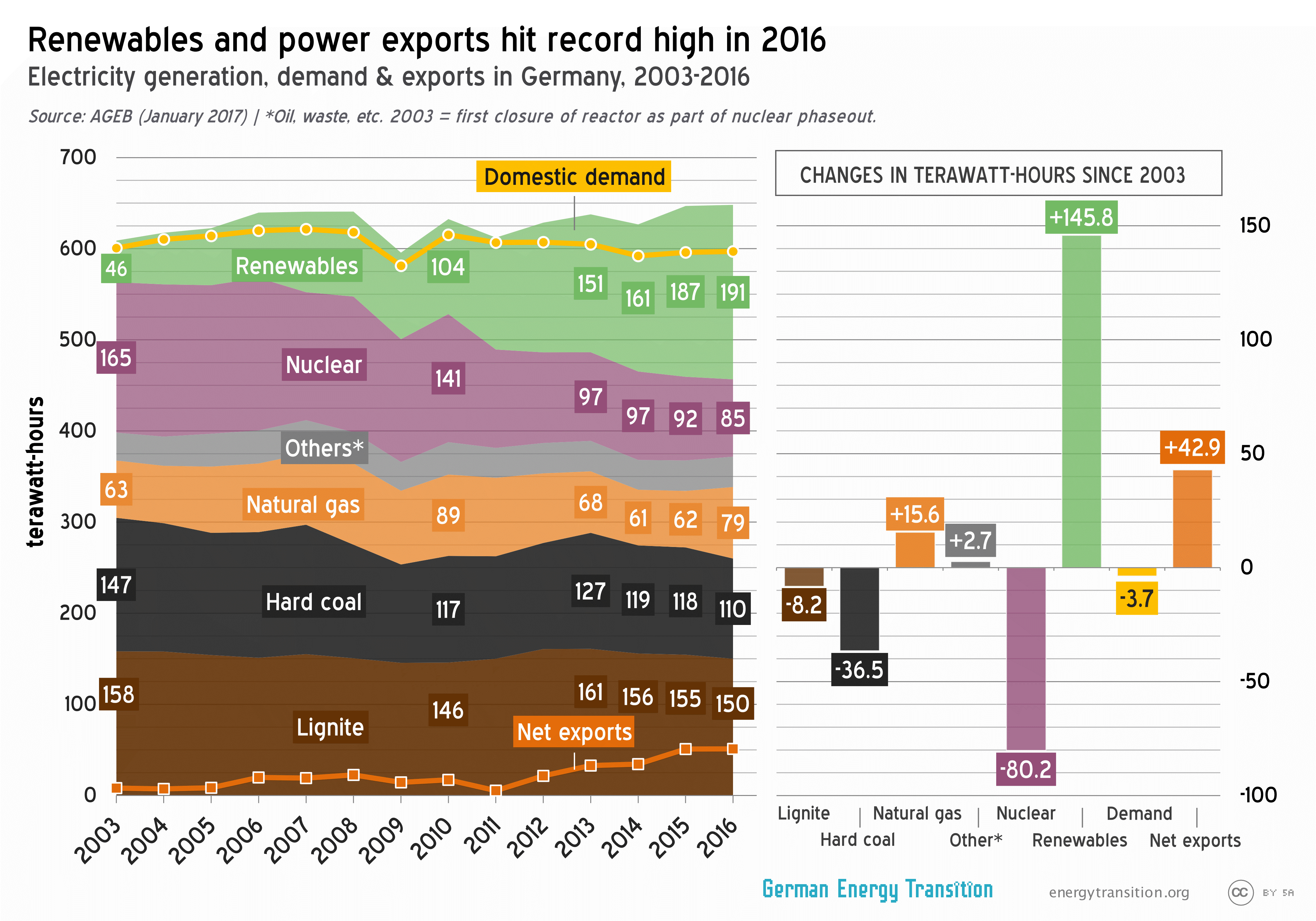
There have been significant investments in economic, political, and social support of renewables which have enabled that growth. Also, the rising price of oil has made it more competitive.
Renewable energy has been promoted. Nuclear energy detractors have only advocated against it, rather than fighting the more difficult "shut down the nuclear plants and also spend money on more renewables" fight, they went with just "shut down the nuclear plants". Coal was the unintended result.
There is discussion happening at high levels in government, for example the State Secretary at the Federal Ministry for Economic Affairs and Energy, Rainer Baake, used to be the head of Agora Energiewende who put out this coal phase out strategy.
https://energytransition.org/2016/01/proposal-for-a-german-c...
Note that Germany earns more $ per MWh exported to France than vice versa. This is because on average France tends to have surpluses at night and in summer when electricity isn't in high demand. France imports electricity at high prices during cold snaps in winter when German wind tends to be blowing.
Why not?
> Yes, I know: Chernobyl.
It's not only that, there are lots of problems with contemporary nuclear plants as well.
Can you maybe provide some back of the napkin math on why not, or a link to someplace that has done this?
The largest wind turbine being designed anywhere in the world right now would be 500 meters tall (taller than the empire state building) with 200 meter blades and at peak output would generate 50MW. Capacity factors for on-shore plants in the US average about 33%. So 50MW * 9258 hours per year * 33% = 0.152T KWh/year. The largest turbine currently built in the world gets 8MW not 50MW so 0.024T kwh/year.
I.e. we would need ~200 of the biggest wind turbines ever built to equal the amount of energy we get out of the smallest nuclear reactor currently running. And that is just to break even. Comparing the median nuclear plant to the median wind turbine makes the numbers even worse.
Hydro has the problem in the US that there aren't any good sites left. Solar costs even more per KW or per KWh than wind does (~1.5x is what I've seen at grid scale in the US) especially when you include the storage needed to maintain consistent supply throughout a day (~3x wind)
Not true. It was made into law in 2000. The current governing party put it on hold and reinstated it after Fukushima. Currently they are in the process of softening it up again, ie. today was announced that only 10 reactors need to be retired.
Yes, I know: Chernobyl. That's a cop out. Germany need not be governed by hysteria. The difference between Russian/Soviet incompetence and the results we see from France, Ontario and other well governed and highly successful nuclear systems is vast and decisive and could have provided Germany's 'leaders' with the ammo they needed to do something other than indulge anti-nook hysteria.
But that's not what happened... so burn coal instead.