See "The Verriest Lecture 2009: Recent progress in understanding mammalian color vision"
https://pdfs.semanticscholar.org/c9df/0b61e4a45e10577c001513...
Particularly Figure 1. Vertebrate photopigment sensitivity drops off rapidly toward the near IR (~700 nm).
I found this fascinating related (but not peer reviewed) document on arXiv, "Did Evolution get it right? An evaluation of near-infrared imaging in semantic scene segmentation"
https://arxiv.org/pdf/1611.08815.pdf
The author performs semantic segmentation with convnets using conventional visual-spectrum images and compares performance with images spectrally extended into the near-infrared. He finds that adding the additional NIR band did not improve task performance -- hence that evolution "got it right" by not expanding vision into a wavelength region that fails to improve semantic segmentation. I'm not sure how good this work is from a professional biologist's perspective, but I found it damn interesting.
EDIT: note that this laser operating at 1550 nm is far from the long wave IR (~8000 nm and up) that various animals sense to detect prey body heat.
https://www.nature.com/nature/journal/v476/n7358/full/nature...
They use this to find their warm-bodied prey, but of course it's only detection, not vision.
I learned this today, and now I'm happy I did.
https://en.m.wikipedia.org/wiki/Electromagnetic_absorption_b...

Which is to say, eyes were made for seeing the light that was bouncing around in the sea (and not the frequencies that had already been absorbed).
So yes, the simplest answer you can imagine.
I was answering the broader question of not wanting light to penetrate "your surroundings" - ie the desk in front of me or walls around me. Would make life difficult if everything was transparent. Normally when one talks about "surroundings" it means that stuff, not the air (analogous to the water for marine life) both of which obviously need to be at least somewhat transparent for vision to be useful.
Note this is instantaneous, human vision deals with after images which adds blur.
However in the rain, on a highway, we have water falling, water splashed up from the ground, a mist formed by cars, high humidity, and a wet layer on the outside of the car. These factors reasonably could impact this device if the laser is emitting at water's absorption frequency.
EDIT: It appears that this is given a passing mention in the article:
. . . it can receive at a wavelength of 1550 nanometers, deep in the infrared part of the spectrum. That makes this wavelength much safer for human eyes than today’s standard wavelength, 905 nm.
In terms of direct heating, tens of milliwatts isn't even enough to really make a human-detectable rise.
When it is working properly.
The laser is eye-safe, meaning you can look directly at it continuously and be fine. Though, if you did, you would deserve injury. Kind of like sticking your hand in a blender.
The device will not manage to malfunction and miraculously shoot you in the eye from meters away.
Yet wireless access points spew microwave radiation at you all day.
https://en.wikipedia.org/wiki/Sunlight#/media/File:Solar_spe...

Just because I like running numbers, here's the comparison: the laser in this lidar has a power of ~40 mW, ~1000x less than sunlight. Lidar pulses are on the order of 10 nanoseconds, 100,000,000x less than a second. The energy on your eyes is less than 100 billion times less than a second in bright sunlight. There is certainly no mechanism for thermal damage to occur.
Sunlight certainly does cause cancer, although we generally attribute that to the UV in sunlight. Sunlight is also well-known for blinding people.
Also, sunlight is specified in intensity (power/area), and here we only have laser power, not laser spot size, so it is hard to make a fair comparison. nevertheless, sunlight is roughly ~1kW/m^2, so if the laser had a spot size of 2 mm (required to be this big for diffraction over hundreds of meters of propagation to not reduce its intensity too much) we can calculate the power of sunlight in that area: 3 mW. So the laser would be actually ~10x more intense. (if the laser would be 7.2 mm wide then the intensity would be the same as sunlight) But one is comparing totally different wavelengths, so the laser safety rules are different. Two intros to laser safety for whomever is interested: https://www.rp-photonics.com/laser_safety.html https://spie.org/Documents/Publications/00%20STEP%20Module%2...
About thermal damage - funnily enough there is lots of time in nanoseconds to transmit heat and cause thermal damage. Heat transfer is actually reasonably fast at the submicroscale. As a curiosity see https://www.semrock.com/Data/Sites/1/semrockimages/technote_... for the difference between punching a hole with a femtosecond laser (no time for thermal diffusion to happen) and a nanosecond pulsed laser. The area around the laser just completely melts in the nanosecond case. Nevertheless this was done at much higher energies per pulse than the lidar lasers (thankfully!)

40 mW peak power, not average power. Average power somewhat less, maybe 20 mW.
>Also, sunlight is specified in intensity (power/area), and here we only have laser power, not laser spot size, so it is hard to make a fair comparison.
With sunlight and with a laser scanner, the entire body will be illuminated with that power, very roughly. If you stand directly in front of the laser scanner that 40 mW will fall over your entire body, and a similar fraction of the energy will go into your eyes as with sunlight.
Using a maximum permissible exposure chart gives a better sense of danger. Lidar pulses are on the order of 10 nanoseconds, or 1/100th the smallest division on this chart[2]. Even so, you can see that the maximum safe power for 1550 nm is somewhere between 8 and 10,000 watts, at least 800x more than the lidar emits.
1550 nm doesn't chemically damage biological receptors. The damage would have to be thermal, but the laser is pulsed for an incredibly short time and even if it wasn't it's well under what you can be exposed to indefinitely.

http://www.teledyneoptech.com/index.php/product/titan/
[1] (PDF!) http://www.riegl.com/uploads/tx_pxpriegldownloads/Paper_ILMF...
But did they try in low light? It seems that seeing in IR should help with detection of predators or prey at night.
Passive thermal vision that might pick out a warm object in the dark require sensing of ~10,000 nm/10 um infrared, a very different problem! And one that wouldn't be easy to solve biologically, as it basically requires being colder than the object you are sensing. Edit: but not impossible! https://en.m.wikipedia.org/wiki/Infrared_sensing_in_snakes
As you say other creatures are much more sensitive to IR differences.
I wonder if ground-source lidar at night would have similar effects on animals that are "used to" IR coming from above.
https://upload.wikimedia.org/wikipedia/commons/e/e7/Solar_sp...
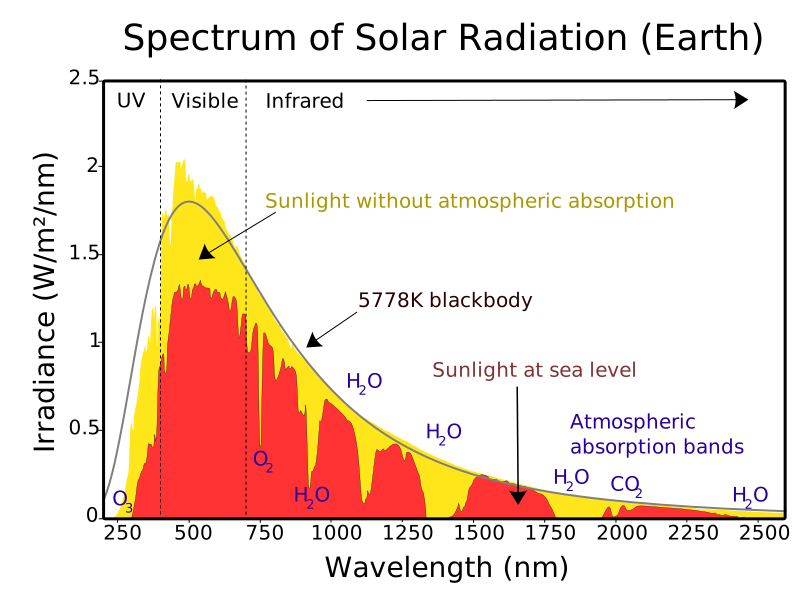
Snakes pick back up around 5000nm since that's the temperature other living animals radiate, which is helpful in hunting. https://en.wikipedia.org/wiki/Infrared_sensing_in_snakes
Also, nocturnal bats will largely be unaffected by cars in no small part because they don't cohabitate with humans very much.
You will save many more insects, raising awareness to this problem.
LIDAR may or may not have an adverse impact on wildlife, but we should at least find out and see if there are simple ways to mitigate any possible side effects.
This is really back of the envelope stuff, but there are lots of factors to consider. You could probably get away with even a 100mW laser with the right setup. Obvious disclaimer that you should respect laser safety and not trust someone's internet napkin calculations.
According to this you're allowed 1W/m^2 at > 1400nm for an accidental exposure (100 seconds): https://workspace.imperial.ac.uk/physics/Public/physicsdocs/...
Equivalently that's 1 mW/mm^2. So the question is, what power is the laser kicking out? A Faro scanner can put out as much as 20mW/mm^2 at 1m and their systems are thus Class 3R. So far, so bad.
However... laser safety ratings are given as "Under normal operating conditions". The laser is being scanned, and very quickly at that, so you'd only be getting very short bursts of light (I don't know if it's truly a pulsed laser). If you stared into the beam continuously you would have problems, but since the beam is only going to hit you for a fraction of a second it's unlikely to do any damage. And indeed Faro say that for practical purposes their system is eye-safe, even though it's got a stonking laser in it.
The tables say you can go up to 10^4 J/m^2 for short exposures and suppose we only have the beam in our eye for 10^-3 seconds (additionally the pulse length will be very short), you're allowed a light power of perhaps 1000 times higher. Maybe divide by a factor of 100 or so because you'd get several repeat exposures if you stood in the same place or if you're standing on a street filled with these things.
Have a look at Faro's manual, Appendix E for a real example of this kind of analysis: https://doarch332.files.wordpress.com/2013/11/e866_faro_lase...
What? IR is lower energy than visible red and that's the first color to go when you get a few feet under water (with no local light source).
fair enough, I got my physics a bit wrong there, but I was under the impression that that window was in the blue/green part of the spectrum since I do know that water is good at blocking UV and even cosmic radiation.
I also know that it's good at blocking visible red, because if you go further than about 20-30 feet down on a sunny day and cut yourself, your blood looks green.
Is there an additional window in the infrared part of the spectrum that supports GP's point?
I mean, maybe it'll scare off deer, or pull them in closer to see what's up? Any number of species with un-intended consequences. Insects in the desert. Pidgeons in the big city. Gulls on the coast.
Maybe it's totally harmless, but I'd like a study that verifies mass adoption would not have ecological consequences.