News for hackers. Stuff that matters.
Re:Seagate Announces 12 TB HDD: 2nd-Gen Helium-Filled HDD by killjoywashere on Thursday March 16, 2017 @06:23PM (#13889731)
I know a few folks who use these, their applications usually involve a lot of them, high in the atmosphere (in flight or remote observatories on mountaintops) where downlink is prohibitive. Any other realistic use cases? Undersea maybe? But space isn't at quite such a premium there.
Re:Seagate Announces 12 TB HDD: 2nd-Gen Helium-Filled HDD by X-Istence on Thursday March 16, 2017 @07:09PM (#13889970)
These are fantastic for long-term storage of something that may need to be retrieved at a moments notice, but is rarely accessed.

One example from a previous job, these in a Ceph cluster as an origin for a CDN delivering video. We transcode the video to various bit rates and chunk em, then clients request them through CDN, there is not a lot of writing, with some reads when the asset is new, but once it is cached it just basically sits and is idle.

Larger capacity meant we could store more data in a single rack, our limitation for the origin wasn't CPU or bandwidth throughput, it was literally our storage that forced us to keep expanding.

The deployment I did was using 8TB drives. We used HGST with their Helium because of the lesser power draw, allowing us to install more servers in a rack without going over our maximum power draw and heat density for cooling.

Re:Seagate Announces 12 TB HDD: 2nd-Gen Helium-Filled HDD by deftnerd on Thursday March 16, 2017 @06:58PM (#13889924)
Delimiter has $10/mo "bring your own drive" storage plans. Just buy this drive and ship it to them and share it with a VPS or cheap server there and you can store a lot of media for a cloud Plex server
Re:Seagate Announces 12 TB HDD: 2nd-Gen Helium-Filled HDD by yourapostasy on Thursday March 16, 2017 @08:40PM (#13890417)
When I looked [1], it reads as if they have an 8 TB cap on this service. That is, you can ship them any drive, up to 8 TB, to plug in and run at $10 per month. It sounds like their pricing is predicated on some kind of assumed Watt-hours per TB.

It would be interesting if someone offered a similar plan, but priced on energy consumed instead, giving incentive for managed storage arrays that power down drives that idle (for some algorithmically-derived definition of "idle", trading off against projected lifespan of the device due to increased power cycling), and other energy-saving practices. Slices up the granularity of cloud hosting even finer.

[1] https://www.delimiter.com/slot-hosting/

Re:Seagate Announces 12 TB HDD: 2nd-Gen Helium-Filled HDD by Amezarak on Thursday March 16, 2017 @06:37PM (#13889801)
If I built my NAS today instead of three years ago, I'd be using them.

You really can't have too much local storage. Price is the only prohibitive factor, though rebuild times are starting to be too.

Another factor to consider is that uplink, if you wanted to store stuff in the cloud, is almost always terribly slow and often capped, plus the cost of storing multiple TBs on any given provider.

Re:Seagate Announces 12 TB HDD: 2nd-Gen Helium-Filled HDD by blackflame7000 on Thursday March 16, 2017 @07:40PM (#13890141)
Rebuild times pretty much forced me out of Raid5 and into a Raid10 after I encountered a secondary drive failure during rebuild. Luckily it was my raid controller pre-flagging questionable sectors that weren't actually reallocated so I was able to recover but now I always like to keep 2 independent backups. I use SFP-10gb links between computers to move files and even that is painfully slow transferring terabytes. You're right, The cloud is in many ways less practical until the bandwidth is available to access it all.
Re:Seagate Announces 12 TB HDD: 2nd-Gen Helium-Filled HDD by walrus01 on Thursday March 16, 2017 @08:08PM (#13890277)
nobody should ever be using raid5 anymore, and that's been true for many years: http://www.zdnet.com/article/why-raid-5-stops-working-in-200...

the use cases for raid5 have pretty much been replaced with raid6 plus hotspare.

Re:Seagate Announces 12 TB HDD: 2nd-Gen Helium-Filled HDD by kristianp on Thursday March 16, 2017 @08:47PM (#13890442)
There's a followup to that article that says Raid 6 won't be recommended by 2019.

http://www.zdnet.com/article/why-raid-6-stops-working-in-201...

Re:Seagate Announces 12 TB HDD: 2nd-Gen Helium-Filled HDD by walrus01 on Thursday March 16, 2017 @09:26PM (#13890611)
Yeah, that is indeed scary, and something to be taken into account for disaster recovery planning. Off site backups of systems need to be designed so that the whole RAID array can be physically destroyed (fire, flood, theft, axe, etc) and recovery will not take a ridiculous amount of time.

The wise sysadmin mantra of "RAID is not a backup" must be kept in mind at all times.

Re:Seagate Announces 12 TB HDD: 2nd-Gen Helium-Filled HDD by XorNot on Friday March 17, 2017 @08:07PM (#13899072)
ZFS in RAIDZ2 mode.

Unless 3 drive controllers die simultaneously, you can survive finding faults during a full rebuild.

Re:Seagate Announces 12 TB HDD: 2nd-Gen Helium-Filled HDD by Filligree on Thursday March 16, 2017 @10:32PM (#13890903)
That's basically why I've gone with raidz3, yeah. raid10 still allows a second drive failure to lose data, it's just less likely to be that specific paired drive.
Re:Seagate Announces 12 TB HDD: 2nd-Gen Helium-Filled HDD by rb666 on Friday March 17, 2017 @01:25AM (#13891712)
Re:Seagate Announces 12 TB HDD: 2nd-Gen Helium-Filled HDD by Dylan16807 on Friday March 17, 2017 @03:00AM (#13892107)
> The only disk more heavily loaded than usual during a mirror vdev resilvering is the other disk in the vdev – which might sound bad, but remember that it’s only being heavily loaded with reads, whereas all of the remaining disks in a RAIDZ vdev are being much more heavily loaded with writes as well as reads during a resilver.

Why is that happening? There's no reason to perform a bunch of writes to those drives.

Re:Seagate Announces 12 TB HDD: 2nd-Gen Helium-Filled HDD by fnj on Friday March 17, 2017 @01:10AM (#13891652)
RAID-Z3, or a mirror of two RAID-Z2s for me, I have one of each. You can also do mirrors with more than just two elements.
Re:Seagate Announces 12 TB HDD: 2nd-Gen Helium-Filled HDD by bigiain on Thursday March 16, 2017 @07:58PM (#13890239)
Yep - it's been a long time since raw storage costs were so high I couldn't justify and afford to use raid 0 [Edit: Raid 1 not 0 - as DuskStar corrected me...) for everything that matters. Whenever I buy drives these days, I buy three of them at a time (if possible, the same size drives from at least two different vendors or batches from the same vendor).
Re:Seagate Announces 12 TB HDD: 2nd-Gen Helium-Filled HDD by DuskStar on Thursday March 16, 2017 @08:11PM (#13890286)
Raid 0 can withstand 0 drive losses - I assume you meant Raid 1 or Raid 10?
Re:Seagate Announces 12 TB HDD: 2nd-Gen Helium-Filled HDD by bigiain on Thursday March 16, 2017 @08:16PM (#13890311)
Arrrggghh - yes, raid 1. Multiple complete copies of everything...
Re:Seagate Announces 12 TB HDD: 2nd-Gen Helium-Filled HDD by Dylan16807 on Thursday March 16, 2017 @10:11PM (#13890816)
Raid 10 still leaves you vulnerable to a second drive failure. I'd personally jump from a multiple parity scheme to at least raid 5+1 without ever stopping at 1+0.

(Though probably something with checksums instead of naked redundancy.)

Re:Seagate Announces 12 TB HDD: 2nd-Gen Helium-Filled HDD by myrandomcomment on Thursday March 16, 2017 @10:23PM (#13890869)
Using FreeNAS I have 4x4TB drives. 2 mirror sets that are mirrors of each other. Only 7.25TB total space but I am not to worried about a failure. Disk are cheap, loosing 16 years of family photos, not so much.
Re:Seagate Announces 12 TB HDD: 2nd-Gen Helium-Filled HDD by bigiain on Thursday March 16, 2017 @08:01PM (#13890252)
Today - I'd probably go with the slightly more proven and slightly less expensive 8TB drives - jumping onto the latest tech for storage isn't something I feel is in my best interest. Six months from now is probably the soonest I'd consider using these (assuming there are no horror stories in places like BackBlaze's blog in the interim...)
Re:Seagate Announces 12 TB HDD: 2nd-Gen Helium-Filled HDD by loeg on Thursday March 16, 2017 @07:20PM (#13890033)
Anywhere space is at a premium. PB/rack matters some places.
Re:Seagate Announces 12 TB HDD: 2nd-Gen Helium-Filled HDD by walrus01 on Thursday March 16, 2017 @07:51PM (#13890207)
Particularly anywhere that $$$/rack per mo and $ per kWh matters. Such as a medium sized CDN or backup service (Backblaze, etc) that wants to cram as many 3.5" drives into a 4U chassis as possible. If one is colocating multiple racks of 4U sized servers as close as possible to a major IX point, the rack space and power costs go up considerably.
Re:Seagate Announces 12 TB HDD: 2nd-Gen Helium-Filled HDD by ChuckMcM on Thursday March 16, 2017 @06:36PM (#13889798)
These are tape drives with a very fast rewind and seek behavior.
Re:Seagate Announces 12 TB HDD: 2nd-Gen Helium-Filled HDD by rincebrain on Thursday March 16, 2017 @07:02PM (#13889944)
In the sense that they're devices with higher performance for sequential than random IO but relatively slow to rewrite the entire device relative to capacity, or specifically the use cases that parent is describing?
Re:Seagate Announces 12 TB HDD: 2nd-Gen Helium-Filled HDD by ChuckMcM on Friday March 17, 2017 @12:43PM (#13895438)
Basically, yes.

Back in the stone age disks were "fast" in random access but they couldn't hold as much as tape could. So to get the storage you had a mix of disk and tape. That started as you had a command you would send to the operator (another historical concept) which was the person who was responsible for 'operating' the computer. That would print a message on a hard copy terminal that would say "Load Tape XYZ on Drive 2" or something similar, the Operator would go to the shelf of tapes, pull out the one that was labeled XYZ and put it on drive 2, "mount it" (which would, on vacuum readers, suck in and tension the tape and read the first block (the label)) and make it available to the operator who could verify it was XYZ and then send pack (again on the console) "tape loaded." Then your batch program would start and you'd get the classic video of a computer with the tape being read in bits and bursts and often another tape being written in bits and bursts.

Computers got bigger (able to process more data) and tape libraries got bigger, one of Sun's big customers was Fingerhut (mail order catalog) in Minnesota and they had a room where there were lots of 'tape operators' and when a customer was on the phone and the operator said "let me bring up your account" it lit a sign in the tape room with the needed tape, someone would jump up and grab it and put it on the nearest tape drive and 'tag' (there was a clock showing time from request to mount) and the tape would identify itself and send the customer record to a disk so that they were "online" and the operator's screen would light up with all the customer details.

IBM and StorageTek made robotic libraries that did the same thing, but without the human in the loop.

Then in the early 2000's NetApp and other storage vendors started offering ATA disk drives (dense, cheap) as storage offerings and slowly, eventually the tape libraries were crushed because this dense storage was more cost effective.

Primary disk storage has now gone over to solid state disks. They have even better random access and generally and do reads at the limits of the interface they are attached to.

But there is still a market for dense, cheap, read mostly data stores. That which used to be tapes, then tape libraries, and now spinning rust in a bath of helium. A typical SATA drive can really only do about 110 "IOPS" per second, in a large part because the mechanics of moving things around is inviolate.

So the use for dense data stores behind a small i/o pipe is read mostly archival and reference data. Oil & Gas sonar dumps, credit card sales transactions, backups of data which is 'live' elsewhere, etc. The role that Tape used to play but no longer does very well.
Re:Seagate Announces 12 TB HDD: 2nd-Gen Helium-Filled HDD by drivethrowinguy on Friday March 17, 2017 @06:47AM (#13892944)
You're probably confusing these with SMR drives. These here are standard PMR, so they are just like any other hard drive regarding random I/O.
Re:Seagate Announces 12 TB HDD: 2nd-Gen Helium-Filled HDD by wmf on Thursday March 16, 2017 @06:29PM (#13889759)
They're mostly used for cheap cloud storage like S3/Dropbox/Backblaze/etc.
Re:Seagate Announces 12 TB HDD: 2nd-Gen Helium-Filled HDD by chx on Thursday March 16, 2017 @06:38PM (#13889815)
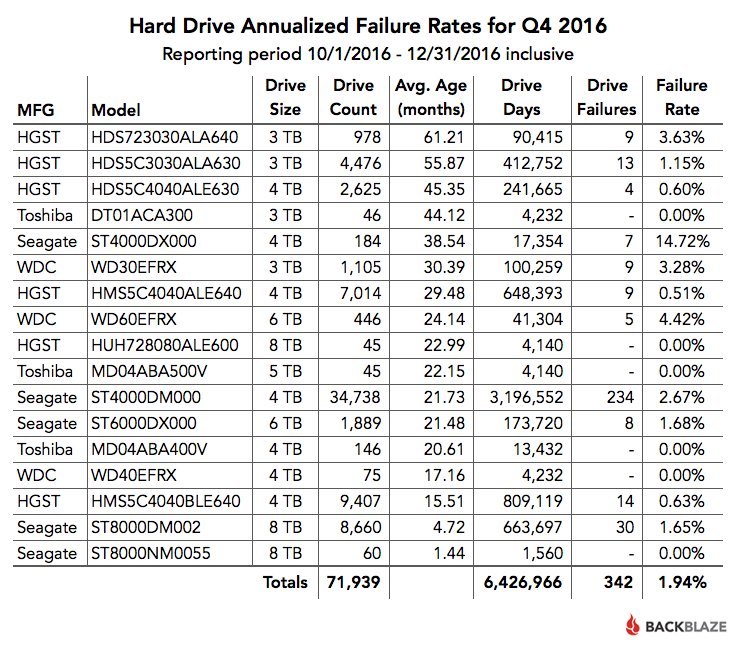
The top dogs are rarely the cheapest gigabyte/dollar wise. If you look at https://www.backblaze.com/blog/wp-content/uploads/2017/01/Q4... you will see their bread-and-butter was still 4TB in 2016 with 8TB slowly introducing.
Re:Seagate Announces 12 TB HDD: 2nd-Gen Helium-Filled HDD by brianwawok on Thursday March 16, 2017 @07:14PM (#13890002)
Built my NAS 8 years ago with 500gb drives. Upgraded 5 years ago to 2 TB. Not even half full yet :(