I cannot emphasize this enough. And even then, be extremely careful with heavy lifts (anything more than, say, what your body weight would be at 20% body fat).
I worked regularly with an extremely good Rippetoe-certified coach. My form was better than most of the beginners you see in the gym. At 40, I was stronger than I was as a high-school athlete, and it was an amazing feeling.
But one day, a 245x5 squat set went very slightly weird. Two days latter, I had tingling and numbness in my foot soles. It turns out that I'd aggravated a relatively minor disk bulge at L4/L5 (about half the population has a disk bulge there). And now I've been in moderate pain for close to three months with very slow improvement.
The long-term prognosis is excellent, as far as I know. I will almost certainly heal. I know plenty of people who've done worse to their backs and who are fine today.
But heed my example: If you're going to do heavy lifts, especially deadlifts or squats, make sure your form is as close to perfect as you can get it, and remember that you can't eliminate all risk.
One thing I have noticed: There are no 55- to 70-year-old powerlifters in the gym. But there are old bodybuilders who've been lifting for 40+ years with only the rarest of injuries. They're careful, and they say things like, "I don't like the risk/reward on heavy squats." When I return to serious lifting, I'm considering on giving up on powerlifting and switching to a more bodybuilding-centric program.
I've noticed this as well, and I've heard it correlated to having an aim in the gym vs sticking to your regimen. That the body builder has an aim, and if something hurts a bit they'll work around it and let it heal. While a powerlifter will push through it (sticking to their routine) inevitably ending in injury.
The point being, don't give up power lifting.. but listen to your body and move away from the PUSH IT/Deviation from routine is failure, kind of attitude.
The idea is explored here by the glute boss, Bret Contreras: https://www.t-nation.com/training/why-bodybuilders-are-more-...
It took months to get back to weight. PR a couple weeks ago of 308lb. Bench 290lb, DL:423lb.
So I'm closing in on 1,000 lbs combined. (Just haven't done it all in one day.)
As to your no old power lifters comment, I'll be 55 in May. While I'll never be a competitive power lifter, I still enjoy lifting.
I have no plans to "give up".
I don't see too many people over 50 in ANY gym. When I hung around PL gyms however I did see older lifters doing their thing, obv. concentrating more on reps but still competing. The kicker is in that age 50+ group just getting out on the platform gets you some kind of a trophy :)
Back injuries suck. Get an inversion table if you don't have one yet.
One note about 55-70 year olds powerlifting vs body building is that they tend to be a lagging indicator since people don't usually start late in life. Also, in the 80s and 90s, bodybuilding was far more popular than powerlifting, so it would make sense that there'd be fewer people in that age category powerlifting.
There are exceptions though: https://www.youtube.com/watch?v=0zjhSlJN-Qw
The sad thing is I haven't been doing a powerlifting routine at all. I decided a couple of years ago when I started lifting that I'd rather look good than be able to lift super heavy weight. I was only deadlifting about 1.2 times my body weight.
Certainly you need to do all of the rehab/prehab strengthening exercises you can - and you need to do them for the rest of your life - but the real turning point for me and that back injury was beginning to walk regularly.
Your body (and your back) are built to walk. Walking will heal you. Yes, it might hurt more and be uncomfortable for the first week or three, but after that, everything tightens up and fires up and tones up ... and all the pieces of your spine put themselves back into place.
I am over 40 now and have been doing (relatively) heavy squats and straight leg deadlifts for the past ten years. Totally asymptomatic.
Does your 20% heuristic change at all for the type of lift? For me that would lead to a bench press near my PR, but a squat and deadlift far below. So bench would feel a bit overpowered if they're all the same. But then again, bench seems less risky.
But I think most people have a danger zone. This is the point where screw-ups start to get dangerous, and you don't want to be doing sloppy deadlifts or squats with a wobbly core. For some people, this might be two plates. For others, it might be the first time they have to reset their deadlift. Or it may be the point where you start getting minor injuries. (It may also depend on genetics: I have reasonably robust shoulders, but an unusually short sciatic nerve and easily-annoyed pyriformis muscles.)
If you're self-taught using videos or books, then when you reach that point, I would recommend paying for a serious powerlifting coach. A lot of self-trained lifters have way too little core tension, or are making other dangerous mistakes. Personally, I worked with a Starting Strength certified coach who was excellent, and who fixed all sorts of mistakes I was making—but it still wasn't enough.
Depending on how completely I recover from this injury, I might just freeze my deadlifts and squats at 225x5 permanently, and focus on a safe subset of bodybuilding lifts. But I do recommend talking to older lifters, and asking them about how they avoid injuries. I've known some admirably buff 55- and 65-year-olds with good injury histories—but they seem to focus on a combination of moderate strength and aesthestics, not on raw powerlifting totals.
Overall, weightlifting is statistically one of the safer sports. But injuries are just a miserable experience, and I encourage people to think about these issues before they're forced to learn about spinal anatomy, MRIs and anti-inflamatory drugs (or about rotor cuffs).
I think up to about 160 it's hard to injure myself with squats or deadlifts. I weigh 150 and am lean. I might just stick around there. It still produces a good physique + strength for me.
I've also been considering sandbag exercises at home after reading about it in this thread. I started bouldering recently as well, which seems to have a more manageable risk profile if I approach it incrementally. (But I need to research that)
My advice to almost everyone is to prioritize consistency and enjoyment over perfect planning. For almost all working professionals, their plans fail on consistency instead of selecting optimal exercises. If you like bouldering, give it a shot. Jiu-jitsu / wrestling is another good activity that'll keep you strong. You'll be better off with either of those than a lifting regiment where you miss days often.
As for weightlifting, the problem people have with handling heavier weight isn't necessarily knowing the form, but being able to keep form as their numbers go up. Core strength is one of the most obvious problems, but you can also have other muscles that aren't quite as strong and those deficiencies become problems when you're doing heavy compound lifts. A good coach won't just teach you form, but identify the areas you need to improve in order to safely handle heavier weight.
If you want to pursue weightlifting / powerlifting, my best advice is to find a gym with a lot of lifters you can make friends with and elite level lifter or two. You'll pick up a lot from observation (in addition to the coaching you get) and the social aspect will make it easier to keep coming back.
that doesnt stop body builders from spreading the gospel of squats, even as they have copious knee and/or back problems.
It all depends on your objective and goals. As with everything moderation is key. A balanced program of squats, deads, pushing exercise (chest/pecs) and a pulling (back/delts) is best for oevrall muscle, bone and tendon health. Whether you do this via free weights, body weight, or machines is really not material.
Rippetoe style heavy free-weight squats, squats and more squats is not the be all and end all of resistance training. Personally, I got into heavy strength training with Rippetoe's books and videos - and, IMHO, he did a great service by educating people about the benefits of heavy (free weight) strength training using a very very simple ('KISS') type program (at a time when the focus was on machines and overly complicated routines). His routines are great for beginners - especially very young ones - hence why they are copied and 're-mixed' so much (like Stronglifts 5x5 and countless variations thereof).
And I would really not suggest heavy squats for improving grip strength - that would be a very inefficient way to train your hand grip.
http://www.bodyrecomposition.com/muscle-gain/squat-versus-le...
http://www.thedreamlounge.net/barbell-squat-worst-exercise/
http://ericcressey.com/newsletter91html
https://criticalmas.com/2012/06/i-no-longer-give-a-squat-abo...
http://community.myprotein.com/off-topic/28225-mark-rippetoe...
https://forums.t-nation.com/t/rippetoe-ripped-apart/191700/7
https://www.bodybuilding.com/images/2016/may/what-all-squate...
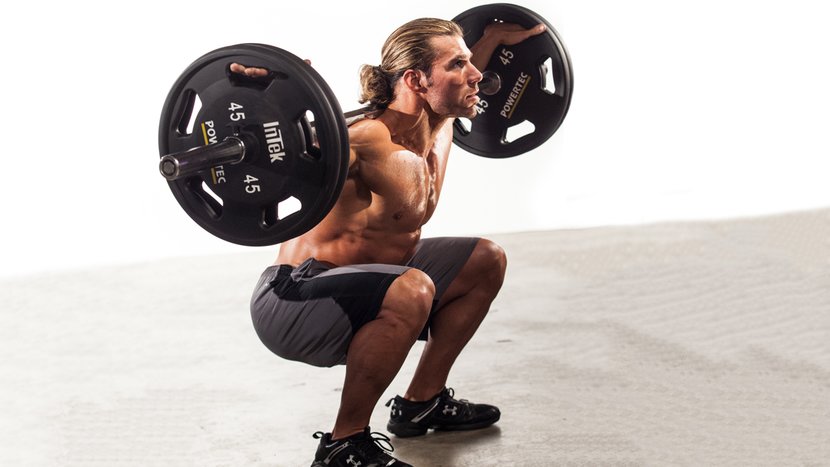
i agree that squats CAN be good for you, but I am stating that the risks outweigh the benefits. Just one bad form squat in your entire life, and you can permanently damage your knees or back. there are much safer exercises that train the same muscles.
as far as provide some data or get out of here, unfortunately I do not know of any good data source on weight lifting injuries and hazard rates.
The best I have is baseball, the toll being in the squatting position takes on players knees is, to use some of the language you have used, 'universally accepted'.
I started doing squats in my late 20s and by the time I reached my body weight I've never had knee pain since. I'm in my mid-30s now.
I do recognize that with bad form and overloading your knees in the wrong way the result could easily have been completely blown out knees.
Mostly near my body weight but lower recently because I haven't been doing it regularly enough. So pretty low weight.
However I just got a bit bored of it all and kind of felt like I always had my ear on the ground for something more interesting, or technical (I do miss squats).
To get to my point I started climbing a few months back and it has totally hit the spot for me. It is incredibly technical, you have both indoor and outdoor options, and you also build incredibly functional strength. Including improving your grip strength more so than in any other sport.
This is totally anecdotal, and of course climbing gyms are not as common as normal gyms. But just in case someone is reading this and wants to give something else a try I highly recommend it.
Also you get to buy some cool gear which is always nice.
It's incredibly satisfying. A mix between problem solving and physical exertion. I've never been a gym rat but I'm excited for my skin and grip strength to return so I can go back every 2-3 days and nail that next level of difficulty.
Most obviously, it offers some whole-body fitness that I don't find boring. But I've gotten a lot of secondary benefits that are hard to pass up. It's gotten me into normal weightlifting because "to climb better" is a clearer motivation than "to be healthier".
And it's a fantastic way to build strength comprehensively. As soon as one body part (bicep, wrist, hip flexor, whatever) taps out you'll struggle to keep going, so you tend to develop whatever is weakest. There's a lot of incentive to work flexibility, too, which can be dangerously ignorable for new weightlifters.
Completely agree.
I just started out and we have several indoor climbing places where I live. I've been trying to find an alternative to having my body being beat up playing hockey two to three times a week and thought this was a good alternative.
First of all, it doesn't cost a lot to get involved. I've found it works my whole body out, engages my brain in a way hockey simply can't and has really made me focus on how my body moves since my grip strength just isn't there yet. So far, I like it a lot and would also recommend it to anybody.
I think you're doing the absolute right thing with climbing. Its not about finding the most optimal physical return on investment for an hour of work but finding something you love so its not work at all.
... or do something that applies your strength in the outside world, like climbing ;) Bonus points for fresh air and awesome view ...
//edit// and at the age of 45.
The scientific consensus is that endurance exercise like walking or running is much better for you than lifting (in terms of longevity, cardiovascular and health benefits).
The bar is a lot higher for mile times, but 7 minute mile still is top ~25% of the American population, given we're all so sedentary.
Fyi, if you want to feel good about your swimming, lookup the youtube vids of the navy seals swimming standards. I know 12yo kids who could pass them. Their pace wouldnt even qualify for the 'fast' lane at my local lap pool (50m/minute).
I'm sure the special forces guys are much bigger and heavier than that and as another commenter said, speed will not be their top priority.
In the SEALs defense, such speeds are horribly inefficient for even the best swimmers. Water gets very thick, with each second below those times requiring a redoubling of efforts. Seals care mote about distance and survival than speed.
But your observation seems accurate, not many people swim.
I'm a reasonable swimmer but this really confused me. I assume you meant 15 min x 5 because 15 x 5 KM would be insane.
How is it that as a society we've devalued physical health so strongly.
The stereotype of nerd as sedentary applies to me, to an extent. I think this is because, genetically, I have a number of physical problems, and also come from a poor background. For most of my youth, I was unable to achieve at a competitive level due to these problems - I have never won a single race, medal or trophy (as where I am from, they are only given out for sporting achievements). However, when I got a computer, my life changed. Suddenly I could create and achieve using nothing other than a keyboard and an internet connection. So in my case, the sedentary nature of my existence probably drove me toward computers, rather than the inverse.
I know quite a few people here in SF that do both. I used to be a state-competitive athlete in Pennsylvania, but I can't even keep up in SF with the times that a lot of my fellow nerds here throw down in Strava (still have a few though, running up the hill on Misson St, one lap around Bernal Heights Park, and running through Almaden Quicksilver Trail San Jose!).
High school athletics is a good way to get into a good college, when you already have academics on par with the majority of applicants (otherwise, it's a crapshoot to get into Ivy League schools with <10% acceptance rate and >90% of the applicants have near-perfect SAT scores).
YMMV, but maybe consider making fewer excuses for your "inability" to perform physically and stop diffusing blame in every direction except the right one (i.e., at you).
Actually, I don't care what you do or think personally, but (assuming you are commenting in good faith...) your demoralizing and plain wrong statements about a putative inverse relationship between mental and physical fitness, and your funny rationalization of your failures, are exactly the kinds of bad cultural tropes that are malforming the bodies and minds of what should have been the healthiest and most performant bunch of homo sapiens to crawl the planet.
As far as my own issues go, I think you're speaking from the perspective of someone who has no medical issues and assuming that everyone else is similarly healthy. I have rheumatoid arthritis and hypermobile ehlers-danlos syndrome (amongst other problems). I try to keep fit, have special shoes and joint supports, do everything my physiotherapist tells me to do, and I exercise fairly intensely for at least an hour a day. But ultimately, I have physical limits that despite continual medical intervention, have proven resistant to treatment besides painkillers. In the last month alone, I've been to hospital 6 times. There's a good chance I won't be able to walk more than a few hundred metres by the time I'm 30, and currently if I try to push myself too hard, I typically end up injuring myself and needing to go to hospital.
A computer, for me, and other people like me, can be one of the most transformative purchases of our lives. On a computer, nobody knows you're disabled and you can do almost everything that an able-bodied person can. Arthritis can be a problem, but heated gloves help a lot with that.
You should pray for a healthy mind in a healthy body.
Ask for a stout heart that has no fear of death,
and deems length of days the least of Nature's gifts
that can endure any kind of toil,
that knows neither wrath nor desire and thinks
the woes and hard labors of Hercules better than
the loves and banquets and downy cushions of Sardanapalus.
What I commend to you, you can give to yourself;
For assuredly, the only road to a life of peace is virtue.
Is there any evidence backing this up? I hear it proclaimed a lot, but there are plenty of examples of brilliant people who are not physically strong, such as Stephen Hawking.
It's not a myth that time you spend, e.g., in the gym is time that's not available for, e.g., programming practice, and vice-versa. Ability beyond raw potential takes time to devop and maintain, and time is a limited resource. TANSTAAFL.
But I would agree - the mind and body are powerfully complimentary.
Handy for reference: https://symmetricstrength.com/standards#/90/kg/male/-
if you're repping it and your max is probably somewhere the mid 500s then you're approaching "elite" level according to USPA: https://www.lift.net/2013/05/09/classification-standards-for...
It's not a bad thing to do, as a climber I care a lot about grip strength, but it's not a significant total-health goal. Grip strength is highly predictive partly because people don't train it, and so it represents overall fitness and muscle development. Working hand strength in isolation just breaks that predictive relationship without producing the overall health improvements that come from an active life and whole-body fitness.
Instead, you want to be small, fit, and not eat much (which means not doing unnecessary exercise). For example, this paper discusses how caloric restriction extends life spans for rodents, primates, and humans across the board: http://www.sciencedirect.com/science/article/pii/S1568163716...
Our push to extend life span has resulted in us being old, pathetic weaklings. A long life that has the last 20 years spent in a variety of sicknesses sounds awful.
Anyway, no more running for me, and as much as I dislike spending time in the gym a short burst of heavy weights a few times a week really is a great tonic!
If I had a dime for each time I heard this... :(
I wish you a speedy recovery!
I strained a muscle in my left back on a deadlift and have been cautious since. But I do like barbells – I'm wondering if there's a safe level where you can do lifts without so much risk. (assuming form is fairly good)
Best thing I've learned from bodybuilding and yoga - listen to your body. If you feel any discomfort beyond normal muscle contractions - stop, rest, and come back tomorrow. Do slower, more controlled movements that tax your muscles more than your joints.
Calisthenics is generally very safe as well (compared to powerlifting), and you can build up an impressive physique doing it.
Some years back I was practicing martial arts. Certain disarms just didn't work on me simply because of how far around the weapon my fingers went.
If you want to have a healthy, long life focus on overall strength. Squats, deadlifts, odd-object carries etc. If you're new to lifting, have someone who isn't show you proper form. Or just read Starting Strength by Mark Rippetoe. Its the bible of heavy lifts.
Source: I can deadlift more than 3 times my bodyweight while still having a 7 min mile.