And that's where it stops. Ma made a general observation and that's it. Historically countries who trade less tend to be hostile toward each others, while countries who trade in bigger volumes are friendly.
Also Ma isn't saying or implying "keep the trade deficit". He says "keep trading. period" (a surplus or a deficit, doesn't matter in the context of his argument.) By the way it's weird that people seem to think it's China's problem that the US have a trade deficit with them. The deficit can be solved by the US selling products and services to China. It's the US' problem to find what to sell. And only the US can solve it.
This is completely wrong.
China has huge barriers in place to dissuade the importation of products that compete with their own. 30% tariffs on certain items, selective application of VAT and currency manipulation all make it near impossible for the US to sell goods in China.
mrb is exactly right. US companies CAN sell in China, if they figure out how to, and some have.
I would even extend that further by saying that if things dry up in the future and we have to keep innovating to stay ahead as China continues to copy and catch up, good. Let's do that. Everyone will be better off.
I can think of one big counterexample off the top of my head: trade between France and Germany in the years leading up to 1914. Strong economic ties didn't prevent Europe from going completely off the rails. Which historical trading partners did you have in mind?
Because it seems to me that they are profiting from the difference in wages. Maybe a case of eat your cake and have it?
Well there's the problem of China not respecting copyright or any type of intellectual property. And that's not just a problem for the Facebooks of the world, they are stealing our agricultural and industrial knowledge as well. And while it's not officially sanctioned by the CCP, it's unofficially encouraged.
Like it or not the global capitalist economy has to be built with some form of protection for content and IP producers. I fail to see how China's model is the 'right way of looking at things'. In fact if we all acted like China I'm guessing the global economy would collapse.
This is an absolutely marvelous way of looking at things.
For once, it ignores that the "global economy" may profit a lot from revising its own terms (especially regarding copyright/IP).
Or that the "global economy" is more like the interests of the few powerful ones who say what it is.
You can't flaunt the rules and regulations of world trade because you disagree with them or want to change them. Besides that's not what China wants. China wants to eat its cake and have it too.
Edit: Wow looks like it's ok to lie, cheat, and steal because "the other guy does it and I think the system is unjust on top of that." Really spectacular arguments from the anti-establishment crowd.
Because from current perspective I can't seem to find a reason why China would back down and let their own economy be taken over by western companies, when protectionism works well for them and their manufacturing is holding the world world by the proverbial balls. It's the tactic USA employed mercilessly (and still does) to get the best position - forcing everyone else to drop their rules to trade with them. Of course, now when China does it it's suddenly a problem, because Facebook, Google and others can't monopolize their market and transfer money to their offshore accounts? :)
And the US is forcing China to. I'm not trying to hold one side up as some kind of moral victor. Yea China's doing the same thing the US would in their position. This isn't some kind of moral equivalency contest.
Your post is the equivalent of Trump excusing Putins behavior because the US has done some pretty bad stuff too.
And there are way more practical better ways of dealing with those than strict locked down control over it. It's not black & white.
Now, we're drifting. My point was: it's normal, acceptable and even desirable to contest and discuss the way cough "everyone" do things, especially when two parties trade. That's how they may all progress.
Going to force, or to war, as too many here seem to suggest (and I just can't believe I read this), solves nothing: it destroys the problem with a long-lived lie (that violence can solve anything) and creates new, larger ones.
I don't give a shit what you think about the current Copyright or IP laws we have in international trade. In fact I think the current system is stupid.
BUT that doesn't mean China gets to unilaterally ignore them because it's beneficial for them. The same way I can't unilaterally ignore our laws on theft just because I think the system of distributing food is wrong. IF China wants to change the rules then they need to do that through the WTO. They decided to join in order to gain access to the global market. If they can't follow those rules then they need to be stopped or kicked out because it's causing serious issues within the global economy, issues that are leading some people to talk about war.
The USA did that to Europe, specially to England.
Or did Japan, Germany, et al. develop their economy through industrial espionage and I just haven't learned about it yet?
I don't know if you were around in the 80's but, if you were and have some memory, this song that we are listening now, should be familiar to you.
And it seems to me that, yes, there is a standard for developing a country's economy: you build and industrial base. For that you need importing technology and knowledge. For that you need foreign currency. So, you sell the job of your people. By the way, what you don't do, if you are clever, is follow the IMF advice.
And, after thirty years' trying, mainland Chinese still make very low-quality hand tools and have severely damaged Western suppliers of the same.
"Give me a good screwdriver and a place to stand - I will move the Earth." - Archimedes322
P.S. Why the downvote? Compare the quality of USA-, European- and Chinese-made (except Taiwanese, which are often exquisite) hand tools. The mainland Chinese don't measure up to a 1920's standards of manufacture in the West.
If it's trade or war, it's China's problem too.
What Ma (/China) is really doing is capitalizing on the fear in US allies that the US will now hold back military support. This is a negotiation happening with Australia, to gain trade terms favorable to China. China is reminding Australia that they are within China's sphere of influence, and that it is Australia who must work to stay on good terms with China.
For context, I'm a USian and think Trump is duplicitous and incompetent, but sympathize with why he was elected. The problem with the TPP was the same problem with our entire political landscape - it mostly consisted of prudent trade terms, but packaged with a bunch of corporate-pushed corruption. It's designed to be against our own interest to defect (game theoretically), but people are getting quite fed up with the scam.
Subsidizing? The US (and others) spends X in China, and Chinese workers and factories sweat their ass off and give back products that the US companies then sell for 2X to 100X.
That's the exact opposite of subsidizing. It's the US that can't produce anymore, or can't produce cheaply enough and with enough tolerances, that found a solution to its issues.
And if you count for the trade deficit, it's China that holds US debt and thus "subsidies" the US.
Read this:
How charitable of them.
Well, whatever makes one sleep at night with their national superiority intact.
As a third party that's neither Chinese nor American, that's what I see.
We have a trade deficit with China because they make so many affordable products that Americans want to buy.
Of course much of that wealth ends up in the hands of the Chinese government, just as the US taxes corporations here. I would probably describe our government's use of most of those funds as "ill-conceived." We certainly wage more wars than China.
Why so belligerent?
Man, we'll be rich in no time if we keep this up.
That's more wishful thinking though. Many touted the same thing in early 20th century: that the increased trade between European powers, economic interdependence, etc. will mean the end of war.
Then WWI and WWII came along.
Trade is itself a kind of soft war (for resources, for markets, etc) and can easily be extended to full war when those are not ample enough.
Ma is maybe guilty of conflating individual agreements between nation states and these kind of larger partnerships like Nafta, EU, Euratom etc (or not being sufficiently nuanced for effect).
Of course, these large supranational agreements (rather than trading agreements per se) seem to be what Trump is opposing.
Also, maybe the US should be careful what it wishes for. The UN, for instance, was set up post WWII to project US / Wilsonian values around the world. While trade deals / supranational agreements are inconvenient sometimes, the US may end up missing them when they're gone and the US has to deal with a truly multipolar world again.
Same in the US I think. I wasn't talking about democrats (the US "centre-left", but about the actual left.
>Also, maybe the US should be careful what it wishes for. The UN, for instance, was set up post WWII to project US / Wilsonian values around the world. While trade deals / supranational agreements are inconvenient sometimes, the US may end up missing them when they're gone and the US has to deal with a truly multipolar world again
Let it come, I say!
That's dangerous. I do agree that the USA has subsidized China too much to its own detriment, but the alternative could be significantly worse for both countries. A collapse of trade would crash both economies, and given the fragility of the Chinese economy a crash there could be a humanitarian and political disaster. It could also lead to the ascent of crazy hard liners.
Honestly I don't see either -- continuing to subsidize China or collapsing trade -- to be a good outcome. It seems we've painted ourselves into a corner.
Then tell me if you still think you understand how trade works.
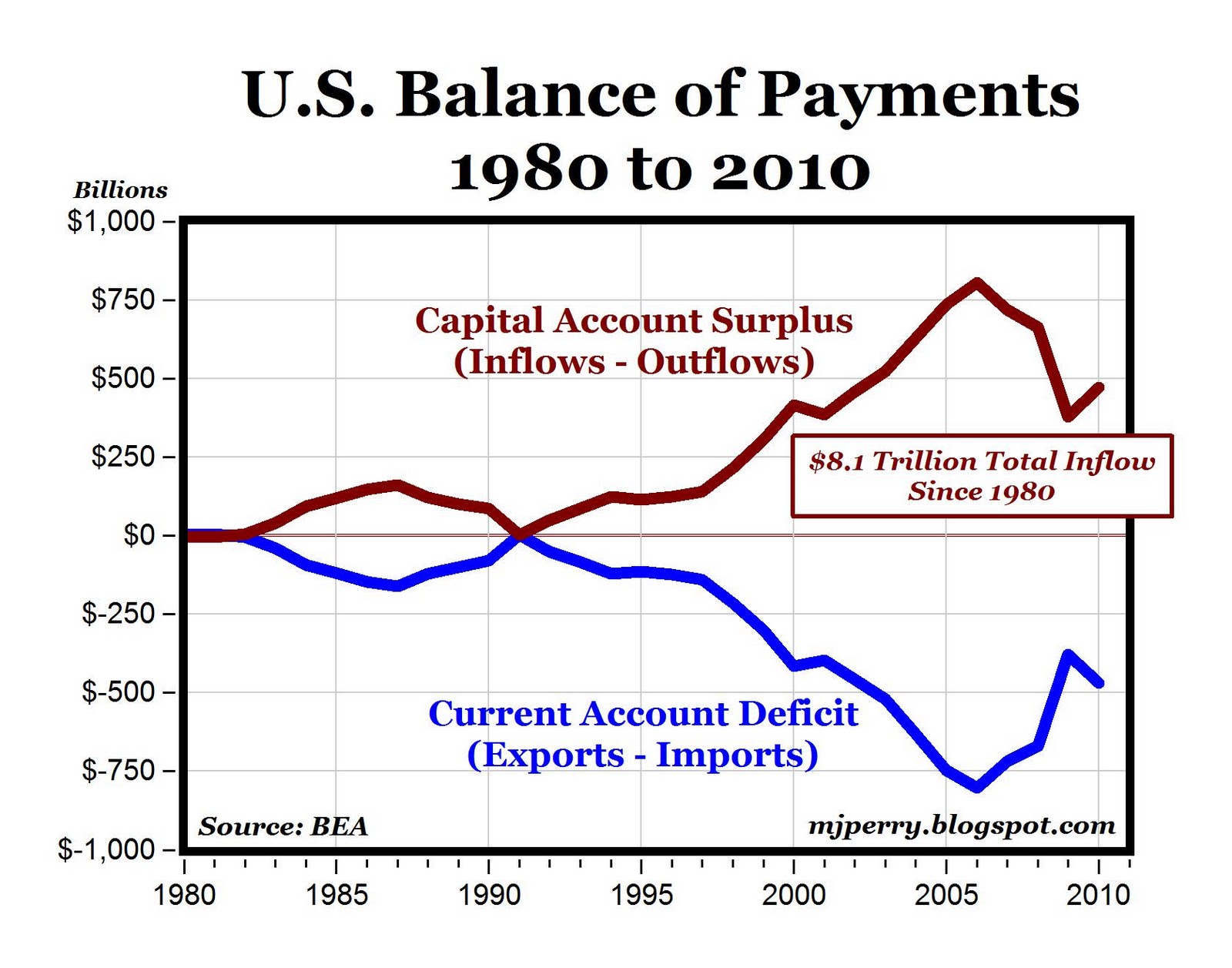
Trade deficits are a meaningless thing to worry about. They're not actual deficits of any kind, and they don't even accurately measure trade, since they generally don't include services or the chains of value-adding.
Manifestly wrong. Large trade deficits are unsustainable for three reasons. They cause private and public debt bubbles in the defect nation. They cause unemployment and underemployment in the defect nation. And, they can cause systemic inefficiencies in the surplus nations that lead to economic and social problems at home, and deflation abroad.
And they don't cause unemployment, they just change the composition of employment. Now, if a country resolutely insists on hampering its own economy with cartels and bizarre regulation, then yes, "trade deficits" can reveal some of those weaknesses more prominently, but they were already there.
Trade deficits are just a mercantilist phantom, conjured up by counting physical goods crossing a border, carefully not counting services and capital investment, and then claiming that wealth is being "drained". It's like measuring evaporation from a lake (exports), ignoring any and all precipitation (payment for exports), and then claiming that the lake is running dry, without actually measuring the water level (per capita income).
"Trade deficits" pretty much always comes down to "foreigners sell us things at a low price, therefore we need to fight them/restrict investment in our economy/make things more expensive for our own consumers". It's never been an actual problem.
I mean, you could solve the US 'trade imbalance' by making it extremely hard for foreigners to invest capital in the US. But of course this would have knock-on effects that make it harder for companies and workers in the US to access investment capital. Or you could shut out foreign goods - and ignore the costs of more expensive domestic goods for US consumers. None of this actually benefits people.
I see nothing in this article to distinguish it from the historically-always-wrong mercantilism that just kept drawing boundaries around areas and then yelled and shouted whenever more of one particular class of good went in than came out.
It almost certainly means that devaluation of the dollar is inevitable (the ultimate fate of any currency that runs an account deficit for long enough), but to say "war is inevitable, therefore declare war today" is ridiculous.
Are you saying that, or are you saying the Mr. Ma is saying that? Because if you are saying that then I'm pretty sure you haven't been following the news since August 6th ... of 1945. What the hell kind of war with China do you think is going to happen, one fought with bubble-gum? War with China means the doomsday clock goes to midnight and we all develop a nice healthy green glow.
Churchill
Playing chicken with an opponent who time after time demonstrates highly rational, self-dealing behavior is the opposite of insane.
And there is never a good time for war between two nuclear powers.
Anyone doubting this interpretation of Ma's comments needs to read Michael Pettis' commentary on Chinese economic policy:
http://foreignpolicy.com/2016/07/22/chinas-currency-manipula...
http://carnegieendowment.org/chinafinancialmarkets/66485
UPDATE: Comments claiming Ma only says, "keep trading"... don't understand how trade works between US-China (read Pettis links above), and are not paying attention to coincidental news from China about new DF-16 ICBM's pointed at the United States. Its almost as if China plans to negotiate trade with a gun pointed at the Trump administration's head.