I understand that this is wrong, and I know it's part of the messaging campaign of climate change deniers (which doesn't make it wrong, but does raise questions about it). First they said it isn't happening, then it isn't caused by humans, then it costs too much to fix, then there is nothing we can do about it. It's just one fallback position after another.
Climate change is a problem of degree; it's not binary. It can be better or worse, depending on what actions we take. The global temperature can rise 2 deg or 2.5 deg or more or less. The sea levels can rise X feet or X+1 feet or more or less. Droughts and can be more or less long and severe. These are very significant differences.
In terms of national priorities, even among Democrats, climate change takes a back seat to (1) jobs; (2) pensions; (3) education; and (4) healthcare. At the same time, it'll require a bigger change to the economy than any of those things.
And that even simple steps like not subsidizing coal, when natural gas is cheaper and there for responsible for the decrease in coal mining, it too expensive of a step?
>climate change is a problem
Do you "deny" that climate change can have non-problematic effects?
Can a temperature increase in one area be beneficial? Can a drought in one area mean more water in another area?
Or to put it in more stark: whatever minor benefits exist are outweighed by the massive risks to mid-long term survival of the human race.
Some think we can simply out-evolve/adapt these changes. That, to me, stinks of hubris.
[1] https://en.wikipedia.org/wiki/Clathrate_gun_hypothesis [2] https://en.wikipedia.org/wiki/Greenhouse_effect
Anyone who does not at least agree that there is evidence that is worrying and worth discussing does not know enough about the subject to be having opinions and posing suggestive questions about it. If you don't at least start with: hey, I understand you are not a total idiot and I understand how it may seem like there is strong anthropogenic climate change going on, but here is why I think that that is not the case, then discussion is pointless.
* It's from 2009
* It's not an official report or conclusion, but appears to be more of a discussion aimed at "scoping" the next report.
Still, it's far better than what previously informed our discussion here.
What evidence is there that climate change could cause more famine than it could increase crop yield?
Why is migration undesirable?
Have you been paying attention at all to European or American politics? Even the very small amount of migration being driven by the Syrian civil war has caused massive amounts of discontent and unrest in the richest nations on Earth. Now imagine whole regions full of people wanting to move because rainfall patterns change, or sea level rise displaces them.
Social unrest is the biggest risk that climate change creates. People like things the way they are, and get very upset when they think things are going to change.
Evidence-based consensus is good, and I am primarily interested in the evidence.
What evidence is there that rising sea levels will cause more harm than benefit?
What evidence is there that there can't be more crop production at more northern, theoretically then warmer, altitudes?
What evidence is there that there can't be increased animal diversity as previously colder areas become more habitable to different species?
A common misunderstanding of global warming is the belief that all points on Earth will see their temperature rise by the same amount.
The average temperature will rise, but many regions of Earth will actually see their temperature go down. Unfortunately, those regions are already not particularly warm, like Antarctica.
Northern regions of Earth have their temperature heavily tied to the amount of sunlight they receive. While they will indeed get warmer compared to now, they will still be cold, and there is nothing that can be done about the six months of night time. Going to Siberia is not the answer, no matter how much you like Mr Putin.
https://upload.wikimedia.org/wikipedia/commons/e/e6/Projecte...
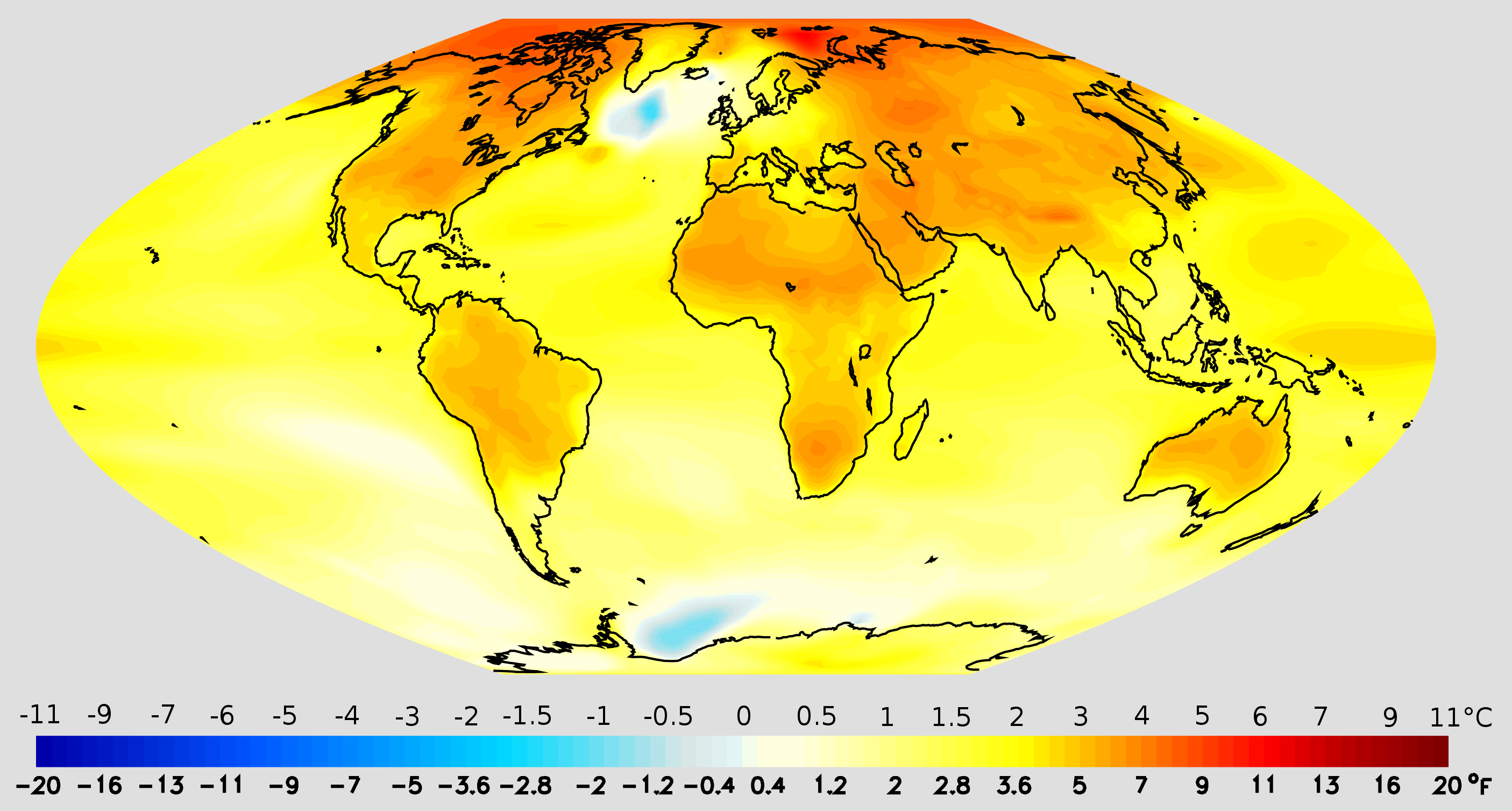
As for rising sea levels: for obvious reasons, settlements near the sea are common. Rebuilding all those cities will be a tremendous cost. Human migration will also be politically straining, which may cause a part of the US to secede. Immigration tends to irritate people for some reason. A famous US president was recently elected thanks to that resentment.
https://upload.wikimedia.org/wikipedia/commons/5/5c/6m_Sea_L...

As for wildlife, rapid changes in temperature are correlated with mass extinction according to the fossil record. In fact, we are already currently undergoing a mass extinction, which is expected to go on: https://en.wikipedia.org/wiki/Holocene_extinction#Global_war....
I point out that a group of people who are employed primarily by a single source are going to generate opinions that are favorable to that source.
If they don't, they are handicapping their ability to put food on the table. Work can still be found without catering to the primary source, but it's not as financially beneficial to do so.
This happens all the time in marketing. Although, to be fair, those studies are often preceded by a number of more accurate private studies, and only the publicized one is suspect.
It's a loose, circumstantial, conspiratorial aspersion, which has nothing to do with the facts of climate change. Maybe they could make more by providing credibility to the oil and gas industry.
Again, look up IPCC reports. We're not a forum of climate scientists. I believe gravity also exists; I haven't read the papers myself and don't have time to find them.
Nor would your or your loved ones' lives be saved next time you're in the hospital.
I only point out that there is an incentive to agree with the hand that feeds you. This goes for labs employed by industry as well.
You seem to be conflating the benefits of society with the benefits of a living, breathing academic who has kids to feed and bills to pay. There is no conscious "government" - there are only conscious individual actors.
No, they have to produce real, scientific studies which are peer reviewed by other scientists all over the world. If there's a bullshit study, that's usually quickly discredited and the scientist's reputation damaged. (See: Andrew Wakefield)
You're also living in a delusional world where scientists are not in high demand and can't find a much higher paying job at a private corporation, if they wanted to.
Doing science for a government contract is a step down for most scientists.
These are highly trained, skilled, educated, and intelligent people you're talking about.
If a scientist is biased by having an employer with an agenda, and that bias manifests in a study, then that study can be exposed as faulty by other scientists. That's how science works. So unless you believe a global cabal of thousands of scientists and their many different employers are all somehow coordinated in their unwillingness to judge each other's studies as flawed, you must give credence to the overwhelming support among scientists for the idea of anthropogenic climate change.
Likewise, if you believe the multitude of studies is flawed, then go ahead and show how. Pick any couple of dozen and have at it. There are plenty of employers with a strong and admitted bias against global warming (e.g. the oil and gas industry), and they employ scientists. If those scientists produce irrefutable studies disproving anthropogenic climate change, then that would become the accepted science, and those scientists would be viewed as luminaries in the field.
As for the cabal: unfortunately, many believe in exactly that -- including, nominally, President-elect Trump, who has stated climate change is a "hoax". I doubt he believes it's literally a hoax, but I don't doubt he understands that acceptance of the science threatens the bank accounts of those making money from the implicated processes. The same people driving the regulatory capture process, plowing money into congressional elections, etc. The real cabal is the force against the science.
There are so few studies leaning in the other direction that it should be easy to choose an "unfairly" discredited one and expose its field-wide refutations as illogical and biased.
We're SOL on stopping climate change, but what we're doing now will define how bad it gets, and the later we start the worse it will be and the harder the mitigation, as it has been since the 70s.
It's not a question of "SOL" or "token gestures" it's a question of how fast and how far it will go, and how much time we will have to handle such concerns as mass population displacements.
Not doing anything is a giant middle fingers to those who follow us, or for those of us who won't be dead within a generation (aka pretty much anyone other than the boomers), a middle finger to future us.
I really want to push back on this. This is in fact an anti-climate-change talking point used to say, "Look it just doesn't matter what we do." While it's true that the destabilizations currently taking place are absolutely a part of our lifetime, in the 200 year timeline the scientific consensus is that if we cut our emissions substantially within this century we will in fact avoid locking our descendents into a full climate flip that is NOT avoidable.
The canonical paper people quote about this is: http://www.ecoequity.org/wp-content/uploads/2009/07/meinshau...
We need to play an aggressive game before 2050, and we can save the ice caps. That is not a token gesture. That's the line that we can draw to not destroy every coastal city in the world.
It's disingenuous to claim that there are only token gestures. Chinas commitment is real, Europes commitment is real, India is more questionable, but the Obama administrations actions through the EPA were also real.
Trumps win will cost us. It means many many more gigatonnes of CO2 in the air, that means a hotter planet, and that means more dead poor people. To the best of sciences ability to tell, THAT is reality.
Empathy, education and concession seems like our best chance.
To adapt a quote.... when they go low and don't realise it, you should still go high.
The "clean coal" that Trump has pushed for costs way too much money to create, transport, and responsibly store the solid carbon. Coal already has a price advantage when compared to natural gas.
However, I agree with you that the voters in Appalachia generally vote against their own interests. Usually for social reasons.
Duck duck go even have a bang command for it (!ud).
ahh S--t, so I did
http://www.cbc.ca/news/canada/phytoplankton-climate-kachur-1...
http://nationalgeographic.org/activity/save-the-plankton-bre...
By "bearing the brunt" you mean "having jobs"? Have you asked them whether they would rather have jobs or not?
Also, they know perfectly well that closing their coal mines doesn't mean that coal doesn't get mined and burned. It just gets mined and burned in other countries where environmental regulations are non-existent.
The simplistic "coal is bad" thesis has a) put a huge number of Americans out of work and b) made the global environment worse.
I'm confident you have sources on b.
Yes.
http://www.eia.gov/todayinenergy/detail.php?id=9751
1) China consumes more coal than the rest of the world combined.
2) Environmental regulations in China range from "minimal" to "non-existent". Do you need sources on that as well?
1. https://www.google.com/amp/mobile.nytimes.com/2016/08/18/wor...
[1] https://www.google.com/amp/s/amp.theguardian.com/environment...
https://en.m.wikipedia.org/wiki/Coal_in_China
Yes, China does produce a lot of solar but what percentage of electricity is that?
https://en.m.wikipedia.org/wiki/Solar_power_in_China
You are speaking in generalities and not using hard data. That is no way to analyze a problem.
I'm not sure why this is confusing.
I'm also not sure why people are modding down factual posts. That type of behavior is exactly what's given you President Trump.
http://www.reuters.com/article/us-column-russell-steel-china... http://www.ita.doc.gov/steel/countries/pdfs/imports-us.pdf
But coal is bad. The coal industry costs about half a trillion in externalized damage to health and the environment annually in the US alone: http://m.huffpost.com/us/entry/831755.
And ironically, the voters in Appalachia being courted are bearing the brunt of it so people in surrounding urban areas can have cheap power: http://www.coal-is-dirty.com/blasting-appalachian-economy.