I doubt donations would be even half of what his creator is getting now.
$70 dollars is already pretty ok, considering I was paying above 150 with student discount on the mid-90 for software tools.
Why this urge to get stuff for free, yet wanting to sell own work.
And yes, I do donnate to all FOSS projects relevant to my work, as if I had bought a license.
I know there are many people who will obey the license, but would not donate. If you dual license it (commerical and GPL), they'd just accept the GPL "deal". So it still makes sense to not have a GPL option business wise.
But what about, instead of open source, they make it "source open" or "source available"? Here is the source, you may not use it unless I die. Or you may use it, but not sell it. Or you must contribute changes back if you release a changed version...
They have no big trade secrets in the source. They already rely on the fact that customers obey licenses that they materially don't have to. So I believe they have nothing to lose by making the source available.
While it's true you can charge for your OSS product, all OSS licenses allow the recipient to distribute the source code (and the built binaries) at no cost. So, OSS does imply free, even if it doesn't mandate it.
>> Just please consider making it free software for all of us
I took that to mean the OP wanted it to be "free as in freedom" not "free as in beer".
For instance, if Apple decided today "Hey why not just make OSX a set of applications, a window manager, and a desktop environment for Linux and make it free software." I'd pay for it. I'd pay the 100 bucks because no one really does UX better then Apple.
I would prefer to acknowledge on-going development costs and pay those for a continually-developed, high-quality editor.
I think he should at least put a demo time limit on using Sublime Unregistered. It's established enough now, and the extra revenue could help speed up development. There are a few things that Atom does in a nicer way, like package management.
But Atom doesn't feel nice because of the speed issues, for me.
I doubt it would be a very good move for the author.
I'm pretty certain that both emacs & vim can do anything Sublime Text can do, but I'm open to being shown otherwise.
Keyboard commands aren't the reason I want Sublime Text. I want it for the amazing plugins that support a load of features as well as having a graphical user interface.
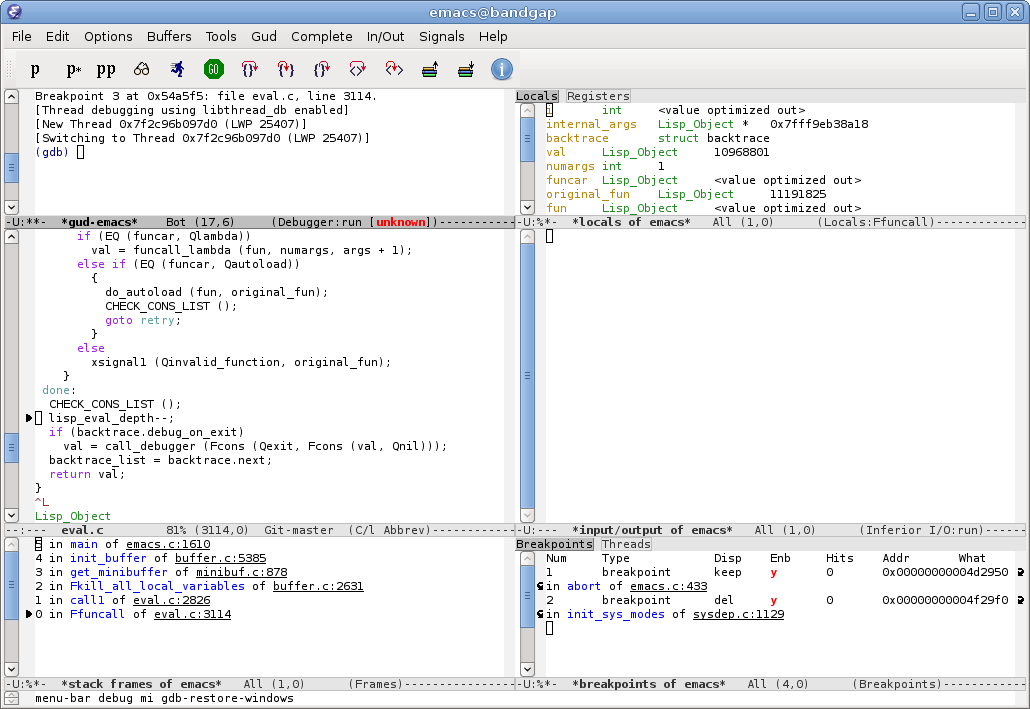
There's a reason people have spent so many years using it.
For example, if there is already a selection, right click in Emacs extends it much like pressing a shift-arrow key does in a typical GUI. (Most modern GUIs will of course pop up a contextual menu in that situation.)
Similar to the keyboard-driven part, as much as possible of the GUI part of Emacs is implemented in Lisp, so it seems to me (as someone who has modified his copy of Emacs to pop up a contextual menu on right click) that it would be fairly easy to write a GUI for Emacs that adheres much more closely to modern conventions than the GUI that comes with Emacs does, but the only project I know of that has tried to do so is the Aquamacs project.
If you continue to use the evaluation copy after you're done evaluating it, nobody's going to stop you, but it is a little dishonest.
If you're an amateur (in the literal sense, not as an insult), then you might be more inclined to pirate it. I guess the developers are savvy enough to realise this, and just put a nag-screen in instead.
Bottom line, some people have the luxury of having such well-paid jobs that open source is a real possibility nowadays. But ST is likely someone's income/living, and shafting the devs isn't cool at all. If you're not happy with this, you can always make another editor, but it turns out to be fairly hard to do (see Atom).
Well, same goes for ST3. Just because it doesn't have agressive DRM and lockouts doesn't make it any more free.
I personally believe creators of software (music, games, other immaterial goods) should be compensated and rewarded fairly, and I gladly let them have their fair share.
At the same time, I find it ridiculous to pay for something that can be copied at no cost. The technology allows everything to be free, but we force an emulation of physical goods onto the digital world, so we don't have to change the way or society works. We use the legal system to enforce this.
I haven't found a way to reconcile these two views yet, this is a major unsolved problem in our society. I believe a solution would need a radical change in how our economy works.
But in the meanwhile, I have no moral problem to "pirate" stuff when I can't afford it or think it is to expensive.
Acrobat Pro? Photoshop? As rarely as I need it and as expensive as it is: Free. MS Office: has become to cumbersome to pirate, costs. Sublime Text? I like the product and want the Indy developer to succeed, so costs, too.
I'm not sure what your difficulty is. There's almost no cost to create a copy, but creating the original has many costs. Since no one is going to pay for creating the original upfront, the developer asks people to pay for the copies, and legal protections ensure that's possible.
Reminds me of an episode of West Wing that discusses the cost of pharaceuticals:
"Why do they charge $100 for a pill that costs $1 to make?"
"Because the first pill cost $100,000,000 to make."
Just let us pull the wool over our own eyes, please.
Pause for a moment and reflect on the few posts above. It feels really weird to conflate in the same breath the entertainment industry and healthcare. I don't believe it's a given that the same standards should apply to both, but the topic flows like it's just that (and I vaguely remember it being about a text-editor, once ... ;) ).
So, entertainment and some perspective on the status quo; It's been roughly half a century since the entertainment/media/content distribution industry has been growing into a very powerful political lobby, pushing for more stronger enforcement of intellectual property rights in the face of changing information technologies.
Some person who doesn't know any better might think, "Hey wait what, artists holding political power? That sounds like one of those crazy counter-culture TAZ-type pipe dreams, I always wondered what would happen if that would actually come to happen ..." -- except of course it didn't because it's not the artists, it's the middle-men that hold nearly all the power -- I'm not that person btw, nor saying I want artists to rule the world ;) Just painting a silly picture to show what intellectual property rights on the surface seem to do (protecting content-creators) but in addition shifting a disproportionally large amount of power completely elsewhere ("rightsholders", "the content industry", "big media", middle-men, etc).
Now here comes the magic trick. Enforcing IP rights, tightening the laws, going after pirates, DRM, all that stuff the content industry is lobbying for, apart from generic "control", what does it really accomplish? It basically tries to make intellectual property into a fungible good. That's what it does. But you can rule and legislate all you want, that doesn't make it so. All that's happened is that you've ruled and legislated it so that people must act (and pretend) that intellectual property is a fungible good. Carefully worded legislation to change a fundamental aspect of reality, it's the closest thing to a magic spell you'll see.
Imagine the other way around, imagine a "free and open matter lobby" decreeing that bananas should no longer be considered a fungible good and that anyone should be able to copy bananas freely. Carefully worded legislation tip-toes around the insanity of this idea, in a way that makes it illegal to commercially differentiate between an "original banana" and its copies, or that copies of a banana are somehow less nutritious than the supposed "original", regardless of the medium they're copied on--instead the big players in the industry advertise their bananas as being intrinsically "more copyable" than the competition (whose bananas are rumoured to come from a "master copy", which is an atrocious lie, as it is illegal to keep track).
If only we could liberate more fruit, we might solve world hunger and in particular we could feed all the starving artists. Maybe next century!
There is no separate shareware version. What makes Sublime unique is that it never stops working; it's evaluation period is open, and treats the user as an adult to do the right and legal thing.
I do get mad when people don't give them money since I really appreciate the model.
It's great that Sublime doesn't have strong DRM, but using the free version indefinitely is just as wrong as using a cracked version of Photoshop, IMHO.
I do care about my fellow developer who wrote ST and seems a nice guy, which is a reason to pay... So maybe I'm not a sociopath after all.
And as someone running a business, it is a significant and unnecessary liability to use pirated or unlicensed software.
Good work to the people behind it, it's an amazing feat no doubt. Just please consider making it free software for all of us who care about that just a bit. Amazing work none the less.