That's not the whole story. The reason Greece is where it is today is because of the cruel austerity package imposed upon them by their European creditors. Here's a chart of their GDP: http://www.tradingeconomics.com/greece/gdp
Now of course there are other reasons as well - Greek manufacturing is non-existent, partly because they outsourced their manufacturing to Europe, who went to Greece en-masse for vacations, but then didn't when the global financial crisis hit.
And of course, having an integrated currency but separate government structures isn't the best idea when you have multiple economies that are at disparate levels of wealth. In an ideal world, Greece would have been able to manage their currency and exchange levels (ie. print money), but of course they couldn't.
As part of the EU, Greece essentially got the worst of both worlds - high import costs, lower (relative) income from tourism. And no control over their own currency. And to make matters worse, they got shit treatment from their creditors - their GDP has plunged since the onset of austerity measures, as has government income.
While perhaps Greece could have done more, they did what they were expected to as part of the EU, and it backfired horribly. Now they're finally doing what needs to be done, and the EU cries foul...
History doesn't start in 2010. Greece pretty much lied to get into the EU and is a badly run country, at best, and a corrupt hell-hole at worst. Low retirement ages, low taxation due to fraud, government being the largest employer, lack of diversification, etc.
Its easy to take this hip anti-EU position for upvotes here, but you're defending a shittily run country in almost every respect.
Please don't spread this toxic myth about Greece. http://www.newstatesman.com/blogs/world-affairs/2012/05/expl...
See more at: http://greece.greekreporter.com/2014/12/04/75-of-greek-pensi...
All developing economies have corruption and productivity issues, the problem isn't that Greece is below the European par, but that they haven't been given enough time, and European creditors set them back a decade.
[1] https://www.nationalpriorities.org/budget-basics/federal-bud...
[2] https://www.google.com/search?sourceid=chrome-psyapi2&ion=1&...
This was much worse than a transfer union (where countries are supposed to help each other in times of crisis, alleviating suffering of the people): it was a direct transfer from the European taxpayer to the big banks - mainly French and German. This was neither in any way legitimated by the public, nor is a Eurozone mechanism. It was decided by the European financtial institutions because it made financial sense, so that the European financial system would not collapse.
Once this has been accomplished, it seems that Greece can be disposed of - risking even the disintegration of the Eurozone. Not much good can come of this.
So let's put this in perspective: Germany has benefited manifold of the european crisis:
- extremely low interest rates paid on debt, as opposed to what the Greeks are experiencing. Some of this is based on fundamentals, some of this is pure speculation, which has hugely benefited Germany and hugely in detriment of the Greek.
- big capital gains for the private German banks by investing in risky Greek bonds (help for the Greeks, which was good)
- no loses on the investments, thanks to international help to unload investments once the situation has started to go out of control. They have enjoyed the upside of their investment, and thanks to intervention by the European authorities, no downside.
And the Euro in general has been a big win for Germany thanks to its low exchange rate.
Now the Germans are risking all this in the name of economic Orthodoxy, but Orthodoxy exists to be broken in exceptional times, as it has been broken in the Eurozone several times during this crisis, as the US has broken it (quantitative easing), as the UK has broken it (buying bankrupt banks), as Island (out of the crisis by now) has broken it. Germany itself has broken it several times in the past - breaking the 3% deficit comes to mind.
And now we can not break it to restructure the debt of a country with a GDP lower than the 2% of the Eurozone's GDP? Give me a break!
This is what gets me. Such is the cosiness between banks and government that this happens. Banks essentially win big time by buying bonds with absurdly high interest rates (that require herculean sacrifices by the citizens of the affected countries to even attempt to repay), all the while completely bypassing the risk that made the interest rates s high in the first place!
And yet if nations are going to share a currency, they need to have a coordinated economic policy, and that ends up happening. Wealthy states in the US perpetually give money to the poorer states, but there isn't an uproar about it. Seems like the EU was doomed to fail if it didn't allow for this.
Not to mention the fact that the EU was also never meant to be a debt collection agency, which means that since German and French banks insisted on buying up higher-yielding Greek debt, they richly deserve to share the consequences of it being unsustainable with the Greek taxpayer.
If you know of good stats I'd love to see.
They took Federal contracts, grants, direct payments and insurance payments to a given state and weighed it against the IRS data for the residents of that state.
Interestingly enough, of the 50 states received back less that $1 for every $1 they paid in, meaning they were net payers. The rest of the states were net receivers of federal money.
A bit easier to see this conclusion here: http://cdn.theatlantic.com/assets/media/img/posts/2014/05/Sl...
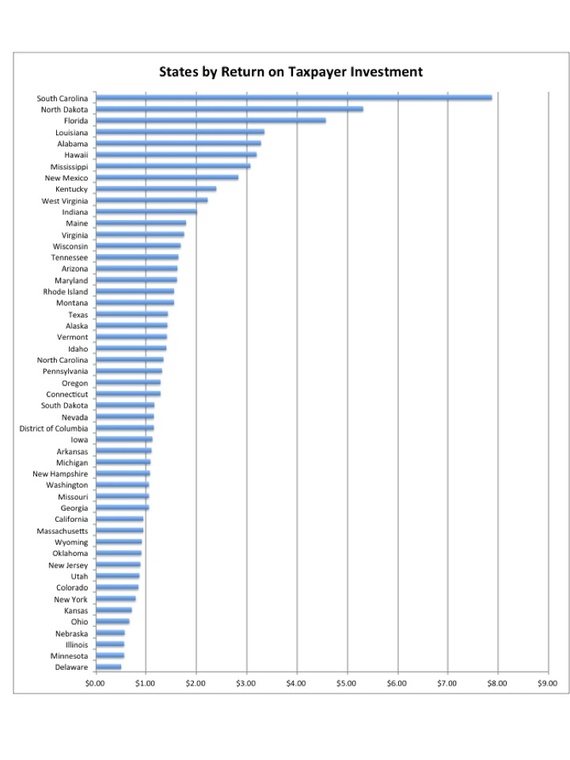
IMO any state that's over 2:1 money in vs out is clearly being subsidized. Granted it's a rough estimate as VA probably receives more money than suggested as so many people commute into DC for federal jobs.
The only thing you've pointed to that looks anything remotely like heading toward bankruptcy is Puerto Rico, which is not a state.
The EU maybe not. The Eurozone, on the other hand, must have a compensation mechanism to allow for the inclusion of countries as different as the Netherlands and Portugal (to use examples far from the polarized Germany<->Greece spectrum).
Whenever a country has a chronic balance of goods surplus, its currency will gain in value. This keeps the surplus from accumulating, by making imports cheaper and exports more expensive. However, combine chronic surplus and chronic deficit in the same monetary zone, and they cancel out. Neither the surplus nor the deficit get corrected automatically by the market.
Now, you can't have a chronic surplus, not any more than you can have a chronic deficit. Either you compensate through other channels of monetary transfer (investment, differential taxation, redistribution), or you are letting the system go in freewheel mode.
If you don't compensate, something is gotta give.
Is that why it's so easy for the rich over there to hide all their wealth in tax havens like e.g. Luxemburg? To avoid transferring any wealth to the country where they actually made it all, via taxation?
A bigger worry globally is that China is starting to show serious economic cracks. It's certainly going to be an interesting time ahead.
Both of these default decisions are more ideologically driven (setting precedents) than they are borne of actual economic necessity, such as the TBTF bank bailouts of 2008.
In Greece's case it's not even the private sector's problem anymore as debt restructuring transferred debt from the banks to the EFSF, an entity funded by public, gov't funds (mostly German, French, & Italian). [0] It's fantastic to see how these debt restructuring deals really work. In essence, creditors wrote down 25% of the debt in order to transfer private risk that they had taken on themselves onto the public.
So the direct losers in the case of a Greek default are the taxpayers and, by the transitive property, the politicians of Germany, France and Italy. Indirectly it would be a blow to investor confidence in the EU, but many would probably see Greece leaving the EU as a positive for the overall EU economy and the Euro.
[0] http://www.socialeurope.eu/2012/03/the-mystery-tour-of-restr...
Or maybe he's crazy like a fox and was courting Russia and China to counter the EU as gambler brinkmanship, but if that was true, there would be a deal by now, not a referendum that will, most likely, remove Greece from the EU.
As a Greek-American I'm always shocked at how extremist the people are there when I visit. They're not like Germans who take something of a middle of the road approach, at least by Euro standards. They're an entirely different beast and I think other EU members are only starting to notice. The EU taking on Greece is like the US making Cuba the 51st state. The culture and governmental divides are huge. It was a bad idea from the start.
I suspect Greece is lost to the EU and somewhat to the West for quite some time. Greeks are prideful people and "OXI" is ingrained into their culture, good or bad.
gasp We can't possibly allow a country to do something we don't agree with just because the people want it! That would be undemocratic!
Nice try. Have you seen their GDP numbers? Their worst quarter was just over 1% contraction, their GDP is around 2% off their all-time high.
Alexis Tsipras and his government have accelerated Greece's decline with their rhetoric, driving bank money out which is reducing the money supply which constrains any recovery. They had to lock down the banks because their economy cannot simply exist on money the state has banked
The EU was never meant to be a transfer union, if it headed that way all the rich nations would likely bail and current politicians would face political defeat.
Close to home (US) Puerto Rico is having difficulties paying their bonds for similar reasons, believing that they could get bailed out just because of what they are.