Now I have to spend days and possibly weeks refactoring dozens of functions and breaking them apart in to managable services so we can not only use them, but also extend and test them.
I'm afraid what Carmack was talking about was meant to be taken with a grain of salt and not applied as a "General Rule" but people will anyway after reading it.
This approach of raising the bar for introducing functions might do well with my "trace tests". I'm going to try it.
[1] Sorry, I've temporarily turned off my site while we wait for clarity on shellsock.
You're getting more coupling to a codebase-wide object then, which goes against some principles, but it allows testing by doing things like
function awesomeStuff(almostAwesome) {
  MoreAwesomeT f1(somethingAlmostAwesome) {
    TestSingleton.emit(somethingAlmostAwesome);
    var thing = makeMoreAwesome(somethingAlmostAwesome)
      // makeMoreAwesome is actually 13 lines of code,
      // not a single function
    TestSingleton.emit(thing);
    return thing;
  };

  AwesomeResult f2(almostAwesomeThing) {
    TestSingleton.emit(almostAwesomeThing);
    var at = makeAwesome(awesomeThing);
      // this is another 8 lines of code.
      // It takes 21 lines of code to make somethin
      // almostAwesome into something Awesome,
      //and another 4 lines to test it.
      // then some tests in a testing framework
      // to verify that the emissions are what we expect.
    TestSingleton.emit(at);
    return at;
  }

return f2(f1(almostAwesome));in production, you could drop testsingleton. In dev, have it test everything as a unit test. In QA, have it log everything. Everything outside of TestSingleton could be mocked and stubbed in the same way, providing control over the boundaries of the unit in the same way we're using now.
I've had to change an implementation that was tested with the moral equivalent to log statements, and it was pretty miserable. The tests were strongly tied to implementation details. When I preserved the real semantics of the function as far as the outside system cared, the tests broke and it was hard to understand why. Obviously when you break a test you really need to be sure that the test was kind of wrong and this was pretty burdensome.
"..trace tests should verify domain-specific knowledge rather than implementation details.."
--
More generally, I would argue that there's always a tension in designing tests, you have to make them brittle to something. When we write lots of unit tests they're brittle to the precise function boundaries we happen to decompose the program into. As a result we tend to not move the boundaries around too much once our programs are written, rationalizing that they're not implementation details. My goal was explicitly to make it easy to reorganize the code, because in my experience no large codebase has ever gotten the boundaries right on the first try.
I think maybe the answer is that you want to do the development all piecemeal, so you can test each individual bit in isolation, and /then/ inline everything...
That sound like it might be effective?
Current experience indicates however that such end-product testing gives you no real advantage to finding out where the problem is occurring, since yeah, you can only test the whole thing at once.
But the sort-of shape in my head is that the god-function is only hard to test (after development) if it is insufficiently functional; aka, if there's too much state manipulation inside of it.
Edit: Ah, hmm, I think my statements are still useful, but yeah, they really don't help with the problem of TDD / subsequent development.
I’m not so sure. I’ve worked on some projects with that kind of test strategy and been impressed by how well it can work in practice.
This is partly because introducing a bug rarely breaks only one test. Usually, it breaks a set of related tests all at once, and often you can quickly identify the common factor.
The results don’t conveniently point you to the exact function that is broken, which is a disadvantage over lower level unit tests. However, I found that was not as significant a problem in reality as it might appear to be, for two reasons.
Firstly, the next thing you’re going to do is probably to use source control to check what changed recently in the area you’ve identified. Surprisingly often that immediately reveals the exact code that introduced a regression.
Secondly, but not unrelated in practice, high level functional testing doesn’t require you to adapt your coding style to accommodate testing as much as low level unit testing does. When your code is organised around doing its job and you aren’t forced to keep everything very loosely coupled just to support testing, it can be easier to walk through it (possibly in a debugger running a test that you know fails) to explore the problem.
Local function bindings declared inline perhaps? It seems to me you could test at that border.
But, it sounds like what you are dealing with is not inline blocks of separable functionality. Sounds like a bunch of good-old, giant, messy functions.
I'm not fanatical about TDD, but in my experience the trajectory of a design changes hugely based on whether or not it had tests from the start.
(I loved your comment above. Just adding some food for my own thought.)
I'm still not sold on the benefits of fine grained unit tests as compared to having more, and better, functional tests.
If the OPs 1k+ methods had a few hundred functional tests then it should be a fairly simple matter to re-factor.
In "the old days" when I wrote code from a functional spec the spec had a list of functional tests. It was usually pretty straightforward to take that list and automate it.
Just so long as the outer function is testable and side-effect-free.
I don't think that's the kind of "inlining" being discussed -- to me that's the sign of a program that was transferred from BASIC or COBOL into a more modern language, but without any refactoring or even a grasp if its operation.
I think the similarity between inlining for speed, and inlining to avoid thinking very hard, is more a qualititive than a quantitative distinction.
I think what's being discussed here is quite either of those - this seems to be "inlining for visibility" and possibly "inlining for simplicity".
My first best-seller was Apple Writer (1979) (http://en.wikipedia.org/wiki/Apple_Writer), written in assembly language. Even then I tried to create structure and namespaces where none existed, with modest success.
Indeed. The definition of the DRY principle [1] is:
Every piece of knowledge must have a single, unambiguous, authoritative representation within a system.
and not:
Don't type the same characters into the keyboard multiple times.
People often forget that.
One nice thing that falls out of Scala's syntax is that it makes this style possible without using mutation:
    val result1 = {
      val bar = barFromFoo1(foo)
      // ...
      baz.awesome()
    }

    val result2 = {
      val bar = ... // unrelated to 'bar' above
      bar.awesome()
    }
In Java you can separate the declaration and assignment of a final variable as long as every branch provably assigns to the variable. For example:
  final int x;
  if(someCondition) {
      final int a = 1;
      final int b = 2;
      x = a + b;
  } else {
      x = 0;
}As a side note, I'd love to see Scala make it's way into game development. I've been messing around trying to get libgdx working with it. But I would love something that lets me take full advantage of the Scala language.
        switch (getchar ()) {
            break; case ' ': enter_text ();
            break; case 'f': view = formulas;
            break; case 'h': col = (col == 0 ? 0 : col-1);
But I mostly stopped coding in C after around this time.
Interestingly, in http://canonical.org/~kragen/sw/dev3/paperalgo, I haven't yet run into the desire to have more than one `case` in a pattern-matching `switch`. I just added that piece of code from Vicissicalc to the paperalgo page.
My coding style seemingly morphs about every few months now. It's sad to think stuff I wrote even three years ago I would never show someone interviewing me or put it in a portfolio nowadays.
    AwesomenessT largerFunction(Foo1 foo1, Foo2 foo2)
    {
        ResultT1 result1 = [&] {
            Bar bar = barFromFoo1(foo1);
            Baz baz = bar.makeBaz();
            return baz.awesome();
        } ();

        ResultT2 result2 = [&] {
            Bar bar = barFromFoo2(foo2);
            return bar.awesome();
        } ();

        return result1.howAwesome(result2);
    }
    const auto values = [&] {
        std::vector <int> v (n);
        std::iota (begin (v), end (v), 0);
        std::shuffle (begin (v), end (v), std::mt19937 {seed});
        return v;
} ();I also try to explicitly name which variables I'm capturing (within reason) as it makes it obvious at a glance what can and can't be modified within the lambda. I really wish it was possible to force constness on captured variables :/
To isolate all of the initialization logic for a single object (e.g., "result1" or "result2") into its own scope. You could use a function (in fact, that's exactly what's being done here—it's just an anonymous function), but moving that logic away from its use and into global scope generally just makes the code more difficult to understand.
> There's no benefit and only drawbacks over the plain old block syntax.
You cannot initialize a const object with the "plain old block syntax." With this, you can, and that is an enormous benefit. It's also much easier to see that the object is initialized; it's not immediately obvious that an uninitialized variable declaration followed by an assignment many lines later will always initialize the variable, but if you initialize it in its declaration, you know it will necessarily be initialized. That is also a very important benefit.
What are the drawbacks? That the syntax is a little uglier? It's not ideal, but it's hardly huge syntactic overhead: four or five non-whitespace characters and a return instead of an assignment. In fact, the syntax is markedly better if you have multiple initialization paths, because you can use return instead of goto; compare
    char* foo;
    {
        char* mem = (char*) malloc (N);
        if (!mem) {
            mem = NULL;
            goto foo_init;
        }
        if (!fgets (mem, N, fd)) {
            free (mem);
            mem = NULL;
            goto foo_init;
        }
    foo_init:
        foo = mem;
    }

    the_next_thing:
    char* foo = [&] {
        char* mem = (char*) malloc (N);
        if (!mem)
            return NULL;
        if (!fgets (mem, N, fd)) {
            free (mem);
            return NULL;
        }
        return mem;
    } ();

    the_next_thing:
In contrast, once you've seen that foo is initialized by a function and that function ends in an unconditional return, you know that foo cannot not be initialized at the_next_thing, period (even if you throw exceptions into the mix!).
You might argue that you can verify the correctness of the first version, and of course you can, just as you can verify the correctness of an HTML parser written in brainfuck. It's all a matter of cognitive load, of the amount of context you have to hold in your head at one time to reason about the correctness of one part of your code. It's the difference between verifying that the function initializing foo has an unconditional return and verifying that every control path in the initialization block reaches foo_init, when what you're really trying to do is just to show that foo will point to a valid string at "the_next_thing."
In fact, that's basically the primary motivation behind functions, next to code reuse. All this pattern is really doing is modularization-by-function of initialization logic without the cognitive overhead induced by lexically separating the logic's definition from its use. In doing so, it delivers the same advantages as the plain-initialization-block pattern, but preserves the comparatively simple control-flow-barrier semantics of functions.
Compared to goto-spaghetti, typing "[&]" and "();" really isn't that big of a deal.
> Some practical Matters --- Using large comment blocks inside the major function to delimit the minor functions is a good idea for quick scanning, and often enclosing it in a bare braced section to scope the local variables and allow editor collapsing of the section is useful. I know there are some rules of thumb about not making functions larger than a page or two, but I specifically disagree with that now -- if a lot of operations are supposed to happen in a sequential fashion, their code should follow sequentially.
He is absolutely correct in this. However, he's wrong with regards to the level of abstraction. Those "operations" should be part of functions that could be scattered all over the code base in whatever order they were written. But at the end of the day, they will be called sequentially right next to each other.
I've often found this to be the case. The developers I see that make these "god" functions are unable to write and compose their code in layers. They instead see the entire run (start->finish) of their programs as one giant series of "sequential" "operations". So what ends up happening is they've got high-level code, interspersed with low level io/networking/db calls.
At work, I have a 450 line function. What it does is very simple:
1) validate the request; if it's invalid, send back an error. 2) look up some information. 3) send that information.
Step 1 is around 300 lines. But a majority of the lines are huge comment blocks describing what the check is for and referencing various RFCs. Yeah, I could have broken this part off into its own function, but ... there will only be one caller and doing so would be doing so for its own sake [1].
Step 2 is one line of code (it calls a function for the information).
Step 3 is the remainder; it's just constructing the response and sending it.
The code is straightforward. It's easy to follow. It's long because of the commentary.
[1] I did have to deal with a code base where the developer went way overboard with functions, most of which only have one caller. It's so bad that the main loop of the program is five calling levels deep. I once traced one particular code path down a further ten levels of function calls (through half a dozen files) before it did actual work.
When I confronted the developer about that, he just simply stated, "the compiler will inline all that anyway." And yes, the compiler we're using can do inlining among multiple object files, which makes it a real pain to debug when all you have is a core file.
There is benefit in being able to group the chunks, and maybe your comments are quite obvious in the grouping. But if I know I'm looking for a "validation" bug, and I come across a grouping of three functions which are called, say, "PrepareRFCRequest", "GetResponseInformation" and "ConstructResponse" then I can very easily deduce that they're not related to my problem and ignore them. You could say they're not my concern.
A lot of these things I talk about build upon each other. i.e. If you then go ahead and put some sort of input validation inside of your "GetResponseInformation" function, then the grouping / function abstraction is pretty much useless and may even be detrimental when debugging, e.g. in my example above.
"there will only be one caller and doing so would be doing so for its own sake" No, there is benefit to putting it in its own function. Even if there is one caller. Because creating functions isn't always about reducing duplication, but of concerns/abstraction and to me above all composability.
"[1] I did have to deal with a code base where the developer went way overboard with functions, most of which only have one caller. It's so bad that the main loop of the program is five calling levels deep. I once traced one particular code path down a further ten levels of function calls (through half a dozen files) before it did actual work."
Perhaps you, I, and the developer you speak of have a different view of what the "main body/loop" of the program, or any program in general.
It almost sounds like you're talking about http://canonical.org/~kragen/sw/dev3/server.s! Or for that matter http://canonical.org/~kragen/sw/aspmisc/my-very-first-raytra...! But it's unlikely you've had to maintain either of them. I intentionally broke things up like that with the idea that it would make it easier to understand. In fact, I originally wrote httpdito as straight-line code and only later factored it into macros to make it easier to understand.
It sounds like you're saying that this was misguided and I should have just used nesting. I'll have to think about that for a while.
Things like database reads/writes should be refactored out immediately. This is boring stuff that only challenges inexperienced developers. Most developers with some experience can grok the idea of a function named 'SaveToDB(stringthing)' or something like it. When not dealing with common operations, the key here is repackaging your functions in a way that the meaning is significantly conveyed through the name of that function without the name being excessively long. Short function bodies also ensure that things remain quickly absorb-able.
Taking if-blocks or loops and putting them into their own function just to shrink the size of the god function to pretend you're refactoring really serves no purpose though (IMO). This is especially true if the number of times those functions are called is less than 2. (believe me, I've seen it!)
They should be refactored out, yes, but refactored out in a different component with little (ideally none) logic in it, not a different location of the higher-level component.
> Taking if-blocks or loops and putting them into their own function just to shrink the size of the god function to pretend you're refactoring really serves no purpose though (IMO). This is especially true if the number of times those functions are called is less than 2.
Of course it serves a purpose. Take a codebase where you have functions that go over 5 or 10 screens. Now, take a codebase which does the exact same thing, but where the god function is split into smaller and smaller functions depending on the complexity. The second codebase is much easier to read (as long as function names are well chosen). It also means that most, if not all, of the comments necessary to understand codebase 1 (which may or may not be present, and may or may not be up to date) can be removed. The number of call sites for a function does not matter. What matters is how small functions make the code easy to read.
I guess I'm different to you in that regard. To me, my "brain dump" is a bunch of function skeletons that I write out at a high-level. E.g. if I know at some point I'll have to parse a file, I brain dump it as:
result = parse_file(get_file_data())
At that point, I've already defined my "higher-level" brain dump (as you call it) without having to worry about stuff like file-format, filenames, checking for deleted files, etc.
"Taking if-blocks or loops and putting them into their own function just to shrink the size of the god function to pretend you're refactoring really serves no purpose though (IMO)"
Well, depends on the if-blocks I'd say. 99% of the time, I bet you that those blocks and loops can grouped into logical pieces of work that happen in stages. Claiming that we do it just to "pretend" we're refactoring doesn't really add anything to the conversation.
I hadn't understood this "maybe leave functions inlined" rant a couple years ago when I first heard about it - it makes a lot of sense now.
It can look a bit daunting at first sight - if you're not used to this style of code, it just looks like your average rambling stream-of-consciousness function - but it's actually pretty easy to keep on top of. And if people really complain, it's super-easy to split out into functions :)
   let result = {
       let b = foo(a);
       let mut c = b.see();
       while (c) {
         c.frob();
       }
       baz(c)
}; let result;
{
let b = foo(a);
let mut c = b.see();
while (c) {
c.frob();
}
result = baz(c);
}The very nice upside would be that you could make the inputs to the blocks explicit. In contrast, the fact that foo1 is an input to step1 and foo2 is an input to step2 can only be understood by careful examination.
If you define a lambda function instead of a block of code and call it right there, it would create a considerable overhead: because if it is a closure, it should save its current scope somewhere. And it is really unnecesary, if you call this function right at the same place where you define it.
    AwesomenessT largerFunction(Foo1 foo1, Foo2 foo2)
    {
        const ResultT1 result1 = [foo1] {
            const Bar bar = barFromFoo1(foo1);
            const Baz baz = bar.makeBaz();
            return baz.awesome();
        } ();

        const ResultT2 result2 = [foo2] {
            const Bar bar = barFromFoo2(foo2);
            return bar.awesome();
        } ();

        return result1.howAwesome(result2);
    }
https://gcc.gnu.org/onlinedocs/gcc/Nested-Functions.html
This allows you to actually write what you want. Nicer still, these internal functions are aware of surrounding context, so they're full closures, and thus you can take their address and pass it around as a callback without needing any void* cookie. I've been using these more and more.
The downsides are that this is a nonstandard gcc-only extension and that it's available in C only, not C++. Depending on what you're doing, these can be deal-breakers.
But if everything is an expression, then nesting seems to arise naturally.
(Edited to fix minor typo)
  let load_x xid =
    // loading code

  // Later on...
  let data' = foo |> map ... |> filter ... |> ... |> map load_x
Similarly you can give a little helper function a short, obvious name knowing it won't have side-effects.
One think that I found beneficial is that by dividing the big functions into smaller ones, the resulting functions have the same abstraction level. To give an exaggerated example: I try to split my functions so that I never deal with Countries, Provinces, Cities, Buildings, People, Body Members, Organs & Cells in the same scope. I try to only deal with one of them per function (sometimes two, in parent-child cases).
I find that 1-abstraction-level functions are easier to understand, and I gladly "pay the price" of having extra one-use names around for this reason. I do try to restrict the scope of those "extra functions" as much as I can, put related functions together, and reduce side-effects as much as I humanly can.
bigFunction = someFunction callBack . otherFunction arg1 callBack2Personally I'd like to see something like Haskell's "where", to create a scope for private functions in the "B style":
    void largerFunction(void) {
        small1();
        small2();
    } where {
        void small1(void) {
            ...
        }
        void small2(void) {
            ...
        }
    }
One can read the high level code in small terms, and dive into details inside the where bound expression.
Please don't call this programming style SSA, that's confusing it with the compiler IR pattern. "Immutable variables" is the popular jargon.
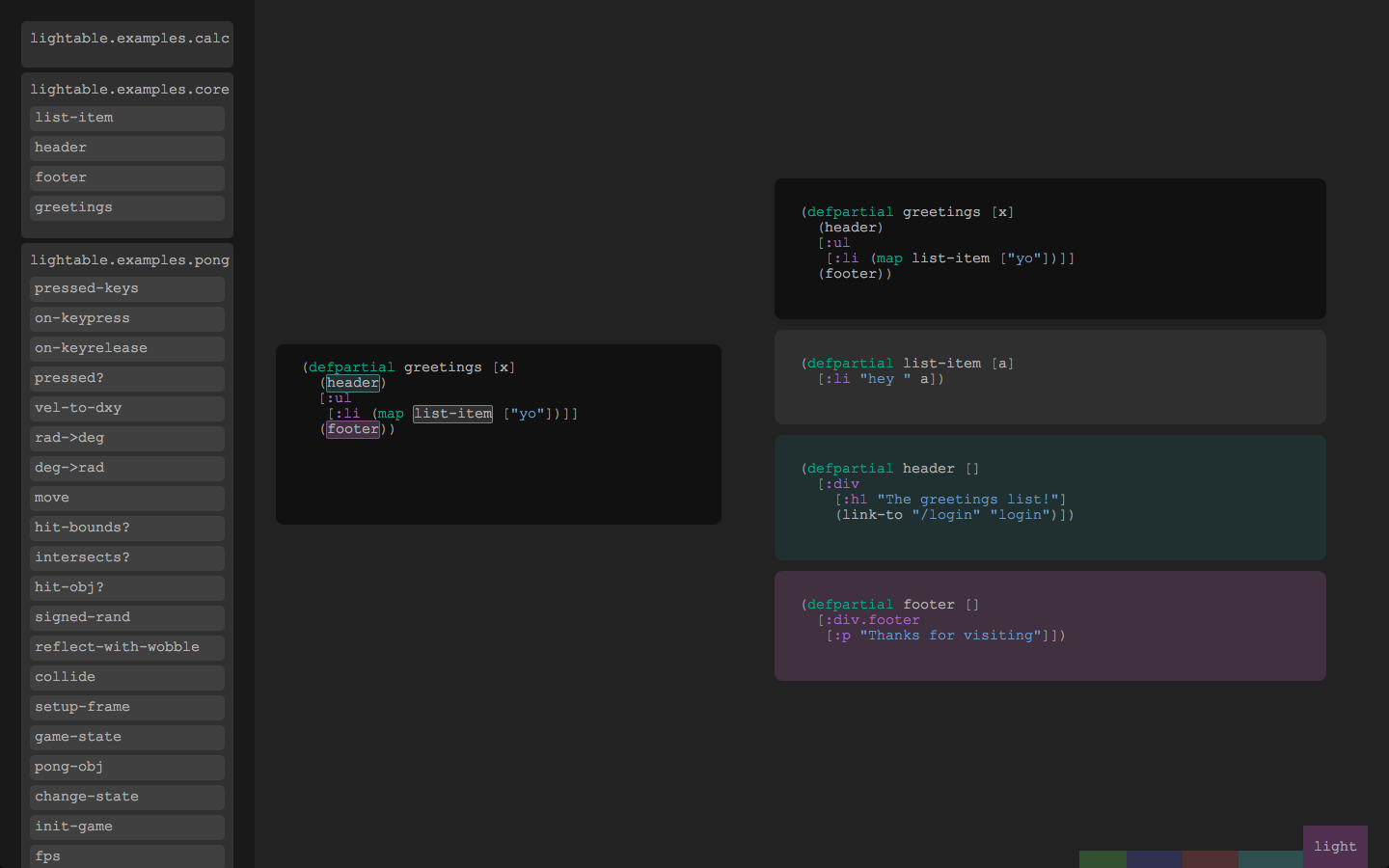
In VS13 the R-Click -> Go to Definition interface is OKay... but it definitely could be better
http://www.chris-granger.com/images/lightable/light-full.png
Lately, I've noticed a pattern emerging that I think John is referring to in the second part. The situation is that often a large function will be composed of many smaller, clearly separable steps that involve temporary, intermediate results. These are clear candidates to be broken out into smaller functions. But, a conflict arises from the fact that they would each only be invoked at exactly one location. So, moving the tiny bits of code away from their only invocation point has mixed results on the readability of the larger function. It becomes more readable because it is composed of only short, descriptive function names, but less readable because deeper understanding of the intermediate steps requires disjointly bouncing around the code looking for the internals of the smaller functions.
The compromise I have often found is to reformat the intermediate steps in the form of control blocks that resemble a function definitions. The pseudocode below is not a great example because, to keep it brief, the control flow is so simple that it could have been just a chain of method calls on anonymous return values.
I make a point to call out out that the temp objects are scope-blocked to the minimum necessary lifetimes primarily because doing so reduces the amount of mental register space required for my brain to understand the larger function. When I see that the first bar and baz go out of existence just a few lines after they come into existence, I know I can discard them from short term memory when parsing the rest of the function. I don't get confused by the second bar. And, I don't have to check the correctness of the whole function with regards to each intermediate value.