This is all-too-familiar to me, after having helped a couple older relatives through serious late-life changes like this.
Further, the general lack of safety net doesn't really apply when you're talking about a person with $1300/mo in disability/SSI, 'free' medical and some savings (/settlement payments). She could live, certainly not lavishly, but at least as well as she did before, just not where she did before or how she did before.
Which is the crux of this entire story.
not interested? or not being able to? it starts to look like a diagnosis (as an extreme illustration Rain Man comes to mind). It is not a big stretch of imagination to allow that after 20 years of being in the same situation an elderly person may lose ability for "changes", just like many lose ability to bend and reach the floor or make a split. Brain is just a biological organ and there is a lot of information around about it losing its "flexibility" with time.
Basically the society is very cruel to its members who lose the ability to function above specific level, be it physical or mental abilities.
There would be much less sympathy for a tenant who moved into a place at below-market rent, and then the rent was adjusted to market. But because a feel-good policy has created a broken market, the day of reckoning eventually had to arrive.
In a city of housing shortages, giving a small minority special protection under the law is a very bad outcome. Too bad for those not under the umbrella, too bad for those when the time comes and the umbrella is removed.
I mean, was she mean and obstructing by explicit willful choice or was it a panic reaction and collapse of reasoning machinery in response to what she perceived as destruction of her world? Former is ill will, while later would seem to be a diagnostable episode.
Sure, but this condition is called "stupidity", and there's a whole section of society that takes offense at the concept.
to me it does. I think as a society we're at the level when we can allow and thus must allow to cut some slack to disabled people, and temporarily or permanent lack of ability to reason is a disability just like not having a leg for example. When some limping guy with a stick say stumble and hit you while falling, would you deploy your anger like it would be in the case of intentional hit? The same way with people who may not be able to function in the society and manage their societal responsibilities at the level we think of as minimally acceptable. Whatever reason for their current condition, to me these are just ill people who need help instead of full legal violence deployed against them. Though, from pure logical point of view, we can just say to this woman that last 20 years she should have learned her some Python, and thus her situation is her own doing. In my personal view, our ability to rein in such logic and deploy compassion instead of it is what determines whether our civilization goes forward or backward.
How? What action should be taken, given a diagnosis, that should not be taken otherwise?
Do you think she would voluntarily accept treatment that would make the eviction process easier?
$1300 a month isn't a lot, but I would be really surprised if there's not somewhere in the SF bay area or a nearby city (Sacramento, etc) where it couldn't cover a small apartment or studio, utilities, and normal monthly costs like groceries.
As noted in other comments, it makes the focus of the article feel disingenuous as compared to people who are being priced out of their homes and don't have any safety net at all.
$~1300 will get you a decent Studio/1BR/Shared in the East Bay (Dublin, Livermore). Not bad neighborhoods, close to BART.
Go even a few miles East of these areas, rent drops rather quickly.
http://factfinder2.census.gov/faces/tableservices/jsf/pages/...
I lived through troubled times a few years back, but I always knew in the back of my mind that no matter what, I'll never be homeless -- a nice big paycheck from daddy was only an asking away - at the cost of only a little momentary humiliation that I was the only person not 'made' in my family. It's tough to even imagine what happens to families who're not well-networked or financially secure to begin with. There is a problem right now, as much as this particular story may hint otherwise.
I'm not saying we shouldn't help these people, but if you are complaining about not being able to get by in the most expensive city in the country, I really don't have any sympathy for you.
I have sympathy for them, because the current tech-boom is displacing(or greatly accelerating a process that was already happening much faster than they can handle.) them and I think that's a shame. IMHO, what makes SF great is its diversity. For reasons I won't get into right now(could probably write a book on it), diversity & high-income don't overlap too much... so watching high-income people displace the diversity is sad to me. I believe it to be a worthy goal to preserve SF's diversity of culture & history like this lady carries; preventing events like this from happening. I don't know how though, but I definitely don't think it's okay to lose it.
Basically, San Francisco voters are responsible for the evictions, whether they be natives, long-time residents or recent tech transplants.
When you increase fancy apartments for techies, the businesses/services around them will also appear and take up more land. More jobs sure, but those salaries aren't going to be able to buy a place near their job ...since the location of the job is probably near the high-paid techies. I still don't understand that Gamestop on market street, SF. Someone needs to interview them and blog about it. Where do those employees live? How do they survive?
I almost wish SF would enforce a limit on how many tech job holders are allowed to live in SF. Not necessarily the ultimate solution, but I think this gentrification needs to be throttled while someone comes up with the ultimate-solution... or just wait out this tech-boom and the problem would go away on its own.
SF is quite dense already, not like the exclusive suburbs to the south.
Unfortunately SF has some of the most restrictive zoning rules anywhere and, as described in the article, construction usually involves evicting tenants paying well below market rent. Given the highly litigious and politicized environment it is much more likely to get worse than better.
SF is 4x less dense than Manhattan, for example.
Here's where I'm coming from - SF is small, old, and largely built. It's in the middle of a very large metropolitan area, but it includes many of the old parts that have had high population densities for a long time. Contrast that with the population densities of most American cities, and the general land area. With the exception of New York, SF much smaller and more densely populated than almost all of the regions used in these comparisons.
Now, when someone builds a large housing development far from the urban center of, say, Houston, that counts as development for Houston. When this happens in Walnut Creek, it goes down as not developing in SF.
So the way I'd answer this question - and I haven't yet - is to look at subregions in major met regions in the US that have had a population density of above 17,000/sq mi for more than 50 years, and try to measure how much development has occurred within those areas in the last 20 years, or what kind of opposition to new development happens in those regions now.
My refutable hypothesis is that SF will no longer show a dramatically different pattern of NIMBYism from those sub-regions outside San Francisco. That doesn't mean it won't show NIMBYism, or that it won't show more NIMBYism than other old, relatively dense regions - I just think that it may reveal that "population density over 17000/sq mi for more than several decades" correlates with general opposition to new construction regardless of whether it happens in SF.
Like I said, I haven't checked, it's just an idea. This would actually take some work to investigate.
It's less dense than LA. If you want to compare it to NYC, it's less dense than the NYC suburbs in NJ and Queens.
Rebuilding at higher densities is definitely practical, they just choose not to do so.
http://en.wikipedia.org/wiki/San_francisco http://en.wikipedia.org/wiki/Los_angeles
The Bay Area as a whole is less dense than the LA Metropolitan area.
It's true that the Bay Area as a whole needs to get denser, but SF proper needs to lead the way.
I guess another phrase this thesis is that SF's apparant NIMBYism is a misleading artifact of what you describe as a "historical accident of municipal lines."
This distortion, of course, can make SF look good as well as bad. You can pump SF up by talking about the ratio of <desirableculturalfactor>:Resident compared to Houston, or Chicago, or LA, conveniently ignoring the fact that in Chicago, the residential suburbs are counted, whereas in SF, they aren't. My guess is that this ratio in LA or Chicago's densest 48 square miles would look quite similar to SF. Or, alternatively, you can make SF look bad by excluding the sort of developments that favor the burbs (such as percentage of households with children - when a family moves from SF to Redwood City, SF "loses" a family - in many areas, this would just be considered a move within the region).
Good or bad, my thesis is that these differences are largely an artifact of how the borders are drawn, rather than innate cultural differences between SF and other metropolitan areas. I don't doubt that these cultural difference exist (and they may in fact be driven by the fact that the electorate in SF isn't diluted by the votes in the surrounding areas), but I think they may be greatly overstated.
The assumption being that I can buy the city block & it's in near other high rises.
Property owners sell off places they would otherwise have rented out or just leave them empty because it just isn't worth the risk. That is what constrains the supply. You'd be crazy to go into the rental business unless you had a lot of units to balance out the Inges of the world, particularly since once you finally evict someone like that you have to tear out the walls to get rid of the stench.
What would make even more sense is very severe fines to the landlord for renting illegal units. Something like a multiple of all the rent they have ever collected on it.
Now, if there was a way a tenant could make a legal unit into an illegal unit and then invoke this, I could see that as a problem.
I can understand the confusion because I once interned for a midwestern city's planning department. There if someone built an unapproved apartment above their garage, the city would hit them like a ton of bricks.
In San Francisco, it is not like that, and these so-called "illegal" units are enshrined by law and practice in many respects. As a tenant, you have nearly all the same rights as a legal unit, so this would probably not figure into your evaluation.
The owner seemed to be caught in the middle of two incompatible laws: 1) You can't have that person living there. 2) You can't make that person leave.
Step 1 - Buy a property that is impacted by certain regulatory constraints (which depresses it's market value heavily). Step 2 - If you are cheap, sit, wait, and pray that natural forces relive you of the regulatory burden (or make life a living hell for your existing tenant in an attempt to get them to move out). If you have some money, actively spend it to rid your property of regulatory constraints. Step 3 - Once unburdened (or partially relived) of said constraints, sell the property and profit handsomely.
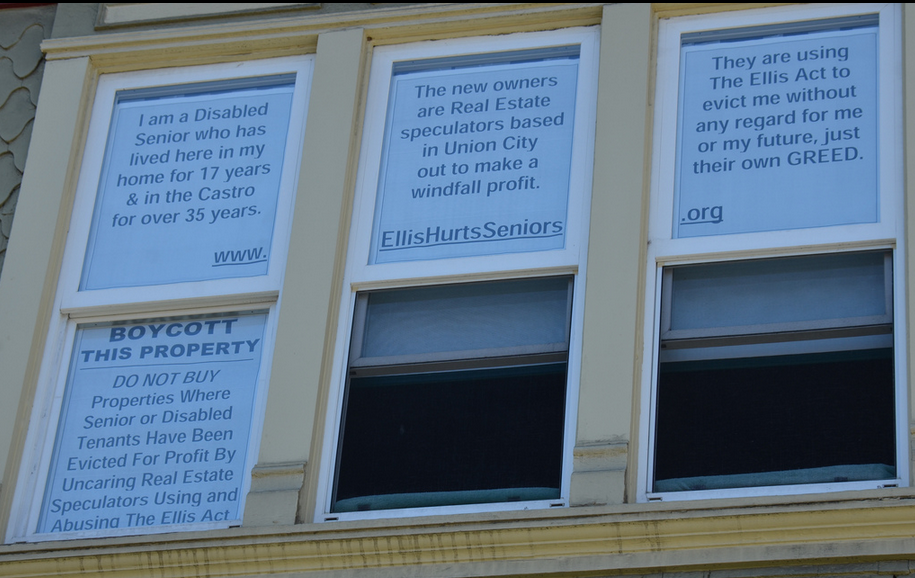
This game is primarily played with rent controlled units and TICs. The owners in question bought property on the cheap, evicted an old disabled lady who is now homeless, and made bank. Sure, the lady was a piece of work herself, but let's not pretend these owners were saints, they knew what the endgame was all along.
They were probably hoping that the tenant would eventually move out on her own so that they could either re-rent the unit for a much higher price, or bring the unit up to code and re-sell it. They didn't let her live there for 10 years because they were being nice, they did it because they were hoping to avoid the messy and expensive legal issues that they eventually had to deal with. Regardless they walked away with ~$770K from the appreciation of their property, so not sure why they deserve any sympathy. As far as investments go, they hit a home run.
This read to me more like story about a squatter in an illegal dwelling, trying to cause as much pain to the owners as she could on her way out.
A property owner wants to, god forbid, sell their property, and they have to suffer through this: http://pix-media.s3.amazonaws.com/blog/632/ScreenShot2014-03...
I'd feel bad for the soon-to-be-prior owners, but the $40k in costs barely dented their 120% return ($723k) over 12 years. It's not like they didn't know she lived there when they bought the place. But it still doesn't mean they are/should be legally obligated to rent to her for the rest of her life.
Honestly if there were not so many social programs in SF the homeless population would be much lower as they would relocate to other less expensive areas and maybe actually be able to afford a place to live. The current social system in SF mixed with the crazy rent prices actually encourages homelessness.
Even I can't afford to live in SF on "developer" pay, so guess what? I don't I live in SF, I moved south where I could find an apartment at a semi-sane price (still extreme, I could make payments on two Teslas for what I pay in rent).
Clearly he should have moved out of the house and let her live there.
Come on. It's sad that she got evicted, but to imply in any way that the tenant is blameless seems ridiculous. You don't get a free pass to be an asshole just because you're old; you're still obligated to try and work with the system.
Given the "[a]t first, Withrington accepted Inge’s presence", I would think that if she'd been a clean and polite tenant it's entirely possible the new landlord would have had no motivation to evict her. There may not even have been the complaint, given the article's not-so-subtle way of saying "maybe the landlord submitted it!!".
Social welfare weakens incentives for individuals to plan and live for the future. People should pay for their own lives with their own dollars, and if they are too foolish and imprudent to account for their old age, they should suffer the consequences of their own actions. They have no one to blame but themselves for not analysing the dangers.
Once people become aware that there are no second chances, behaviour will improve. It's a short-term pain for a major long-term benefit.
Until the full dangers of death and failure operate as incentives, moderated only by the free choice of individuals to cooperate and render assistance, our economies will never grow to their full extent, and our prosperity will always remain limited. In the long term, any society that clings to these dysfunctional social policies will be outcompeted by societies that discard them. In the much longer term, if the planet as a whole is held back by these policies, we may expect to be outcompeted by other, more progressive alien civilisations.
So in essence you imply that the state must act as a coercive mechanism to override the personal interest of its productive citizens.
From where I stand it appears that you endorse tyranny. Can you explain otherwise?
In my world, though, there are layoffs, long periods of unemployment, expensive catastrophic events, and generally a whole heapin' helpin' of reasons why people may need financial assistance for reasons that have nothing to do with their life choices. There are people who have done everything "right" and go into bankruptcy because a family member with insufficient health insurance gets sick. Do these things not happen in your world?
There have been plenty of insurance systems developed throughout time whereby people can hedge their risks. Previously however insurance was informal and consensual - you signed up to a Roman college. You and everyone else in the society engaged in it of your own free choice. If your group couldn't manage its finances it went broke (or more accurately appealed to an aristocrat.)
Nowadays we live in such enlightened times that the elements of choice and freedom have largely been removed.
You talk about Roman College as if it were something available to the destitute, 70-year old serf? Come on.
Today we have millions of people working full-time jobs, making less than a living wage. That is a structural, societal problem, and no planning on an individual laborer's level is going to counter that.
How about you get back to us on your 50th birthday and tell us if the best way for minimum wage laborers to pay for basic healthcare is to beg rich people?
The only thing rich people hate more than taxes is bums. Something about moral deficiency, right?
2) "Serfs" are medieval. And besides, this is an argument about free citizens, so the very concept is irrelevant.
3) The colleges were all independent, spontaneously organised by poor citizens. Anyway, apart from subsidised grain and generalised patronage the Roman ruling classes didn't design social welfare systems akin to anything we would recognise (and again, the comparison is difficult, because the patricians were generally using their own fortunes to win favour with the masses)
4) The colleges insured primarily against the possibility of funeral costs in the event of sudden death - the most important shock financial event the average poor Roman expected to face. There was no effective medical technology in Roman times, but Romans cared a lot about having a good funeral and being remembered.
5) The colleges weren't "available" to anyone unless they paid their way. If you wanted that protection, you paid your membership dues. So yes, if the destitute old free citizen had been prudent and consistently paid their dues before striking bad luck, they would be okay (well, they'd get their nice funeral, but you know what I mean.)
6) Maybe your millions of people making "less than the living wage" (however you define that) should take a leaf out of the book that seems popular to users of this site - looking for ways to improve the value of the services they offer?
7) What is so wrong with the idea of people directly petitioning others for funds to purchase healthcare? Heck, they don't even need to just petition the extremely wealthy. Powerful modern technology allows people to petition the entire world for funds (if they can convince people their cause is worthy.)[1] One of the benefits of living in a more advanced age than 50BC.
8) I feel like you are imagining me wrong. To be clear: I am young, broke, and largely unaccomplished. I have no significant assets beyond my intelligence and my ambition. I have no vested interest to protect. In fact, I am someone who stands to gain the most short-term from these sorts of welfare policies. Hell, I even work for "minimum wage" currently - another thing I would like to see abolished!
I simply want society to reward and encourage people who provide genuine value, and stop forcing productive citizens to subsidise unproductive citizens, without any accountability or metrics for the benefit of their investment, because a) I want to make my way up in the world honestly, by offering true value for trade, and b) because I am concerned about the economic damage caused by pervasive, dysfunctional contemporary policy.
If society got rid of all this terrible policy, the abundance of opportunities from the ensuing economic growth would do more to improve the fortunes of the assiduous in a few years than social welfare has accomplished in decades.
[1] www.kickstarter.com
I'm just speculating, though; perhaps you would be crowned King of All There Is and paid the fealty you are so surely due, as you have responsibly planned whilst the impoverished clearly have not. All hail Nirnira, may the bones of the weak be used to grow his giant throne!
[apologies for feeding the troll, he's just so cute but ideologically dangerous]
The result? Essentially innocent people, like the property owner, get "stuck" with "it's your problem now" where various agencies give contradictory mandates, backed with fines. How was property owner supposed to respond when told he must get rid of the illegal dwelling, but also told he can't evict the tenant?
I mostly sympathize with the property owner here. As a tenant, especially a tenant in an illegal or undocumented dwelling, you have to expect that a day of reckoning will come. Even property owners can be "evicted" (eminent domain), much less a property renter.