"And [Mozilla's Mike Shaver] affected my framing of the problem deeply – I remember one day a couple of years back when we were talking about some market share point, thinking about how incredibly, insanely competitive the browser technology landscape was – and he said to me: “Look, this is the world we wanted. And this is the world we made.” Wow. Exactly right. He taught me so much about how enormous an impact a group of dedicated people can make."
I've bumped into Mike a few times at Facebook; he's one of the most knowledgeable people I've ever met.
Really? I don't think WebGL is that important. What's it really good for besides laggy browser games? What's with the hype on browser games anyway? They're always going to perform much slower than native code. I don't see WebGL becoming such a critical aspect of browsing that the average user would consider IE "crippled" for not supporting it.
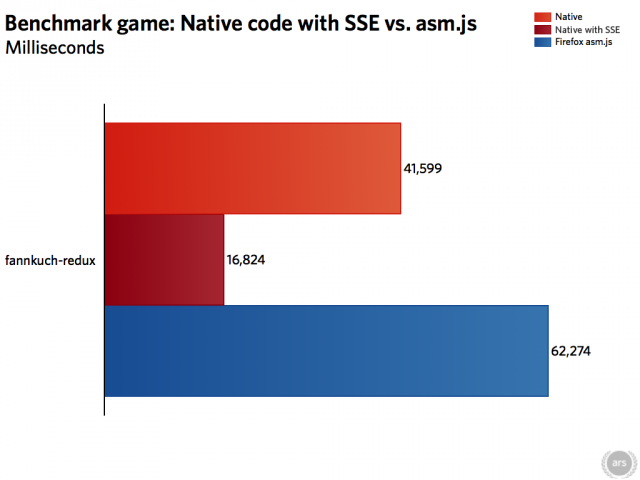
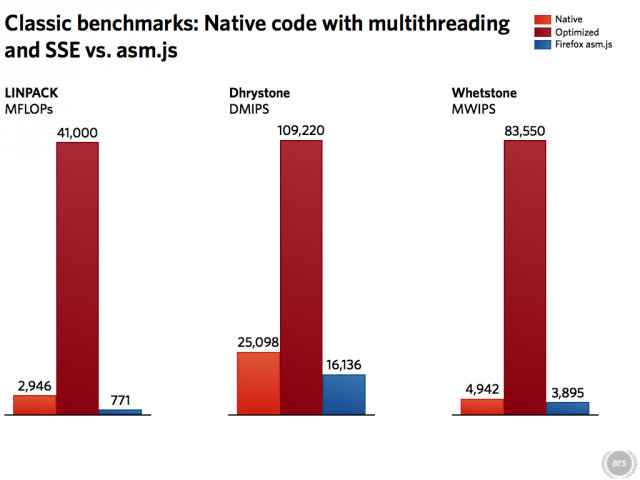
Only in wilfully misleading benchmarks. Allow use of SIMD and multithreading and asm.js can be as much as 50 times slower:
http://cdn.arstechnica.net/wp-content/uploads/2013/05/native...
http://cdn.arstechnica.net/wp-content/uploads/2013/05/classi...
[1] http://lists.w3.org/Archives/Public/public-fx/2012JulSep/007...
There are three issues:
1) Language pluggable?
2) Spec-ed shader languages
3) Mandatory languages
The proposal was:
1) No
2 & 3) GL SL ES
Microsoft proposed:
1) Yes
2) GL SL ES
3) None
The perfectly reasonable compromise would have been:
1) Yes
2 & 3) GL SL ES
#1 is about planning for extensibility. Just look at the hackery with JS where lonely, otherwise ignored, strings are used for things like "use strict" and "use asm". Or where Microsoft added "conditional comments", which quite frankly, was essential to the development of Outlook Web Access, which basically gave us Ajax. Or all the absurd vendor prefixes on CSS tag names. Or one of 100 other little hacks that browser vendors have invented to try to innovate past the standard. Pushing pass the standard, by the way, is the only way forward. We've learned that lesson by now, so we should plan for extensibility.
The reasons are manifold, but here are a few:
- Standardizing non-standardness gives proprietary implementations an unwarranted air of legitimacy and blesses incompatibility.
- Proprietary plugins and extensions are more likely to have untested security vulnerabilities and widen the browser attack surface.
- Proprietary extensions violate the essential web principles of cross-platform compatibility, graceful degradation, progressive enhancement, and accessibility.
One cant believe anything MS says. And it's another proof of that.
Remember when WebGL wasnt "secure"? Strange , now it is.
I say bull* , like their bull Venture Capital sh*t.
But I guess they have enough spare change to do community management on HN ( ie propaganda ), looking at all the MS spin here.
Credit to Mozilla for pushing 3d on the web and forcing the issue. Any browser that doesn't implement WebGL will soon be considered crippled; Microsoft desperately wants to avoid that title again, so in a way, Mozilla forced their hand.
Competition at work.