If you’re making six figures on two incomes, it’s plenty tolerable.
If you’re single and working as a street sweeper or make $60K a year outside the cities, it makes you want to burn the system down.
For anyone who isn’t rolling in cash, it’s economically oppressive. I’m not surprised that breeds resentment. I consider this the biggest blind spot of green movements: “It’s not that much more expensive to be green” said by someone who can afford it to people who can’t. A modern “let them eat cake.”
That's why smog rules vary per county.
The problem with Chinese imports and the American auto industry gives me serious flashbacks to the 1970s, when cheap Japanese compacts came in and took business away from American automakers.
Seems to me the American auto industry can't learn to adapt until some foreign competitor comes in and repeatedly kicks them in the nuts.
The real "let them eat cake" is the biggest polluters externalizing the costs of that pollution down to the people, all while the state is dismantling the EPA and clean energy.
Imagine if we had real public transportation across the nation. Less pollution AND cheaper for the average person. Wonder why that isn't happening.
Because the US is overwhelmingly urban sprawl and is not Europe. The only way to fix this is to tear down and rebuild (which we cannot afford), or accept that public transit wait times are terribly slow due to the distance between stops.
Combine that with a lack of nerve to aggressively combat crime or antisocial behavior on transit, maybe a fear of perpetuating inequality or something, and anyone who isn’t a man doesn’t feel safe trying it.
That's a bad excuse
a) because Europe isn't one single demographic but still public transport is useful, reliable and safe everywhere (from Dublin/Zurich on the low side of the population density scale to London/Paris/Madrid on the high side and Amsterdam/Hamburg/Prague in the middle).
and b) there are plenty of examples outside of Europe. Melbourne is urban sprawl. The metro area is 50 miles east to west, 30 miles north to south (more, but there's also a big bay) and a population of only 5 million. A lower population density than the Denver MSA but manages to run a train/bus/tram system that's useful, reliable and safe.
Blaming sprawl or population count, while being outshone by Canada, means it's neither of the above. Perhaps we can move on to the auto companies pushing out light rail in California in the fifties to bump their own profits, or accept that it's the American people and their ethos that has left the automobile as the claimed only option.
I'm not sure I would point the finger at "green movements" though.
Gavin Newsom warms to Big Oil in climate reversal: https://calmatters.org/politics/2025/08/oil-compromise-calif...
I think your idea is a great solution to the problem and would give politicians cover with their environmental base and a win for their constituents.
Newsom is not a refinery nor does he own any refineries. He cannot increase any production by definition.
(As a side benefit, he can also blame the need on Trump, if the environmentalists get on his case...)
Marathon Martinez (2020) converted to renewables. Crude capacity 157 MBD, Renewables capacity 48 MBD
P66 Rodeo (2022) converted to renewables. Crude capacity 120 MBD, Renewables capacity 50 MBD
P66 LA (2025) shutdown. Crude capacity 139 MBD
Valero Bencia (2026) shutdown. Crude capacity 145 MBD
The California Air Resource Board (CARB) has promulgated a revised Cap and Invest rule that threatens the viability of the remaining refineries. All the remaining California refineries have sent CARB, the Governor and the CA legislature letters pointing this out.
California is now a net importer of gasoline following these refinery closures.
I don't get it either, but that's the audience that has been cultivated.
This is all about keeping China down, and preserving American Hegemony. That's his definition of "making America great again". He doesn't care that you're paying more for food, gasoline, etc. and that the rest of the third world will soon be starving.
Gulf States get a swap line (can't let Wall St crash), but you get no bail out because the elites don't care that you are hurting. They care about the Gulf States hurting because that ultimately means Wall St will crash which would hurt the Billionaire elites.
So to sum up, the reason is maintain America's Hegemony and protect the Billionaire class.
https://today.usc.edu/las-environmental-success-story-cleane...
>Would you really want to hurt children for cheaper gas?
Nice appeal to emotion.
I'd rather have clearer skies.
https://www.clarity.io/blog/how-air-pollution-affects-childr...
https://www.clarity.io/blog/a-closer-look-at-los-angeles-inf...
"Poor air quality does not affect all parts of LA equally. Communities of color and low-income residents are disproportionately impacted by polluted air. In certain areas, traffic-related emissions, including nitrogen oxides (NOx), carbon monoxide (CO), and benzene concentrations, are up to 60% higher.
A study led by UCLA found that the air in disadvantaged neighborhoods contained not only more fine particulate matter, but also more toxic particulates as well. Places facing the most socioeconomic disadvantages “experience about 65% higher toxicity than people in the most advantaged group,” according to Suzanne Paulson, UCLA professor of atmospheric and oceanic sciences and the senior author of the study.
These same groups often have less access to health care and good nutrition, putting them at an even greater health risk. Everyone deserves to breathe clean air, and communities of color and low-income residents are unfortunately facing the worst of LA’s notorious smog."
Saving a buck at the expense of someone with no control of their situation is a choice.
https://ifunny.co/picture/yes-the-planet-got-destroyed-but-f...
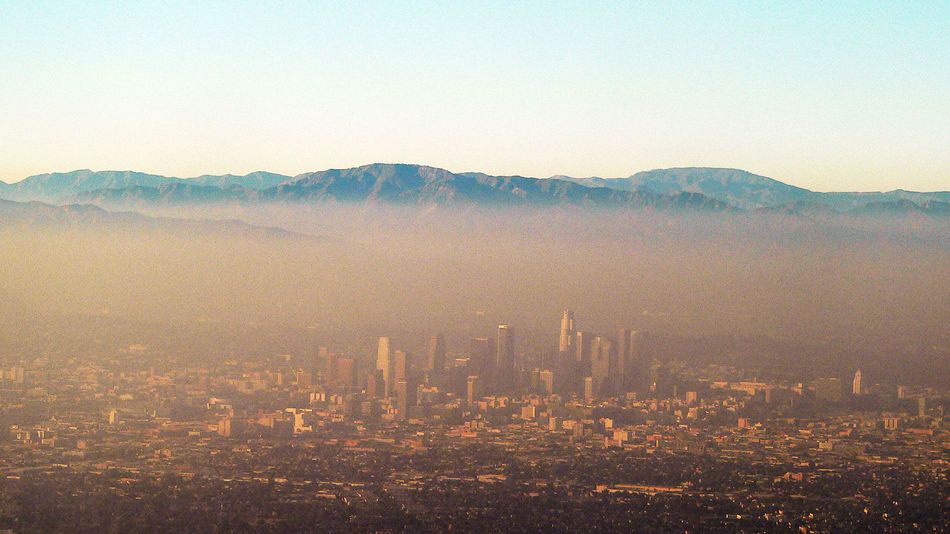
Cars may burn cleaner but they still burn, and there are more of them than ever.
Easing economic pain in exchange for health pain is nonsensical. Breathe from your own tailpipe if its no big deal.
Yes. Most voters would, too. "Cheaper gas" understates how serious even a $20/week increase in living costs can be for a household on the margin.
It's reality. It doesn't go away if you ignore it. Aversion to higher gas prices isn't a luxury problem for a lot of people. Any realistic strategy for an energy transition has to acknowledge and accomodate that.