While in theory human drivers should be situationally aware of the higher risks of children being around, the reality is that the majority will be in their own bubble of being late to drop their kid off and searching for the first free spot they can find.
The autonomous cars have really got more aggressive recently as i mentioned before:
https://news.ycombinator.com/item?id=46199294
Also Waymo handling road visibility issue:
I have a similar school drop-off, and can confirm that the cars are typically going around 17-20mph around the school when they're moving. Also that yes, human drivers usually do stay much closer to the centerline.
However, Waymo was recently cleared to operate in my city, and I actually saw one in the drop-off line about a week ago. I pulled out right in front of it after dropping my kid off. And it was following the line of cars near the centerline of the road. Honestly its behavior was basically indistinguishable from a human other than being slightly more polite and letting me pull out after I put my blinker on.
I certainly do this. But asserting that most humans would usually do this? Have you ever actually seen humans drive cars? This is absolutely not what they do. On top of that, they run stop signs, routinely miss pedestrians in blind spots, respond to texts on their phone, or scroll around on their display to find the next song they want to put on.
I wouldn't call it likely. Sure, there are definitely human drivers who are better than Waymo, but IME they're few and far between. Much more common to be distracted or careless.
Consider this scenario:
5 kids are walking on the sidewalk while you're driving past them. But suddenly a large dumpster is blocking your view of them just as you pass. You saw them before the dumpster, but not after your car and the dumpster completely blocks the view.
Does a human brain carry some worry that they suddenly decide to run and try to cross the street after the dumpster? Does Waymo carry that worry or just continue to drive at the exact same speed.
Again, it's not like every driver will think about this, but many drivers will (even the bad ones).
I don't think this is true. There are infinitely many scenarios in a complex situation like a road with traffic, cars parked, pedestrians about, weather, etc. My brain might be able to quickly assess a handful, but certainly not all.
If there's ten kids nearby, that's basically ten path scenarios, and that might be reduced if you have great visibility into some of them.
> My brain might be able to quickly assess a handful, but certainly not all.
What would you do if you can't assess all of them? Just keep driving same speed?
If the situation is too overwhelming you'll almost certainly back off, I know I would. If I'm approaching that school block and there's like 50 small kids running around in all directions, I have no idea what's going on and who is going where, so I'm going to just stop entirely until I can make some sense of it.
To fix that, you program the car to handle situations with obstructed vision, which will handle not just this specific scenario, but all relating to obstructed line-of-sight — basically slow down enough to be able to stop in time in case something jumps out from behind the obstacle.
Really though, this is less of an engineering problem and more of a social cost-benefit analysis one.
On one hand, I'd say hitting a kid at 6mph in the worst case scenario once in a blue moon probably isn't that big of a deal.
On another, someone here calculated that "even 1MPH slower would likely have resulted in no contact in this scenario".
So really, it's not possible to say whether this was handled properly or not without access to data only Waymo has and establishing some standard of how much injury we're okay with vs the impact on travel times. Remember, we're seemingly ok with ~40 000 americans dying every year due to car transportation.
Safe driving starts with speed, lowering speed and informing the passengers seems like a no-brainer.
There are a very, very large number of scenarios. Every single possible different state the robot can perceive, and every possible near future they can be projected to.
Ten kids is not 10 path scenarios. Every kid could do a vast number of different things, and each additional kid raises the number of joint states to another power.
This is trivially true. The game that makes driving possible for humans and robots is that all these scenarios are not equally likely.
But even with that insight, it’s not easy. Consider a simple case of three cars about to arrive at an all-way stop. Tiny differences in their acceleration - potentially smaller differences than the robot can measure - will result in a different ordering of cars taking turns through the intersection.
It’s a really interesting problem.
This is the difference between computing and humans. The car will attempt to compute all possible path scenarios because it has no instict, and it might not be possible to compute everything in real time so it might fail.
But the human will easily deal with the situation.
Try running through a sports field in an elementary school during lunch, full of unpredictable kids running around. Can you make it from one side to the other without crashing into a whole bunch of kids? Of course you can. You didn't need to try to compute an exponential number of scenarios, you just do it easily. The human brain is pretty amazing.
And current practical approaches are mostly end to end (or nearly) ML systems that do not compute a lot of alternative paths, and they work in approximately constant time independent of the scenario.
You strongly imply that computers can’t drive, but you could have written that in a Waymo.
Not all of those need to be done "quickly". That's where LLMs fail
You note the weather when you leave. You understand the traffic five minutes ahead. You recognize pedestrians far ahead of time.
Computers can process a lot in fractions of a second. Humans can recognize context over many minutes.
The Waymo may have done better in the fraction of a second, but humans can avoid being in that situation to begin with.
It doesn't seem like self driving cars take into account the icy conditions of roads for one simple example.
Patently, obviously false. A human brain will automatically think of SOME scenarios. For instance, if a collision seems imminent, and the driver is holding a cup of coffee, these ideas are likely to occur to the driver:
IF I GRAB THE STEERING WHEEL AND BRAKE HARD, I MIGHT NOT HIT THAT PEDESTRIAN IN FRONT OF ME.
IF I DON'T CONTINUE HOLDING THE COFFEE CAREFULLY, I MIGHT GET SCALDED.
THIS SONG ON MY RADIO IS REALLY ROCKING!
IF I YANK MY WHEEL TO THE LEFT, I MIGHT HIT A CAR INSTEAD OF A HUMAN.
IF I BRAKE HARD OR SWERVE AT ANY TIME IN TRAFFIC, I CAN CAUSE AN ACCIDENT.
Experiments with callosal patients (who have damaged the connective bridge between the halves of their brains) demonstrate that this is a realistic picture of how the brain makes decisions. It offers up a set of possible actions, and attempts to choose the optimal one and discard all others.
A computer program would do likewise, EXCEPT it won't care about the coffee cup nor the radio (remove two bad choices from consideration).
It still has one bad choice (do nothing), but the SNR is much improved.
I'm not being hyperbolic; self-preservation (focusing on keeping that coffee in my hand) is a vital factor in decision-making for a human.
> ...where Waymo has pre-programmed ones (and some NN based ones).
Yes. And as time goes on, more and better-refined scenarios will be added to its programming. Eventually, it's reasonable to believe the car software will constantly reassess how many humans are within HUMAN_RUN_DISTANCE + CAR_TRAVEL_DISTANCE in the next block, and begin tracking any that in an unsafe margin. No human on Earth does that, continually, without fail.
> Does a human brain carry some worry that they suddenly decide to run and try to cross the street after the dumpster? Does Waymo carry that worry or just continue to drive at the exact same speed.
You continue to imply that Waymo cannot ever improve on its current programming. Does it currently consider this situation? Probably not. Will it? Probably.
It's amazing how much nonsense we let slide with human drivers, and then get uptight about with anything else. You see the same attitude with bicycles. Cars run stop signs and red lights all day long and nobody bats an eye, but a cyclist does it and suddenly they're a menace.
I think any fair evaluation of this (once the data was available) would conclude that Waymo was taking reasonable precautions.
That's exactly part of the problem. If it is programmed to be over-cautious and go 17 in a 25 zone, that feels like it is safe. Is it?
It takes human judgment of the entire big picture to say meaningfully whether that is too slow or too fast. Taking the speed limit literally is too rigid, something a computer would do.
Need to take into account the flow of the kids (all walking in line vs. milling around going in all directions), their age (younger ones are a lot more likely to randomly run off in an unsafe direction), what are they doing (e.g. just walking, vs. maybe holding a ball that might bounce and make them run off after it), their clustering and so on.
Driving past a high school with groups of kids chatting on the sidewalk, sure 20mph is safe enough. Driving past an elementary school with a mass of kids with toys moving in different directions on the same sidewalk, 17mph is too fast.
And if I'm watching some smaller kids disappear behind a visual obstruction that makes me nervous they might pop up ahead of it on the street, I slow down to a crawl until I can clearly see that won't happen.
None of this context is encoded in the "25mph when children are present" sign, but for most humans it is quite normal context to consider.
But would be great to see video of the Waymo scene to see if any of these factors was present.
Here's my problem. If you follow the instructions on the sign, it still says to slow down. There's no threshold for slow enough. No matter how slow you're going, the sign says "Slow Down". So once you become ensnared in the visual cone of this sign, you'll be forced to sit stationary for all eternity.
But maybe there's a loop-hole. It doesn't say how fast you must decelerate. So if you come into the zone going fast enough, and decelerate slowly enough, you can make it past the sign with some remaining non-zero momentum.
You know, I've never been diagnosed on the spectrum, but I have some of the tendencies. lol.
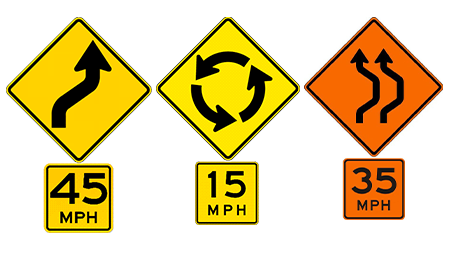
Much better to be specific than a vague "slow down". There's a road near me with two tight turns a couple blocks apart. One advises 25mph and the other advises 10mph.
Everyone's replying to you as if you truly don't understand the sign's intention but I'm sure you do. It's just annoying to be doing everything right and the signs and headlines are still telling you you're wrong.
There was a driving safety safety ad campaign here: "Drive to the conditions. If they change, reduce your speed." You can imagine how slow we'd all be going if the weather kept changing.
We might have OCPD.
In advertising: "Treat yourself. You deserve it!"
Me: What if someone who didn't deserve it heard this message. How can you possibly know what I deserve? Do all people deserve to treat themselves? Is the notion of deserving or treating really so vacuous?
Normies: jfc
I hate when people pretend to be smarter than everyone else by pointing this kind of utterance and insisting that someone, somehow, will parse those statements in the most literal and stupid manner.
Then there are the ignorant misanthropes that can't waste a chance to repeat their reductionist speculations about human cognition. Just like the idiot Elon Musk that wasted billions in irrecoverably fucked self-driving system based on computer-version because he underestimated the human visual cortex.
Fucking annoying midwits.
This is idle XKCD-style musing.
FYI, unless you are a commerical truck, a cop, or a racer, your speedometer will read slightly fast, sometimes as much as 5 to 10%. This is normal practice for cars as it limits manufacturer liability. You can check this using independant gps, ie not an in-dash unit. (Just imagine the court cases if a speedo read slower than the actual speed and you can understand why this started.)
[0] https://www.dmv.ca.gov/portal/handbook/california-driver-han...
Edit: However, elsewhere in the thread someone linked this Streetview image that shoes that this particular school zone is 15mph: https://maps.app.goo.gl/7PcB2zskuKyYB56W8?g_st=ac
To put it another way. If an autonomous vehicle has a reaction time of 0.3 seconds, the stopping distance from 17 mph is about the same as a fully alert human driver (1 second reaction time) driving 10.33 mph.
There's a case to be made that it wasn't slow enough.
On that very same road with a 20mph limit, 40mph might be completely safe or 3mph might be extremely negligently dangerous. It all depends on what is going on in the area.
Nobody was injured.
They even wrote a blog post about it:
https://waymo.com/blog/2023/07/past-the-limit-studying-how-o...
https://www.gov.uk/theory-test/hazard-perception-test
... could in some circumstances know that there's a likelihood that a child will emerge suddenly and reduce their speed in anticipation where circumstances allow.
Note that: If you cut speed but other drivers can't see why they may overtake, even unsafely, because you are a nuisance to them. Slowing in anticipation that a child will run out from behind the SUV, only for a car behind you to accelerate around you and smack straight into the child at even higher speed, is not the desired outcome even though you didn't hurt anybody...
And yes, we'd need to see the video to know. It's like that Sully scenario. In a prepared test skilled pilots were indeed able to divert and land, but Sully wasn't prepared for a test. You're trained to expect engine failure in an aeroplane - it will happen sometimes so you must assume that, but for a jet liner you don't anticipate losing both engines, that doesn't happen. There's "Obviously that child is going in the road" and "Where the fuck did they come from?" and a lot in between and we're unlikely to ever know for sure.
Waymos constantly track pedestrians nearby, you can see it on the status screen if you ride in one. So it would be both better able to find pedestrians and react as soon as one was on a collision course. They have a bit more visibility than humans do due to the sensor placement, so they also can see things that aren't that visible to a person inside the car, not to mention being constantly aware of all 360 degrees.
While I suppose that in theory, a sufficiently paranoid human might outdo the robot, it looks to me like it's already well above the median here.
While the deep details are not public, Waymo has shared a fair amount of description of their system, from which you can glean some ideas about the world model it creates and the actions it takes in specific situations: https://waymo.com/blog/2024/10/ai-and-ml-at-waymo https://waymo.com/blog/2025/12/demonstrably-safe-ai-for-auto... https://waymo.com/blog/2024/10/introducing-emma
Note the weaselly "immediately detected the individual as soon as they began to emerge" in the puff piece from Waymo Comms. No indication that they intend to account for environmental context going forward.
If they already do this, why isn't it factored in the model?
And I completely agree that from that instant forward, the car did everything correctly.
But if I was the accident investigator for this, I would be far more interested in what happened in the 30 seconds before the car saw the kid.
Was the kid visible earlier and then disappear behind an obstruction? Or did the kid arrive from the side and was never earlier visible? These are the more important questions.
and that can potentially allow internal planning algorithm to choose more risky and aggressive trajectories/behavior, etc. say to reach target destination faster and thus deliver higher satisfaction to the passengers.
Waymos do this and have for years. They know where the people are around them and will take precautionary action based on that.
Here's a video from 2019 of one understanding that a car in the bike lane means the cyclists may dart out into the lane it's in and taking action based on that. https://waymo.com/blog/2019/05/safety-at-waymo-self-driving-...
That video is nearly 7 years old at this point and they've gotten much, much better since then.
If you think a fully-attentive human driver would have done better, I think you're kidding yourself.
I know you didn't make this point, but if anyone think the average LA driver would have done better than this I've got a bridge to sell you and that's really what matters more. (I say that as someone who used to live like half a mile from where this happened)
I've read studies saying that most drivers don't brake at max effort, even to avoid a collision. This may be at least one of the reasons that Waymo predicted that an attentive human would likely have been going faster than their car at the moment of impact. I've got a good idea of my fun-car's braking performance, because I drive it hard sometimes, but after reading that I started practicing a bit with my wife's car on the school run, and... Yeah: it's got a lot more braking power than I realized. (Don't worry, I brake hard on a long straight exit ramp, when no one's behind me, a fast slow-down is perfectly safe, and the kiddo loves it.) I've now got an intuitive feel for where the ABS will kick in, and exactly what kind of stopping distance I have to work with, which makes me feel like a safer driver.
Second, going off my experience of hundreds and hundreds of ride-share rides, and maybe thirty Waymo journeys, I'd call the best 10-15% of humans better drivers than Waymo. Like, they're looking further up the road to predict which lane to be in, based on, say, that bus two blocks away. They also drive faster than Waymos do, without a perceptual decrease in safety. (I realize "perceptual" is doing some work in that sentence!) That's the type of defensive and anticipatory urban driver I try to be, so I notice when it's done well. Waymo, though, is flat-out better, in every way, than the vast majority of the ride-share drivers I see. I'm at the point where I'll choose a Waymo any time it'll go where I'm headed. This story reinforces that choice for me.
Going early means you slow early, which means you also take longer to reach the child, but you're braking for all of that extra time, so you're slowing down even more.
Ha! It is unbelievable how difficult it is to make someone brake hard. You'd think it's the easiest thing possible in the age of ABS - just press hard as you can.
I have a lot of experience on this, I used to teach car control both to teens and adults. One of the frequent exercises was seemingly very simple: Drive at Xmph until this spot, then brake at maximum power.
The vast majority of people can't do it on the first or second try, they'll just meekly press on the brake like they're coasting to a stop. After more coaching that hard means hard, they start to get it, but it takes many many tries.
I have no idea what happened here but in my experience of taking waymos in SF, they are very cautious and I'd struggle to imagine them speeding through an area with lots of pedestrians milling around. The fact that it was going 17mph at the time makes me think it was already in "caution mode". Sounds like this was something of a "worst case" scenario and another meter or 2 and it would have stopped in time.
I think with humans, even if the driver is 100% paying attention and eyes were looking in exactly the right place where the child emerged at the right time, there is still reaction times - both in cognition but also physically moving the leg to press the pedal. I suspect that a waymo will out-react a human basically 100% of the time, and apply full braking force within a few 10s of milliseconds and well before a human has even begun to move their leg.
Sometimes it would detect something and I think "huh? Must be a false positive?" but sure enough it turns out that there really was someone standing behind a tree or just barely visible around a corner etc.
Sure none of those have run out in front of us, but the fact it is spotting them and tracking their movement before I am even aware they're there is impressive and reassuring.
Correct. Human reaction time is at its very best ~250ms. And that's when you're hyper-focused on reacting to a specific stimuli and actively try to respond to it as fast as possible.
During normal driving, a focused driver will react on the order of 1s. However, that's assuming actively paying attention to the road ahead. If you were to say, be checking your mirrors or looking around for any other reason this can easily get into multiple seconds. If you're say, playing on your phone (consider how many drivers do this), forget it.
A machine however is 100% focused 100% of the time and is not subject to our poor reaction times. It can brake in <100ms every time.
On the other hand, a software fault could make it run into an obstacle that'd be obvious to a human at full speed.
Anyway, from the article,
> According to the NHTSA, the accident occurred “within two blocks” of the elementary school “during normal school drop off hours.” The safety regulator said “there were other children, a crossing guard, and several double-parked vehicles in the vicinity.”
So I mean, it is hard to speculate. Probably Waymo was being reasonably prudent. But we should note that this description isn’t incompatible with being literally in an area where the kids are leaving their parents’ cars (the presence of “several double parked cars brings this to mind). If that’s the case, it might make sense to consider an even-safer mode for active student unloading areas. This seems like the sort of social context that humans might have and cars might be missing.
But things speculation. It would be good to see a video.
How do you know that? The article says it slowed from 17 mph. That’s cautious progress speed, not cruising speed.
We'd have to see video of the full scene to have a better judgement, but I wouldn't call it likely.
The car reacted quickly once it saw the child. Is that enough?
But most humans would have been aware of the big picture scenario much earlier. Are there muliple kids milling around on the sidewalk? Near a school? Is there a big truck/SUV parked there?
If that's the scenario, there is a real probability that a child might appear, so I'm going to be over-slowing way down pre-emptively even thought I haven't seen anyone, just in case.
The car only slows down after seeing someone. The car can react faster that I can after seeing someone, but as a human I can pre-react much earlier based on the big picture, which is much better.