News for hackers. Stuff that matters.
Re:Spanish track was fractured before high-speed train disas... by montroser on Sunday January 25, 2026 @03:12PM (#46757689)
What are the some of the ways that tracks are monitored for fractures like this? It must have been pretty substantial in order to be described as "complete lack of continuity". Makes me think of literally electronic continuity tests -- are those ever used in this context? Or how about cameras mounted on trains using image processing? Or drones?

It seems a shame that a few other trains passed beforehand with this anomaly in place and yet it went undetected.

Re:Spanish track was fractured before high-speed train disas... by sigwinch28 on Sunday January 25, 2026 @03:15PM (#46757714)
Measurement trains filled with cameras and LIDAR

For example, in the U.K.:

https://en.wikipedia.org/wiki/New_Measurement_Train

Re:Spanish track was fractured before high-speed train disas... by user_7832 on Sunday January 25, 2026 @03:43PM (#46757992)
LIDAR is good, but as another commenter pointed out, Ultrasonic Flaw Detection (USFD) is the gold standard for crack/flaw detection.
Re:Spanish track was fractured before high-speed train disas... by jen729w on Sunday January 25, 2026 @04:29PM (#46758468)
Re:Spanish track was fractured before high-speed train disas... by amelius on Sunday January 25, 2026 @03:17PM (#46757731)
There are special trains with measurement equipment on board, but yes, it sounds to me like every train should be equipped with some basic sensors for anomaly detection.
Re:Spanish track was fractured before high-speed train disas... by 1718627440 on Sunday January 25, 2026 @05:55PM (#46759459)
The measurement trains drive slowly in the night.
Re:Spanish track was fractured before high-speed train disas... by Azrael3000 on Sunday January 25, 2026 @06:03PM (#46759546)
Not necessarily, the measurement train my company develops can go up to 100 km/h and measure certain rail features every 5mm at that speed.
Re:Spanish track was fractured before high-speed train disas... by lefra on Monday January 26, 2026 @01:00AM (#46762319)
100 km/h is slow compared to passenger train (even non-high-speed ones). Depending on how packed the schedule is, it might not be possible to analyse track during the day without causing backups.
Re:Spanish track was fractured before high-speed train disas... by mkl on Monday January 26, 2026 @01:42AM (#46762543)
Re:Spanish track was fractured before high-speed train disas... by mitthrowaway2 on Monday January 26, 2026 @03:06AM (#46763019)
Indeed!

> Line inspection is carried out at full speed, up to 270 km/h or 168 mph on the Tōkaidō Shinkansen and 285 km/h or 177 mph on the Sanyō Shinkansen

Re:Spanish track was fractured before high-speed train disas... by N19PEDL2 on Tuesday January 27, 2026 @08:15AM (#46779546)
Re:Spanish track was fractured before high-speed train disas... by gambutin on Sunday January 25, 2026 @03:17PM (#46757738)
AFAIK, one technique for monitoring cracks uses ultrasonic sensors. They send sound waves through the rails and detect cracks by analyzing reflected waves.
Re:Spanish track was fractured before high-speed train disas... by direwolf20 on Sunday January 25, 2026 @03:43PM (#46757986)
TFA indicates a 40cm gap — huge!
Re:Spanish track was fractured before high-speed train disas... by buildbot on Sunday January 25, 2026 @03:50PM (#46758054)
I suppose that counts/was caused by a fracture but almost a half meter of gap in the track is nuts. Like describing a limb that’s totally removed as a bone fracture.

Though conceivably the break was very small and a train impacting the slightly lifted rail just caused a good chunk of it to explode.

Re:Spanish track was fractured before high-speed train disas... by WarOnPrivacy on Sunday January 25, 2026 @04:15PM (#46758312)
> Though conceivably the break was very small and a train impacting the slightly lifted rail just caused a good chunk of it to explode.

The crown (top) of the rail seems to be missing after the gap. The crown-less section then continues ~3 meters before it disappears behind the investigator on the left. IDK what that might indicate.

ref pic: https://ichef.bbci.co.uk/news/1024/cpsprodpb/ecb4/live/53924...
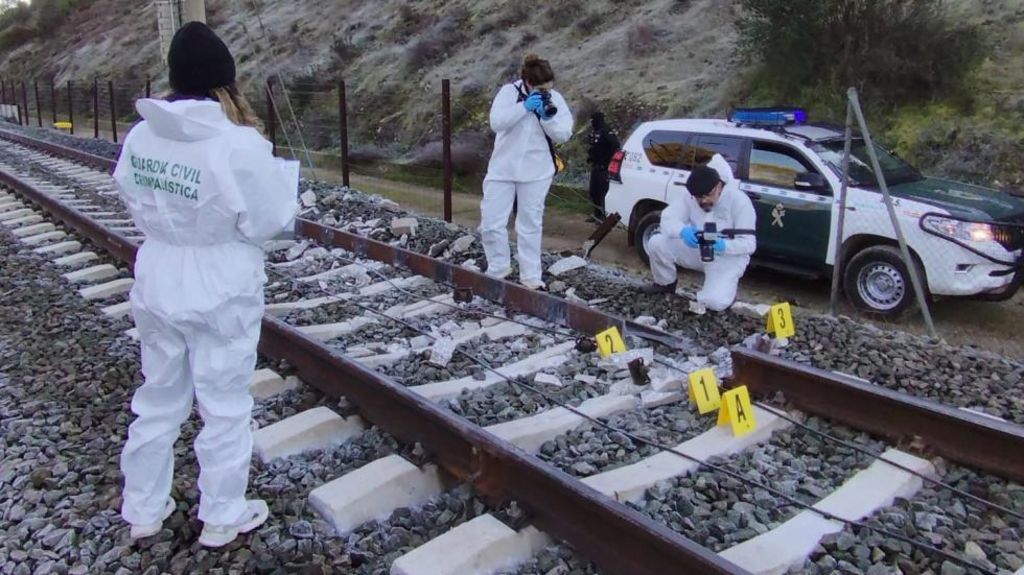
Re:Spanish track was fractured before high-speed train disas... by zidel on Sunday January 25, 2026 @04:27PM (#46758454)
The rail is laying on its side in that picture, so what is visible is the foot not the web.

edit: other angles of the same location here: https://youtu.be/DIQ4SrGSua0?t=1174

Re:Spanish track was fractured before high-speed train disas... by WarOnPrivacy on Sunday January 25, 2026 @10:51PM (#46761685)
> The rail is laying on its side in that picture

Ah, I see it now. The marks from contact with the ties should have clued me in earlier.

Re:Spanish track was fractured before high-speed train disas... by kgwgk on Sunday January 25, 2026 @04:48PM (#46758691)
Yes, the “fracture” (the problem was actually at a joint) was there for a while. The missing segment of rail was still there when the train arrived - the derailment affected only the last cars.
Re:Spanish track was fractured before high-speed train disas... by smcl on Monday January 26, 2026 @03:24AM (#46763128)
The "fracture" being referred to is a weld that somehow failed. The gap you are seeing is because an enormous, heavy train travelling at 200km/h hit that fracture and the rear half of the train derailed, tearing up sleepers and kicking all manner of debris around including ballast and, in this case, parts of newly-fractured (and therefore weakened) track.
Re:Spanish track was fractured before high-speed train disas... by ThePowerOfFuet on Sunday January 25, 2026 @04:33PM (#46758524)
No, that gap was created after the rail broke and the train derailed as a result.

The crack was in the weld, causing one side to sink and the wheel to hit the start of the next section of rail which was no longer welded to it, causing stress fractures to form in the rail which later caused that 40cm piece to break off.

Re:Spanish track was fractured before high-speed train disas... by crote on Monday January 26, 2026 @03:00AM (#46762982)
Next to the weld, if we're being pedantic. The weld itself is stronger than regular rail, but the welding process weakens the rail right next to it.
Re:Spanish track was fractured before high-speed train disas... by djoldman on Sunday January 25, 2026 @04:20PM (#46758350)
Wheel Impact Load Detector.

It measures vertical forces in kips - (kilo-pounds-force, 1 KIP = 1,000 lbs)

They have these in the USA.

Re:Spanish track was fractured before high-speed train disas... by iggldiggl on Wednesday January 28, 2026 @03:10PM (#46800876)
Those are for the opposite problem – detecting defective trains (overweight respectively otherwise faulty weight distribution as well as wheel flats).
Re:Spanish track was fractured before high-speed train disas... by dkbrk on Sunday January 25, 2026 @11:03PM (#46761753)
You can look at the Wikipedia page on railway defect dectectors [0].

Under "rail break monitors" it mentions both electrical continuity and time-domain reflectometry can be used, and are most frequently used on high-speed tracks.

In addition, there are vast array of other detectors using acoustic sensors, strain gauges, accelerometers, cameras in the visible and infrared spectrum or laser measurement, that potentially could have detected an anomaly (i.e. damage to the wheels of other trains before the incident).

[0]: https://en.wikipedia.org/w/index.php?title=Defect_detector

Re:Spanish track was fractured before high-speed train disas... by NamTaf on Monday January 26, 2026 @08:45AM (#46765559)
Wheel impacts are the main way. But hardware can be bulky and trains can be surprisingly cramped.

We squeezed some track condition monitoring hardware into some locos but it was single-driver operations locations and we cannibalised some of the room that would have otherwise been occupied by the second driver.