Western governments have been mostly incapable of building housing and infrastructure. We have a severe housing shortage, barely improved public transport since the 80s, a lack of energy production (in Europe), lack of reservoirs, an aging population and increased international competition, etc.
And this all creates a huge pressure for ordinary people, just housing alone has a huge impact now - stunting the formation of families, and effectively taxing productive people to fund those who were lucky enough to buy the assets in the past.
[1] https://www.worldometers.info/world-population/germany-popul...
Note: I have a personal theory that one way China was able to perform at this it's current stage of growth, was because it was expanding a lot of first generation real estate development to new areas. It will be very interesting to see if they are able to maintain low housing costs going forward into the next couple decades.
There are dubious claims that the lower end market will be served by aged-out high end market housing and that's simply not the case. It ignores that housing stock ages out of usability - and remodeling is often more expensive to work on than the initial builds. Once you remodel them, they occupied at the high end, then they never free up or go down in rent for other portions of the market.
National averages can hide a lot of local issues. I'm in Berlin right now, I'm told by locals that it's lost the reputation it used to have for "cheap" housing. (It's not cheap, but I'll have to take their word for it that it ever was, I've not found historical purchase prices vs. income graphs like I've seen in the UK).
Meanwhile, if you're willing to look at 115 year old places in the arse end of nowhere: https://www.immobilienscout24.de/expose/165084645?referrer=H... or https://www.immobilienscout24.de/expose/164269182?referrer=H...
- Massive change in the average household size: way fewer people live together now (delayed couple & family formation, divorce, etc.). If you go from 4 people per household to 2 people per household, now you need twice as many homes.
- Massive internal migration: declining population in a lot of rural areas and increasing in cities & their suburbs. So lot of empty houses and super cheap houses in Dumbfuck, Nowhere but scarce & expensive homes where people want to live.
There is also the problem of housing "lost" to the lifestyles of the well-to-do - whether that's 1%'ers who own multiple houses, or regular housing which becomes short-term rentals (Airbnb or whatever). In places, those are major problems. Overall - the biggest problem those cause might be that they're socially divisive distractions from bigger issues.
https://www.umweltbundesamt.de/daten/private-haushalte-konsu...
This means that the working class had immense wealth and so simple jobs could support a family on a single income, buy a house, etc.
Compare that to today — the two richest families in Germany hold more wealth than the bottom 50% COMBINED.
It is no wonder that normal families cannot afford to buy property anymore; and are forced to rent. This further exacerbates the wealth gap.
Another nice statistic is the productivity VS wage VS pensions curve: https://substackcdn.com/image/fetch/$s_!KDug!,f_auto,q_auto:...
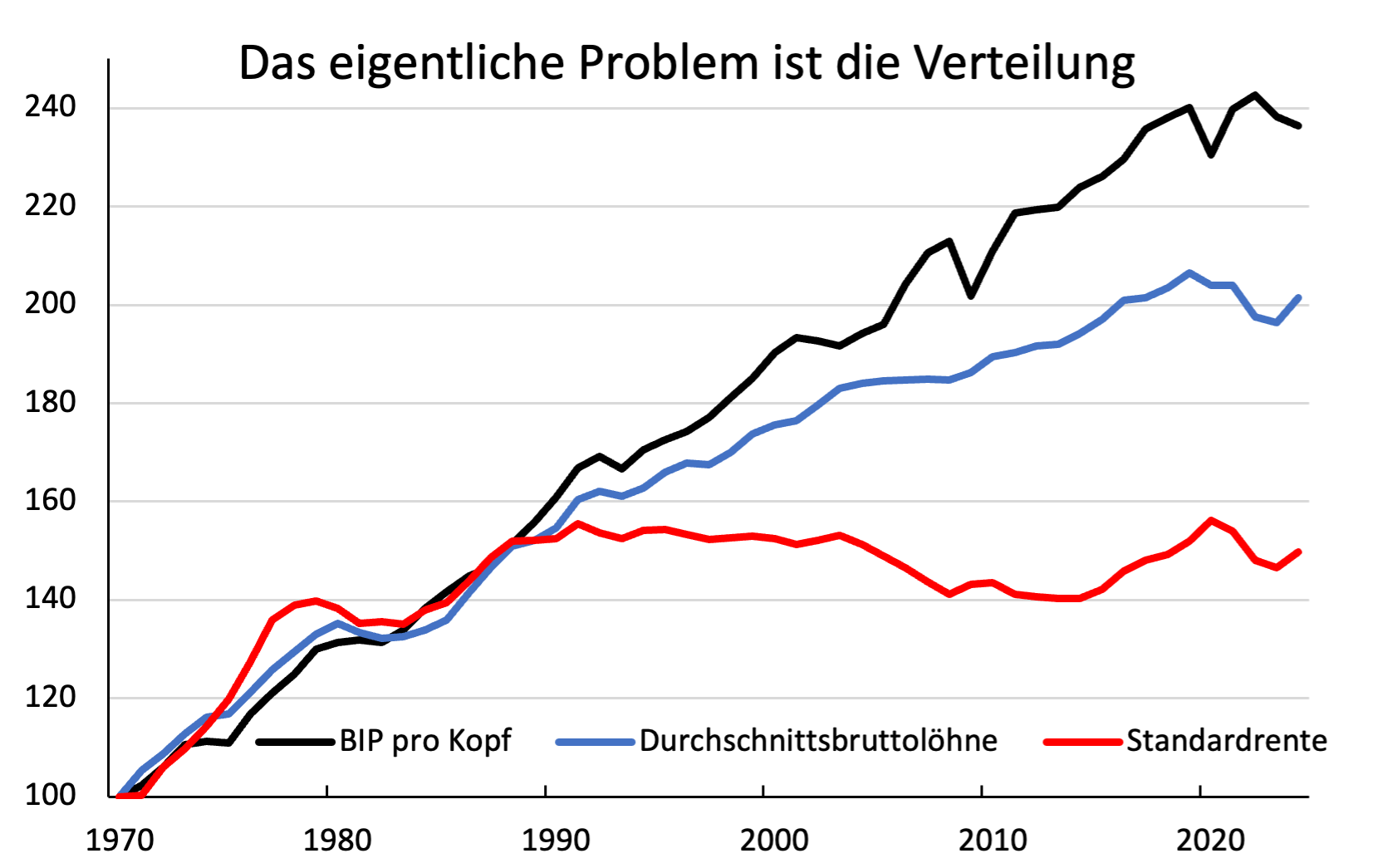
(Black line - GDP, blue line - avg comp; red line - avg pension)
In short - the productivity increased; but ordinary people are being squeezed out of the gains regardless. No wonder that everyone turns sour at some point.
1) the 50% net wealth tax vis-a-vis 1948 currency reform?
2) which 2 richest families in Germany hold more wealth than the bottom 50% combined?
3) most wealth distribution plots I have seen show a significant negative start (people in debt) then a large number of people with effectively 0 net wealth (what is earned is spent) and then a rise towards the haves. From such plots for different nations I am not surprised that the lower 2 digit percentages effectively have net 0 (with those in debt balancing those having a mediocre surplus), so it would seem trivial for this factoid to be true in many nations (with a slight change of the 50% number or a slight change of the exact number of richest families)
The perspective you give is certainly remarkable in the sense that the Nazi rise was basically a counterreaction to the rising popularity of communist ideas, with the end result... a redistribution of wealth after all, not even a holocaust could stop the wealth redistribution.
2) https://www.die-linke.de/fileadmin/user_upload/20230530-PK-A...
3) theoretically people could own via the state: if the state has resources (eg. hospital buildings, schools) that benefits all people ~uniformly. However, due to privatization more and more government wealth is also sold off.
Wealth redistribution is the only way the living standards of ordinary families will improve. I’m just hoping we can skip the war part, this time. I think its possible.
Well, sometimes people do in fact get crazy or act irrationally.
You need to learn to recognize that when it comes from your side of the media, too.
It's good that you bring up housing. There are, to my knowledge no political parties that have made housing their top agenda item. They only use housing as a talking point to serve their message. For example the extreme right will just say, immigrants are occupying all the housing supply. The extreme left will say it's just capitalism that is to blame.
The regular voting public doesn't even agree that there's a connection between increasing the supply of housing and housing becoming more affordable.
Their position is, roughly, "there's plenty of housing already - it just needs to be more affordable for regular people". Sometimes this even manifests in support for self-defeating demand subsidies like help-to-buy schemes for new homeowners
This is a position that can never be satisfied because it is fundamentally disconnected from reality. It is equivalent to the meme of the dog with the stick in its mouth who wants you to throw the stick for them, but not take the stick from them.
The reason we need non stop housing construction is because the underlying issue is capitalism's demand for infinite growth.
It seems to me that at least in the US the issue is location. There's cheap stock in places without jobs and ridiculously expensive stock where the good jobs are located. It doesn't have to be this way.
New money is created by lending it into existence, with interest.
That last bit is key. In order to pay off the interest, you need money, which was also loaned into existence with interest.
The only way to maintain this is through constant economic growth. Without it there's a deflationary collapse.
Capitalism has financialized housing, and that seems to be a major cause of the "can't actually build housing" problem.
https://en.wikipedia.org/wiki/Longhouse
https://en.wikipedia.org/wiki/Pueblo
https://en.wikipedia.org/wiki/Shabono
(And quite a few others.)
But populations were relatively stable until capitalism drove us towards the growth mindset.
Ordinary people who are turning fascists are not turning fascists because of economic anxiety. They reject party that make economy better.
I didn't realize there was a cut and dry "correct" answer. Has it occurred to you that perhaps you are subject to similar biases as other people without being aware of it?
There is cut and dry response to this economic one tho. If you look at the economic performance of past presidents, there is very clear pattern of who simultaneously makes debt higher and economy worst. There is also nothing in Trumps past performance that would suggest he would make economy better. And in fact, he is making it worst.
Sometimes things are cut and dry. Economic anxiety is just an excuse we use, so that we can idealize conservative people. If you read what they write and say, it is very clear it is not the economy that makes them vote how they vote.
German and Italian fascism took a similar path. In Italy the state even took over some industry, but the big industrialists with power did great. It didn’t end well for them, but their pal Franco was smarter and hung in there for decades.
The people have real grievances but tend to follow any *hole who has been the visible problem all along but can say the problem is that they were blocked from creating the ultimate vision of a perfect **hole.
I don't know the answer to representational democracy but I think there is something in systems like the Scandinavian judiciary where the jury is professional and competent.
A place like the US is a failure because there is a fear of setting any professional requirements on political positions. This is not irrational because the US has not dealt with its history of Jim Crow laws such that it will never happen again. The US is actually organized to make sure it happens again.
The grandparent said billionaires though. Some of them may have economic anxiety (not being in the government's graces might damage your company), but it seems most see a possibility of operating in an environment where they are not constrained by 'pesky' rules. E.g. leveraging Trump's wrath to pressure the EU into dropping laws like the DMA/DSA that protects citizens against the power of large tech companies.
I can't speak for other countries, but in the US, a big reason the real problems aren't being addressed is because of propaganda.
To my mind, the biggest problem is ultimately wealth/power consolidation in the hands of a shrinking group, resulting from massive consolidation of markets, repeatedly eliminating taxes on the most wealthy, and legalized bribery finally cemented in the Citizens United ruling.
As a regular worker, you have limited job mobility because there are fewer businesses within any market you may specialize in, those remaining players in the market often act as cartels, and emboldened shareholders demand layoffs on the regular. It feels like you're drowning in costs because housing has long outpaced inflation while your typical yearly raise rarely meets or exceeds it.
You can turn to your representatives for some relief, but voting Republican is guaranteed to make the problem worse (and they aren't shy about telling you they'll screw you over for the benefit of the wealthy), while voting Democrat doesn't actually make things better because they're controlled by the same special interests and merely present the illusion of an alternative.
The consolidated media, owned almost entirely by wealthy individuals with explicit mandates to support right-wing messages (e.g., Fox News, Newsmax, OAN, Sinclair Broadcasting group, and now Paramount Skydance) and constantly tell you that all your problems are really the fault of immigrants and other minorities - hence how we ended up with ICE-occupied cities, while simultaneously only making the problem worse with tariffs, which both increased prices and led to a slump in job creation.
I don't think those are mutually exclusive. There can be real problems, and propaganda can magnify those and lead people to decisions that are for the benefit of the propagandist rather than things that will actually solve the problem.
In the US, it's a de-facto duopoly on power, held up by a number of "winner-takes-all" rules. Politicians of either party will do everything in their power to keep "outsiders" (i.e. people/parties that are not entrenched in the two-party system and might actually drive positive change) from ever gaining a foothold.
In Germany it's the famous 5% rule that virtually ensures that every new party must maximize populism or perish.
I'm sure it's very similar in most other "democratic" countries.
Laws aren't perfect. In fact they often are buggy as hell. The electoral law is certainly no exception. However it is ultimately the law that matters most as it determines who can raise to power and who can't. Ensuring it fair and democratic should be the #1 civic duty.
The downside is encouraging career politicians, but the upside is that if you can't win increasingly high stakes elections over a period of 10 years or so then you probably have no business being the president of a country this size.
Otherwise we would have loonies like the Grey Panthers (old people party), the “Spiritual Party”, or the extreme right-wing “Republicans” (AFD is moderate compared to those) being able to vote on laws etc.
Of course that also cuts out some parties that I have supported in the past, but the system allows a lot of parties to participate that aren’t _that_ populist (e.g. the Greens, the Left, the Pirates (I think they managed to get a seat or two in the past))
Of course it’s not perfect, but I still think it’s one of the best flawed systems we came up with so far. We should keep iterating on it but very slowly and carefully.
As someone who writes algorithms for a living I can think of ~ 100 ways to resolve this bug without limiting the original intent. You don't have to be a rocket scientist to come up with one. However the fact that this %5 rule hasn't been changed tells you everything you need to know about the legislators.
Take your global warming example, and suppose we have a magic wand to make everybody agree that it's happening, that humans were causing it, that its happening fast enough to cause massive extinctions, and that action now might still prevent this. With all of these given as universally held beliefs, it should be easy to resolve right? Well no, because in this scenario the magic wand aligned just about everything except values. Does somebody really care about the long term ecological impact of the thing more than they care about how environment austerity would impact them and their family personally? Some will, some won't, so the political debate remains standing. In fact, many of those selfish people will probably decide to stubbornly insist on a narrative that global warming isn't real, even though they know it is (thanks to the magic wand), so you'll be left wondering if your wand even worked at all.
(s/access/assess)
It's more of a communication tool than one for exact modeling of system dynamics, but this could follow once the basic mechanics are agreed on.
For example, let's take global warming as an example. The embellished fake news narrative is that any action at all to reduce our carbon footprint will bring about complete economic collapse, and that global warming is fake news anyway and extreme weather has a completely intangible effect on the life of people living today.
Both of those are false embellished fake news narratives that build upon real concerns. It's true that we should keep the economic health of the nation in frame when we discuss measures. It's true that we might to some extent insure ourselves against natural distastes. But the fake news narrative is the embellishment of these concerns.
Is it selfish to take the attitude that humanity will deal with the consequences of its actions as they arise? That rather than expending vast amounts of capital reorganizing and regulating society to prevent disturbances before they happen we can instead accept the disturbances and deal with the consequences as necessary?
I don't personally think very highly of such a plan but neither do I think that it is reasonable to apply a blanket label of "selfish" to anyone who speaks in favor of it.
In case you didn't mean this, do you agree that the propaganda you're referencing above is the "you" in this sentence? eg the propaganda is the thing that is asking them to decide on covid or climate change.
I don't think anyone who is genuine expects the public to have expertise in these topics. The propaganda seems centred around a constant war against intellectualism and expertise, such that people think they should have an opinion on things they are woefully unqualified to have opinions on, and politicians just align themselves to what they think will get votes.
?? The op is making “propaganda” by some assertions in their comment?
To much poison in the well without any (social) accountability
But it's more or less the premise of democracy.
A professor in our school jokingly said that the key of functional democracy is to distance average voters from decision making processes. Now I am not so sure whether he was joking at all.
The only reliable solution I know to that is for people to be principled. People need to know what core fundamentals matter to them and they need to stick to those guns consistently.
Today it seems like we've lost that almost entirely. Most people hold strong views on certain topics or policies but they aren't driven by principles, that becomes clear when their strong opinions contradict themselves at a pretty fundamental level.
There are plenty of symptoms of the problem and I'm oversimplifying here, but if I could wave a magic wand and change one thing it would be to restore principles back in the average person. I honestly don't care what their principles are, I don't think that's the point, we simply can't move in a good direction without people knowing what matters to them.
Is it basically economic? We had this amazing economic ride from 1945 through the early 1970s, and that gave a view of what life could be like that permeated society and gave hope, and the hope continued long past the growth. Now people are realizing that the hope is not likely to happen to them. Is the fear caused by realizing that the hope is in danger? (That hope is in danger in another way, too. People are realizing that, even if they get better economic circumstances, past a certain point prosperity is still kind of empty.)
Or is the fear manufactured? Is it part of the propaganda? Are we being made to feel afraid, so that we can have a crisis of democracy? So that more non-democratic leaders can take over?
Or is it something else?
I'd argue that dealing with the fear itself is more important, and safer, in the moment. Knowing and understanding the cause is more useful, and safer to deal with, after the panic or fear has subsided.
I mean, you could say "we're going to deal with this by teaching people not to be afraid of this stuff", but why not do interrupt the source as well?
My point there was only that its risky. I see the risk on two fronts, in the moment its hard to recognize the root cause and there are some people who will take advantage of the fear to point "the mob", as it were, at the wrong cause for their own gain.
...and educated.
Today it seems like we've lost that almost entirely.
We replaced it by egoism. Through decades of neoliberalism we are taught to only care about ourselves, not our communities. Making money and buying things became our main philosophy. It does not matter if you are actually well-off, everyone is in a race with everyone else.
As a result, we don't stand up against injustice as long as it does not affect us much. And the egoism makes everything seem like a zero-sum game, if an immigrant gets a house paid by taxes, then I must be losing something.
This is also what permeates current US policy - you can only win if someone else loses. In this mindset it is not possible to have cooperation that is mutually beneficial.
I hope we can heal as mankind and take care of each other again.
I am always torn a bit on education as a goal though. I don't like centralized education, it makes it much to easy to lead to similar problems we have today when any small group of people can decide what and how every person is required to be taught.
We need people educated by their own choice, going down whatever paths they find interesting and learning from that journey. Its my belief that people are generally good, and given the time and space to find their own core principles, and a Democratic type of system where our voices can be heard, things will generally work out for the best in the end. I'll always take the collective opinion of principled individuals over the strongly held views of the small few in power at the time.
Personally, I don't think it's that hard of an ask. The problem was allowing the platforming of disinformation sponsored by adversary nation states that led to the mental pollution and radicalization of so many individuals.
Also, not protecting the neutral institutions and allowing that distrust be sown was a big mistake.
Finally, not taking the reports of infiltration of police and security agencies by extreme right organizations seriously has been proving to be a nation-ending level of an error.
Genuine question: what exactly is a "crisis of democracy"?
I see this term thrown around all the time now, but all I can conclude is it's just part of the hyperbolic rhetoric that dominates mainstream and social media.
We've seen how misinformation -- including ideas that were once fringe, believed only by a minority of cranks -- spreads and becomes acceptable, becomes a "legitimate alternative opinion".
We've seen, too, how hostile states, populists within, spread falsehoods to sew havoc and division.
My only hope, really, is that I think some of the younger generation are slightly more alert than some Gen X and millennials (my own generation) as to the dangers of misinformation online.
I wish I knew the solution too. Like you, I feel quite helpless even in terms of what to WANT. Can the Twitters of the world be regulated? If so, are we as a society able to agree on how it should be regulated, or are we too divided to agree on anything?
It's a mess. I don't know how we get out of it.
Warren Buffet
https://www.nytimes.com/2006/11/26/business/yourmoney/26ever...
Now there are many players. The useful idiots have enriched themselves enough that they are a force unto themselves,
The difference now is how targeted, specific, and external said campaigns can be - for cheap.
Previously, if you started to send the anti-every-other-group propaganda to each individual, you’d be clearly identifiable, it would be more visible (flyers, leaflets, etc.) and consequences could be aimed in your direction.
What is going on now appears to be more like most people have ‘your own little narcissist’ in their pocket, poking their buttons in a way designed to drive them and everyone else crazy while deflecting the blame on everyone else.
Also, as the peer comment noted - all of this distracts from people’s actual real needs being met, which makes them easier to manipulate. It’s a classic strategy for any Narcissist.
Not that previously there weren’t real issues (including, quite literally Nazi’s), but it previously required a whole society to go through something like a wide scale traumatic event (like post-WW1 massive external payments, hyperinflation, and associated social problems!) to get the momentum going.
Of course, then it was super dangerous because you had most of a society on the same page and working together. :s
Here, it seems like it’s mostly chaos and navel gazing, with small scale specific targeting of high profile areas, for ratings. At least so far.
The Overton window is shifting, and I’m not looking forward to where it is going so far.
Take gay marriage, for instance. There was a time when 95% (number made up, but I think it's roughly right) of the population thought that obviously gay marriage wasn't real marriage. There was a clearly defined window, and 95% of the population's position fit within 95% of the population's idea of what the window was.
Now you have maybe 40% of the population thinking that if you don't support gay marriage, you're a fascist oppressor and persecutor. You still have 30% thinking that no, gay marriage does not fit what marriage is. And you have the middle 30% thinking some variant of "they can marry, but you can question that without being a nazi". And each of those positions holds their own idea of where the Overton window is supposed to be.
In that landscape, there is no view of where the Overton window is that is 1) held by the majority of people and 2) the majority of people hold views that fit within that window. That's what I mean by the window shattering, not just moving.
No America is pretty uniquely having one, but because of American exceptionalism instead it can never just be an American problem it simply must be a global one.
Simultaneously, propaganda is getting worse. If you read the NY Post/Facebook and watch Fox, you aren't just getting a different opinion from someone watching CNN and reading the NYT. You're getting different facts. I encourage people to do a comparison. Its wild.
You have individuals who at best completely a BSc in Business Studies, and you are asking them to decide on COVID or climate change. That by itself is a hard ask. Then you infiltrate their content consumption habits and you bombard them with propaganda. And then these people are asked to decide on the future of the nation. This of course only compounds on the natural divisions that are already present within the electorate.
I'm not immune from this, and neither are you. I don't know what the solutions should be and how CS graduates in particular can help. It just seems to me that we haven't developed enough on a social level to deal with these challenges.