Clients can be almost automatic with a HATEOS implementation, because it is a self describing protocol.
Of course, Open API (and perhaps to some extent now AI) also mean that clients don't need to be written they are just generated.
However it is important perhaps to remember the context here: SOAP is and was terrible, but for enterprise that needed a complex and robust RPC system, it was beginning to gain traction. HATEOS is a much more general yet simple and comprehensive system in comparison.
Of course, you don't need any of this. So people built APIs they did need that were not restfull but had an acronym that their bosses thought sounded better than SOAP, and the rest is History.
That was the theory, but it was never true in practice.
The oft comparisons to the browser really missed the mark. The browser was driven by advanced AI wetware.
Given the advancements in LLMs, it's not even clear that RESTish interfaces would be easier for them to consume (say vs. gRPC, etc.)
Many server-rendered websites support REST by design: a web page with links and forms is the state transferred to client. Even in SPAs, HATEOAS APIs are great for shifting business logic and security to server, where it belongs. I have built plenty of them, it does require certain mindset, but it does make many things easier. What problems are you talking about?
That solves no problem at all. We have Richardson maturity model that provides a crisp definition, and it's ignored. We have the concept of RESTful, which is also ignored. We have RESTless, to contrast with RESTful. Etc etc etc.
None of this discourages nitpickers. They are pedantic in one direction, and so lax in another direction.
Ultimately it's all about nitpicking.
Only because we never had the tools and resources that, say, GraphQL has.
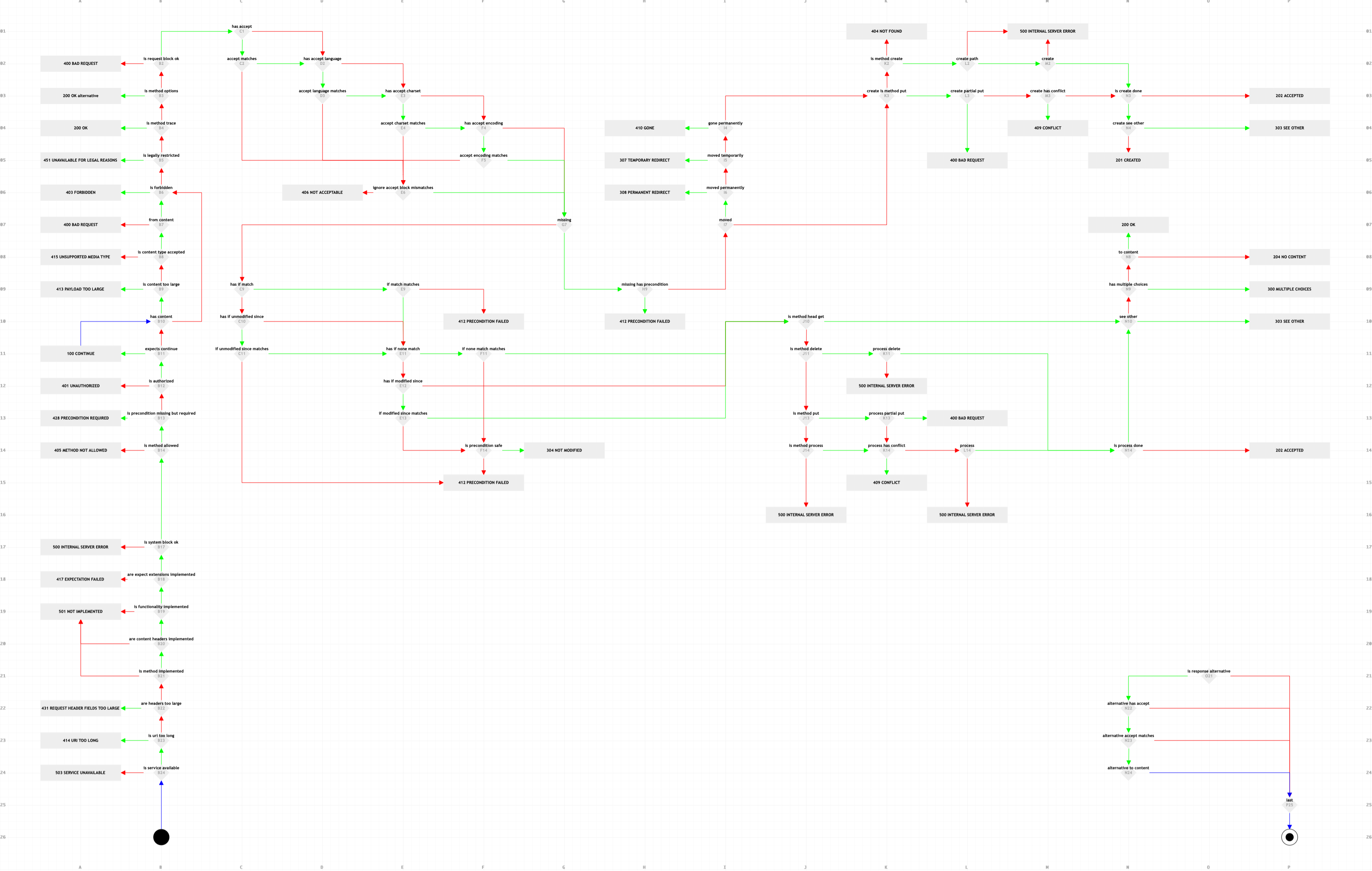
And now everyone keeps re-inventing half of HTTP anyway. See this diagram https://raw.githubusercontent.com/for-GET/http-decision-diag... (docs https://github.com/for-GET/http-decision-diagram/tree/master...) and this: https://github.com/for-GET/know-your-http-well
GraphQL promised to solve real-world problems.
What real world problems does HATEOAS addresses? None.
HATEOAS didn't need to "promise" anything since it was just describing already existing protocols and capabilities that you can see in the links I posted.
And that's how you got POST-only GraphQL which for years has been busily reinventing half of HTTP
HATEOAS solves a problem that doesn't exist in practice. Can you imagine an API provider being like, "hey, we can go ahead and change our interface...should be fine as long as our users are using proper clients that automatically discover endpoints and programmatically adapt accordingly"? Or can you imagine an API consumer going, "well, this HTTP request delivers the data we need, but let's make sure not to hit it directly -- instead, let's recursively traverse a graph of requests each time to make sure this is still the way to do it!"
More links here: https://news.ycombinator.com/item?id=44510745
Neo4j's old REST API was really good about that. See e.g. get node: https://neo4j.com/docs/rest-docs/current/#rest-api-get-node
Perhaps the real issue was that XML is awful and a much thinner resource representation simplifies most of the problems for developers and users.
   {
    … resource model
    _links: {
       “delete” : { “href” : “.” }
    }
I can see some meat on these bones. The counterpoint is that the protocol is now chattier than it would be otherwise... But a full analysis of bandwidth to the client would have to factor that you have to ship over a whole framework to implement those rules and keep those rules synchronized between client and server implementation.
So that never got done (because it's complex) and people started building apps like "my airline reservation app" but then realized to to build that domain app you don't need all the abstraction of a full REST system.
Have you ever heard of HTTP's OPTIONS verb?
https://developer.mozilla.org/en-US/docs/Web/HTTP/Reference/...
Follow-up trick question: how come you never heard of it and still managed quite well to live without it?
Yes, I'm aware of this header and know the web standards well enough.
In hypermedia API you communicate to client the list of all operations in the context of the resource (note: not ON the resource), which includes not only basic CRUD but also operations on adjacent resources (e.g. on user account you may have an operation of sending a message to this user). Yes, in theory one could use OPTIONS with a non-standard response body to communicate such operations that cannot be expressed in plain HTTP verbs in Allow header.
However such solution is not practical, because it requires an extra round trip for every resource. There's a better alternative, which is to provide the list of operations with the resource using one of the common standards - HAL, JSON-LD, Siren etc. The example in my another comment in this thread is based on HAL. If you wonder what is that, look no further than at Spring - it does support HAL APIs out of the box from quite a long time. And of course there's an RFC draft and a Wikipedia article (https://en.wikipedia.org/wiki/Hypertext_Application_Language).
Nah, machine readable docs beat HATEOAS in basically any application.
The person that created HATEOAS was really not designing an API protocol. It's a general use content delivery platform and not very useful for software development.
* If the API is available over HTTP then the only verb used is POST.
* The API is exposed on a single URL and the `method` is encoded in the body of the request.
At some level language is outside of your control as an individual even if you think it's literally wrong--you sometimes have to choose between being 'correct' and communicating clearly.
Basically: define a schema for your JSON, use an obvious CRUD mapping to HTTP verbs for all actions, use URI local-parts embedded in the JSON, use standard HTTP status codes, and embed more error detail in the JSON.
People do not define media types because it's useless and serves no purpose. They define endpoints that return specific resource types, and clients send requests to those endpoints expecting those resource types. When a breaking change is introduced, backend developers simply provide a new version of the API where a new endpoint is added to serve the new resource.
In theory, media types would allow the same endpoint to support multiple resource types. Services would sent specific resource types to clients if they asked for them by passing the media type in the accept header. That is all fine and dandy, except this forces endpoints to support an ever more complex content negotiation scheme that no backend framework comes close to support, and this brings absolutely no improvement in the way clients are developed.
So why bother?
When it’s just yours and your two pizza team, contract-first-design is totally fine. Just make sure you can version your endpoints or feature-flag new API’s so it doesn’t break your older clients.
Because words have specific meanings. There’s a specific expectation when using them. It’s like if someone said “I can’t install this app on my iPhone” but then they have an android phone. They are similar in that they’re both smartphones and overall behave and look similar, but they’re still different.
If you are told an api is restful there’s an expectation of how it will behave.
And today, for most people in most situations, that expectation doesn’t include anything to do with HATEOAS.
Few people actually use the word RESTful anymore, they talk about REST APIs, and what they mean is almost certainly very far from what Roy had in mind decades ago.
People generally do not refer to all smartphones as iPhones, but if they did, that would literally change the meaning of the word. Examples: Zipper, cellophane, escalator… all specific brands that became ordinary words.
Because September isn't just for users.
Because what got backnamed HATEOAS is the very core of what Fielding called REST: https://roy.gbiv.com/untangled/2008/rest-apis-must-be-hypert...
Everything else is window dressing.
Why do people feel compelled to even consider it to be a battle?
As I see it, the REST concept is useful, but the HATEOAS detail ends up having no practical value and creates more problems than the ones it solves. This is in line with the Richardson maturity model[1], where the apex of REST includes all the HATEOAS bells and whistles.
Should REST without HATEOAS classify as REST? Why not? I mean, what is the strong argument to differentiate an architectural style that meets all but one requirement? And is there a point to this nitpicking if HATEOAS is practically irrelevant and the bulk of RESTful APIs do not implement it? What's the value in this nitpicking? Is there any value to cite thesis as if they where Monty Python skits?
[1] https://en.wikipedia.org/wiki/Richardson_Maturity_Model