So I would like to see better e-bike laws that make it illegal to have a machine that's too heavy and/or fast, and to issue court summonses to people operating those machines in bike lanes. That seems fair. It's a clear hazard, it's a selfish use of resources, and if everyone did it they'd just close the bike path altogether because it'd become unusable.
Having said that, that's not what the city is doing. They're fixated on cyclists running red lights and stop signs, not distinguishing between different kinds of bikes. Bikes, and e-bikes, are safer than cars for everyone around them. We want to encourage people to bike more and drive less because they're so much safer. (Remember a bike isn't like a car -- if a cyclist hits a pedestrian, they're gonna get hurt too!) For this reason, many states allow bikes to treat red lights as stop signs and stop signs as yield signs. So NYC's sudden shift in policy, to me, feels backwards.
It sucks because if safety was really the major concern the mayor could have just built more and safer bike lines -- which was what he promised to do, made a plan to do, and then just didn't.
Absolutely agree this is silly and cities should be encouraging cycling.
> We want to encourage people to bike less and drive more
assuming you meant to flip this?
An e-bike that can even do 20mph comfortably is much closer to a moped than a bicycle, partly due to weight, and partly due to "ease of speed". Obviously a person can easily cycle 20mph, but it just isn't the kind of thing you do on in a crowded area. Very different when it is just a throttle. So grouping them in with bikes, rather than mopeds or similar, is just extremely silly
There are pedal assist ebikes hitting the market that are nearly indistinguishable from a road bicycle and weigh as much as a kitted out steel touring bike (i.e. ~35-40 lbs) and can comfortably do 20 mph.[0] I don't really think that's treading any sort of line of being close to a moped.
Also there are absolutely people riding analog bikes capable of having an average cadence of 15-20 mph who ride with reckless abandon on crowded mixed-used paths in cities - so maybe you don't do that, but there's a pretty large subset of cyclists who are doing that because biking is more of a sport activity than strictly pragmatic form of transportation. Bad bike path etiquette extends beyond ebikes
[0] ride1up is one brand making such bikes
Where I live I find cyclists to be the most reckless participants in traffic, way more than drivers and pedestrians. Cyclists never have to take even the most basic course even just in school to learn legislation or general rules. They always act like they own the road whether on the sidewalk among pedestrians, or on the street among cars. E-bikes just made this worse because everyone can cycle above their natural capabilities now.
But it's also clear that the "blast radius" of a cyclist is usually very limited compared to the damage a car can cause even with banal actions like opening a door at the wrong time. So I understand why their behavior is tolerated compared to when drivers to the same.
They should be encouraging cycling, but not by making red lights a free-for-all.
I once lived on the corner of a pretty busy cycling street by the beach in Florida, with a stoplight in the intersection outside my window. We had these gigantic "trains" of cyclists regularly just blowing straight through red lights, because there typically wasn't a lot of traffic coming from the cross street. I remember one occasion where a car was entering the intersection from the cross street (car had the green light, major street had the red), and a huge train of about 20 bicycles at full speed ran the red light and slammed into the side of the car with a loud "thump thump thump thump thump thump..." Total wreckage. Busted bicycles all over the street after they fucked up, and the cyclists had the nerve to be irate. If I hadn't run out and started recording, the car driver probably would have been assaulted by these raging hotheads.
These guys need to obey traffic laws, too.
More curves, lower limits, more stops. Cities that implement more bike-friendly and pedestrian-friendly design are safer for everyone, cars included.
I've personally run two red lights in the last month or so. Both were late at night where I'm literally the only visible vehicle on the road at a timed (no sensor) intersection where I was waiting for over a minute for the light to change. That's obviously a very different scenario than when you have to interact with other drivers on the road.
Like, the reason pedestrians jay walk isn't that they're selfish, it's that the streets aren't designed for them and we put far too little crosswalks, with far too little protection. We can make the situation safer for everyone, a win-win.
It's not an us versus them type thing which is where I think most car design conversations go. When we de-prioritize cars, it helps everyone, including the cars.
But you know, go downtown, and ride around a bit in traffic, on the greenbelt, etc. And you'll see the cyclists are typically going to make a better decision for themselves and others than cars will.
Like I said, it's fine. If you can't understand it, maybe go experience it first hand.
I've seen many road bikes do exactly this on a crowded bike path of pedestrians, scooters, and e-bikes. I've also seen e-bikes wait patiently to pass and slow down when there's traffic. I think proclaiming that e-bike riders are worse than road bike riders is patently false.
So it's not really an "e-bike" problem. It's really a speed problem.
All else being equal, yes. But NYC drivers are exceptionally skilled relative to the rest of the country. They're nuts in a lot of ways, but they're also far more respectful of pedestrians, far more aware of their surroundings, far more willing to drive slowly, and far more happy to stop for pedestrians even if they technically have the right of way.
NYC e-bike riders (especially the Citi bikes) are the opposite. They're far less likely to stop, far more likely to be going way faster than is safe, and far more likely to blow through stop signs entirely.
There's a well-documented phenomenon in safety that the "safer" choice in the abstract can actually end up being more dangerous because it feels safer, which leads to riskier behavior. I fear this is what is happening in NYC: incentivizing people to ride bikes doesn't get you 10x as many of the good, respectful, careful bikers you had 10 years ago. It gets you a whole bunch of reckless amateurs who buy the hype that bikes are safer and bike like maniacs. We may well find that that's worse for pedestrian safety than the well-known and well-regulated dangers of cars.
Even having said that, I kind of agree that it's true that drivers in Manhattan tend to be pretty aware, considerate, and mindful compared to other cities, all the traffic lights notwithstanding. But they have to be -- even just a little bit of distraction and they will kill someone. I can't say the same for the Citi bikers as reckless as they may be. They're far more likely to hurt themselves than someone else, and I'd rather have the reckless amateurs be on bikes than driving cars.
The appropriate forums are filled with people outraged on the "ban on e-bikes" that NY State & City are leading the charge for. They were the first to ban non-UL certified bikes, and have proposed and/or enacted several other regulations against over-wattage bikes.
I'm not sure how effective the laws and enforcement are, but NYC is definitely doing more than nothing to get rid of the heaviest/fastest bikes.
Probably worth noting at this point that the ultimate beneficiaries are people ordering food on various delivery services. In my experience, these overpowered bikes are almost exclusively used by delivery drivers.
I rarely order online (too much trash, too many hostile UX patterns of sneaking in fees disguised as "taxes" etc.), but when I do, I'd really prefer the delivery person would not risk their and others' lives running red lights all the way.
https://gothamist.com/news/new-queensboro-bridge-walkway-ope...
Fwiw, shouldn’t we consider the weight of the bike (e-bike or not e-bike) + the weight of the rider?
On my 75lb e-bike and weighing 160lb, am I more dangerous than a 220lb dude on a 15lb Schwinn?
Speed’s an issue also, but I’ve had my road bike up to 55 mph (downhill) and never exceed 24 mph on my e-bike.
So, I guess I’m saying to be equitable, set speed and combined weight limits on all things with 2 wheels.
I would tend to agree but it needs qualifying. If e-bikes run reds but cars do not, then this might not be true anymore.
But I would exhort city bikers and e-bikers, I know it feels convenient to flip back and forth between being a "car" and a "pedestrian" at a whim, but please don't. You're generally supposed to be a "car", at least where I live. And the step where you were a pedestrian a moment ago and just come wandering into my lane because you're a "car" now is probably about the most dangerous thing you do on a daily basis. Pick a lane, literally and metaphorically.
I'm aware of this issue so I'm watching you like a hawk if you're doing this, but I'd advise against betting that everyone else is watching that well. That ped->car transition is very rough on everyone around you.
I'll also agree that cars need to be a lot more aware of bikes in general, but this particular issue is definitely on the bikers.
> You're generally supposed to be a "car", at least where I live.
In NYC, cyclists can follow pedestrian walk signals even when traffic light is red.
https://legistar.council.nyc.gov/LegislationDetail.aspx?ID=2...
Notice how it says "Status: Filed (End of Session)" at the top?
Other legislation will say something like "Enacted" [1]
[1]: https://legistar.council.nyc.gov/LegislationDetail.aspx?ID=2...
https://legistar.council.nyc.gov/LegislationDetail.aspx?ID=3...
Meh. I have no problem if a cyclists wants to flip back and forth between a "car" and a "pedestrian".
It's just that a "pedestrian" uses their feet to move. So if you want to get off the bike to walk across an intersection with pedestrians; I really don't see a problem.
Cars are much more dangerous than bikes, but they rarely leave the lanes, travel in (mostly) known directions - though I’ve learned from experience to always look both ways even on one-way streets.
Bikes aren’t that terribly dangerous (though a pedestrian hit by an e-bike at 28 mph can be killed), but they’re entirely unpredictable and seeming appear as if by magic from directions you wouldn’t think possible.
It feels like you're contradicting yourself here. The restricted tracks and predictability make them by definition more safe than cars. And that bears out in fatalities. I get what you're going for in that trains are more scary from a mass standpoint, but we don't measure safety by how dangerous things look. We look at actual metrics. And trains are safe.
Cars suffer from too much maneuverability - they do avoid most of the incidents and accidents.
I don't know about the UK or US, but here in France, the majority of pedestrians killed each year die on "protected" crossings. So whether those are traffic lights or "zebra" crossings, yes, that's a very major source of accidents.
Addendum:
Would love to see per-modality statistics on this for UK/US. Here in France, the preliminary stats for 2024 look like this:
https://masto.bike/system/media_attachments/files/114/521/93...
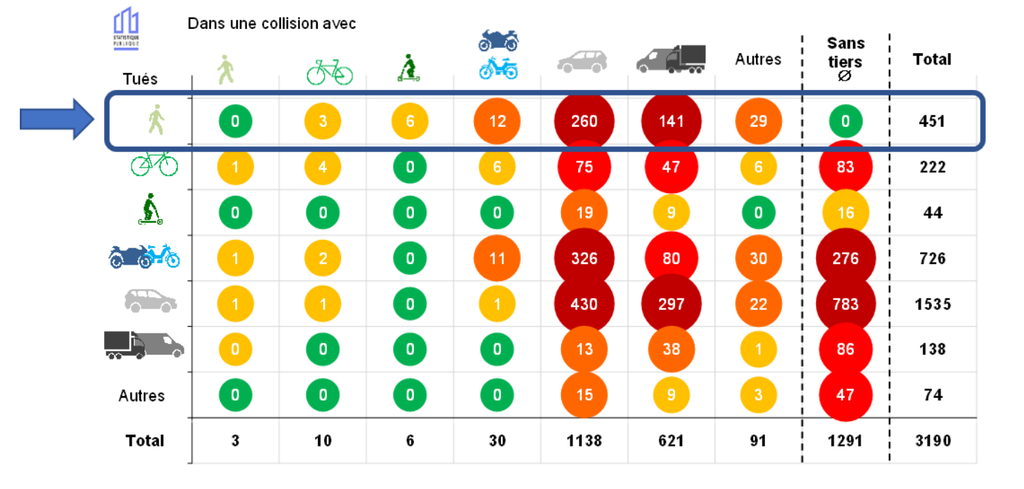
The table shows the deaths per modality (leftmost column, "tués") and in collision with which modality they were killed (and "sans tiers" for "no counterparty").
Needless to say, cars and trucks are dominating the "who kills the most people" contest, far outweighing their percentage in transport usage.
Source: https://www.onisr.securite-routiere.gouv.fr/sites/default/fi...
That seems like it would allow school kids to cross the road much more safely than painted lines would.
This viral video is from where I grew up: https://www.youtube.com/watch?v=Pp4gouR2Ei4 The Volvo truck that juuust manages to stop when kids are running out behind the bus.
Yeah, stats are difficult.
Au contraire, it is fairly easy.
Around here, e-vehicles are classified according to weight, power amd max speed. These parameters define where and how you can use them, what features are required, what protective gear is required and what licenses or insurance are required to operate them.
https://www.traficom.fi/en/transport/road/electric-personal-...
Injuries sustained is much more difficult to quantify yet it's the more interesting comparison. The article says the ratio is 120 to 1 of lives taken by cars vs ebikes. I think that is because a car accident is significantly more likely to kill the pedestrian rather than only injure them. I would be interested in reading how many pedestrians are injured at all by other people's ebikes vs other people's cars.
It's also estimated that there's 10-50x as many car injuries as car-related deaths...
Which means even to get to the injury rate of cars - you're looking for, potentially, as many 6000x as many serious bike accidents.
It's possible, but it doesn't seem likely.
Speaking of NYC, not London, there are several reasons I see for this. 1. NYC has used bike lanes as pedestrian safety infrastructure, siting the bike lanes right against sidewalks, providing a buffer from cars. NYC DOT has done a lot of research every time a new bike lane has been added, and every time they did that pedestrian deaths and severe injuries dropped. However, the flip side is that you're gonna have e-bikes much closer to you than cars.
2. Street infrastructure, including red light timing, etc. is entirely based on cars and not bikes. The bike lights, for example, switch directly from green to red, providing no "yellow" period to stop. This actually makes sense because bikes are significantly safer, but it leads to different behavior than cars, which some pedestrians feel is "unfair". What would actually be fair would be to design the infrastructure suitable for bikers as well.
3. Pedestrians simply have different expectations of cars/ebikes. You will reliably see tourists not even look for bikes while crossing the bike path and stand in the middle of the bike path or walk in the bike path in a way they never would with a car lane.
4. Bikes are just given much poorer infrastructure. In NYC, you have narrow bike lanes, several of which are interrupted with slick and dangerous sewer gratings, and with no space to pass, with car parking right next to them leading to people constantly hopping through the bike lane from their cars to the sidewalk without looking, constantly creating a danger of opening their doors without looking causing bikes to be "doored", etc.
There's way too much "feels" in this discussion. It's about time someone provided some actual data that bikes, and even e-bikes, have even slightly increased risks to pedestrians, when all the actual data suggests otherwise, and it's about time we recognize that at least in places like NYC, the "danger" caused by bikes/e-bikes, is literally because the city has made bikers a buffer to protect pedestrians from the actual dangers on the road, the 1-2 ton cars traveling at incredible speeds through dense urban areas.
> There's way too much "feels" in this discussion
I agree that hard numbers are useful, but dismissing feeling entirely isn't useful. Feeling safe is an important quality for a city.
On narrow one-way roads with street parking, cars tend to go quite slowly and look out carefully for pedestrians coming out from between cars. At a stop sign you can check left and right, cross, and expect that cars will see you and stop even if they were for some reason planning on running the sign. It's even possible to safely jaywalk in most cases because the cars are going slowly enough that you can see them, judge their speeds, and cross before they reach you.
E-bikes as a rule do not behave that way on narrow roads. They will drive much faster than is safe (presumably because the road feels less narrow to them relatively) and end up outrunning their visibility and yours. I've never come close to being hit by a car in Brooklyn, but there have been numerous close calls with bikes, and they've all been on narrow roads with street parking where I was attempting to cross at a stop sign which the bike ran.
This is already true in NYC. It just another law that there aren't enough resources to be enforced IMO
However, you do have car lane legal scooters that also ride in the bike lanes when convenient which are a real problem.
These aren't e-bikes, however, and are not supposed to be in the bike lane in the first place.
That's already the case in the UK. Only e-bikes with assist limited to IIRC 15.5mph (you can pedal quicker than that, though) are legal to use on public roads without the usual license, registration, number plate and insurance. Basically, unrestricted e-bikes (e.g. throttle activated ones that provide power without needing to be pedalled) are the same as e-motorbikes and covered by the same laws, though there's certainly lots of them around. I would guess that the e-motorbikes cause less problems than the typical distracted car driver does and so the police aren't prioritising them.
In Washington DC last year, people finally were fed up with all the psycho moped riders zipping around. When the police investigated, the said the city only had 150 registered mopeds, which were most likely not the offending vehicles. So they took trucks around the city and checked every moped, seized 500 on sight, and arrested 129 people. These were unregistered (a crime/misdemeanor), and they were all operated by unauthorized immigrants.
The response from a DC "community organizer"? "It's an education issue".
By the way, they never bothered enforcing electric bikes/scooters, and they don't need a license or helmets.
https://www.wusa9.com/article/news/investigations/dc-police-...
It’s already the case in the EU and the UK. An e-bike is limited to 250 W and 15.5 mph (25 km/h). Above that it’s a speedbike and require a license, helmet, insurance, licence plate, and cannot use cycle lanes.
Also, actual e-bikes aren’t that much heavier than normal city bikes, maybe 5 kg extra.
> “Since e-bikes do not require a license, drivers of e-bikes can simply ignore their traffic summons with no repercussions whatsoever, making any enforcement futile,” the police spokesperson said. However, the new requirement that cyclists appear in court, or face an arrest warrant if they fail to, creates “a strong incentive to show up in court.”
Cannot speak for its accuracy.
Anecdotally (London not NYC) I feel like I am "endangered" by e-bikes much more often than cars, because they seem to regularly skip red lights and come silently shooting out from the other side of a car while you are crossing, which a car simply cannot do. They are far heavier than a normal bike and seem to be closer to a small incredibly quiet moped.
Obviously lives-saved is the most important metric, but that doesn't mean the "feeling of safety" component is worthless. The comparison around deaths is only useful if those figures are primarily car deaths caused by running red lights.
I feel like the most sensible policy is requiring licenses for e-bikes above a certain power level (not easy!) and then bringing parity to the treatment of cars vs e-bikes after that